From the free course Western Civilization I on Lykke
The Middle Ages
Key concepts: Feudalism · Manorialism · The Crusades · The Catholic Church · The Black Death
An examination of the period between the fall of Rome and the beginning of the Renaissance, focusing on the social, religious, and political structures of Medieval Europe.
The Middle Ages
Overview
The Middle Ages, spanning roughly from the fall of the Western Roman Empire in 476 CE to the dawn of the Renaissance in the 14th and 15th centuries, represents a thousand-year epoch of profound structural transformation. Often mischaracterized as a "Dark Age" of intellectual stagnation, modern historiography views this period as a sophisticated evolutionary bridge. It was characterized by the decentralization of political power, the rise of a monolithic ecclesiastical authority, and the development of complex agrarian economic systems that eventually buckled under the weight of pandemic and social upheaval.
Feudalism: The Decentralized Political Architecture
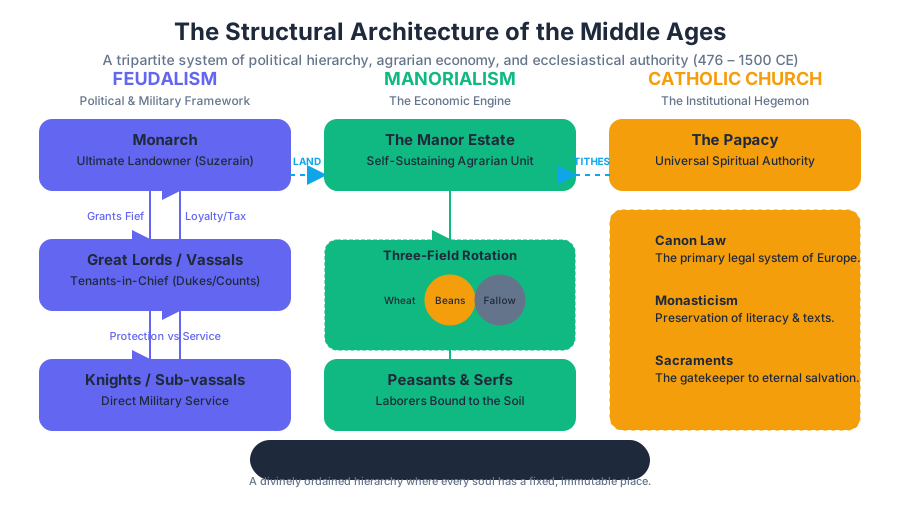
Feudalism was the primary political and military framework of Middle Age Europe. It emerged as a pragmatic response to the collapse of central Roman authority and the subsequent need for local security against Viking, Magyar, and Saracen incursions.
1. What it is
Feudalism is defined as a decentralized social organization based on a web of reciprocal legal and military obligations. The core unit of this system was the fief (land granted by a lord) and the vassalage (the status of a person who received the land in exchange for service).
Definition: The Feudal Contract A socio-political arrangement where a Lord (suzerain) granted land and protection to a Vassal in exchange for auxilium et consilium (aid and counsel), typically manifesting as 40 days of military service per year.
2. How it Works: The Hierarchy of Oaths
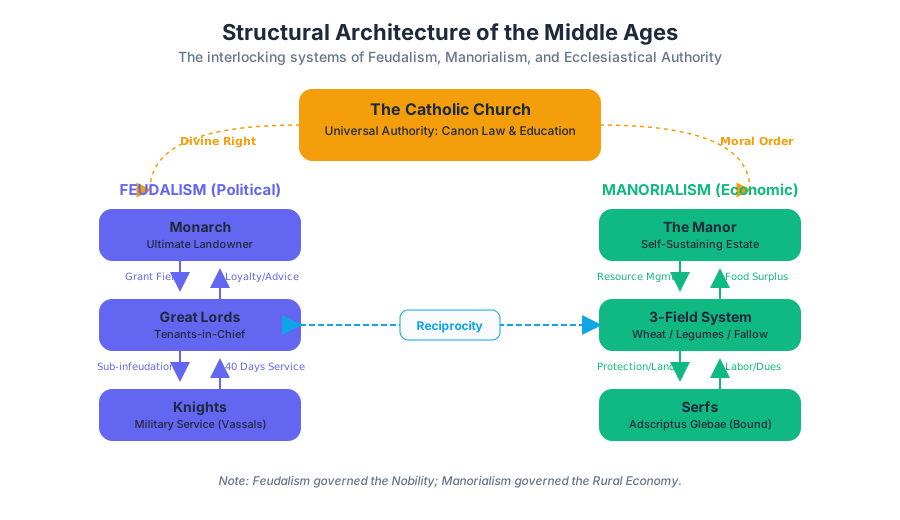
The system operated on a "nested" logic. The King theoretically owned all land but sub-infeudated it to Great Lords, who further divided it among Lesser Lords and Knights.
| Rank | Role | Primary Obligation |
|---|---|---|
| Monarch | Ultimate Landowner | Grants land (fiefs) to high nobility for loyalty. |
| Great Lords (Dukes/Counts) | Tenants-in-Chief | Provide military units and advice to the King. |
| Lesser Lords/Knights | Sub-vassals | Direct military service and local administration. |
| Peasants/Serfs | Laborers | Provide food and labor (not technically part of the feudal military hierarchy). |
Manorialism: The Economic Engine
While Feudalism governed the relationship between nobles, Manorialism (or Seignorialism) governed the relationship between the noble and the peasantry. It was the fundamental unit of the rural economy.
1. The Manor as a Self-Sustaining System
The Manor was an autonomous estate consisting of the lord's residence, a church, a village, and surrounding farmland. Unlike the volatile political world of feudalism, manorialism was a rigid, tradition-bound economic system.
2. Land Allocation and Labor
The land was typically divided into three categories:
- Demesne: Land reserved exclusively for the lord.
- Dependent Land: Land worked by serfs to support themselves.
- Common Land: Woods and pastures used by the entire community.
3. The Three-Field System
To prevent soil exhaustion, manors implemented a "Three-Field System," an early form of algorithmic resource management.
4. Variations: Serfdom vs. Slavery
Serfs were not slaves; they were "bound to the land." They could not be sold away from the manor, but they could not leave without permission. This provided a stable, albeit low-productivity, labor force for the aristocracy.
| Feature | Serfdom | Slavery |
|---|---|---|
| Legal Status | Person with limited rights | Property |
| Mobility | Bound to the soil (Adscriptus glebae) | Mobile at owner's will |
| Family Rights | Right to marry and keep family intact | No inherent family rights |
| Economic Output | Retained surplus after dues | All output owned by master |
The Catholic Church: The Institutional Hegemon
In the absence of a strong centralized state, the Catholic Church functioned as the "universal" institution of Europe. It was the sole provider of education, the primary arbiter of law (Canon Law), and the gatekeeper of spiritual salvation.
1. The Great Chain of Being
The Church promoted a cosmological view where every creature had a fixed place in a hierarchy ordained by God. This provided the ideological justification for the rigid social classes of the Middle Ages.
2. Political and Legal Power
The Church held its own courts and collected its own taxes (Tithes, usually 10% of produce). The Papacy often clashed with secular monarchs over "Lay Investiture"—the right to appoint local church officials.
3. The Monastic Tradition
Monasteries served as the "data centers" of the Middle Ages. Monks painstakingly copied manuscripts, preserving Greek and Roman knowledge that would have otherwise been lost.
The Crusades: Geopolitical Expansion
The Crusades (1095–1291) were a series of religiously sanctioned military expeditions intended to recover the Holy Land from Muslim rule.
1. Motivation and Catalysts
- Papal Ambition: Pope Urban II sought to unite warring European nobles against a common "infidel" enemy.
- Primogeniture: Younger sons of nobles, who inherited no land, sought to carve out their own kingdoms in the Levant.
- Economic Interests: Italian city-states (Venice, Genoa) wanted to secure trade routes to the East.
2. Outcomes and Legacy
While the Crusades were a military failure for Christendom in the long run (Jerusalem remained under Muslim control), they were a catalyst for massive cultural and economic change.
| Crusade | Date | Primary Outcome |
|---|---|---|
| First Crusade | 1096–1099 | Captured Jerusalem; established Crusader States. |
| Third Crusade | 1189–1192 | "Crusade of Kings" (Richard the Lionheart); failed to retake Jerusalem. |
| Fourth Crusade | 1202–1204 | Sacked Constantinople (Christian city); deepened the Great Schism. |
| Long-term Impact | N/A | Introduction of sugar, silk, spices, and Arabic numerals to Europe. |
Key Insight: The Paradox of the Crusades The Crusades fostered deep-seated religious animosity, yet they simultaneously ended European isolation by forcing interaction with the more technologically advanced Islamic and Byzantine civilizations.
The Black Death: Systemic Collapse and Transition
The 14th century was defined by the Black Death (1347–1351), a pandemic of bubonic plague caused by the bacterium Yersinia pestis.
1. Pathogenesis and Spread
The plague traveled along the Silk Road via fleas on rats. In an era before germ theory, the sudden death of 30% to 60% of Europe's population was viewed as divine punishment or planetary misalignment.
2. Economic Disruption: The Labor Scarcity Loop
The massive mortality rate triggered a fundamental shift in the economic power balance. With fewer peasants available to work the land, the value of labor skyrocketed.
3. The End of Serfdom
Lords attempted to freeze wages through legislation (e.g., the English Statute of Labourers 1351), but market forces prevailed. Peasants began to demand cash wages and lower rents, leading to the Peasants' Revolt of 1381 and the eventual dissolution of the manorial system.
4. Cultural Impact: Memento Mori
The ubiquity of death led to a cultural obsession with mortality, reflected in the Danse Macabre (Dance of Death) in art and literature, and a growing skepticism toward the Church's inability to stop the plague.
Summary of the Middle Ages Evolution
The Middle Ages was not a static period. It was a dynamic system that moved from extreme decentralization to the beginnings of the modern nation-state.
| Era | Focus | Key Characteristic |
|---|---|---|
| Early Middle Ages (500–1000) | Survival | Decentralization, Manorialism, Viking Raids. |
| High Middle Ages (1000–1300) | Expansion | Rise of Towns, Universities, Crusades, Gothic Architecture. |
| Late Middle Ages (1300–1500) | Crisis/Transition | Black Death, Hundred Years' War, Decline of Feudalism. |

Source Materials
Study Western Civilization I on Lykke
This course page is free to open: signed out, you can read its first two sections, and signing in, on any plan, opens the rest. The free Lykke Chrome extension syncs your own Canvas courses, so ChatGPT, Claude and Muse can answer from your classes and deadlines. It only reads Canvas.
Add the free extensionSign in to open every sectionAll sections of Western Civilization I · Browse more course pages