From the free course Western Civilization I on Lykke
Renaissance and Reformation
Key concepts: Humanism · The Printing Press · Protestant Reformation · Counter-Reformation · Thirty Years' War
This section covers the cultural rebirth of Europe and the religious upheavals that ended the medieval period and ushered in the early modern era.
Renaissance and Reformation
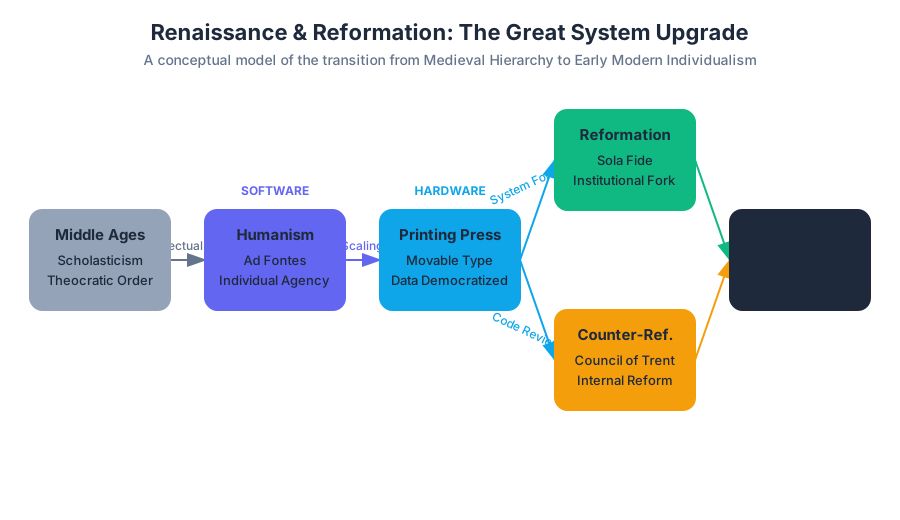
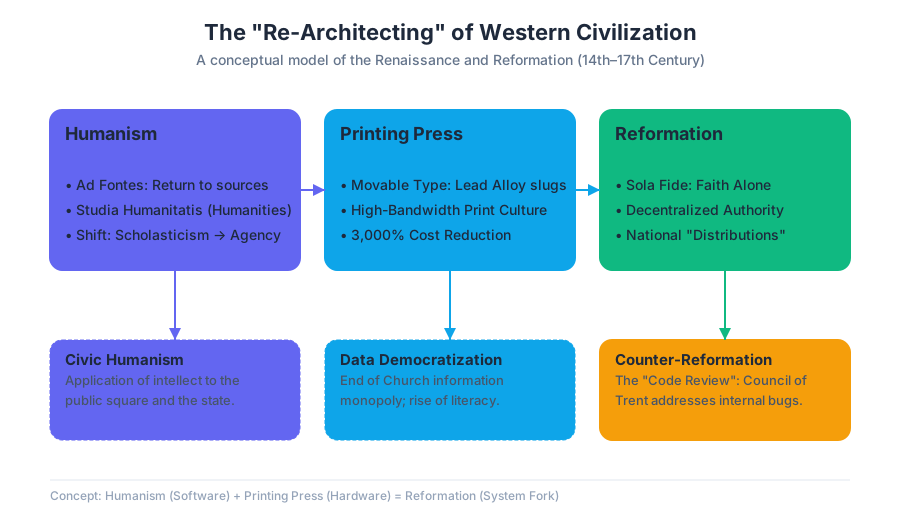
The period between the 14th and 17th centuries represents a fundamental "re-architecting" of Western Civilization. It marks the transition from the Middle Ages—characterized by feudalism, theocratic dominance, and a collective identity—to the Early Modern era, defined by individualism, secular inquiry, and the rise of the nation-state. This shift was not a single event but a series of overlapping intellectual, technological, and religious "patches" to the existing social operating system.
Humanism: The Intellectual Framework
Humanism was the primary intellectual driver of the Renaissance. It was a shift from Scholasticism (the medieval method of learning based on Aristotelian logic and Church dogma) to Studia Humanitatis (the study of the humanities: grammar, rhetoric, history, poetry, and moral philosophy).
The Mechanics of the Humanist Shift
Humanism functioned by "decoupling" human potential from divine predestination. While medieval thought viewed the world as a static hierarchy (the Great Chain of Being), Humanists viewed the individual as a dynamic agent capable of self-improvement through the study of classical antiquity.
Definition: Ad Fontes Literally "to the sources." This was the Humanist rallying cry to bypass medieval commentaries and return to the original Greek and Hebrew texts of the Bible and classical philosophy.
| Feature | Medieval Scholasticism | Renaissance Humanism |
|---|---|---|
| Primary Goal | Reconcile faith with reason | Cultivate the "Universal Man" (L'uomo Universale) |
| Core Texts | The Bible, Aristotle, Church Fathers | Cicero, Plato, Virgil, Homer |
| Language focus | Medieval Latin | Classical Latin, Greek, Hebrew |
| View of Man | Inherently sinful, dependent on Grace | Possessing dignity and creative agency |
| Education | Professional (Law, Medicine, Theology) | Liberal Arts (Civic development) |
Civic Humanism
In the Italian city-states (notably Florence), this evolved into Civic Humanism, which argued that the highest use of the intellect was for the benefit of the state. This moved the ideal of the "good life" from the monastery to the public square.
The Printing Press: A Hardware Revolution
If Humanism was the software, the Printing Press was the hardware that allowed it to scale. Developed by Johannes Gutenberg around 1440, the press moved Europe from a "low-bandwidth" manuscript culture to a "high-bandwidth" print culture.
Movable Type
The core innovation was not the press itself (which existed for wine and paper), but the movable type—the ability to cast individual letters in a durable metal alloy that could be rearranged and reused.
Impact on Information Theory
The printing press reduced the cost of book production by approximately 3,000%. This created a "democratization of data" where the Church could no longer effectively censor the flow of information. The "Index Librorum Prohibitorum" (List of Prohibited Books) became increasingly difficult to enforce as clandestine presses could be set up in any basement.
The Protestant Reformation: The Great Schism
The Protestant Reformation was a religious and political movement that fractured the hegemony of the Roman Catholic Church. While it began as an internal "bug report" (Martin Luther’s 95 Theses), it quickly escalated into a full-scale system fork.
The Theological Logic: Sola Fide vs. Merit
The central conflict was the mechanism of Justification (how a human is made "right" with God).
\begin{aligned}
\text{Catholic Model:} & \quad \text{Faith} + \text{Works (Sacraments/Charity)} \rightarrow \text{Salvation} \\
\text{Lutheran Model:} & \quad \text{Faith Alone (Sola Fide)} \rightarrow \text{Salvation} + \text{Works as a byproduct}
\end{aligned}
Key Reformers and Their "Branches"
The Reformation was not a monolithic movement; it branched into several distinct "distributions" of Christianity.
| Branch | Founder | Key Distinctive | Political Alignment |
|---|---|---|---|
| Lutheranism | Martin Luther | Sola Fide, Sola Scriptura | German Princes (Northern HRE) |
| Calvinism | John Calvin | Predestination (The Elect) | Swiss Cantons, Scotland, Netherlands |
| Anglicanism | Henry VIII | Royal Supremacy over the Pope | English Monarchy |
| Anabaptism | Various | Adult baptism, separation of Church/State | Radical fringes (persecuted by all) |
The Counter-Reformation: The Catholic Response
The Catholic Church did not remain static. The Counter-Reformation (or Catholic Reformation) was a dual-track strategy: internal reform and external defense.
The Council of Trent (1545–1563)
The Council was the "Code Review" of the Catholic Church. It addressed corruption (abolishing the sale of indulgences) but doubled down on traditional dogma (affirming the seven sacraments and the authority of the Pope).
The Jesuit Order
Founded by Ignatius of Loyola, the Society of Jesus (Jesuits) acted as the "special forces" of the Counter-Reformation. They focused on three pillars:
- Education: Establishing elite universities to win back the minds of the youth.
- Missionary Work: Expanding the "user base" of Catholicism to the New World and Asia.
- Political Advisory: Serving as confessors to Catholic monarchs to influence state policy.
The Thirty Years' War: The Conflict of Systems
The tensions between the Reformation and Counter-Reformation culminated in the Thirty Years' War (1618–1648). While it began as a religious conflict within the Holy Roman Empire (HRE), it evolved into a continental struggle for hegemony involving France, Sweden, Spain, and Austria.
Phases of the War
- Bohemian Phase: Localized religious revolt.
- Danish Phase: Intervention of Northern Protestant powers.
- Swedish Phase: Gustavus Adolphus (the "Father of Modern Warfare") introduces mobile artillery.
- French Phase: Cardinal Richelieu (a Catholic) supports Protestants to weaken the Habsburgs—the ultimate triumph of Raison d'État (Reason of State) over religious solidarity.
The Peace of Westphalia (1648): The Modern Protocol
The war ended with the Peace of Westphalia, which established the "Westphalian System" of international relations. This is the foundation of the modern world order.
Key Insight: Westphalian Sovereignty The principle that each state has exclusive sovereignty over its territory. It established the rule of Cuius regio, eius religio (Whose realm, his religion), effectively ending the Pope's claim to universal political authority.
The Westphalian State Configuration
The treaty shifted the "unit of analysis" in history from the Empire/Church to the Sovereign State.
Summary of the Transition
The Renaissance and Reformation represent the "Great Decoupling."
- Humanism decoupled the individual from the collective.
- The Printing Press decoupled information from the clergy.
- The Reformation decoupled the soul from the Roman hierarchy.
- Westphalia decoupled the state from the Church.
These movements set the stage for the Enlightenment and the Scientific Revolution, as the "authority of the ancients" and the "authority of the Church" were replaced by the "authority of evidence and reason."
- Humanism: Intellectual movement focusing on classical texts and human potential.
- Ad Fontes: "To the sources"; the Humanist method of returning to original manuscripts.
- Movable Type: Gutenberg's innovation allowing for rapid, cheap mass-printing.
- 95 Theses: Martin Luther's 1517 challenge to the Catholic sale of indulgences.
- Sola Fide: The Protestant doctrine of "Faith Alone."
- Predestination: Calvinist belief that God has already chosen who will be saved.
- Council of Trent: The Catholic Church's formal response and internal reform.
- Jesuits: The Society of Jesus; educators and missionaries of the Counter-Reformation.
- Cuius regio, eius religio: The principle that a prince's religion determines the religion of his subjects.
- Westphalian Sovereignty: The concept that states have total control over their internal affairs.
- Conceptual Link: How did the Humanist concept of Ad Fontes directly enable the Protestant Reformation?
- Answer: By encouraging scholars to read the Bible in its original Greek and Hebrew, they discovered discrepancies between the original text and the Latin Vulgate used by the Church.
- Technological Impact: Why was the printing press considered a "force multiplier" for Martin Luther but not for earlier heretics like Jan Hus?
- Answer: Hus's ideas were localized and easily suppressed via manuscript burning. Luther's ideas were printed in the thousands and distributed across borders faster than the Church could react.
- Political Logic: Why did Catholic France fight on the side of the Protestants during the Thirty Years' War?
- Answer: Raison d'État. France wanted to weaken the Habsburg Empire, which surrounded them, prioritizing national power over religious affiliation.
- Systemic Change: What was the most significant shift in international law introduced by the Peace of Westphalia?
- Answer: The transition from a hierarchical world (headed by the Pope/Emperor) to a horizontal world of equal, sovereign states.
Key Themes to Master:
- The Shift in Authority: Understand the move from Institutional Authority (The Church) to Individual/Textual Authority (The Bible/The Humanist).
- The Role of Technology: Be able to explain how the printing press changed the "economics of ideas."
- The Geography of Religion: Identify which parts of Europe remained Catholic (South/West) and which became Protestant (North/East).
- The Birth of the State: Trace the evolution from feudal territories to the sovereign nations defined at Westphalia.
- The Renaissance Man: Define the ideal of the "Universal Man" and how it differs from the medieval ideal of the "Ascetic Monk."
Source Materials
Study Western Civilization I on Lykke
This course page is free to open: signed out, you can read its first two sections, and signing in, on any plan, opens the rest. The free Lykke Chrome extension syncs your own Canvas courses, so ChatGPT, Claude and Muse can answer from your classes and deadlines. It only reads Canvas.
Add the free extensionSign in to open every sectionAll sections of Western Civilization I · Browse more course pages