Western Civilization I
Institution: MIT
1 study materials · 3 sections
Western Civilization I provides a comprehensive survey of the historical development of Western society from prehistory through the mid-17th century. The course examines the foundations of Western culture in the Ancient Near East, the classical achievements of Greece and Rome, and the evolution of European society during the Middle Ages. It concludes with the transformative impacts of the Renaissance and the Reformation, ending with the Peace of Westphalia in 1648.
Course Sections
Prehistory and Ancient Civilizations
Key concepts: Neolithic Revolution · Mesopotamia · Ancient Egypt · Classical Greece · Roman Empire
This section explores the origins of human society, the development of agriculture, and the rise of the first major civilizations in Mesopotamia, Egypt, Greece, and Rome.
Prehistory and Ancient Civilizations
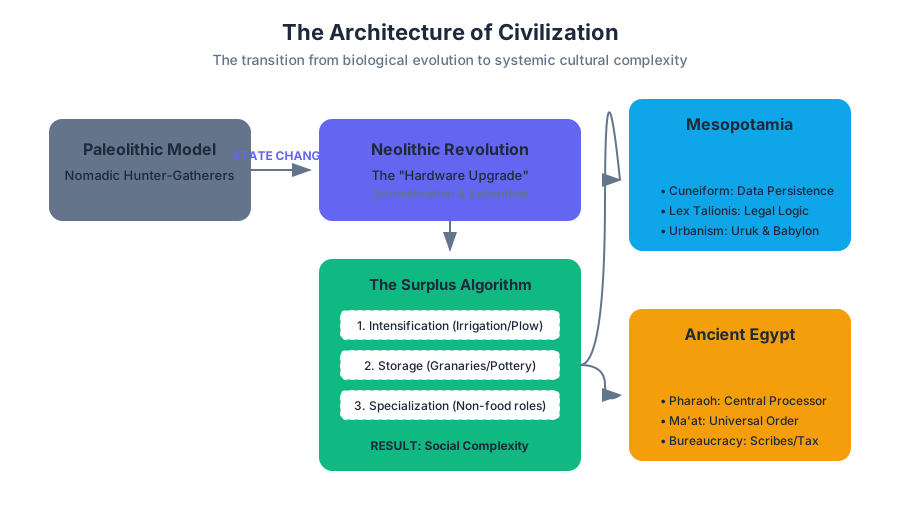
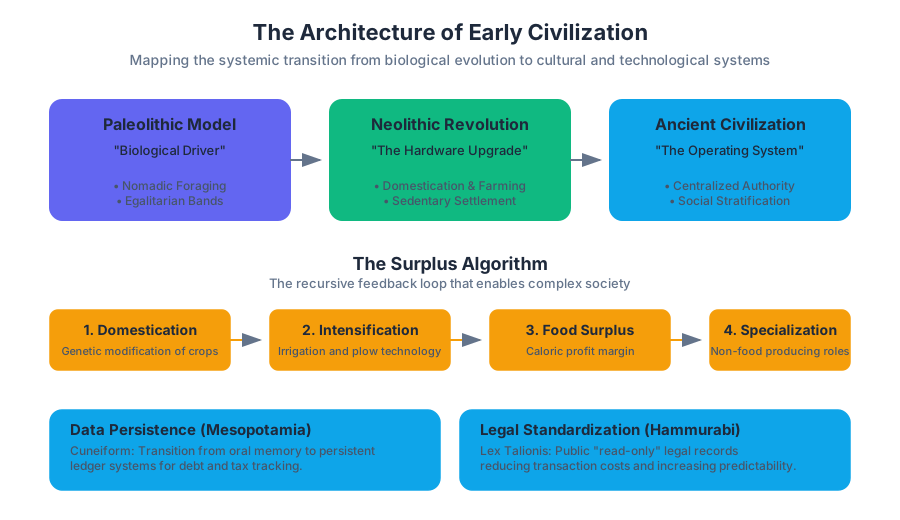
The transition from prehistory to civilization represents the most significant "state change" in human history. It is the shift from biological evolution being the primary driver of human experience to cultural and technological evolution taking the lead. This section explores the foundational architectures of Western Civilization, beginning with the systemic overhaul of human subsistence known as the Neolithic Revolution and culminating in the administrative and legal frameworks of the Roman Empire.
The Neolithic Revolution: The Great Hardware Upgrade
The Neolithic Revolution (c. 10,000 – 3,000 BCE) was not a single event but a fundamental shift in the "operating system" of human society. It marked the transition from the Paleolithic (Old Stone Age) model of nomadic hunting and gathering to the Neolithic (New Stone Age) model of settled agriculture and animal domestication.
Definition: The Neolithic Revolution The wide-scale transition of many human cultures during the Neolithic period from a lifestyle of hunting and gathering to one of agriculture and settlement, making an increasingly large population possible.
The Mechanics of Sedentism
The shift was driven by the end of the last Ice Age, which created "hothouse" conditions in regions like the Fertile Crescent. This allowed for the domestication of "founder crops" (emmer wheat, einkorn wheat, barley, lentils, peas) and "founder animals" (sheep, goats, cattle, pigs).
| Feature | Paleolithic (Hunter-Gatherer) | Neolithic (Agriculturalist) |
|---|---|---|
| Subsistence | Foraging, hunting, scavenging | Farming, animal husbandry |
| Mobility | Highly nomadic; follow herds | Sedentary; permanent housing |
| Social Structure | Egalitarian; small bands (20-50) | Hierarchical; large settlements (1000+) |
| Property | Minimal; communal | Private ownership; land rights |
| Population Growth | Low (limited by caloric density) | High (caloric surplus) |
| Labor | Generalist (everyone gathers/hunts) | Specialist (potters, smiths, priests) |
The "Surplus" Algorithm
The core driver of civilization is the Food Surplus. In a hunter-gatherer society, the energy required to obtain food roughly equals the energy provided by the food. Agriculture introduces a "profit margin."
- Domestication: Selecting for traits that benefit humans (e.g., non-shattering wheat stalks).
- Intensification: Using irrigation and plows to increase yield per acre.
- Storage: Developing granaries and pottery to preserve the surplus.
- Specialization: Because not everyone needs to farm, individuals can specialize in non-food-producing roles (governance, tool-making, religion).
Mesopotamia: The Cradle of Systems Engineering
Located between the Tigris and Euphrates rivers, Mesopotamia (Greek for "between the rivers") served as the first laboratory for large-scale social engineering. Because the rivers were unpredictable and required massive irrigation projects to manage, the region necessitated the development of centralized authority.
Cuneiform and Data Persistence
The Sumerians developed Cuneiform, the world's first writing system, not for poetry, but for accounting. Civilization required a way to track debts, taxes, and inventory that exceeded the capacity of human memory.
/*
 * A low-level simulation of a Sumerian Grain Ledger system.
 * This represents the transition from oral memory to persistent data.
 */

#include <stdio.h>
#include <string.h>

typedef struct {
    char farmer_name[50];
    int shekels_of_silver_debt;
    float bushels_of_barley_stored;
} LedgerEntry;

void record_transaction(LedgerEntry *ledger, int *count, char *name, float grain) {
    strcpy(ledger[*count].farmer_name, name);
    ledger[*count].bushels_of_barley_stored = grain;
    // The temple takes a 10% "protection and irrigation" tax
    float tax = grain * 0.10f;
    ledger[*count].bushels_of_barley_stored -= tax;
    (*count)++;
    printf("Transaction logged: %s deposited %.2f bushels (Tax: %.2f)\n", name, grain, tax);
}

int main() {
    LedgerEntry uruk_ledger[100];
    int total_entries = 0;

    record_transaction(uruk_ledger, &total_entries, "Enkidu", 150.5);
    record_transaction(uruk_ledger, &total_entries, "Gilgamesh", 500.0);

    return 0;
}
The Code of Hammurabi: The First API for Justice
The Babylonian King Hammurabi (r. 1792–1750 BCE) issued one of the earliest and most complete written legal codes. It established the principle of Lex Talionis (the law of retaliation), or "an eye for an eye."
Key Insight: Legal Standardization By writing laws on public stelae (large stone slabs), Hammurabi shifted the source of justice from the whim of a local judge to a standardized, "read-only" public record. This reduced transaction costs and increased social predictability.
Ancient Egypt: The Theocratic Monolith
While Mesopotamia was a collection of often-warring city-states, Ancient Egypt benefited from the natural barriers of the desert and the predictable flooding of the Nile, leading to a remarkably stable, 3,000-year civilization.
The Pharaoh as the Central Processor
In Egypt, the Pharaoh was not just a king but a living god. This "Theocratic Centralization" allowed the state to mobilize massive amounts of labor for projects that had no immediate economic return but immense symbolic value: the Pyramids.
Administrative Hierarchy
Egypt functioned through a rigorous bureaucracy of scribes. They managed the Nilometer (to predict flood levels and set tax rates) and the distribution of rations.
| Level | Role | Responsibilities |
|---|---|---|
| Pharaoh | God-King | Maintaining Ma'at (universal balance/order) |
| Vizier | Chief Administrator | Oversight of the treasury and justice system |
| Nomarchs | Regional Governors | Managing the Nomes (provinces) |
| Scribes | Data Entry/Accountants | Tax collection, census, and record-keeping |
| Artisans/Farmers | Producers | Building monuments and growing food |
-- A conceptual schema for the Egyptian Pharaonic Bureaucracy
-- Tracking the construction of a pyramid (The "Giza Project")

CREATE TABLE Dynasties (
    dynasty_id INT PRIMARY KEY,
    era_name VARCHAR(50) -- e.g., Old Kingdom, Middle Kingdom
);

CREATE TABLE Pharaohs (
    pharaoh_id INT PRIMARY KEY,
    name VARCHAR(100),
    dynasty_id INT,
    reign_start_year INT,
    FOREIGN KEY (dynasty_id) REFERENCES Dynasties(dynasty_id)
);

CREATE TABLE Monument_Projects (
    project_id INT PRIMARY KEY,
    pharaoh_id INT,
    monument_type VARCHAR(50), -- e.g., Pyramid, Obelisk
    labor_force_size INT,
    completion_status BOOLEAN,
    FOREIGN KEY (pharaoh_id) REFERENCES Pharaohs(pharaoh_id)
);

-- Query to find all active pyramid projects in the Old Kingdom
SELECT p.name, m.labor_force_size
FROM Pharaohs p
JOIN Monument_Projects m ON p.pharaoh_id = m.pharaoh_id
WHERE m.monument_type = 'Pyramid' AND p.dynasty_id BETWEEN 3 AND 6;
Classical Greece: The Humanist Pivot
If Mesopotamia and Egypt were about order and scale, Classical Greece was about logic and agency. The Greeks shifted the focus from the divine to the human—a philosophy known as Humanism.
The Polis: The City-State Architecture
The Polis was the fundamental unit of Greek life. Unlike the vast empires of the East, the Polis was small, allowing for experimental forms of government.
- Athens: Developed Demokratia (rule by the people). It was a direct democracy where citizens (free adult males) voted on all laws.
- Sparta: An Oligarchy (rule by the few) focused on military excellence and state stability.
The Socratic Method and Rationalism
Greek philosophers (Socrates, Plato, Aristotle) moved away from mythological explanations for the world toward Rationalism—the idea that the universe follows logical laws that the human mind can discover.
The Socratic Method A form of cooperative argumentative dialogue between individuals, based on asking and answering questions to stimulate critical thinking and to draw out ideas and underlying presuppositions.
Mathematical Foundations
The Greeks formalized mathematics as a deductive system. The Golden Ratio ($\phi$) and the Pythagorean Theorem were not just abstract concepts but were applied to architecture (the Parthenon) to achieve "perfect" aesthetic harmony.
\text{The Golden Ratio } \phi \text{ is defined as:} \\
\phi = \frac{1 + \sqrt{5}}{2} \approx 1.6180339887... \\
\text{In architecture, a rectangle with sides } a \text{ and } b \text{ is 'golden' if: } \\
\frac{a+b}{a} = \frac{a}{b} = \phi
The Roman Empire: The Universal Framework
Rome’s genius lay not in original philosophy (which they largely borrowed from the Greeks) but in Engineering and Jurisprudence. They built the "infrastructure" (both physical and legal) that would define the West for two millennia.
From Republic to Empire
Rome began as a Republic (Res Publica - "the public thing"), characterized by a complex system of checks and balances between the Senate (aristocrats) and the Assemblies (commoners). Following the rise of Julius Caesar and his heir Augustus, it transitioned into an Empire, a centralized autocracy that maintained the facade of republican institutions.
The Pax Romana and Infrastructure
The Pax Romana (Roman Peace) was a 200-year period of relative stability that allowed for the greatest integration of the Mediterranean world in history. This was facilitated by:
- Roman Roads: A network of over 50,000 miles of paved roads designed for rapid troop movement and trade.
- Aqueducts: Mastery of the arch allowed Romans to transport water over vast distances using gravity.
- Roman Law: The development of Civil Law (Jus Civile), which applied to citizens, and International Law (Jus Gentium), which applied to all people regardless of nationality.
| Concept | Description | Modern Legacy |
|---|---|---|
| Precedent | Using previous court cases to decide current ones | Common Law systems |
| Innocent until proven guilty | The burden of proof lies with the accuser | Modern criminal justice |
| Contract Law | Formalizing agreements between private parties | Global commerce |
| Citizenship | A legal status with specific rights and duties | Modern nation-states |
The Roman "Stack"
To manage an empire of 60 million people, the Romans used a highly modular administrative stack.
# Conceptual configuration for a Roman Province (Provincia)
province:
  name: "Gallia Narbonensis"
  governor:
    title: "Proconsul"
    term_limit: 1_year
    powers: [imperium, iudicium]
  infrastructure:
    roads: "Via Domitia"
    aqueducts: ["Pont du Gard"]
    urban_center: "Nemausus"
  defense:
    legions:
      - id: "Legio X Equestris"
        strength: 5000
        status: "fortified"
  economy:
    currency: "Denarius"
    primary_exports: ["Wine", "Olive Oil", "Grain"]
    tax_rate: 0.10 # Decuma (tithe)
Common Pitfalls in Understanding Ancient History
- The "Linear Progress" Fallacy: Assuming that history is a steady climb toward "betterment." The collapse of the Roman Empire, for instance, led to a significant loss of technical knowledge (e.g., concrete-making) that wasn't recovered for centuries.
- Anachronistic Democracy: Thinking Athenian democracy is like modern representative democracy. Athens was a direct democracy, but it was also highly exclusive (excluding women, slaves, and foreigners).
- Monolithic "Western" Identity: The idea of "The West" didn't exist for the Romans or Greeks. They saw themselves as distinct from "Barbarians" (non-Greek/Latin speakers), but their world was Mediterranean-centric, not Europe-centric.
Synthesis: The Legacy Pipeline
The "Prehistory and Ancient" era established the core components of the Western cultural stack:
- Neolithic Revolution: The hardware (agriculture/surplus).
- Mesopotamia: The database (writing/accounting).
- Egypt: The operating system (centralized bureaucracy).
- Greece: The logic/UI (philosophy/democracy).
- Rome: The network/legal framework (infrastructure/law).
The Middle Ages
Key concepts: Feudalism · Manorialism · The Crusades · The Catholic Church · The Black Death
An examination of the period between the fall of Rome and the beginning of the Renaissance, focusing on the social, religious, and political structures of Medieval Europe.
The Middle Ages
Overview
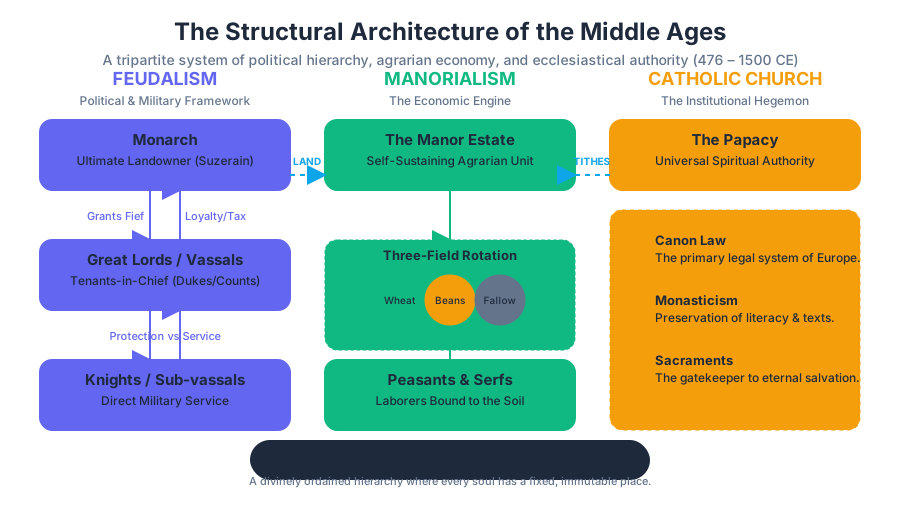
The Middle Ages, spanning roughly from the fall of the Western Roman Empire in 476 CE to the dawn of the Renaissance in the 14th and 15th centuries, represents a thousand-year epoch of profound structural transformation. Often mischaracterized as a "Dark Age" of intellectual stagnation, modern historiography views this period as a sophisticated evolutionary bridge. It was characterized by the decentralization of political power, the rise of a monolithic ecclesiastical authority, and the development of complex agrarian economic systems that eventually buckled under the weight of pandemic and social upheaval.
Feudalism: The Decentralized Political Architecture
Feudalism was the primary political and military framework of Middle Age Europe. It emerged as a pragmatic response to the collapse of central Roman authority and the subsequent need for local security against Viking, Magyar, and Saracen incursions.
1. What it is
Feudalism is defined as a decentralized social organization based on a web of reciprocal legal and military obligations. The core unit of this system was the fief (land granted by a lord) and the vassalage (the status of a person who received the land in exchange for service).
Definition: The Feudal Contract A socio-political arrangement where a Lord (suzerain) granted land and protection to a Vassal in exchange for auxilium et consilium (aid and counsel), typically manifesting as 40 days of military service per year.
2. How it Works: The Hierarchy of Oaths
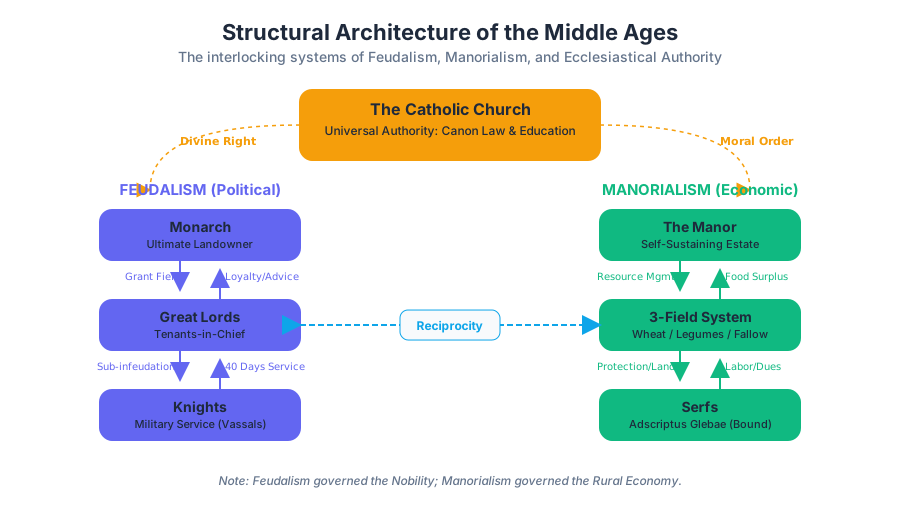
The system operated on a "nested" logic. The King theoretically owned all land but sub-infeudated it to Great Lords, who further divided it among Lesser Lords and Knights.
| Rank | Role | Primary Obligation |
|---|---|---|
| Monarch | Ultimate Landowner | Grants land (fiefs) to high nobility for loyalty. |
| Great Lords (Dukes/Counts) | Tenants-in-Chief | Provide military units and advice to the King. |
| Lesser Lords/Knights | Sub-vassals | Direct military service and local administration. |
| Peasants/Serfs | Laborers | Provide food and labor (not technically part of the feudal military hierarchy). |
3. Implementation: The Logic of Sub-infeudation
In technical terms, feudalism can be modeled as a directed acyclic graph (DAG) where nodes represent individuals and edges represent the "oath of fealty." However, the system often suffered from "circular dependencies" when a vassal held land from two different lords.
/*
 * A low-level representation of the Feudal Hierarchy
 * demonstrating the recursive nature of sub-infeudation.
 */

#include <stdio.h>
#include <stdlib.h>

typedef struct Vassal {
    char* name;
    int military_quota; // Number of knights owed to lord
    struct Vassal** sub_vassals;
    int sub_vassal_count;
} Vassal;

Vassal* create_vassal(char* name, int quota) {
    Vassal* v = malloc(sizeof(Vassal));
    v->name = name;
    v->military_quota = quota;
    v->sub_vassals = NULL;
    v->sub_vassal_count = 0;
    return v;
}

void grant_fief(Vassal* lord, Vassal* sub_vassal) {
    lord->sub_vassal_count++;
    lord->sub_vassals = realloc(lord->sub_vassals, sizeof(Vassal*) * lord->sub_vassal_count);
    lord->sub_vassals[lord->sub_vassal_count - 1] = sub_vassal;
}
Manorialism: The Economic Engine
While Feudalism governed the relationship between nobles, Manorialism (or Seignorialism) governed the relationship between the noble and the peasantry. It was the fundamental unit of the rural economy.
1. The Manor as a Self-Sustaining System
The Manor was an autonomous estate consisting of the lord's residence, a church, a village, and surrounding farmland. Unlike the volatile political world of feudalism, manorialism was a rigid, tradition-bound economic system.
2. Land Allocation and Labor
The land was typically divided into three categories:
- Demesne: Land reserved exclusively for the lord.
- Dependent Land: Land worked by serfs to support themselves.
- Common Land: Woods and pastures used by the entire community.
3. The Three-Field System
To prevent soil exhaustion, manors implemented a "Three-Field System," an early form of algorithmic resource management.
# Manorial Crop Rotation Logic (The Three-Field System)
cycle_config:
  field_A:
    year_1: "Winter Wheat (Planting: Autumn, Harvest: Summer)"
    year_2: "Spring Beans/Legumes (Nitrogen Fixation)"
    year_3: "Fallow (Recovery/Grazing)"
  field_B:
    year_1: "Fallow"
    year_2: "Winter Wheat"
    year_3: "Spring Beans"
  field_C:
    year_1: "Spring Beans"
    year_2: "Fallow"
    year_3: "Winter Wheat"
4. Variations: Serfdom vs. Slavery
Serfs were not slaves; they were "bound to the land." They could not be sold away from the manor, but they could not leave without permission. This provided a stable, albeit low-productivity, labor force for the aristocracy.
| Feature | Serfdom | Slavery |
|---|---|---|
| Legal Status | Person with limited rights | Property |
| Mobility | Bound to the soil (Adscriptus glebae) | Mobile at owner's will |
| Family Rights | Right to marry and keep family intact | No inherent family rights |
| Economic Output | Retained surplus after dues | All output owned by master |
The Catholic Church: The Institutional Hegemon
In the absence of a strong centralized state, the Catholic Church functioned as the "universal" institution of Europe. It was the sole provider of education, the primary arbiter of law (Canon Law), and the gatekeeper of spiritual salvation.
1. The Great Chain of Being
The Church promoted a cosmological view where every creature had a fixed place in a hierarchy ordained by God. This provided the ideological justification for the rigid social classes of the Middle Ages.
2. Political and Legal Power
The Church held its own courts and collected its own taxes (Tithes, usually 10% of produce). The Papacy often clashed with secular monarchs over "Lay Investiture"—the right to appoint local church officials.
-- Schema for a Medieval Parish Tithe Registry
CREATE TABLE Parishioners (
    id INT PRIMARY KEY,
    name VARCHAR(100),
    manor_id INT,
    status ENUM('Serf', 'Freeman', 'Knight')
);

CREATE TABLE TithePayments (
    payment_id INT PRIMARY KEY,
    parishioner_id INT,
    year INT,
    commodity_type VARCHAR(50), -- e.g., 'Grain', 'Wool', 'Livestock'
    quantity_received DECIMAL(10,2),
    FOREIGN KEY (parishioner_id) REFERENCES Parishioners(id)
);

-- Query to calculate total grain tithe for a specific manor
SELECT SUM(quantity_received)
FROM TithePayments
JOIN Parishioners ON TithePayments.parishioner_id = Parishioners.id
WHERE commodity_type = 'Grain' AND manor_id = 101;
3. The Monastic Tradition
Monasteries served as the "data centers" of the Middle Ages. Monks painstakingly copied manuscripts, preserving Greek and Roman knowledge that would have otherwise been lost.
The Crusades: Geopolitical Expansion
The Crusades (1095–1291) were a series of religiously sanctioned military expeditions intended to recover the Holy Land from Muslim rule.
1. Motivation and Catalysts
- Papal Ambition: Pope Urban II sought to unite warring European nobles against a common "infidel" enemy.
- Primogeniture: Younger sons of nobles, who inherited no land, sought to carve out their own kingdoms in the Levant.
- Economic Interests: Italian city-states (Venice, Genoa) wanted to secure trade routes to the East.
2. Outcomes and Legacy
While the Crusades were a military failure for Christendom in the long run (Jerusalem remained under Muslim control), they were a catalyst for massive cultural and economic change.
| Crusade | Date | Primary Outcome |
|---|---|---|
| First Crusade | 1096–1099 | Captured Jerusalem; established Crusader States. |
| Third Crusade | 1189–1192 | "Crusade of Kings" (Richard the Lionheart); failed to retake Jerusalem. |
| Fourth Crusade | 1202–1204 | Sacked Constantinople (Christian city); deepened the Great Schism. |
| Long-term Impact | N/A | Introduction of sugar, silk, spices, and Arabic numerals to Europe. |
Key Insight: The Paradox of the Crusades The Crusades fostered deep-seated religious animosity, yet they simultaneously ended European isolation by forcing interaction with the more technologically advanced Islamic and Byzantine civilizations.
The Black Death: Systemic Collapse and Transition
The 14th century was defined by the Black Death (1347–1351), a pandemic of bubonic plague caused by the bacterium Yersinia pestis.
1. Pathogenesis and Spread
The plague traveled along the Silk Road via fleas on rats. In an era before germ theory, the sudden death of 30% to 60% of Europe's population was viewed as divine punishment or planetary misalignment.
2. Economic Disruption: The Labor Scarcity Loop
The massive mortality rate triggered a fundamental shift in the economic power balance. With fewer peasants available to work the land, the value of labor skyrocketed.
import matplotlib.pyplot as plt

def simulate_labor_market(population, land_value):
    """
    A simplified model of the post-plague labor market.
    As population drops, labor scarcity increases bargaining power.
    """
    wages = []
    pop_levels = []

    current_pop = population
    while current_pop > population * 0.5:
        # Labor value is inversely proportional to population density
        labor_value = (land_value / current_pop) * 100
        wages.append(labor_value)
        pop_levels.append(current_pop)
        current_pop -= (population * 0.05) # Simulating plague waves

    return pop_levels, wages

# Visualization of the economic shift
3. The End of Serfdom
Lords attempted to freeze wages through legislation (e.g., the English Statute of Labourers 1351), but market forces prevailed. Peasants began to demand cash wages and lower rents, leading to the Peasants' Revolt of 1381 and the eventual dissolution of the manorial system.
4. Cultural Impact: Memento Mori
The ubiquity of death led to a cultural obsession with mortality, reflected in the Danse Macabre (Dance of Death) in art and literature, and a growing skepticism toward the Church's inability to stop the plague.
Summary of the Middle Ages Evolution
The Middle Ages was not a static period. It was a dynamic system that moved from extreme decentralization to the beginnings of the modern nation-state.
| Era | Focus | Key Characteristic |
|---|---|---|
| Early Middle Ages (500–1000) | Survival | Decentralization, Manorialism, Viking Raids. |
| High Middle Ages (1000–1300) | Expansion | Rise of Towns, Universities, Crusades, Gothic Architecture. |
| Late Middle Ages (1300–1500) | Crisis/Transition | Black Death, Hundred Years' War, Decline of Feudalism. |

Renaissance and Reformation
Key concepts: Humanism · The Printing Press · Protestant Reformation · Counter-Reformation · Thirty Years' War
This section covers the cultural rebirth of Europe and the religious upheavals that ended the medieval period and ushered in the early modern era.
Renaissance and Reformation
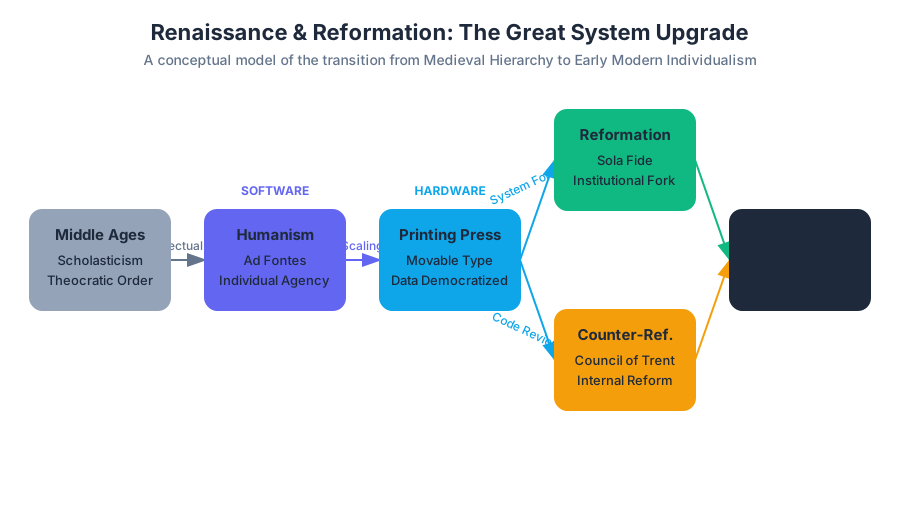
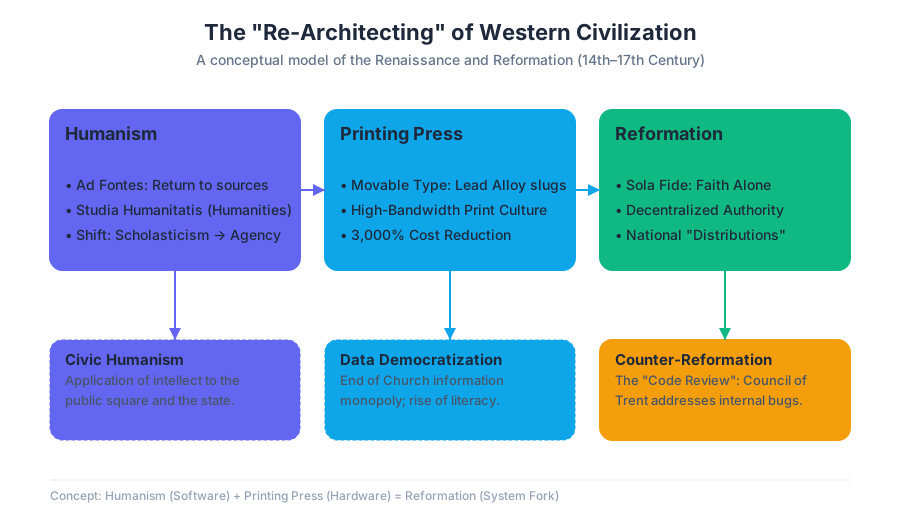
The period between the 14th and 17th centuries represents a fundamental "re-architecting" of Western Civilization. It marks the transition from the Middle Ages—characterized by feudalism, theocratic dominance, and a collective identity—to the Early Modern era, defined by individualism, secular inquiry, and the rise of the nation-state. This shift was not a single event but a series of overlapping intellectual, technological, and religious "patches" to the existing social operating system.
Humanism: The Intellectual Framework
Humanism was the primary intellectual driver of the Renaissance. It was a shift from Scholasticism (the medieval method of learning based on Aristotelian logic and Church dogma) to Studia Humanitatis (the study of the humanities: grammar, rhetoric, history, poetry, and moral philosophy).
The Mechanics of the Humanist Shift
Humanism functioned by "decoupling" human potential from divine predestination. While medieval thought viewed the world as a static hierarchy (the Great Chain of Being), Humanists viewed the individual as a dynamic agent capable of self-improvement through the study of classical antiquity.
Definition: Ad Fontes Literally "to the sources." This was the Humanist rallying cry to bypass medieval commentaries and return to the original Greek and Hebrew texts of the Bible and classical philosophy.
| Feature | Medieval Scholasticism | Renaissance Humanism |
|---|---|---|
| Primary Goal | Reconcile faith with reason | Cultivate the "Universal Man" (L'uomo Universale) |
| Core Texts | The Bible, Aristotle, Church Fathers | Cicero, Plato, Virgil, Homer |
| Language focus | Medieval Latin | Classical Latin, Greek, Hebrew |
| View of Man | Inherently sinful, dependent on Grace | Possessing dignity and creative agency |
| Education | Professional (Law, Medicine, Theology) | Liberal Arts (Civic development) |
Civic Humanism
In the Italian city-states (notably Florence), this evolved into Civic Humanism, which argued that the highest use of the intellect was for the benefit of the state. This moved the ideal of the "good life" from the monastery to the public square.
The Printing Press: A Hardware Revolution
If Humanism was the software, the Printing Press was the hardware that allowed it to scale. Developed by Johannes Gutenberg around 1440, the press moved Europe from a "low-bandwidth" manuscript culture to a "high-bandwidth" print culture.
Technical Implementation: Movable Type
The core innovation was not the press itself (which existed for wine and paper), but the movable type—the ability to cast individual letters in a durable metal alloy that could be rearranged and reused.
/*
* Low-level conceptual model of a Movable Type Layout Engine
* This simulates the memory-efficient reuse of character 'slugs'
* in a printing frame (chase).
*/
#include <stdio.h>
#include <string.h>
#define MAX_CHASE_SIZE 1024
#define TYPE_ALLOY "Lead-Antimony-Tin"
typedef struct {
char glyph;
int width_pts;
int height_pts;
char material[20];
} TypeSlug;
void compose_line(TypeSlug *chase, const char *text, int *cursor) {
for (int i = 0; i < strlen(text); i++) {
chase[*cursor].glyph = text[i];
chase[*cursor].width_pts = 12; // Standard Pica
strcpy(chase[*cursor].material, TYPE_ALLOY);
(*cursor)++;
}
}
int main() {
TypeSlug printing_chase[MAX_CHASE_SIZE];
int current_pos = 0;
compose_line(printing_chase, "Ad Fontes", ¤t_pos);
printf("Frame initialized with %d slugs using %s.\n", current_pos, TYPE_ALLOY);
return 0;
}
Impact on Information Theory
The printing press reduced the cost of book production by approximately 3,000%. This created a "democratization of data" where the Church could no longer effectively censor the flow of information. The "Index Librorum Prohibitorum" (List of Prohibited Books) became increasingly difficult to enforce as clandestine presses could be set up in any basement.
The Protestant Reformation: The Great Schism
The Protestant Reformation was a religious and political movement that fractured the hegemony of the Roman Catholic Church. While it began as an internal "bug report" (Martin Luther’s 95 Theses), it quickly escalated into a full-scale system fork.
The Theological Logic: Sola Fide vs. Merit
The central conflict was the mechanism of Justification (how a human is made "right" with God).
\begin{aligned}
\text{Catholic Model:} & \quad \text{Faith} + \text{Works (Sacraments/Charity)} \rightarrow \text{Salvation} \\
\text{Lutheran Model:} & \quad \text{Faith Alone (Sola Fide)} \rightarrow \text{Salvation} + \text{Works as a byproduct}
\end{aligned}
Key Reformers and Their "Branches"
The Reformation was not a monolithic movement; it branched into several distinct "distributions" of Christianity.
| Branch | Founder | Key Distinctive | Political Alignment |
|---|---|---|---|
| Lutheranism | Martin Luther | Sola Fide, Sola Scriptura | German Princes (Northern HRE) |
| Calvinism | John Calvin | Predestination (The Elect) | Swiss Cantons, Scotland, Netherlands |
| Anglicanism | Henry VIII | Royal Supremacy over the Pope | English Monarchy |
| Anabaptism | Various | Adult baptism, separation of Church/State | Radical fringes (persecuted by all) |
The Counter-Reformation: The Catholic Response
The Catholic Church did not remain static. The Counter-Reformation (or Catholic Reformation) was a dual-track strategy: internal reform and external defense.
The Council of Trent (1545–1563)
The Council was the "Code Review" of the Catholic Church. It addressed corruption (abolishing the sale of indulgences) but doubled down on traditional dogma (affirming the seven sacraments and the authority of the Pope).
The Jesuit Order
Founded by Ignatius of Loyola, the Society of Jesus (Jesuits) acted as the "special forces" of the Counter-Reformation. They focused on three pillars:
- Education: Establishing elite universities to win back the minds of the youth.
- Missionary Work: Expanding the "user base" of Catholicism to the New World and Asia.
- Political Advisory: Serving as confessors to Catholic monarchs to influence state policy.
-- Conceptual Schema for the Index Librorum Prohibitorum
-- Used to track and suppress "heretical" documentation

CREATE TABLE BannedBooks (
    BookID INT PRIMARY KEY,
    Title VARCHAR(255),
    Author VARCHAR(255),
    ReasonForBan TEXT,
    SeverityLevel INT, -- 1: Minor Correction, 5: Total Destruction
    DateAdded DATE
);

INSERT INTO BannedBooks (Title, Author, ReasonForBan, SeverityLevel, DateAdded)
VALUES ('De revolutionibus orbium coelestium', 'Nicolaus Copernicus', 'Contradicts Geocentric Scripture', 4, '1616-03-05');
The Thirty Years' War: The Conflict of Systems
The tensions between the Reformation and Counter-Reformation culminated in the Thirty Years' War (1618–1648). While it began as a religious conflict within the Holy Roman Empire (HRE), it evolved into a continental struggle for hegemony involving France, Sweden, Spain, and Austria.
Phases of the War
- Bohemian Phase: Localized religious revolt.
- Danish Phase: Intervention of Northern Protestant powers.
- Swedish Phase: Gustavus Adolphus (the "Father of Modern Warfare") introduces mobile artillery.
- French Phase: Cardinal Richelieu (a Catholic) supports Protestants to weaken the Habsburgs—the ultimate triumph of Raison d'État (Reason of State) over religious solidarity.
The Peace of Westphalia (1648): The Modern Protocol
The war ended with the Peace of Westphalia, which established the "Westphalian System" of international relations. This is the foundation of the modern world order.
Key Insight: Westphalian Sovereignty The principle that each state has exclusive sovereignty over its territory. It established the rule of Cuius regio, eius religio (Whose realm, his religion), effectively ending the Pope's claim to universal political authority.
The Westphalian State Configuration
The treaty shifted the "unit of analysis" in history from the Empire/Church to the Sovereign State.
# Conceptual Configuration for a Westphalian State (post-1648)
state_entity:
  name: "Kingdom of France"
  sovereignty:
    internal: absolute # No external interference in domestic laws
    external: recognized # Equality of states regardless of size
  religious_policy:
    official_religion: "Catholicism"
    tolerance_level: "Limited" # Edict of Nantes (revoked later)
  boundaries:
    defined_by: "Treaty"
    enforcement: "Standing Army"
  diplomatic_protocol:
    ambassadors: permanent
    treaty_binding: true
Summary of the Transition
The Renaissance and Reformation represent the "Great Decoupling."
- Humanism decoupled the individual from the collective.
- The Printing Press decoupled information from the clergy.
- The Reformation decoupled the soul from the Roman hierarchy.
- Westphalia decoupled the state from the Church.
These movements set the stage for the Enlightenment and the Scientific Revolution, as the "authority of the ancients" and the "authority of the Church" were replaced by the "authority of evidence and reason."
- Humanism: Intellectual movement focusing on classical texts and human potential.
- Ad Fontes: "To the sources"; the Humanist method of returning to original manuscripts.
- Movable Type: Gutenberg's innovation allowing for rapid, cheap mass-printing.
- 95 Theses: Martin Luther's 1517 challenge to the Catholic sale of indulgences.
- Sola Fide: The Protestant doctrine of "Faith Alone."
- Predestination: Calvinist belief that God has already chosen who will be saved.
- Council of Trent: The Catholic Church's formal response and internal reform.
- Jesuits: The Society of Jesus; educators and missionaries of the Counter-Reformation.
- Cuius regio, eius religio: The principle that a prince's religion determines the religion of his subjects.
- Westphalian Sovereignty: The concept that states have total control over their internal affairs.
- Conceptual Link: How did the Humanist concept of Ad Fontes directly enable the Protestant Reformation?
- Answer: By encouraging scholars to read the Bible in its original Greek and Hebrew, they discovered discrepancies between the original text and the Latin Vulgate used by the Church.
- Technological Impact: Why was the printing press considered a "force multiplier" for Martin Luther but not for earlier heretics like Jan Hus?
- Answer: Hus's ideas were localized and easily suppressed via manuscript burning. Luther's ideas were printed in the thousands and distributed across borders faster than the Church could react.
- Political Logic: Why did Catholic France fight on the side of the Protestants during the Thirty Years' War?
- Answer: Raison d'État. France wanted to weaken the Habsburg Empire, which surrounded them, prioritizing national power over religious affiliation.
- Systemic Change: What was the most significant shift in international law introduced by the Peace of Westphalia?
- Answer: The transition from a hierarchical world (headed by the Pope/Emperor) to a horizontal world of equal, sovereign states.
Key Themes to Master:
- The Shift in Authority: Understand the move from Institutional Authority (The Church) to Individual/Textual Authority (The Bible/The Humanist).
- The Role of Technology: Be able to explain how the printing press changed the "economics of ideas."
- The Geography of Religion: Identify which parts of Europe remained Catholic (South/West) and which became Protestant (North/East).
- The Birth of the State: Trace the evolution from feudal territories to the sovereign nations defined at Westphalia.
- The Renaissance Man: Define the ideal of the "Universal Man" and how it differs from the medieval ideal of the "Ascetic Monk."
Source Materials
Study Western Civilization I with AI — Free on Lykke
Sign up for free to generate personalized flashcards, quizzes, and study guides from this course. Chat with an AI tutor that knows the material.
Get Started FreeView this course wiki on Lykke · Browse all public course wikis