From the free course Think Python, 2nd edition on Lykke
Advanced Concepts and Object-Oriented Programming
Key concepts: Object-Oriented Programming · Algorithm Analysis · Software Development Life Cycle · Advanced Data Structures · Syntax and Semantics
Explores advanced topics including algorithm analysis, object-oriented programming, and the software development life cycle.
Advanced Concepts and Object-Oriented Programming
The transition from procedural programming to Object-Oriented Programming (OOP) and formal Algorithm Analysis marks the evolution of a student into a software engineer. While early programming focuses on "how to make the computer do X," advanced computer science focuses on "how to design a system that is maintainable, scalable, and efficient." This article synthesizes the core tenets of software design, the mathematical rigor of complexity analysis, and the architectural patterns that define modern development.
Syntax and Semantics: The Foundation of Meaning
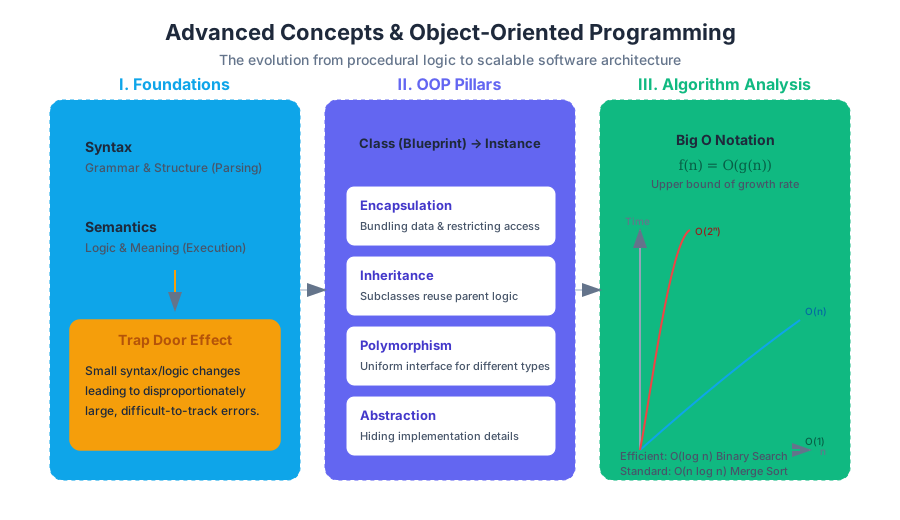
Before diving into complex architectures, one must distinguish between the syntax (the rules governing the structure of a program) and the semantics (the meaning or logic of the program). In high-level languages like Python, syntax errors are caught by the interpreter, but semantic errors—often called logic errors—are the primary source of bugs in professional software.
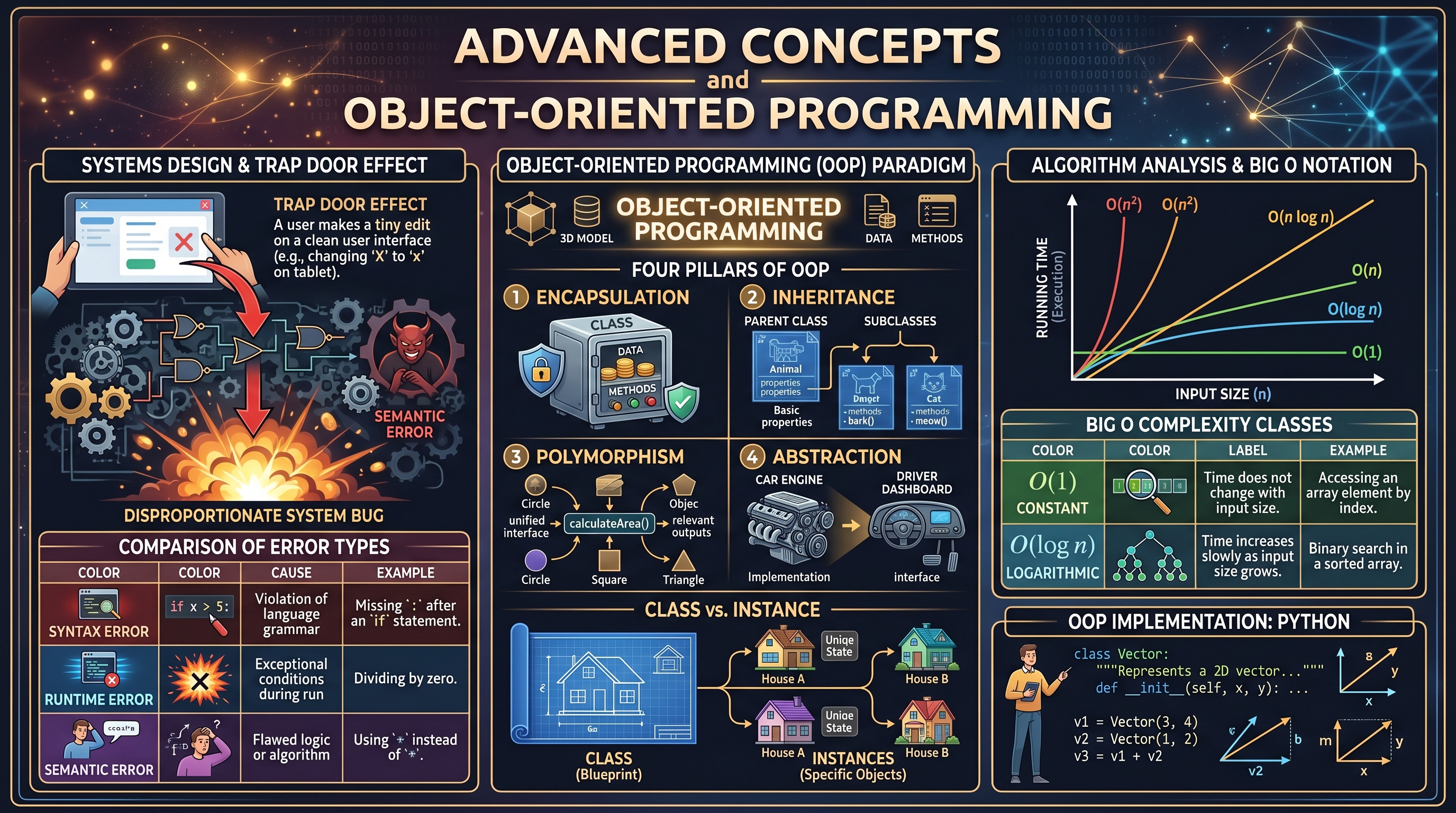
Allen Downey, in Think Python, highlights the Trap Door Effect: a phenomenon where a small, seemingly insignificant change in syntax or logic leads to a disproportionately large and difficult-to-track error in the program's output. Understanding the relationship between the two is critical for effective debugging.
Comparison of Error Types
| Error Type | Detection Phase | Cause | Example |
|---|---|---|---|
| Syntax Error | Parsing/Compile Time | Violation of language grammar | Missing a colon : after an if statement. |
| Runtime Error | Execution Time | Exceptional conditions during run | Dividing by zero or accessing a non-existent index. |
| Semantic Error | Post-Execution | Flawed logic or algorithm | Using + instead of * in a formula. |
Object-Oriented Programming (OOP)
Object-Oriented Programming is a paradigm based on the concept of "objects," which can contain data (in the form of attributes or properties) and code (in the form of methods). OOP is designed to bridge the gap between the real world and the digital world by modeling entities as self-contained units.
Core Pillars of OOP
- Encapsulation: Bundling the data and the methods that operate on that data into a single unit (a class) and restricting access to some of the object's components.
- Inheritance: A mechanism where a new class (subclass) inherits the attributes and methods of an existing class (parent class), promoting code reuse.
- Polymorphism: The ability of different types to be treated as instances of the same class through a uniform interface, often achieved via method overriding.
- Abstraction: Hiding complex implementation details and showing only the necessary features of an object.
Definition: Class vs. Instance A Class is a blueprint or template for creating objects. An Instance is a specific object created from a particular class, possessing its own unique state but sharing the structure defined by the class.
Implementation: The Pythonic Approach
In Python, every value is an object. When we define a class, we are essentially defining a new type. The following example demonstrates a non-trivial implementation of a Vector class, utilizing operator overloading to provide intuitive semantics.
import math

class Vector:
    """Represents a 2D vector with coordinate-based arithmetic."""

    def __init__(self, x=0, y=0):
        self.x = x
        self.y = y

    def __str__(self):
        return f"Vector({self.x}, {self.y})"

    def __add__(self, other):
        """Overloads the '+' operator for Vector addition."""
        if isinstance(other, Vector):
            return Vector(self.x + other.x, self.y + other.y)
        raise TypeError("Operand must be of type Vector")

    def magnitude(self):
        """Calculates the Euclidean norm of the vector."""
        return math.sqrt(self.x**2 + self.y**2)

    def __lt__(self, other):
        """Allows comparison based on magnitude (Polymorphism)."""
        return self.magnitude() < other.magnitude()

# Usage
v1 = Vector(3, 4)
v2 = Vector(1, 2)
v3 = v1 + v2
print(f"Resultant: {v3}, Magnitude: {v3.magnitude():.2f}")
print(f"Is v1 < v2? {v1 < v2}")
Algorithm Analysis and Big O Notation
Algorithm Analysis is the process of predicting the resources (usually time or memory) required by an algorithm. This is not measured in seconds—as hardware varies—but in the growth rate of the execution time relative to the input size ($n$).
Big O Complexity Classes
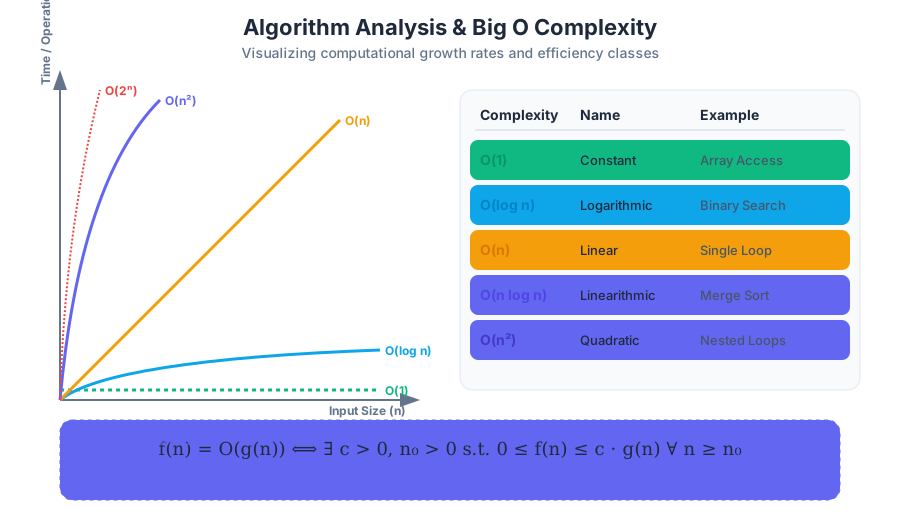
We use Big O Notation to describe the upper bound of an algorithm's running time, focusing on the "worst-case" scenario.
| Notation | Name | Description | Example |
|---|---|---|---|
| $O(1)$ | Constant | Time does not change with input size. | Accessing an array element by index. |
| $O(\log n)$ | Logarithmic | Time increases slowly as $n$ grows. | Binary search in a sorted list. |
| $O(n)$ | Linear | Time increases proportionally to $n$. | Iterating through a list once. |
| $O(n \log n)$ | Linearithmic | Standard for efficient sorting. | Merge Sort or Quick Sort. |
| $O(n^2)$ | Quadratic | Time increases with the square of $n$. | Nested loops (e.g., Bubble Sort). |
| $O(2^n)$ | Exponential | Time doubles with each addition to $n$. | Recursive Fibonacci calculation. |
Mathematical Foundation
The formal definition of Big O provides a rigorous way to compare algorithms:
f(n) = O(g(n)) \iff \exists c > 0, n_0 > 0 \text{ s.t. } 0 \le f(n) \le c \cdot g(n) \text{ for all } n \ge n_0
This states that for sufficiently large $n$, the function $f(n)$ will never exceed $g(n)$ multiplied by some constant $c$. This allows engineers to ignore hardware-specific constants and focus on the fundamental efficiency of the logic.
Advanced Data Structures
While basic lists and strings are sufficient for simple scripts, advanced software requires structures optimized for specific operations like searching, sorting, or mapping.
Dictionaries and Hashing
A Dictionary (or Hash Map) is perhaps the most important data structure in modern programming. It stores key-value pairs and provides $O(1)$ average-time complexity for lookups. This is achieved through hashing, where a "hash function" converts a key into an index in an underlying array.
Tuples and Sets
- Tuples: Immutable sequences. They are used for fixed collections of data and can be used as keys in dictionaries (unlike lists) because they are hashable.
- Sets: Unordered collections of unique elements. They are optimized for membership testing (
x in set) and mathematical operations like union and intersection.
Performance Comparison: List vs. Set
| Operation | List ($n$ elements) | Set ($n$ elements) |
|---|---|---|
| Append/Add | $O(1)$ | $O(1)$ |
Search (in) |
$O(n)$ | $O(1)$ |
| Delete | $O(n)$ | $O(1)$ |
| Ordered? | Yes | No |
Software Development Life Cycle (SDLC)
Writing code is only one phase of the Software Development Life Cycle (SDLC). Professional development follows a structured process to ensure that the software meets user needs and is maintainable over time.
Phases of the SDLC
- Planning and Requirement Analysis: Defining the scope and objectives.
- Design: Architecting the system, choosing data structures, and defining the OOP hierarchy.
- Implementation (Coding): The actual writing of the source code.
- Testing: Verifying that the code works as intended (Unit testing, Integration testing).
- Deployment: Releasing the software to a production environment.
- Maintenance: Fixing bugs and adding new features over time.
Real-World Context: CI/CD Pipelines
In modern DevOps, the SDLC is often automated using Continuous Integration and Continuous Deployment (CI/CD). This ensures that every change is tested and analyzed before it reaches the user.
# Example GitHub Actions Workflow for SDLC Automation
name: Python Package CI

on: [push]

jobs:
  build:
    runs-on: ubuntu-latest
    steps:
    - uses: actions/checkout@v3
    - name: Set up Python
      uses: actions/setup-python@v4
      with:
        python-version: '3.10'
    - name: Install dependencies
      run: |
        python -m pip install --upgrade pip
        pip install flake8 pytest
    - name: Lint with flake8
      run: |
        # Stop the build if there are Python syntax errors or undefined names
        flake8 . --count --select=E9,F63,F7,F82 --show-source --statistics
    - name: Test with pytest
      run: |
        pytest tests/
Low-Level Perspectives: OOP in C
To truly understand OOP, it is helpful to see how it is implemented at a lower level. In a language like C, which lacks native class support, developers use structs and function pointers to simulate objects. This reveals that an "object" is simply a block of memory with a specific layout.
#include <stdio.h>
#include <stdlib.h>

// The "Class" structure
typedef struct Shape {
    int x, y;
    void (*draw)(struct Shape*); // Function pointer (Method)
} Shape;

// A "Method" implementation
void drawCircle(Shape* self) {
    printf("Drawing circle at (%d, %d)\n", self->x, self->y);
}

int main() {
    // Manual instantiation and "constructor"
    Shape* myCircle = malloc(sizeof(Shape));
    myCircle->x = 10;
    myCircle->y = 20;
    myCircle->draw = drawCircle;

    // "Method" invocation
    myCircle->draw(myCircle);

    free(myCircle);
    return 0;
}
Common Pitfalls and Debugging Techniques
As systems grow in complexity, debugging becomes a systematic process rather than a guessing game.
The "Trap Door" of Mutable Defaults
A common mistake in Python OOP is using mutable objects (like lists) as default arguments in methods. Because default arguments are evaluated only once at definition time, every instance of the class shares the same list.
Misunderstanding Big O
A common misconception is that $O(n^2)$ is always slower than $O(n)$. For very small values of $n$, the constant factors (which Big O ignores) might make the "slower" algorithm perform better. Analysis must always consider the expected input size.
Debugging Strategies
- Reading: Examine your code, read it back to yourself, and check that it says what you meant to say.
- Running: Experiment by making small changes and running different variations.
- Ruminating: Take time to think about the error. What kind of error is it? What was the last thing you changed?
- Retreating: If you are stuck, undo the recent changes until you have a working program again, then rebuild.
Summary of Advanced Concepts
| Concept | Key Takeaway |
|---|---|
| OOP | Use classes to group data and behavior; leverage inheritance for reuse. |
| Algorithm Analysis | Optimize for growth rates ($O(n)$) rather than raw speed. |
| Data Structures | Choose the right tool (e.g., Sets for uniqueness, Dicts for mapping). |
| SDLC | Software is a process, not just a product; testing and maintenance are vital. |
| Semantics | Logic errors are harder to find than syntax errors; use systematic debugging. |
Source Materials
Study Think Python, 2nd edition on Lykke
This course page is free to open: signed out, you can read its first two sections, and signing in, on any plan, opens the rest. The free Lykke Chrome extension syncs your own Canvas courses, so ChatGPT, Claude and Muse can answer from your classes and deadlines. It only reads Canvas.
Add the free extensionSign in to open every sectionAll sections of Think Python, 2nd edition · Browse more course pages