From the free course The Word on College Reading and Writing on Lykke
Uncovering Deeper Meaning
Key concepts: Surface vs. Deeper Meaning · Themes and Symbols · Reader-Text Conversation · Personal Identity
Distinguishes between surface-level plot/facts and the deeper themes, symbols, and character interactions.
Uncovering Deeper Meaning
In the academic ecosystem, a text is not merely a sequence of characters or a static document; it is a dynamic vessel of information. While the colloquial definition of a text often limits it to books or essays, the academic definition expands this to include any medium that conveys meaning—films, songs, paintings, advertisements, and even architectural structures. To "read" a text at a college level is to engage in a process of hermeneutics, or the theory and methodology of interpretation. This process requires moving beyond the literal "surface" to extract the "buried treasure" of underlying themes, symbols, and rhetorical strategies.
The Architecture of Meaning: Surface vs. Deep
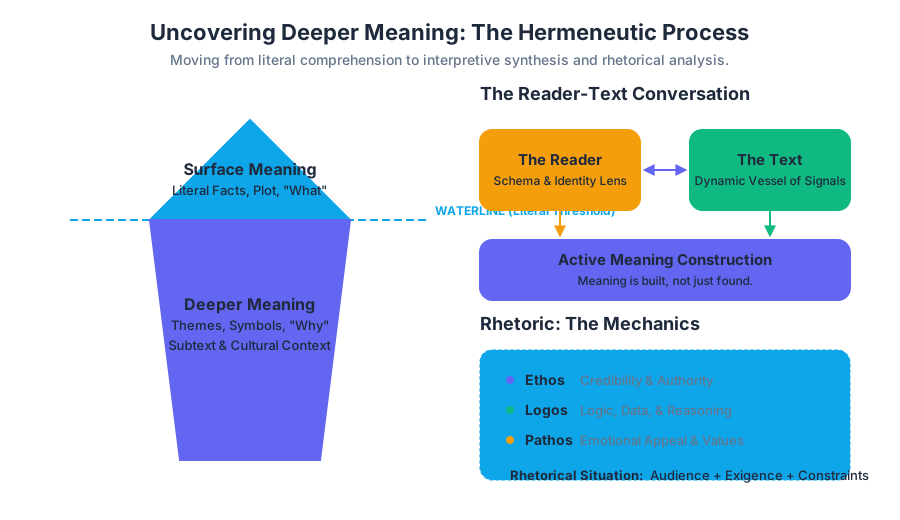
The distinction between Surface Meaning and Deeper Meaning is the foundation of critical analysis. Think of a text as an iceberg: the visible portion above the waterline represents the literal events, facts, and data, while the massive structure beneath represents the subtext, cultural context, and authorial intent.
Definition: Surface Meaning The literal, explicit content of a text. It answers the "what," "who," and "where" of a narrative or argument. In a technical document, this is the raw data; in a story, it is the plot.
Definition: Deeper Meaning The implicit, abstract themes and messages. It answers the "why" and "how." It involves identifying patterns, symbols, and the broader social or philosophical implications of the work.
Comparative Analysis of Meaning Layers
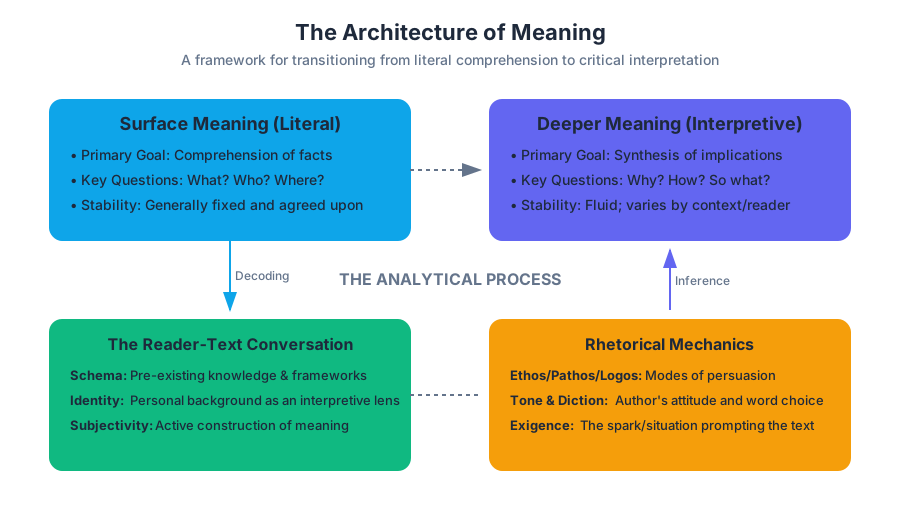
| Feature | Surface Meaning (Literal) | Deeper Meaning (Interpretive) |
|---|---|---|
| Primary Goal | Comprehension of facts and sequence. | Synthesis of themes and implications. |
| Key Questions | What happened? Who is involved? | Why does this matter? What does it symbolize? |
| Cognitive Load | Lower; focuses on decoding and recall. | Higher; focuses on evaluation and inference. |
| Stability | Generally fixed; most readers agree on facts. | Fluid; varies based on reader perspective and context. |
| Example (The Great Migration) | Millions of African Americans moved North. | A quest for agency amidst systemic economic determinism. |
The Reader-Text Conversation
Interpretation is not a passive reception of data; it is an active Reader-Text Conversation. This concept posits that meaning is not "found" in the text like a fossil, but is "constructed" through the interaction between the author’s signals and the reader’s schema (pre-existing knowledge and frameworks).
The Role of Personal Identity
Your personal background—including your gender, ethnicity, socioeconomic status, and life experiences—acts as a lens through which you view a text. This is why two readers can walk away from the same poem with radically different interpretations.
- Subjectivity: Acknowledging that your emotional response is a valid starting point for analysis.
- Self-Awareness: Critically questioning why you reacted to a specific passage. Is it because of the author’s tone, or a personal bias you hold?
- Identity Markers: Using gender-neutral language and inclusive pronouns in your own writing reflects an awareness of the diverse "conversation" happening in the modern academic sphere.
Rhetoric: The Mechanics of Persuasion
To uncover deeper meaning, one must understand Rhetoric—the art of speaking or writing effectively and persuasively. Analyzing rhetoric involves looking at how an author manipulates language to achieve a specific Author’s Purpose.
The Rhetorical Triangle and Beyond
While traditional rhetoric focuses on Ethos (credibility), Pathos (emotion), and Logos (logic), modern analysis also considers the Rhetorical Situation: the intersection of the audience, the exigence (the spark that prompted the writing), and the constraints (cultural or medium-based limitations).
Rhetorical Components Table
| Component | Definition | Analytical Focus |
|---|---|---|
| Main Point | The central claim or thesis. | Is the claim explicit or must it be inferred? |
| Author’s Purpose | The reason for writing (to inform, persuade, entertain). | What change does the author want to see in the audience? |
| Tone | The author's attitude toward the subject. | How do word choice and syntax convey emotion? |
| Audience Awareness | The intended recipient of the message. | What assumptions does the author make about the reader's knowledge? |
| Jargon | Specialized language used by a specific group. | Does the jargon exclude outsiders or establish authority? |
Case Study: Jacob Lawrence’s "Migration Series"
A prime example of uncovering deeper meaning is the analysis of Jacob Lawrence’s Migration Series. On the surface, these sixty tempera paintings depict the mass movement of African Americans from the rural South to the urban North. However, a deep dive reveals a complex interplay between Economic Determinism and Collective Ambition.
Symbols and Themes in Lawrence’s Work
Lawrence uses specific visual elements—Migration Colors (vibrant greens, yellows, and oranges) and Naturalism vs. Modernism—to convey the emotional weight of the journey.
- Push Factors: Labor shortages, crop failure (the boll weevil), and systemic violence.
- Pull Factors: The "promise" of the North, industrial jobs, and the hope for social equity.
- The Deeper Message: While the migrants were "pushed" by economic forces, Lawrence emphasizes their agency. They were not just victims of history; they were architects of their own destiny.
Technical Execution: The "Sleuth" Method
To move from passive reading to active analysis, one must adopt the mindset of a detective. This involves a non-linear approach to the text.
1. Pre-reading (The Investigation)
Before reading the first word, scan the text for visual clues.
- Title Analysis: What does the title suggest about the scope?
- Author Credentials: Is the author a journalist, a scientist, or a witness?
- Headings and Pull-outs: These often function as the "skeleton" of the argument.
- Visual Aids: Captions and charts often contain the densest information.
2. Annotation and Schema Building
Annotation is the physical manifestation of the reader-text conversation. By marking the text, you are "talking back" to the author.
- Vocabulary Development: Looking up unfamiliar words is non-negotiable. In college-level texts, a single misunderstood word can derail an entire argument.
- Note-taking: Summarizing paragraphs in the margins helps with information retention and forces you to synthesize the author's points.
3. Mathematical Representation of Interpretation
We can model the process of interpretation as a Bayesian update. Your initial understanding (Prior) is modified by new evidence found in the text (Likelihood), resulting in a new, deeper understanding (Posterior).
P(Meaning | Text) = \frac{P(Text | Meaning) \times P(Meaning)}{P(Text)}
In this model:
- $P(Meaning | Text)$ is the probability that your interpretation is correct given the textual evidence.
- $P(Meaning)$ is your Schema or prior knowledge.
- $P(Text | Meaning)$ is how well the specific words in the text support your interpretation.
Structural Integrity: Citation and Evidence
A deep-dive analysis is only as strong as the evidence supporting it. In academic writing, this requires rigorous Information Literacy and adherence to citation standards like MLA 8th Edition.
The Container System
MLA 8 introduced the concept of "containers." A source (like an article) is held within a container (like a journal), which might be held within a second container (like a database).
MLA 8th Edition Component Map
| Order | Element | Example |
|---|---|---|
| 1 | Author | De Souza, Michael. |
| 2 | Title of Source | "Economic Determinism in Art." |
| 3 | Title of Container | Journal of African American Studies |
| 4 | Other Contributors | edited by Sarah Miller, |
| 5 | Version | vol. 12, |
| 6 | Number | no. 4, |
| 7 | Publisher | Oxford UP, |
| 8 | Publication Date | 2016, |
| 9 | Location | pp. 45-60. |
Common Pitfalls in Analysis
Even experienced readers encounter obstacles when trying to uncover deeper meaning. Recognizing these "anti-patterns" is crucial for academic success.
- The Literal Trap: Focusing so much on "what happened" that you fail to see the symbolic significance.
- Confirmation Bias: Only noticing evidence that supports your pre-existing beliefs while ignoring counter-arguments in the text.
- Over-reading: Assigning deep symbolic meaning to every minor detail (e.g., "the curtains were blue because the author was depressed," when the author just liked the color blue).
- Ignoring the Rhetorical Situation: Analyzing a text without considering when it was written or who it was written for. A text from 1920 cannot be judged solely by 2024 social standards without acknowledging the historical context.
Conclusion: The Path to Mastery
Uncovering deeper meaning is a skill that improves with Reading Stamina and habit formation. By creating an optimal study environment, managing distractions, and engaging in daily reading practice across a variety of genres, you build the cognitive muscles required for high-level analysis. Whether you are analyzing a 60-panel painting series by Jacob Lawrence or a technical manual on systems architecture, the goal remains the same: to move past the surface and engage with the core ideas that shape our world.
Source Materials
Study The Word on College Reading and Writing on Lykke
This course page is free to open: signed out, you can read its first two sections, and signing in, on any plan, opens the rest. The free Lykke Chrome extension syncs your own Canvas courses, so ChatGPT, Claude and Muse can answer from your classes and deadlines. It only reads Canvas.
Add the free extensionSign in to open every sectionAll sections of The Word on College Reading and Writing · Browse more course pages