From the free course The Word on College Reading and Writing on Lykke
The Writing Process
Key concepts: Prewriting · Drafting · Revising · Reading to Write · Synthesis
Outlines the stages of writing from prewriting to revising, emphasizing the link between reading and writing.
The Writing Process
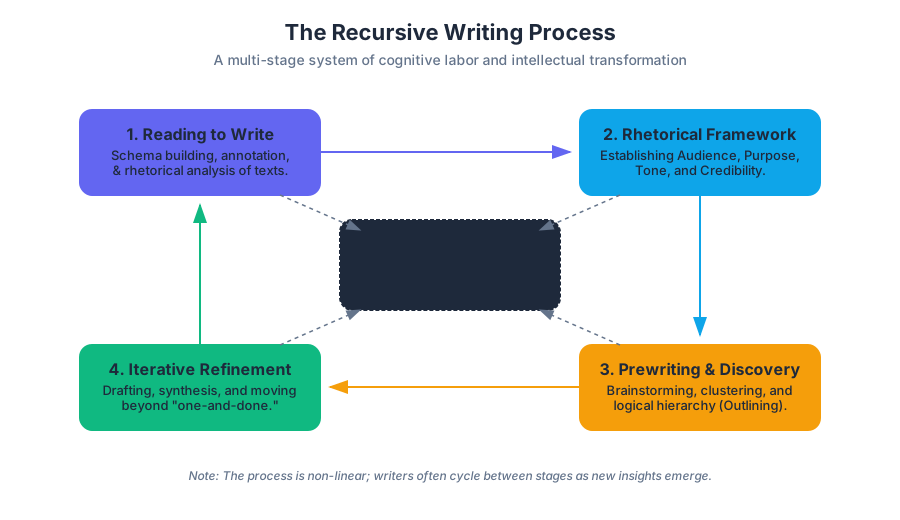
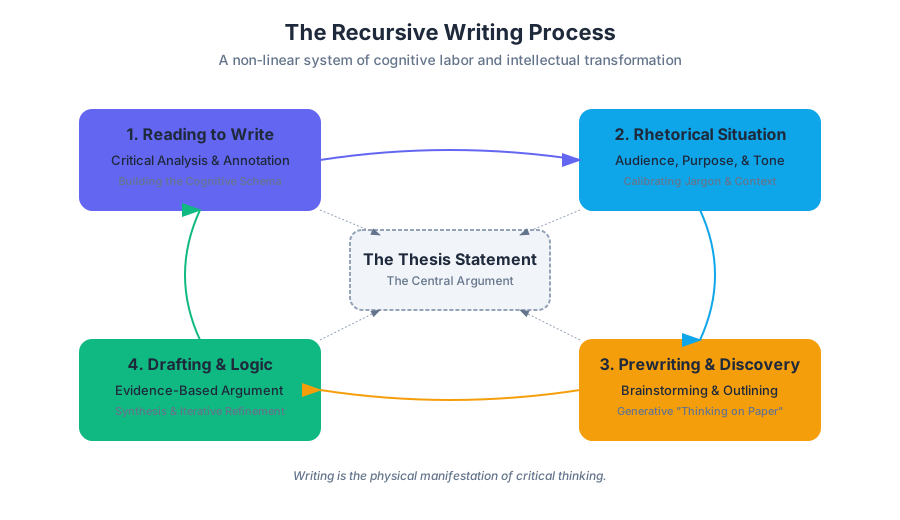
The writing process is not a linear progression from start to finish but a recursive, multi-stage system of cognitive labor. In an academic context, writing is the physical manifestation of critical thinking. It requires the integration of reading, analysis, synthesis, and iterative refinement. To master the writing process is to move away from the "one-and-done" mentality of high school assignments toward a sophisticated, professional workflow where the final product is the result of multiple layers of intellectual transformation.
The Foundation: Reading to Write
Expert writing begins long before a single word is typed into a document. It begins with Reading to Write—the practice of using critical reading tools to analyze the structure, rhetoric, and evidence of existing texts to inform one's own work. In the academic ecosystem, "text" is defined broadly.
Definition: Text In a scholarly context, a text is any object that conveys meaning and can be "read" or analyzed. This includes traditional media (books, journals, essays) and non-traditional media (films, paintings like Jacob Lawrence’s Migration Series, advertisements, or even source code).
Critical Reading and Annotation
To read critically is to move beyond mere information extraction. It involves identifying the Author's Purpose (the "why") versus the Main Point (the "what"). A reader must act as a "sleuth," looking for clues in the title, author credentials, and publication venue to build a mental Schema—a cognitive framework that allows the brain to organize new information efficiently.
| Strategy | Action | Objective |
|---|---|---|
| Pre-reading | Scanning titles, headings, and author bios. | Build initial schema and predict content. |
| Annotation | Marking margins with questions, definitions, and connections. | Active engagement; prevents "passive scanning." |
| Contextualization | Researching unfamiliar jargon or historical references immediately. | Ensure precision in comprehension. |
| Rhetorical Analysis | Identifying the target audience and the author's tone. | Understand how the text attempts to persuade. |
The Mechanics of Reading Analysis
When analyzing a text like De Souza’s critique of Jacob Lawrence, a writer must distinguish between Economic Determinism (the "push/pull" factors of the Great Migration) and the Collective Ambition of the subjects. This requires a high level of Information Literacy, or the ability to find, evaluate, and use information effectively.
The Rhetorical Framework
Before the first draft is written, the writer must establish the Rhetorical Situation. Writing is never done in a vacuum; it is a communication between a specific author and a specific audience for a specific reason.
Audience Awareness and Jargon
One of the most common pitfalls in college-level writing is the misuse of Jargon—specialized language used by a particular profession or group. While jargon can provide precision among experts, it creates a barrier for general audiences. Effective writers calibrate their language based on the "Audience Assumptions."
| Component | Description | Key Question |
|---|---|---|
| Purpose | The goal of the piece (to inform, persuade, or entertain). | What do I want the reader to do or think after reading? |
| Audience | The intended recipients of the message. | What does my reader already know? What are their biases? |
| Tone | The writer's attitude toward the subject. | Is the language formal, objective, or conversational? |
| Credibility | The evidence and logic used to support claims. | Why should the reader trust my perspective? |
Phase I: Prewriting and Discovery
Prewriting is the generative phase where the writer moves from "reading" to "thinking on paper." It is the most non-linear part of the process.
- Brainstorming/Clustering: Creating a visual map of ideas to see how concepts like "Push Factors" (crop failure) and "Pull Factors" (labor shortages) connect.
- Freewriting: Writing without stopping for a set period to bypass the "internal critic."
- Outlining: Establishing a logical hierarchy. A strong outline ensures that each paragraph serves the Thesis Statement—the central argument of the piece.
The Logic of Argumentation
Academic writing relies on Logical Reasoning. A writer must avoid logical fallacies and ensure that every claim is backed by Evidence. In the case of the Migration Series analysis, the evidence consists of both the visual elements of the paintings (colors, shapes) and the historical context of the 1940s.
% Mathematical representation of a Writing Argument (Logic)
% Let C = Claim, E = Evidence, W = Warrant (Connection)
% A valid argument A exists if:

A = \sum_{i=1}^{n} (C_i + E_i \cdot W_i) \implies T

% Where:
% T = Thesis Statement
% n = Number of supporting points
% W must validate that E actually supports C.
Phase II: Drafting and Iteration
The Drafting phase is about momentum. The goal is to translate the prewriting plan into a continuous narrative. Many students struggle with "Writer's Block" during this phase because they attempt to edit while they draft.
Key Insight: The Discovery Draft The first draft is often called a "Discovery Draft." Its primary purpose is to see if the ideas hold up when expanded into full paragraphs. It is expected to be "messy" and structurally incomplete.
Paragraph Construction
A formal academic paragraph should follow a standard architecture:
- Topic Sentence: The "mini-thesis" of the paragraph.
- Evidence/Quotes: Integrated source material.
- Analysis: The writer’s explanation of how the evidence supports the topic sentence.
- Transition: A bridge to the next concept.
Phase III: Revision and Global Refinement
There is a critical distinction between Revising and Editing. Most novice writers stop at editing (fixing typos), but professional-grade writing requires deep revision.
| Feature | Revision (Global) | Editing (Local) |
|---|---|---|
| Scope | Structural, logical, and conceptual. | Sentence-level, grammatical, and mechanical. |
| Actions | Moving paragraphs, deleting entire sections, changing the thesis. | Fixing commas, checking spelling, varying word choice. |
| Goal | Clarity of argument and flow of ideas. | Correctness and polish. |
| Timing | Should happen first. | Should happen last. |
Peer Review and Collaboration
Revision is often a collaborative process. Peer Review allows a writer to see their work through the eyes of the audience. It identifies "blind spots" where the writer assumed the reader had knowledge they did not actually possess.
Synthesis: Joining the Academic Conversation
Synthesis is the highest level of the writing process. It is the act of combining insights from multiple sources to create a new, original argument. It is not merely a summary of what others have said; it is a "conversation" where the writer acts as the moderator.
Source Integration and MLA 8th Edition
To maintain Academic Integrity and avoid Plagiarism, writers must use a standardized citation system. The MLA 8th Edition focuses on "Containers."
| Citation Component | Example |
|---|---|
| Author | De Souza, Michael. |
| Title of Source | "Economic Determinism in the Migration Series." |
| Title of Container | Journal of African American Studies. |
| Publisher | University of Oregon Press. |
| Location | pp. 45-60. |
When synthesizing, a writer might use a "Signal Phrase" to introduce a source: “While Akanegbu highlights the statistics of distance education, De Souza reminds us that the human element of ambition cannot be quantified.”
Overcoming Cognitive Friction
The writing process is physically and mentally taxing. Successful writers manage their environment and biological rhythms.
- Diurnal Cycles: Identifying whether one is more productive in the morning or evening.
- Distraction Management: Removing smartphones and digital notifications to enter a "Flow State."
- Stamina: Writing is a muscle. Building "Writing Stamina" involves consistent daily practice rather than "binge writing" before a deadline.
Common Pitfalls
- The "Thesaurus Syndrome": Using complex words incorrectly to sound "academic." This usually obscures meaning.
- Quote Dumping: Dropping a quote into a paragraph without explaining its relevance.
- Linear Rigidity: Refusing to change an outline even when the research suggests a better direction.
Source Materials
Study The Word on College Reading and Writing on Lykke
This course page is free to open: signed out, you can read its first two sections, and signing in, on any plan, opens the rest. The free Lykke Chrome extension syncs your own Canvas courses, so ChatGPT, Claude and Muse can answer from your classes and deadlines. It only reads Canvas.
Add the free extensionSign in to open every sectionAll sections of The Word on College Reading and Writing · Browse more course pages