From the free course The Word on College Reading and Writing on Lykke
Textual Structure and Form
Key concepts: Form and Function · Organizational Patterns · Textual Anomalies · Paragraph Structure
Examines how the organization and physical layout of a text contribute to its overall message.
Textual Structure and Form
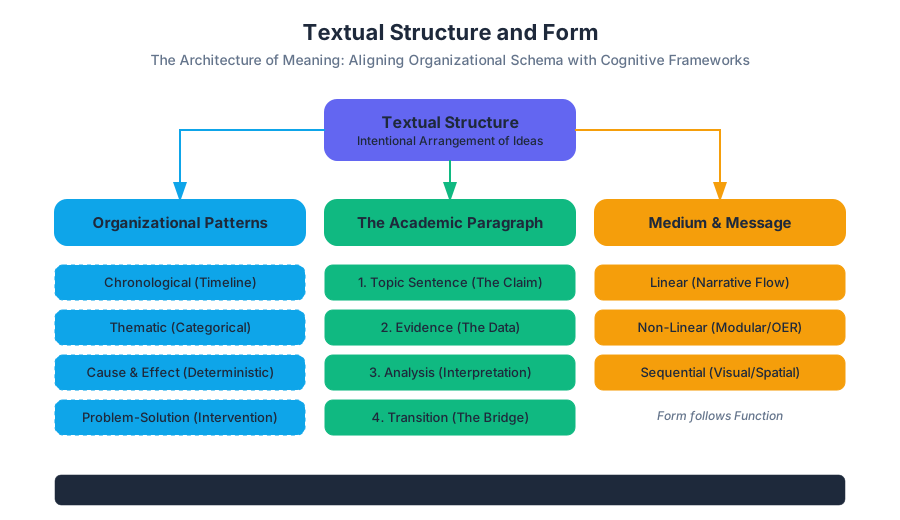
In the domain of academic literacy and information architecture, Textual Structure refers to the intentional arrangement of ideas, evidence, and transitions within a document to achieve a specific rhetorical objective. While "content" represents the raw data or message, "form" serves as the delivery mechanism that dictates how a reader processes that information. Understanding this relationship is not merely an exercise in labeling; it is a prerequisite for high-level critical reading and effective technical communication.
In an academic context, a text is defined broadly as any object that can be "read"—whether it is a traditional peer-reviewed journal article, a sequence of sixty paintings like Jacob Lawrence’s Migration Series, or a structured dataset. The structure of these texts is rarely accidental. It is a response to the constraints of the medium, the expectations of the audience, and the complexity of the subject matter.
Form and Function: The Architecture of Meaning
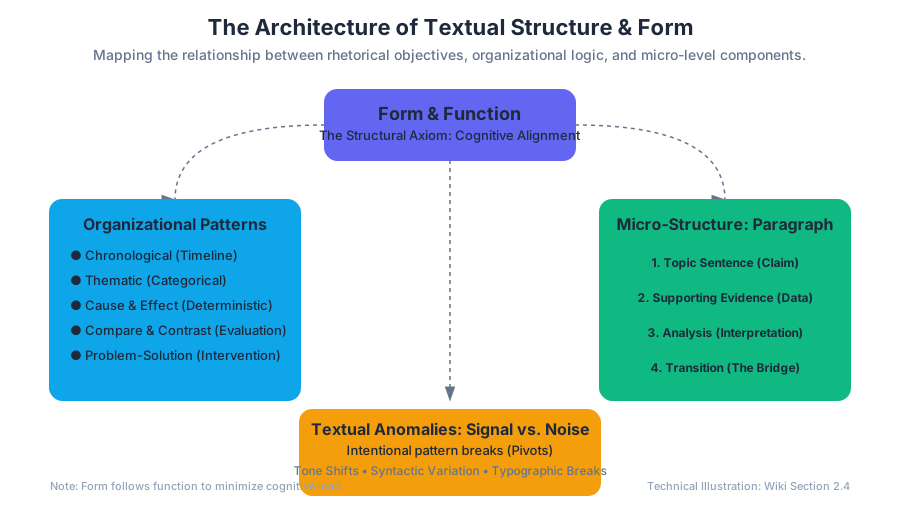
The principle of Form and Function posits that the physical or logical layout of a text should directly support its communicative purpose. In technical writing, form follows function to minimize cognitive load. In creative or rhetorical writing, form may be manipulated to create emphasis, tension, or a specific emotional resonance.
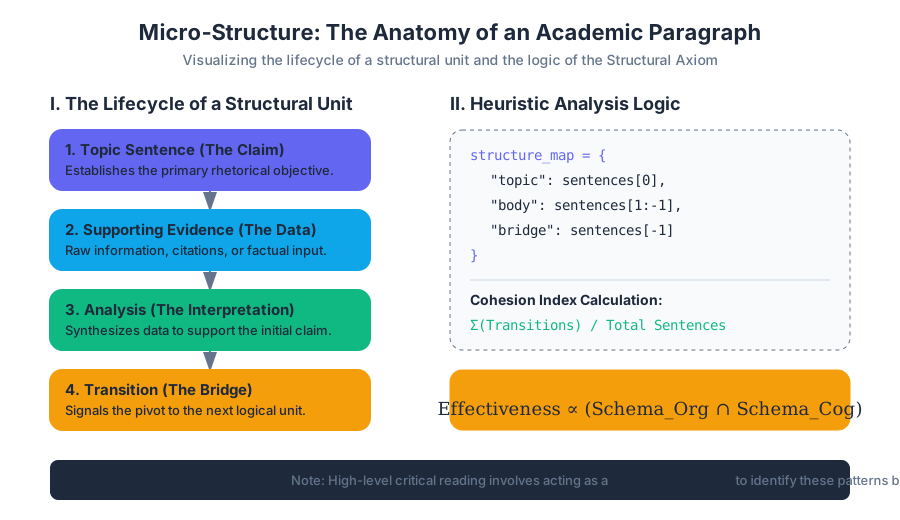
The Structural Axiom: The effectiveness of a text is proportional to the alignment between its organizational schema and the reader's cognitive "schema"—the mental framework used to organize and interpret information.
The Interplay of Medium and Message
Different media require different structural strategies. A non-linear reference tool, such as The Word on College Reading and Writing, is structured as an Open Educational Resource (OER), allowing users to jump between sections like "The Writing Process" and "Information Literacy" without losing context. This contrasts with a narrative essay, which relies on a linear progression to build an argument.
| Feature | Traditional Linear Text | Non-Linear/OER Text | Visual/Sequential Text (e.g., Lawrence) |
|---|---|---|---|
| Primary Goal | Argumentative Persuasion | Just-in-time Reference | Narrative Synthesis |
| Navigation | Sequential (Start to Finish) | Hyperlinked/Topical | Visual Flow/Captions |
| Structural Unit | The Paragraph | The Module/Section | The Panel/Image |
| Constraint | Logical Flow | Modular Independence | Spatial Continuity |
Organizational Patterns: The Logic of Arrangement
Writers employ specific Organizational Patterns to signal the relationship between ideas. Identifying these patterns during the "pre-reading" phase—a process where the reader acts as a "sleuth" to gather visual clues—allows for more efficient information extraction.
Common Structural Schemas
- Chronological: Arranging information according to a timeline. Essential for histories or process documentation.
- Thematic/Topical: Grouping ideas by category. Common in literature reviews and encyclopedic entries.
- Cause and Effect: Establishing a deterministic relationship between events.
- Compare and Contrast: Highlighting similarities and differences to evaluate two or more entities.
- Problem-Solution: Identifying a challenge and proposing a technical or social intervention.
Paragraph Density and Structure
At the micro-level, the Academic Paragraph serves as the fundamental building block of structure. A robust paragraph typically follows a predictable lifecycle: the Topic Sentence (the claim), Supporting Evidence (the data), Analysis (the interpretation), and the Transition (the bridge to the next concept).
Textual Anomalies: Signal vs. Noise
A Textual Anomaly occurs when a writer intentionally breaks an established pattern. In the same way that a sudden silence in a musical piece draws attention, a structural break in a text signals a "pivot" or a point of maximum importance.
- Flashbacks/Flash-forwards: Disrupting chronological flow to provide necessary context or foreshadowing.
- Tone Shifts: Moving from objective jargon to personal anecdote to build pathos.
- Visual Interruptions: The use of pull-outs, bolded terms, or "Migration Colors" in a series to highlight a specific theme (e.g., the collective ambition in Lawrence's work).
| Anomaly Type | Description | Rhetorical Effect |
|---|---|---|
| Syntactic Variation | Shifting from long, complex sentences to short, punchy ones. | Increases urgency or emphasizes a core truth. |
| Typographic Break | Use of italics, bolding, or non-standard fonts. | Signals a definition or a shift in the "layer of meaning." |
| Structural Deviation | A sudden list in the middle of a narrative essay. | Facilitates rapid information scanning and highlights key data. |
Rhetoric and Audience Awareness
Structure is inextricably linked to Rhetoric—the art of persuasive communication. A writer’s choice of structure is dictated by their Audience Awareness. For instance, a text written for experts may use dense Jargon and a complex, non-linear structure, assuming the reader has the necessary Schema to navigate it. Conversely, a text for a general audience must use "Plain Language" and a highly guided, linear structure.
The Rhetorical Triangle in Structure
- Author’s Purpose: Is the goal to explain, describe, or persuade?
- Main Point vs. Evidence: The structure must ensure the main point is prominent, often placed in the "Introduction" or "Conclusion" (the serial position effect).
- Tone and Language: The "feel" of the text, established through word choice and structural rhythm.
\text{Structural Effectiveness} (E) = \frac{\sum (\text{Evidence} \times \text{Relevance})}{\text{Cognitive Load} (L)}
Where $L$ is a function of jargon density and structural complexity. As $L$ increases, $E$ decreases unless the reader's prior knowledge (Schema) compensates for the complexity.
Information Literacy: Metadata and Citations
In the modern academic landscape, the structure of a text extends beyond its prose to its Metadata—the citations and references that anchor it in a broader conversation. The MLA 8th Edition provides a "container-based" structure for these citations, emphasizing that the source of the information is as much a part of its structure as the content itself.
MLA 8th Edition: The Container System
Unlike previous editions that had rigid rules for every media type, MLA 8 uses a universal set of "Core Elements."
| Order | Element | Example |
|---|---|---|
| 1 | Author | Akanegbu, Anuli. |
| 2 | Title of Source | "50 Striking Statistics..." |
| 3 | Title of Container | EDTech |
| 4 | Other Contributors | (Translators, Editors) |
| 5 | Version | (Edition) |
| 6 | Number | vol. 2, no. 1 |
| 7 | Publisher | CDW |
| 8 | Publication Date | 12 July 2012 |
| 9 | Location | www.edtechmagazine.com/... |
Critical Reading: The Sleuth’s Methodology
To master textual structure, one must adopt the habits of a "sleuth." This involves Pre-reading and Active Engagement.
The Pre-reading Workflow
- Analyze the Title: What does it promise?
- Check Author Credentials: What is the "Ethos" or credibility?
- Skim Headings and Pull-outs: These are the "signposts" of the organizational pattern.
- Examine Visual Aids: Captions and images often summarize complex data (e.g., the "Migration Series" captions provide the narrative glue for the paintings).
- Scan Topic Sentences: This provides a "skeleton" of the argument before the meat is added.
Managing Distractions and Stamina
Reading complex structures requires Stamina. Academic texts are "dense"—every word is chosen for precision. Developing a routine, identifying one's Diurnal Cycle (optimal time of day), and creating a distraction-free environment are structural requirements for the reader, just as the topic sentence is for the writer.
Common Pitfalls in Analyzing Structure
- Confusing Topic with Purpose: The topic is what the text is about (e.g., The Great Migration); the purpose is what the author wants to achieve (e.g., to argue that economic determinism was a primary driver).
- Ignoring the "Link" in Paragraphs: Many writers provide evidence but fail to "link" it back to the main claim, leaving the reader to do the heavy lifting.
- Over-reliance on Jargon: Using specialized language can obscure the structure for non-experts, leading to a "breakdown in communication."
- Linear Reading of Non-linear Texts: Attempting to read an OER or a reference book from cover to cover often leads to burnout and poor retention.
Case Study: Jacob Lawrence's Migration Series
The Migration Series serves as a masterclass in Visual Structure.
- Form: 60 panels with accompanying captions.
- Function: To portray the mass movement of African Americans from the rural South to the urban North.
- Structural Choice: By using a sequence, Lawrence creates a sense of "Collective Ambition." The repetition of colors and themes across panels acts as a structural "thread" that binds disparate geographic experiences into a single narrative arc.
Conclusion: The Synthesis of Form
Textual structure is not a static container but a dynamic system. Whether it is the "sleuth-like" pre-reading of an OER or the rhythmic analysis of a 60-panel art series, understanding how a text is built is the key to unlocking what it means. By recognizing organizational patterns, identifying textual anomalies, and respecting the relationship between form and function, readers and writers can navigate the increasingly complex landscape of college-level literacy with precision and clarity.
Source Materials
- The Word on College Reading and Writing
- The Word on College Reading and Writing
- The Word on College Reading and Writing
- The Word on College Reading and Writing
- The Word on College Reading and Writing
- The Word on College Reading and Writing
- The Word on College Reading and Writing
- The Word on College Reading and Writing
Study The Word on College Reading and Writing on Lykke
This course page is free to open: signed out, you can read its first two sections, and signing in, on any plan, opens the rest. The free Lykke Chrome extension syncs your own Canvas courses, so ChatGPT, Claude and Muse can answer from your classes and deadlines. It only reads Canvas.
Add the free extensionSign in to open every sectionAll sections of The Word on College Reading and Writing · Browse more course pages