From the free course The Word on College Reading and Writing on Lykke
Summarizing and Critiquing
Key concepts: Summarizing · Objective Writing · Critiquing · Cultural Context · Evaluation
Teaches the difference between objective summary, analysis, and constructive critique.
Summarizing and Critiquing: The Architecture of Academic Engagement
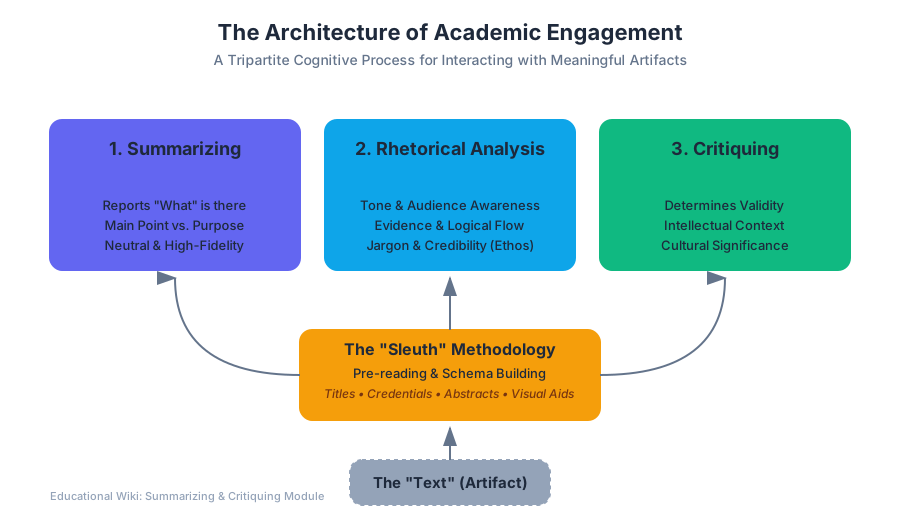
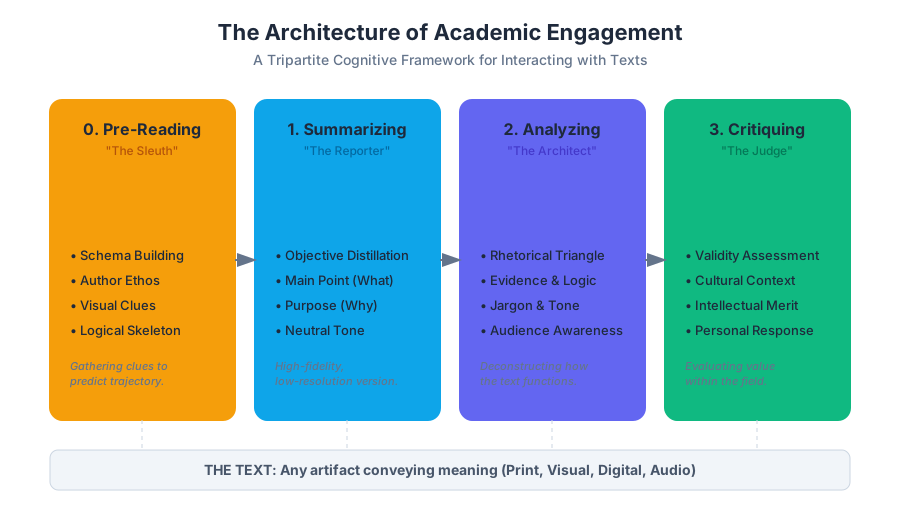
In the landscape of higher education, the ability to interact with a text—defined broadly as any artifact conveying meaning—is the fundamental currency of scholarship. This interaction is not a monolithic act but a tripartite process consisting of Summarizing, Analyzing, and Critiquing. While a novice reader might conflate these, the expert practitioner recognizes them as distinct cognitive layers: reporting what is there, explaining how it functions, and evaluating its validity within a broader cultural and intellectual context.
The Foundational Layer: Defining the "Text"
In an academic environment, a text is any object that can be "read" for meaning. This extends beyond the traditional printed page to include visual art, films, musical compositions, and digital media. The process of engagement begins with Schema Building, a cognitive heuristic where the reader uses pre-reading strategies to create a mental framework before deep-diving into the content.
Pre-reading and the "Sleuth" Methodology
Effective reading is non-linear. Before consuming a text from start to finish, a scholar acts as a "sleuth," gathering visual and structural clues to predict the author's trajectory. This involves analyzing titles, author credentials, headings, and topic sentences.
| Element | Analytical Purpose | Schema Contribution |
|---|---|---|
| Author Credentials | Establishes Ethos and potential bias. |
Determines the level of specialized jargon to expect. |
| Abstract/Introduction | Identifies the Thesis or central claim. |
Provides the "map" for the subsequent data. |
| Visual Aids/Captions | Highlights data peaks or emotional anchors. | Connects abstract concepts to concrete representations. |
| Topic Sentences | Reveals the logical skeleton of the argument. | Allows for rapid skimming to locate specific evidence. |
1. Objective Summarizing: The Art of Condensation
Summarizing is the process of distilling a text to its essential components while maintaining strict objectivity. A successful summary does not "talk back" to the author; it functions as a high-fidelity, low-resolution version of the original work.
The Mechanics of the Summary
To summarize effectively, one must distinguish between the Main Point (the "what") and the Author’s Purpose (the "why").
- Main Point: The primary assertion or finding.
- Author’s Purpose: The rhetorical intent—to persuade, to inform, to entertain, or to provoke action.
Definition: Objective Summary A neutral restatement of a source's central ideas and major supporting details, stripped of the reader's personal opinion, bias, or external critique.
2. Rhetorical Analysis: Deconstructing the "How"
While a summary reports what was said, Analysis explains how the author attempted to achieve their goal. This requires an understanding of Rhetoric—the art of persuasive communication.
The Rhetorical Triangle and Jargon
Analysis involves interrogating the author's Audience Awareness. An author writing for a peer-reviewed journal will use specialized jargon—technical language specific to a field—to establish credibility and precision. However, if that same author uses jargon for a general audience, it may function as a barrier to entry, potentially indicating a lack of audience awareness or an attempt to obscure weak reasoning with "big words."
| Analytical Lens | Key Question | Indicator |
|---|---|---|
| Tone | What is the author's attitude? | Word choice (connotative vs. denotative). |
| Evidence | How is the claim supported? | Use of statistics, anecdotes, or expert testimony. |
| Logic | Does the conclusion follow the premises? | Presence of logical fallacies or sound syllogisms. |
| Credibility | Why should we trust this source? | Citations, publisher reputation, and author history. |
Mathematical Representation of Rhetorical Velocity
We can conceptualize the "persuasiveness" of a text ($P$) as a function of the strength of its evidence ($E$), the alignment with audience values ($A$), and the clarity of its delivery ($C$).
P \approx \int_{t_0}^{t_f} (E \cdot A \cdot C) \, dt
Where $t$ represents the progression of the text from introduction to conclusion.
3. Critiquing: The Evaluative Layer
Critiquing is the most advanced form of engagement. It is a constructive evaluation that asks: Is this right? Is it complete? What are the underlying assumptions? A critique does not necessarily mean "finding fault"; it means judging the merits and limitations of the work.
Case Study: Economic Determinism in Jacob Lawrence’s Migration Series
Consider an analysis of Jacob Lawrence’s sixty-panel artwork. A summary would state that the series depicts the mass movement of African Americans from the rural South to the urban North. An analysis would focus on Lawrence’s use of "Migration Colors" (vibrant, primary tones) and recurring motifs to create a sense of collective rhythm.
A critique, however, would engage with the concept of Economic Determinism—the theory that social phenomena are determined by economic factors.
- Push Factors: Crop failures, Jim Crow laws, lack of opportunity.
- Pull Factors: Labor shortages in Northern factories, the promise of higher wages.
The critic might argue that while Lawrence acknowledges these deterministic forces, his work ultimately emphasizes Collective Ambition and human agency, suggesting that the migrants were not merely "pushed" like chess pieces but were active participants in their own liberation.
Evaluating Evidence and Credibility
A critique must rigorously examine the Evidence. In the age of Information Literacy, checking the "Works Cited" page is a primary critical act.
| Evidence Type | Strength | Weakness |
|---|---|---|
| Statistical Data | High (if sample size is large). | Can be manipulated or lack context. |
| Anecdotal Evidence | High emotional impact. | Low generalizability; "the plural of anecdote is not data." |
| Peer-Reviewed Research | Gold standard for reliability. | Can be slow to update; paywalls limit access. |
4. Information Literacy and Source Attribution
To critique effectively, one must understand the provenance of information. Modern scholarship relies on standardized citation formats, such as MLA 8th Edition, to ensure transparency and prevent plagiarism.
The MLA 8th Edition Framework
The 8th edition moved away from static rules for every media type and toward a universal set of Core Elements. This "Container" system allows for the citation of anything from a YouTube video to a traditional book.
5. Common Pitfalls in Summarizing and Critiquing
Even experienced writers fall into traps when moving between these three modes.
- The "Opinion Creep" in Summaries: Including phrases like "The author wrongly suggests..." in a summary. This violates the principle of objectivity.
- Parroting vs. Interrogating: Summarizing a source and then moving on without analyzing how the argument was built or critiquing its validity.
- Jargon Overload: Using the source's specialized language in your own critique without defining it, which obscures your own analytical voice.
- Ignoring Cultural Context: Critiquing a historical text (like a 1942 "We Can Do It" poster) using 21st-century norms without acknowledging the original rhetorical situation.
Synthesis: The Writing Process
Engagement with texts is not a one-off event but a recursive process.
- Prewriting: Creating the schema and "sleuthing" the text.
- Drafting: Generating the summary and initial analysis.
- Revising: Strengthening the critique, checking for logical fallacies, and ensuring proper source integration.
By mastering the triad of Summarizing, Analyzing, and Critiquing, the scholar moves from being a passive consumer of information to an active contributor to the academic conversation.
- Text: Any artifact (written, visual, auditory) that conveys meaning and can be analyzed.
- Rhetoric: The art of using language effectively and persuasively.
- Jargon: Specialized language used by a particular profession or group; can be a barrier to general audiences.
- Economic Determinism: The theory that social and political structures are determined by economic conditions.
- Schema: A mental framework or "map" used to organize and interpret new information.
- MLA 8th Edition: A citation style that uses a "container" system to provide a flexible framework for all source types.
- Push/Pull Factors: Economic or social forces that drive migration (Push = negative local conditions; Pull = positive distant conditions).
- Question: What is the primary difference between a summary and a critique?
- Answer: A summary is an objective report of the text's main ideas, while a critique is an evaluative judgment of the text's reasoning and evidence.
- Question: Why is "pre-reading" considered a non-linear strategy?
- Answer: Because it involves skipping ahead to headings, topic sentences, and visual aids to build a schema before reading the text sequentially.
- Question: In the context of Jacob Lawrence's Migration Series, what would be considered a "Pull Factor"?
- Answer: Labor shortages in Northern factories that promised higher wages and better opportunities.
- Question: How does the MLA 8th Edition "Container" system differ from previous versions?
- Answer: It uses a universal set of core elements rather than specific rules for every individual media type.
- Question: What is the risk of using excessive jargon when writing for a general audience?
- Answer: It can alienate the reader, obscure the main point, and suggest a lack of audience awareness.
Study Guide: Summarizing and Critiquing
I. Core Definitions
- Summarizing: Condensing the "What" and "Why" (Main Point and Purpose) into a neutral, objective brief.
- Analyzing: Deconstructing the "How" (Rhetoric, Tone, Evidence, Jargon).
- Critiquing: Evaluating the "So What?" (Validity, Assumptions, Cultural Context).
II. The Reading Process
- Environment: Identify your diurnal cycle (best time of day) and minimize distractions.
- Sleuthing: Analyze titles, credentials, and structural markers (headings).
- Active Engagement: Annotate, look up unfamiliar words immediately, and identify the thesis.
III. Rhetorical Analysis Checklist
- Audience: Who is the intended reader?
- Ethos: Is the author credible?
- Logos: Is the reasoning sound?
- Pathos: Does the author use emotional appeals?
- Jargon: Is the technical language appropriate for the audience?
IV. Evaluation Criteria for Critique
- Relevance: Is the evidence current and applicable?
- Sufficiency: Is there enough evidence to support the claim?
- Bias: Does the author acknowledge counter-arguments or alternative perspectives?
- Context: How does the cultural or historical setting influence the message?
V. Citation Essentials (MLA 8)
- Core Elements: Author, Title of Source, Title of Container, Other Contributors, Version, Number, Publisher, Publication Date, Location.
- Goal: Provide a clear path for the reader to locate the original source.
Source Materials
- The Word on College Reading and Writing
- The Word on College Reading and Writing
- The Word on College Reading and Writing
- The Word on College Reading and Writing
- The Word on College Reading and Writing
- The Word on College Reading and Writing
- The Word on College Reading and Writing
- The Word on College Reading and Writing
Study The Word on College Reading and Writing on Lykke
This course page is free to open: signed out, you can read its first two sections, and signing in, on any plan, opens the rest. The free Lykke Chrome extension syncs your own Canvas courses, so ChatGPT, Claude and Muse can answer from your classes and deadlines. It only reads Canvas.
Add the free extensionSign in to open every sectionAll sections of The Word on College Reading and Writing · Browse more course pages