From the free course The Word on College Reading and Writing on Lykke
Style and Voice
Key concepts: Sentence length variation · Point of View (PoV) · Language Complexity · Dialect · Rhythm
Focuses on the 'sound' of writing, including sentence variety, point of view, and language complexity.
Style and Voice
The Architecture of Expression: An Overview
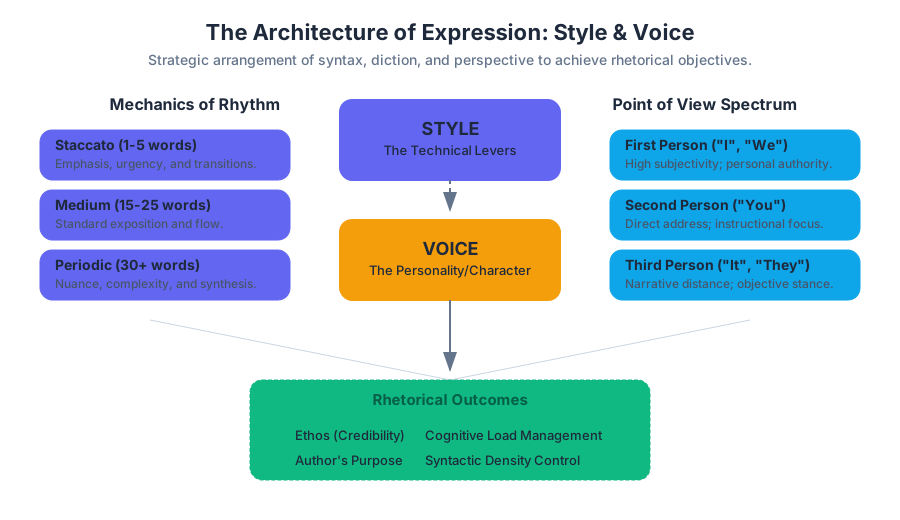
In the realm of academic and professional communication, Style is frequently misunderstood as mere "decoration" or "flair." In reality, style is the functional architecture of a text—the strategic arrangement of syntax, diction, and rhythm to achieve a specific rhetorical objective. While Voice represents the "personality" or "character" of the writing, style is the set of technical levers a writer pulls to project that voice.
As explored in The Word on College Reading and Writing, style is not an afterthought; it is the primary mechanism through which a writer establishes credibility (ethos), manages the reader’s cognitive load, and ensures that the author’s purpose is realized. Whether one is analyzing the economic determinism in Jacob Lawrence’s Migration Series or documenting a complex API, the stylistic choices—from sentence length to the use of gender-neutral pronouns—determine the text's accessibility and impact.
Sentence Length and Structural Rhythm
The variation of sentence length is the "breath" of a text. It controls the rhythm (the pattern of sounds and pauses) and the pacing (the speed at which the reader consumes information).
The Mechanics of Variation
- Short Sentences: These provide clarity, emphasis, and tension. They are often used for "punchy" declarations or to summarize a complex point.
- Long Sentences: These allow for nuance, description, and the connection of multiple ideas. They are essential for showing relationships between concepts, such as cause and effect.
- The Rhythmic Shift: A sudden short sentence after several long ones creates a "rhetorical stop," forcing the reader to pay attention to the concluding thought.
Definition: Syntactic Density The ratio of information-carrying words to the total number of sentences. High syntactic density often requires longer, more complex sentence structures to maintain logical flow.
| Sentence Type | Primary Function | Cognitive Load | Typical Use Case |
|---|---|---|---|
| Staccato (1-5 words) | Emphasis, urgency, or transition. | Low | Summarizing a major finding. |
| Telegraphic (5-10 words) | Clarity and directness. | Low-Medium | Defining a core term. |
| Medium (15-25 words) | Standard exposition. | Medium | Explaining a process or mechanism. |
| Periodic (30+ words) | Nuance, complexity, and buildup. | High | Synthesizing multiple sources or evidence. |
Point of View (PoV) and Narrative Distance
Point of View is the perspective from which a text is written. In college-level writing, the choice of PoV is a strategic decision based on the audience and the rhetorical situation.
The PoV Spectrum
- First Person ("I", "We"): Establishes a personal connection or "eyewitness" authority. Common in reflective essays, memoirs, or collaborative research (e.g., "We found that...").
- Second Person ("You"): Directly addresses the reader. Primarily used in instructional materials, like The Word on College Reading and Writing, to guide the student through exercises.
- Third Person ("He", "She", "They", "It"): The standard for academic and objective writing. It creates narrative distance, suggesting that the information is being presented by a neutral observer rather than a biased participant.
| Point of View | Subjectivity Level | Common Contexts | Pitfalls |
|---|---|---|---|
| First Person Singular | High | Personal narratives, opinion pieces. | Can seem unprofessional in hard sciences. |
| First Person Plural | Medium | Scientific papers, collaborative reports. | "The Royal We" can feel pretentious. |
| Second Person | High | Tutorials, OER textbooks, speeches. | Can feel accusatory or overly informal. |
| Third Person Objective | Low | Research papers, news, documentation. | Can feel dry, "robotic," or detached. |
Mathematical Representation of Narrative Distance
We can conceptualize narrative distance ($D_n$) as a function of the frequency of personal pronouns ($P$) and the use of evaluative adjectives ($A$) relative to the total word count ($W$):
D_n = 1 - \left( \frac{\sum P + \sum A}{W} \right)
Where a higher $D_n$ indicates a more objective, "distant" style typical of formal academic discourse.
Language Complexity and the Jargon Threshold
Language Complexity refers to the sophistication of vocabulary and the density of specialized terminology, often called jargon. While jargon is necessary for precision within a specific field (e.g., "economic determinism" in art history), it can become a barrier to understanding when writing for a general audience.
The "Curse of Knowledge"
Writers often suffer from the "curse of knowledge"—the inability to remember what it was like not to know a specific concept. Effective style involves audience awareness, where the writer calibrates their language complexity to the reader's expected knowledge base.
Balancing Precision and Accessibility
- Define Terms: If a technical term is necessary, define it immediately (e.g., "Rhetoric is the art of persuasive communication").
- Use Plain Language: Replace "utilize" with "use" or "subsequent to" with "after" unless the complex version adds specific value.
- Inclusive Language: Modern style guides, including OER (Open Educational Resources) like The Word, emphasize gender-neutral language (using "they/them" as a singular pronoun) to ensure the text is inclusive of all readers.
| Complexity Level | Vocabulary Type | Sentence Structure | Target Audience |
|---|---|---|---|
| Foundational | Common usage, no jargon. | Simple/Compound. | General public, K-12. |
| Intermediate | Defined technical terms. | Varied. | Undergraduates, non-specialists. |
| Expert | High-density jargon. | Complex/Subordinated. | Peer reviewers, senior engineers. |
Dialect, Punctuation, and Identity
Style is also a vehicle for Identity. Dialect—the regional or social variety of a language—can be used in narrative writing to ground a story in a specific place or culture. In the analysis of Jacob Lawrence’s Migration Series, the "voice" of the paintings is often described through the lens of Naturalism vs. Modernism. While these are visual styles, they mirror linguistic styles:
- Naturalism: Direct, "unfiltered" representation (similar to plain, objective prose).
- Modernism: Abstract, rhythmic, and symbolic (similar to poetic or highly stylized prose).
The Role of Punctuation in Voice
Punctuation is the "notation" of writing. It tells the reader when to pause, when to stop, and how to inflection.
- The Semicolon: Connects two independent but related thoughts; suggests a sophisticated, "academic" voice.
- The Dash: Creates a sharp break or adds an emphatic afterthought; suggests a more dynamic, conversational voice.
Rhetorical Voice and Persuasion
As defined in the source materials, Rhetoric is the art of persuasive communication. Style is the primary tool of rhetoric. A writer's "voice" is often a blend of three classical appeals:
- Ethos (Credibility): Established through precise language, correct MLA/APA citations, and a professional tone.
- Pathos (Emotion): Established through vivid imagery, rhythmic sentence variation, and evocative word choice.
- Logos (Logic): Established through clear organizational structures, evidence-based claims, and "if-then" syntactic patterns.
Comparing Persuasive Styles
| Style Approach | Focus | Key Stylistic Markers | Effect on Reader |
|---|---|---|---|
| Authoritative | Ethos | Formal diction, passive voice (sometimes), complex syntax. | Trust in the author's expertise. |
| Empathetic | Pathos | First/Second person, sensory details, varied rhythm. | Emotional resonance/connection. |
| Analytical | Logos | Third person, data-heavy, "plain" language, clear transitions. | Intellectual conviction. |
Modern Stylistic Standards: Inclusivity and OER
The shift toward Open Educational Resources (OER) has fundamentally changed stylistic expectations in academia. Because OER materials are designed to be accessible to a global, diverse audience, the "voice" of these texts (like The Word on College Reading and Writing) tends to be:
- Collaborative: Often written by multiple authors, leading to a "polyvocal" but unified style.
- Inclusive: Aggressively uses gender-neutral pronouns and avoids culturally specific idioms that might alienate non-native speakers.
- Non-Linear: Designed as a reference tool where style must remain consistent across disparate modules so the reader can jump in anywhere.
Common Pitfalls in Style and Voice
Even senior writers fall into stylistic traps. Recognizing these is the first step toward a "polished" voice.
- The "Thesaurus Syndrome": Using overly complex words where a simple one would suffice. This often obscures meaning rather than enhancing it.
- Passive Voice Overuse: While common in science ("The solution was heated"), excessive passive voice makes writing feel sluggish and hides the "actor" of the sentence.
- Tone Inconsistency: Shifting from a formal, academic tone to a casual, "slangy" tone within the same paragraph.
- Ignoring the "Container": In MLA 8th edition style, the "container" (the larger work a source is found in) dictates the citation style. Similarly, the "container" of your writing (blog vs. thesis) should dictate your style.
Key Insight: The Goal of Style Style is successful when it becomes "transparent"—meaning the reader is so engaged with the ideas that they don't notice the mechanics of the writing, yet those mechanics are what make the engagement possible.
Source Materials
Study The Word on College Reading and Writing on Lykke
This course page is free to open: signed out, you can read its first two sections, and signing in, on any plan, opens the rest. The free Lykke Chrome extension syncs your own Canvas courses, so ChatGPT, Claude and Muse can answer from your classes and deadlines. It only reads Canvas.
Add the free extensionSign in to open every sectionAll sections of The Word on College Reading and Writing · Browse more course pages