From the free course The Word on College Reading and Writing on Lykke
Rhetorical Analysis
Key concepts: Rhetoric · Author's Purpose · Tone and Bias · Evidence and Credibility · Jargon
Introduces rhetoric as the art of persuasion and provides tools for analyzing an author's purpose and tone.
Rhetorical Analysis
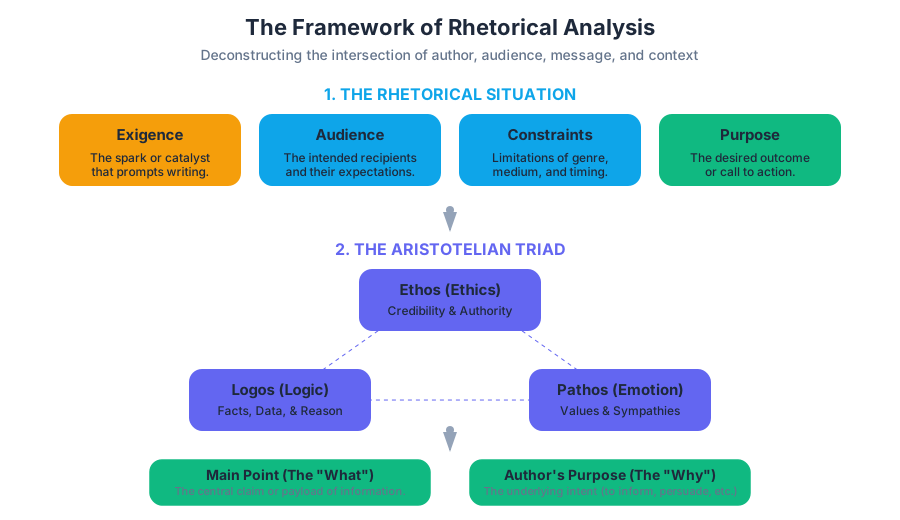
Rhetorical analysis is the systematic study of how writers and speakers use language to influence an audience. Rather than focusing solely on what a text says (its content), rhetorical analysis investigates how a text works (its delivery, structure, and persuasive strategies). In an academic context, rhetoric is not a pejorative term for "empty speech," but rather a sophisticated toolkit for navigating the "Rhetorical Situation"—the complex intersection of author, audience, message, and context.
The Foundations of Rhetorical Theory
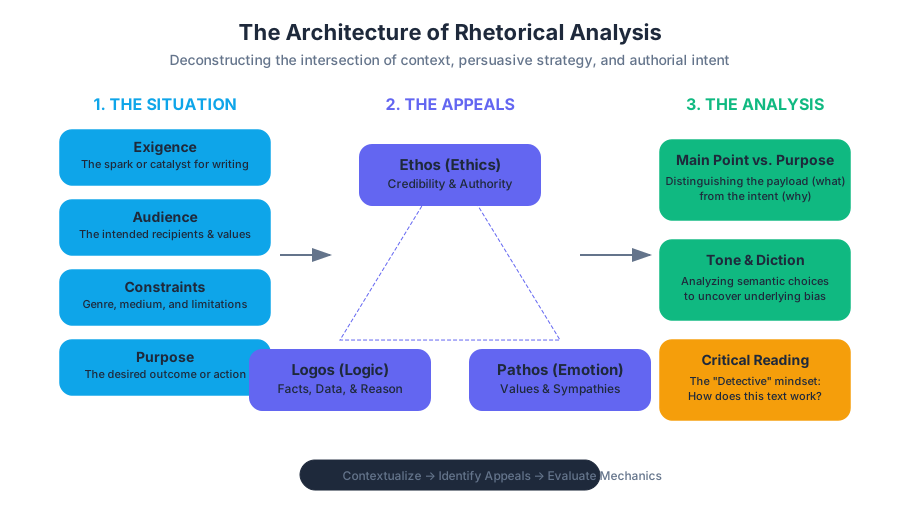
At its core, rhetoric is the art of effective or persuasive communication. To analyze a text rhetorically is to deconstruct the choices an author makes to achieve a specific effect. This process requires moving beyond "linear reading" (reading for plot or basic information) and engaging in "critical reading," where the reader acts as a detective looking for the mechanics of persuasion.
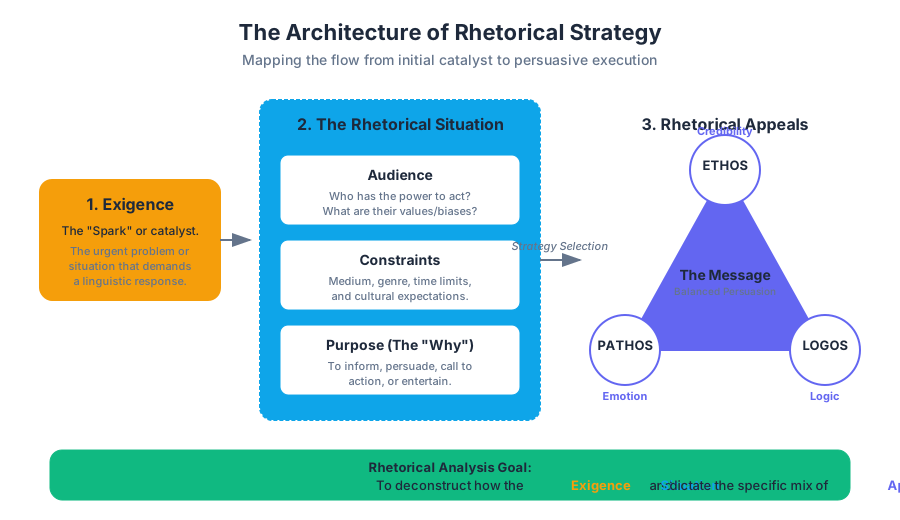
Definition: The Rhetorical Situation The Rhetorical Situation consists of the Exigence (the spark or catalyst that prompts the writing), the Audience (the intended recipients of the message), the Constraints (the limitations or expectations of the medium/genre), and the Purpose (the desired outcome).
The Rhetorical Triangle
Persuasion is traditionally categorized into three primary modes of appeal, often referred to as the Aristotelian Triad. A balanced rhetorical strategy often leverages all three, though the weight of each depends on the audience and purpose.
| Appeal | Technical Term | Focus | Mechanism |
|---|---|---|---|
| Logic | Logos |
The Message | Facts, statistics, syllogisms, and rational reasoning. |
| Ethics | Ethos |
The Author | Credibility, authority, and the moral character of the speaker. |
| Emotion | Pathos |
The Audience | Values, beliefs, sympathies, and emotional triggers. |
Author's Purpose vs. Main Point
A common pitfall in rhetorical analysis is conflating the Main Point with the Author's Purpose. While they are intrinsically linked, they serve different functions within the text's architecture.
- Main Point (The "What"): The central claim, thesis, or primary information the author wants the reader to understand. It is the "payload" of the communication.
- Author's Purpose (The "Why"): The underlying intent behind the communication. Does the author want to inform, persuade, entertain, satirize, or call to action?
Distinguishing Content from Intent
To identify the purpose, one must look at the "action verbs" of the text. If a text provides a series of instructions on how to set up a server, the main point is the configuration steps, but the purpose is to instruct or enable. If a text argues that the Great Migration was driven by economic determinism, the main point is the historical causality, but the purpose may be to reframe a historical narrative or challenge existing scholarship.
Tone, Bias, and Semantic Choice
Tone refers to the author's attitude toward the subject matter or the audience. It is conveyed through Diction (word choice), Syntax (sentence structure), and Imagery. In rhetorical analysis, identifying tone is essential for uncovering Bias—the inclination toward a particular perspective that may inhibit neutral judgment.
Analyzing Tone via Sentiment and Diction
Authors select words not just for their denotation (literal meaning) but for their connotation (emotional associations). Consider the difference between describing a policy as "flexible" versus "inconsistent." Both might describe the same set of facts, but the rhetorical effect is polar opposite.
To analyze tone programmatically, one might look at the frequency of "loaded" terms.
Evidence and Credibility (Ethos and Logos)
A text’s persuasiveness relies heavily on the quality of its Evidence. Rhetorical analysis evaluates evidence not just for its truth value, but for its relevance and sufficiency.
Types of Evidence and Their Rhetorical Functions
Different genres of writing demand different types of evidence. A peer-reviewed scientific paper relies on empirical data, while a personal essay may rely on anecdote.
| Evidence Type | Rhetorical Strength | Common Pitfalls |
|---|---|---|
| Statistical Data | High (Logos); provides a sense of objective scale. | Can be manipulated via "cherry-picking" or lack of context. |
| Expert Testimony | High (Ethos); leverages existing authority. | "Appeal to Authority" fallacy if the expert is outside their field. |
| Anecdotal Evidence | High (Pathos); makes abstract issues relatable. | Not statistically representative; can lead to overgeneralization. |
| Historical Precedent | Moderate; provides context and "lessons learned." | False analogies; assuming the past perfectly predicts the future. |
The Logic of Persuasion
In formal rhetorical analysis, we often look for the underlying logical structure. This can be represented as a Syllogism or an Enthymeme (a syllogism with an unstated assumption).
The mathematical representation of a logical rhetorical claim can be viewed through the lens of probability and Bayesian inference:
P(H|E) = \frac{P(E|H) \cdot P(H)}{P(E)}
In this context:
- $P(H|E)$ is the Credibility of the author's claim ($H$) given the evidence ($E$).
- $P(E|H)$ is the likelihood that we would see this evidence if the claim were true.
- $P(H)$ is the Prior Probability (the audience's existing belief or the claim's inherent plausibility).
- $P(E)$ is the total probability of the evidence occurring.
A rhetorician's goal is to maximize $P(H|E)$ by providing evidence that is highly likely under their claim but unlikely otherwise.
Jargon and Audience Awareness
Jargon is specialized language used by a particular profession or group. In rhetorical analysis, jargon is a double-edged sword.
- As an Ethos Builder: Using technical terms correctly signals to an expert audience that the author is a member of the "in-group." It provides precision and saves time.
- As a Barrier: When writing for a general audience, excessive jargon can alienate readers, creating a "Curse of Knowledge" where the author assumes the reader knows more than they do.
Audience Segmentation
Effective rhetoric requires "Audience Awareness"—the ability to tailor language to the specific knowledge base and values of the reader.
| Audience Type | Knowledge Level | Rhetorical Strategy |
|---|---|---|
| Lay Audience | Low to None | Define all terms; use analogies; focus on "big picture" implications. |
| Managerial | Moderate | Focus on decision-making data; use executive summaries; highlight ROI. |
| Expert/Technical | High | Use precise jargon; focus on methodology; provide raw data/code. |
Case Study: Rhetoric in Visual Text
Jacob Lawrence’s "Migration Series"
Rhetorical analysis is not limited to written words. In an academic sense, a "text" is anything that conveys meaning. Jacob Lawrence’s Migration Series (sixty panels of tempera paintings) serves as a profound example of visual rhetoric.
- Exigence: The mass movement of African Americans from the rural South to the urban North (The Great Migration).
- Main Point: The migration was a complex phenomenon driven by both "push" factors (crop failure, injustice) and "pull" factors (industrial jobs, hope).
- Rhetorical Strategy: Lawrence uses a consistent color palette (Migration Colors) to create a sense of unity across the sixty panels, mirroring the "collective ambition" of the migrants. By using a "Naturalism vs. Modernism" style, he strips away individual facial features in many panels, making the figures representative of a universal experience rather than specific individuals.
- Economic Determinism: The series rhetorically argues that economic forces—labor shortages during WWI—were the primary engine of change, yet it balances this "Logos" with the "Pathos" of the human struggle for dignity.
Common Pitfalls in Rhetorical Analysis
- Summary vs. Analysis: The most common mistake is simply summarizing what the author said instead of explaining how they said it. If your paragraph starts with "The author says..." and ends with a quote, it's likely summary. If it starts with "The author utilizes [strategy] to [effect]...", it is analysis.
- Assuming Intent: We cannot always know what an author was thinking, but we can analyze the effect of their choices. Use phrases like "The text suggests" or "The strategy functions to" rather than "The author thought."
- Ignoring the Counter-Argument: Strong rhetorical analysis looks at how an author handles opposing views. Does the author use a Prolepsis (anticipating an objection and answering it)? If they ignore counter-arguments entirely, their "Ethos" may be weakened for a skeptical audience.
- Misidentifying the Audience: Writing a technical manual for a child and writing it for a senior engineer requires different rhetoric. Failing to identify the intended audience leads to a flawed analysis of whether the text was "effective."
Synthesis: The Reading-Writing Loop
Rhetorical analysis is a recursive process. By deconstructing the work of others, writers become more intentional in their own drafting process. This involves:
- Pre-reading: Scanning titles, headings, and author credentials to build a "schema" (mental framework).
- Annotation: Engaging in a "conversation" with the text by marking up margins with observations on tone and evidence.
- Revision: Applying rhetorical awareness to one's own work—checking for gender-neutral language, ensuring jargon is appropriate for the audience, and verifying that the "Purpose" is clearly supported by the "Main Point."
Source Materials
Study The Word on College Reading and Writing on Lykke
This course page is free to open: signed out, you can read its first two sections, and signing in, on any plan, opens the rest. The free Lykke Chrome extension syncs your own Canvas courses, so ChatGPT, Claude and Muse can answer from your classes and deadlines. It only reads Canvas.
Add the free extensionSign in to open every sectionAll sections of The Word on College Reading and Writing · Browse more course pages