From the free course The Word on College Reading and Writing on Lykke
Pre-Reading Strategies
Key concepts: Pre-reading · Title Analysis · Author Credentials · Visual Aids · Schema Building
Introduces the 'sleuthing' method of pre-reading to build a mental schema before diving into a text.
Pre-Reading Strategies
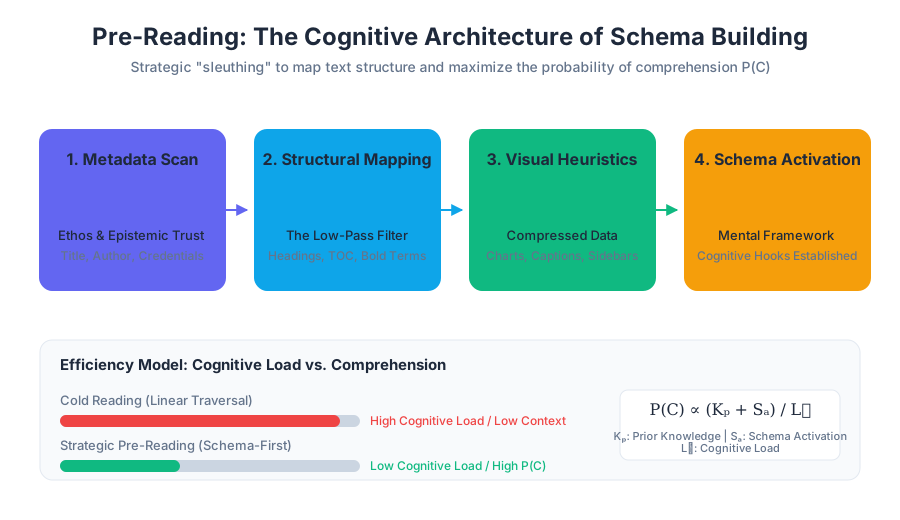
In the ecosystem of academic and professional literacy, "cold reading"—the act of diving into a complex text without prior context—is a computationally expensive and cognitively inefficient process. Pre-reading is the strategic deployment of heuristic "sleuthing" to gather visual, structural, and rhetorical clues before committing to a full-depth traversal of the material. By treating a text not as a linear stream of data but as a structured architecture to be surveyed, the reader builds a mental schema: a cognitive framework that facilitates faster information retrieval and deeper comprehension.
The Cognitive Architecture of Schema Building
At its core, pre-reading is an exercise in Schema Building. In cognitive psychology, a schema is a mental structure of preconceived ideas, a framework representing some aspect of the world, or a system of organizing and perceiving new information.
Definition: Schema Building The process of activating prior knowledge and creating "mental hooks" upon which new information can be hung. Without an established schema, new data points lack relational context, leading to rapid decay in short-term memory.
When a reader engages in pre-reading, they are essentially performing a "low-pass filter" scan of the document. They identify the "high-frequency" structures—titles, headings, and bolded terms—to map the boundaries of the subject matter. This reduces the cognitive load during the actual reading phase because the brain is no longer struggling to identify where it is in the argument; it is merely filling in the details of an already-mapped territory.
The Mechanics of Information Extraction
The efficiency of pre-reading can be modeled as a trade-off between time spent and the "probability of comprehension" ($P(C)$). If $K_p$ represents prior knowledge and $S_d$ represents the structural density of the text, pre-reading aims to maximize the initial state of $K_p$ before the intensive reading process begins.
| Reading Mode | Goal | Speed | Depth of Processing |
|---|---|---|---|
| Pre-reading | Structural mapping & Schema activation | Very High (>1000 wpm) | Surface/Relational |
| Skimming | Identification of main gist | High (400-700 wpm) | Intermediate/Gist |
| Active Reading | Critical analysis & synthesis | Moderate (100-300 wpm) | Deep/Analytical |
| Scanning | Locating specific data points | Variable | Targeted/Minimal |
Phase 1: Metadata and Epistemic Authority
The first stage of pre-reading involves analyzing the "wrapper" of the text: the title and the author's credentials. This is not merely a formality; it is a critical evaluation of the text's Ethos and its intended scope.
Title and Heading Analysis
Titles in academic and professional contexts are rarely poetic; they are descriptive. A title like "Economic Determinism and Ambition in the Migration Series by Jacob Lawrence" provides a roadmap of the entire argument. It identifies the Subject (Jacob Lawrence's Migration Series), the Theoretical Lens (Economic Determinism), and the Counter-Argument/Nuance (Ambition).
Author Credentials and Epistemic Trust
Understanding who wrote the text is as important as what is written. In the age of Information Literacy, checking credentials allows the reader to identify potential biases, the author's field of expertise, and the "conversation" the author is participating in.
| Credibility Marker | Significance | Red Flags |
|---|---|---|
| Institutional Affiliation | Indicates the peer-review environment and research standards. | Lack of clear affiliation or "think tanks" with hidden agendas. |
| Publication History | Shows the author's long-term commitment to a specific niche. | Writing on a topic far outside their documented expertise. |
| Citations/References | Demonstrates the text's grounding in existing scholarship. | Heavy reliance on self-citation or outdated sources. |
| Tone and Language | Indicates the intended audience (Academic vs. General). | Overuse of inflammatory language or lack of nuance. |
Phase 2: Structural Decomposition and Visual Heuristics
Once the metadata is established, the reader moves to the Visual Aids and Structural Markers. This phase treats the text as a spatial object rather than a temporal one.
Visual Aids and Captions
Visual aids—charts, graphs, maps, and photographs—often contain the "compressed" essence of the author's data. For example, in an analysis of Jacob Lawrence’s Migration Series, the visual sequence of the sixty panels provides a narrative arc that text alone might struggle to convey. Captions are particularly high-value targets during pre-reading because they bridge the gap between abstract data (the image) and the author's interpretation (the text).
The "Big Picture" Heuristic
By examining pull-out quotes, sidebars, and bolded terms, a reader can identify the Jargon of the field. Jargon is not just "difficult words"; it is the specialized vocabulary that allows for precise communication within a discipline. Identifying these terms early prevents the "stumble effect" during deep reading.
Phase 3: Rhetorical Analysis and Logical Flow
The final stage of pre-reading is the transition from what the text is to how it functions. This involves analyzing the Rhetoric—the art of persuasive communication.
Main Point vs. Author’s Purpose
A common pitfall is confusing the topic with the purpose.
- Topic: The Great Migration.
- Main Point: The Great Migration was driven by both economic necessity and a desire for agency.
- Purpose: To argue that Jacob Lawrence’s art captures a psychological reality that statistics miss.
Topic Sentence Scanning
The most effective way to map the logical flow of a text is to scan the Topic Sentences (usually the first sentence of each paragraph). In well-structured academic writing, the first sentence acts as a "mini-thesis" for the paragraph. By reading only these sentences, a reader can reconstruct the entire "skeleton" of the argument.
Theorem: The Topic Sentence Heuristic Given a text $T$ composed of paragraphs $P_1, P_2, ..., P_n$, the logical progression $L$ can be approximated by the sequence of the first sentences $S_{i,1}$ of each paragraph. $L \approx \sum_{i=1}^{n} S_{i,1}$
Variations and Extensions: Non-Linear Reference Usage
Not all texts are meant to be read from start to finish. The Word on College Reading and Writing emphasizes that college-level texts are often used as non-linear references.
The OER and Collaborative Context
In the context of Open Educational Resources (OER), texts are often modular. Pre-reading in a modular environment requires the reader to understand the "Container" (the larger work) and the "Source" (the specific chapter). This is reflected in MLA 8th Edition citations, which emphasize the "Container" logic.
| Citation Component | Pre-Reading Utility |
|---|---|
| Author | Establishes Ethos. |
| Title of Source | Defines the specific scope. |
| Title of Container | Defines the broader field or platform (e.g., a journal or website). |
| Publisher | Indicates the institutional backing. |
| Location (URL/DOI) | Provides the path for further verification. |
Mathematical Derivation of Information Density
We can quantify the "utility" of pre-reading by looking at the information density of different text segments. If $I(x)$ is the information content of a segment $x$:
$$I(\text{Title}) \gg I(\text{Heading}) \gg I(\text{Topic Sentence}) \gg I(\text{Body Sentence})$$
By focusing on high-$I$ segments, the reader achieves a "lossy compression" of the text that is sufficient for building the initial schema.
% Mathematical representation of the Pre-reading Efficiency Ratio (PER)
PER = \frac{\text{Information Gained (Schema Units)}}{\text{Time Invested (Seconds)}}

% A high PER is achieved by targeting elements where:
\nabla \text{Comprehension} \approx \text{max}
Common Pitfalls in Pre-Reading
Even experienced readers can fall into traps that negate the benefits of pre-reading:
- The "Skimming" Trap: Confusing pre-reading with skimming. Pre-reading is about structure; skimming is about content. If you are trying to understand the nuances of the argument during pre-reading, you are going too deep too fast.
- Ignoring the "Boring" Parts: Skipping the table of contents or the index. These are the "API documentation" of the book; they tell you exactly how the information is indexed.
- Confirmation Bias: Only looking for clues that support what you already know. True pre-reading should identify "known unknowns"—terms or concepts that you realize you don't understand.
- Passive Observation: Failing to take "pre-notes." A quick map or a list of questions generated during pre-reading significantly increases retention.
Summary of the Pre-Reading Pipeline
To implement pre-reading effectively, follow this standardized pipeline:
- Examine the Metadata: Analyze the title, author, and publication date.
- Survey the Architecture: Read the Table of Contents and check the Index for key terms.
- Scan Visuals: Look at every image, graph, and table. Read their captions.
- Identify Structural Markers: Note headings, subheadings, and bolded/italicized jargon.
- Perform Topic Sentence Skimming: Read the first and last paragraph of the piece, and the first sentence of every paragraph in between.
- Synthesize the Schema: Write a one-sentence prediction of the author's main argument.
By following this protocol, the reader transforms from a passive consumer of text into an active "sleuth," ready to interrogate the material with precision and purpose.
Source Materials
Study The Word on College Reading and Writing on Lykke
This course page is free to open: signed out, you can read its first two sections, and signing in, on any plan, opens the rest. The free Lykke Chrome extension syncs your own Canvas courses, so ChatGPT, Claude and Muse can answer from your classes and deadlines. It only reads Canvas.
Add the free extensionSign in to open every sectionAll sections of The Word on College Reading and Writing · Browse more course pages