From the free course The Word on College Reading and Writing on Lykke
Post-Reading and Reflection
Key concepts: Post-reading reflection · Minute paper · Dialectic Notes · Memory retention
Explains the importance of processing information after reading through journals and structured notes.
Post-Reading and Reflection
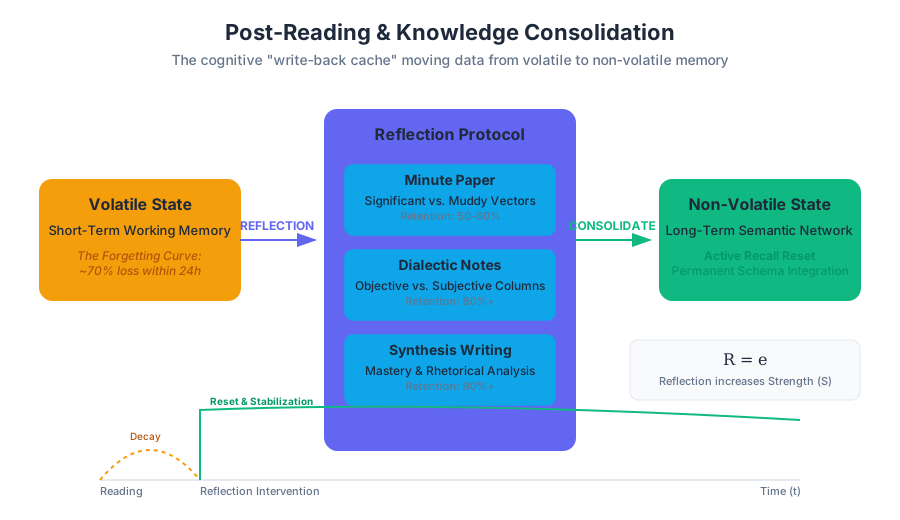
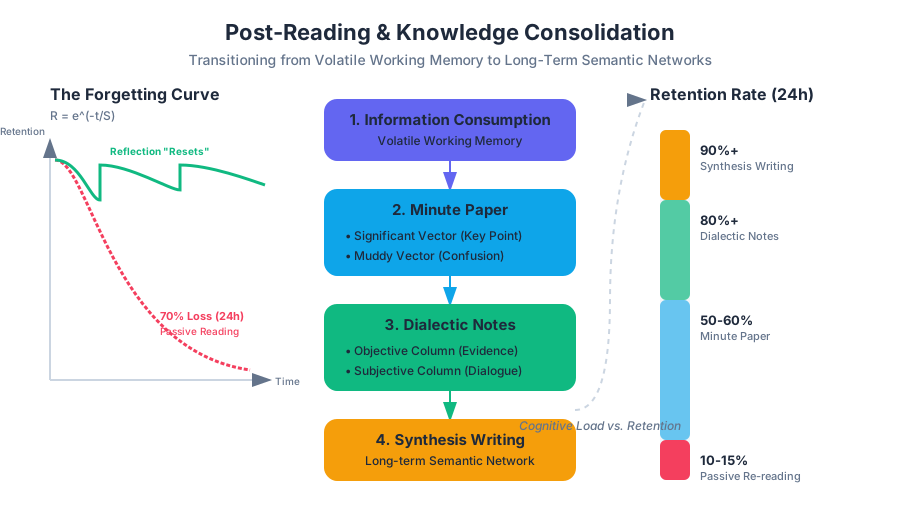
The cognitive process of reading does not terminate at the final period of a text. In high-level academic and professional contexts, the period immediately following the consumption of information—the Post-Reading and Reflection phase—is the most critical window for knowledge consolidation. Without a structured reflection protocol, the "Forgetting Curve" begins to degrade information retention almost immediately, often resulting in a loss of up to 70% of new data within 24 hours.
Post-reading is the "write-back cache" of the human cognitive architecture. It is the process of moving information from volatile short-term working memory into the non-volatile long-term semantic network. This phase involves synthesizing the author’s rhetoric, evaluating evidence, and reconciling new data with existing mental schemas.
The Cognitive Mechanics of Retention
To understand why post-reading reflection is mandatory, one must examine the mechanics of Memory Retention. Learning is not a passive recording; it is an active reconstruction. When we reflect, we are performing Active Recall, which strengthens the neural pathways associated with the information.
The Forgetting Curve Theorem: In the absence of active rehearsal or reflection, the strength of a memory trace ($S$) decays exponentially over time ($t$), expressed as $R = e^{-t/S}$, where $R$ is stability and $S$ is the relative strength of memory.
By intervening with reflection techniques immediately after reading, we effectively "reset" the decay curve, increasing the half-life of the information.
| Retention Method | Cognitive Load | Retention Rate (24h) | Primary Use Case |
|---|---|---|---|
| Passive Re-reading | Low | 10-15% | Surface-level familiarity |
| Highlighting | Low | 20% | Identification of key terms |
| Minute Paper | Medium | 50-60% | Immediate synthesis |
| Dialectic Notes | High | 80%+ | Deep critical analysis |
| Synthesis Writing | Very High | 90%+ | Mastery and application |
The Minute Paper: Rapid Synthesis
The Minute Paper is a high-efficiency heuristic used to capture the "essence" of a text before the details begin to blur. It is designed to force the reader to prioritize information hierarchy.
Implementation
A Minute Paper typically addresses two fundamental vectors:
- The Significant Vector: What was the most important thing you learned?
- The Muddy Vector: What remains the most confusing or "muddiest" point?
By identifying the "muddiest point," the reader engages in Metacognition—thinking about their own thinking. This identifies gaps in the mental model that require immediate "patching" through further research or discussion.
Dialectic Notes: The Epistemic Dialogue
Dialectic Notes (also known as Double-Entry Journals) represent a more rigorous, structural approach to reflection. This method moves beyond mere summary into the realm of Rhetorical Analysis.
The Dual-Column Structure
The page is divided into two distinct zones:
- The Objective Column (Left): Direct quotes, specific data points, and the author's primary claims. This represents the "textual evidence."
- The Subjective Column (Right): The reader's response, critiques, connections to other texts, and questions. This represents the "interrogative layer."
This structure forces a "dialogue" between the reader and the author. It prevents the reader from being a passive recipient of information and instead positions them as a peer reviewer.
| Left Column (The Text) | Right Column (The Reflection) |
|---|---|
| "Economic determinism was the primary driver of the Great Migration." | Does this ignore the 'Push' factors of social violence? How does Lawrence's art reflect this? |
| MLA 8th Edition focuses on 'Containers' for citations. | This modularity makes sense for digital media where the 'container' (e.g., a database) changes but the source doesn't. |
| Author uses a formal, academic tone with heavy jargon. | The jargon might alienate the general audience, suggesting the text is intended for a specialized 'in-group.' |
Synthesis and Rhetorical Analysis
Post-reading is where Synthesis occurs—the act of combining disparate elements to form a coherent whole. In the context of academic writing, such as the analysis of Jacob Lawrence’s Migration Series, synthesis involves looking at the "Migration Colors" and "Naturalism vs. Modernism" and connecting them to the socio-economic "Push and Pull Factors."
Rhetoric and Audience Awareness
Reflection must also account for Rhetoric: the art of persuasion. An expert reader reflects on:
- Author’s Purpose: Is the text meant to inform, persuade, or entertain?
- Audience Assumptions: What does the author assume the reader already knows?
- Tone and Language: How does the choice of words (jargon vs. plain language) influence the perceived Credibility (Ethos) of the piece?
Definition: Rhetorical Situation: The set of circumstances (Author, Audience, Topic, Purpose, and Context) that surround a piece of communication. Reflection is the process of deconstructing this situation.
\text{Synthesis} = \sum (\text{Textual Evidence}) + \text{Prior Knowledge} \times \text{Critical Reflection}
Information Literacy and Source Integrity
A key component of post-reading in the modern era is Information Literacy. This involves verifying the Evidence and Credibility of the source. After reading, one must reflect on the "Container" of the information—a concept central to MLA 8th Edition citation.
The Container Logic
In MLA 8, the "Container" is the larger work in which a source is found (e.g., a website containing an article, or a database containing a journal). Reflecting on the container helps the reader evaluate the source's authority.
Common Pitfalls in Post-Reading
Even experienced researchers fall into traps during the reflection phase.
- The Summary Trap: Writing a summary instead of a reflection. A summary repeats what the author said; a reflection analyzes how and why they said it.
- Confirmation Bias: Only reflecting on points that agree with your existing worldview.
- Delayed Reflection: Waiting too long to reflect. The "Minute Paper" must literally happen within minutes to capture the "Muddy Points" before they are forgotten.
- Ignoring Jargon: Skipping over specialized terms. Post-reading is the time to look up jargon and integrate it into your vocabulary.
Advanced Techniques: The Reading Journal and Zettelkasten
For long-term academic growth, Reading Journals provide a chronological record of intellectual development. Unlike Dialectic Notes, which are usually text-specific, a journal allows for cross-textual reflection.
The Zettelkasten Method
A "Slip-box" or Zettelkasten is a system where reflections are broken down into "atomic notes." Each note contains one idea, its source, and its connection to other notes. This transforms post-reading from a static exercise into a dynamic, growing "second brain."
| Feature | Reading Journal | Zettelkasten |
|---|---|---|
| Structure | Chronological | Networked/Linked |
| Scope | Broad reflections | Atomic ideas |
| Retrieval | Linear search | Tag/Link based |
| Goal | Processing experience | Knowledge production |
Final Synthesis: Connecting the Dots
Post-reading and reflection turn a "text" (which, as defined in college reading, can be anything from a book to a song) into Knowledge. Whether you are analyzing the "Great Migration" or learning "MLA 8th Edition" citation rules, the process is the same:
- Deconstruct the rhetoric.
- Analyze the evidence.
- Synthesize the main points.
- Reflect on the gaps in your understanding.
This habit of mind is what distinguishes a "student" from a "scholar." It is the difference between having read something and having learned it.
Source Materials
- The Word on College Reading and Writing
- The Word on College Reading and Writing
- The Word on College Reading and Writing
- The Word on College Reading and Writing
- The Word on College Reading and Writing
- The Word on College Reading and Writing
- The Word on College Reading and Writing
- The Word on College Reading and Writing
Study The Word on College Reading and Writing on Lykke
This course page is free to open: signed out, you can read its first two sections, and signing in, on any plan, opens the rest. The free Lykke Chrome extension syncs your own Canvas courses, so ChatGPT, Claude and Muse can answer from your classes and deadlines. It only reads Canvas.
Add the free extensionSign in to open every sectionAll sections of The Word on College Reading and Writing · Browse more course pages