The Word on College Reading and Writing
Institution: MIT
42 study materials · 13 sections
The Word on College Reading and Writing is a comprehensive, multimedia guide designed to help students transition into college-level literacy. The course defines 'texts' broadly—encompassing everything from traditional books to visual media—and provides a flexible framework for mastering the reading and writing processes. Key areas of focus include active reading strategies like annotation, rhetorical analysis, information literacy, and the iterative stages of academic writing.
Course Sections
Introduction to College Literacy
Key concepts: Academic definition of a text · Open Educational Resources (OER) · Gender-neutral language · Non-linear reference usage
Defines the academic concept of a 'text' and introduces the course's flexible, inclusive approach to reading and writing.
Introduction to College Literacy
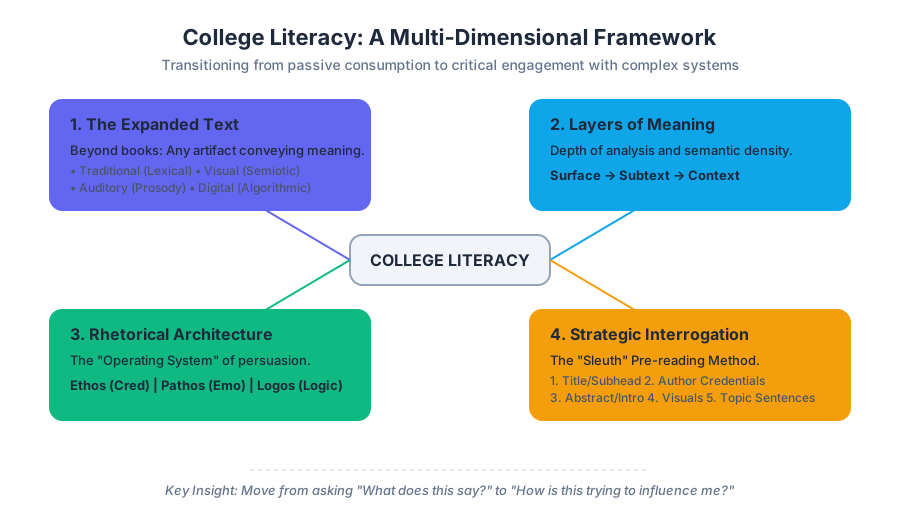
College literacy represents a fundamental shift from passive consumption of information to active, critical engagement with complex systems of meaning. In the modern academic landscape, literacy is no longer confined to the ability to decode printed words; it is a multi-dimensional competency involving the analysis of diverse media, the ethical navigation of information ecosystems, and the mastery of persuasive communication. This guide serves as a high-level technical manual for navigating The Word on College Reading and Writing, an Open Educational Resource (OER) designed to facilitate this transition.
The Academic Definition of a Text
In a scholarly context, the term text is decoupled from its colloquial association with "books" or "printed matter." Academically, a text is defined as any artifact that conveys meaning and can be interpreted. This broad definition allows scholars to apply the same rigorous analytical frameworks to a 14th-century manuscript, a 21st-century cinematic sequence, or a data visualization.
Traditional vs. Non-Traditional Texts
The distinction between text types is primarily one of medium and sensory engagement, rather than intellectual value.
| Category | Examples | Primary Mode of Analysis |
|---|---|---|
| Traditional | Peer-reviewed journals, monographs, essays, poetry | Lexical analysis, syntax, structural criticism |
| Visual | Advertisements, paintings (e.g., Jacob Lawrence’s Migration Series), photography | Iconography, composition, color theory, semiotics |
| Auditory | Podcasts, speeches, musical compositions, oral histories | Prosody, tone, rhythm, rhetorical cadence |
| Digital/Interactive | Websites, social media threads, video games, software code | UX/UI analysis, hyperlinking logic, algorithmic bias |
Layers of Meaning and Semantic Density
To "read" a text in college is to perform an extraction of multiple layers:
- Surface Level (Literal): What is explicitly stated or shown?
- Subtextual Level (Implicit): What is suggested through connotation, tone, or juxtaposition?
- Contextual Level (Extrinsic): How do historical, social, and economic factors (e.g., the "Push and Pull" factors of the Great Migration) shape the text?
Rhetoric: The Architecture of Persuasion
Rhetoric is the strategic use of communication to achieve a specific purpose with a specific audience. It is the "operating system" of academic discourse. Understanding rhetoric allows a student to move from asking "What does this say?" to "How is this trying to influence me?"
The Rhetorical Triangle and Appeals
The effectiveness of a text is often measured by its balance of the three classical rhetorical appeals:
| Appeal | Technical Definition | Academic Application |
|---|---|---|
| Ethos | The credibility or ethical standing of the author. | Citing peer-reviewed sources; demonstrating expertise. |
| Pathos | The appeal to the audience's emotions or values. | Using narrative examples to illustrate the human cost of a policy. |
| Logos | The internal consistency and logical strength of the argument. | Using data, syllogisms, and inductive/deductive reasoning. |
Authorial Purpose and Audience Awareness
Every academic text is a response to a specific rhetorical situation. This involves identifying the Main Point (the "what") versus the Author’s Purpose (the "why"). For instance, a paper on Jacob Lawrence might have the main point that his use of primary colors creates urgency, but the purpose is to argue that Lawrence prioritizes collective ambition over individual struggle.
Key Insight: Writing for a general audience requires the mitigation of jargon—specialized language that acts as a barrier to entry. Effective college writing balances technical precision with accessibility.
The Mechanics of Information Extraction
To handle the high volume of reading in college, students must move away from linear reading (start to finish) toward strategic interrogation of the text.
The "Sleuth" Method (Pre-reading)
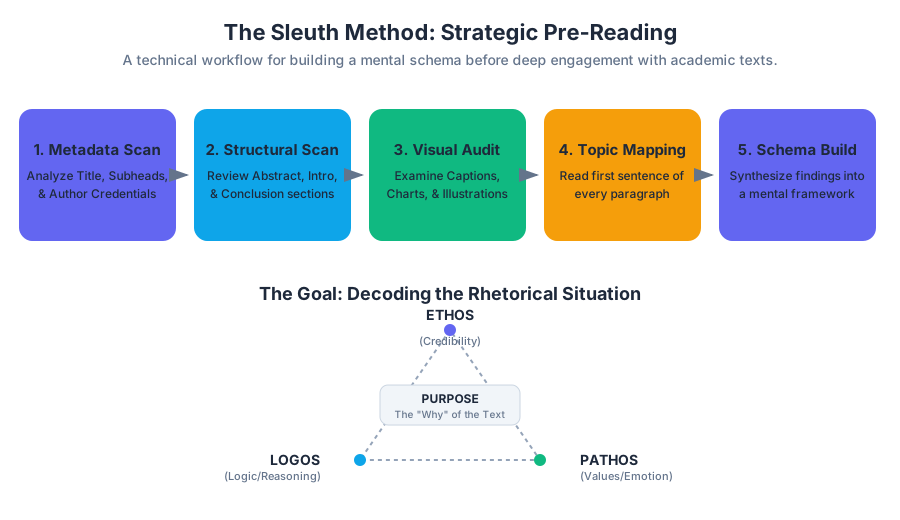
Before committing to a deep read, a "literacy engineer" scans the text's metadata to build a mental schema. This process significantly reduces cognitive load during the actual reading phase.
- Title and Subhead Analysis: Predicting the scope and stance.
- Author Credentialing: Evaluating the "Ethos" before engagement.
- Abstract/Introduction/Conclusion: Identifying the "Logos" or core argument.
- Visual and Caption Scan: Understanding the "Pathos" or illustrative evidence.
- Topic Sentence Mapping: Reading the first sentence of each paragraph to map the logical flow.
Implementation: Textual Analysis via Python
In modern digital humanities, we can use computational tools to perform initial "surface" reads of large text corpora to identify patterns before performing close reading.
import nltk
from nltk.tokenize import word_tokenize
from collections import Counter

def analyze_text_density(text_data):
    """
    Analyzes a text to determine its lexical diversity and
    most frequent rhetorical markers.
    """
    # Tokenize and normalize
    tokens = [w.lower() for w in word_tokenize(text_data) if w.isalpha()]

    # Calculate Lexical Diversity (Unique words / Total words)
    lexical_diversity = len(set(tokens)) / len(tokens)

    # Identify high-frequency terms (potential jargon or themes)
    common_terms = Counter(tokens).most_common(10)

    return {
        "diversity_score": round(lexical_diversity, 4),
        "top_themes": common_terms
    }

# Example usage with a snippet of academic text
sample_text = "Economic determinism pushed migrants from the South while pull factors drew them North."
results = analyze_text_density(sample_text)
print(f"Lexical Diversity: {results['diversity_score']}")
print(f"Top Themes: {results['top_themes']}")
Open Educational Resources (OER) and Information Literacy
This course utilizes Open Educational Resources (OER). Unlike traditional proprietary textbooks, OER are teaching, learning, and research materials that reside in the public domain or have been released under an open license (like Creative Commons).
The 5 Rs of OER
The utility of OER is defined by the "5 Rs" framework, which empowers both students and instructors to interact with the material as a living document:
- Retain: The right to make, own, and control copies of the content.
- Reuse: The right to use the content in a wide range of ways.
- Revise: The right to adapt, adjust, modify, or alter the content itself.
- Remix: The right to combine the original or revised content with other material.
- Redistribute: The right to share copies of the original content, your revisions, or your remixes with others.
Non-Linear Reference Usage
Because The Word on College Reading and Writing is an OER, it is structured as a non-linear reference tool. It is not designed to be read from page 1 to page 300 in sequence. Instead, it functions like a library of API documentation: you "call" the specific module you need (e.g., "MLA Citation" or "Overcoming Writer's Block") based on your current project requirements.
Inclusivity and Gender-Neutral Language
Academic literacy involves evolving linguistic standards to reflect a more precise and inclusive understanding of the world. The use of gender-neutral language is not merely a social preference; it is a requirement for academic accuracy and ethical communication.
The Singular "They" and Pronoun Logic
In academic writing, using "he or she" is increasingly viewed as clunky and exclusionary. The singular they is now accepted by major style guides (APA, MLA, Chicago) as a grammatically correct way to refer to an individual whose gender is unknown or irrelevant to the context.
| Traditional/Binary | Gender-Neutral/Inclusive | Rationale |
|---|---|---|
| "Each student must bring his book." | "Students must bring their books." | Pluralization avoids gender entirely. |
| "An author must cite his or her sources." | "An author must cite their sources." | Singular 'they' is more fluid and inclusive. |
| "Manpower" | "Workforce" or "Staff" | Removes gendered bias from neutral roles. |
| "Chairman" | "Chair" or "Coordinator" | Focuses on the function, not the person. |
The Writing Process: A Recursive Lifecycle
Writing in college is rarely a linear path from "Idea" to "Final Draft." It is a recursive process, meaning it involves loops where the writer returns to earlier stages based on new insights.
Phases of the Writing Pipeline
- Prewriting: Brainstorming, outlining, and research.
- Drafting: The "shitty first draft" where ideas are translated into prose without self-censorship.
- Revising: High-level structural changes (moving paragraphs, changing the thesis).
- Editing/Proofreading: Low-level "polishing" (grammar, spelling, citation accuracy).
Logic Flow for Source Evaluation
When integrating sources (like Jacob Lawrence's paintings or a peer-reviewed article), a writer must pass the source through a "credibility filter."
ALGORITHM: Evaluate_Source(Source S, Context C)
-----------------------------------------------
IF S.Author has relevant credentials OR S.Publisher is peer-reviewed:
    IF S.Date is within acceptable range for C:
        IF S.Evidence supports S.Claims:
            IF S.Bias is acknowledged OR minimized:
                RETURN "High Credibility - Use for Core Argument"
            ELSE:
                RETURN "Medium Credibility - Use with Attribution/Caveat"
        ELSE:
            RETURN "Low Credibility - Do Not Use"
    ELSE:
        RETURN "Outdated - Use only for Historical Context"
ELSE:
    RETURN "Unverified - Use for Pathos only (if at all)"
Citation Standards: MLA 8th Edition
Academic literacy requires rigorous attribution. The MLA (Modern Language Association) 8th Edition moved toward a "container-based" system, which is more flexible for digital and non-traditional texts.
The Container System
Instead of having a different rule for every possible media type, MLA 8 uses a standardized list of "Core Elements."
| Element | Example |
|---|---|
| Author | De Souza, Michael. |
| Title of Source | "Economic Determinism in the Migration Series." |
| Title of Container | Journal of African American Studies |
| Other Contributors | Edited by Sarah Miller, |
| Version/Number | vol. 12, no. 4, |
| Publisher | University of Oregon Press, |
| Publication Date | 2016, |
| Location | pp. 45-60. |
Real-World Usage: CLI Citation Management
For students managing dozens of sources, command-line tools or Markdown-based workflows can automate the formatting of Works Cited pages.
# Example: Using Pandoc to convert a Markdown file with
# BibTeX citations into a formatted MLA PDF.

pandoc essay.md \
    --citeproc \
    --bibliography=references.bib \
    --csl=modern-language-association.csl \
    -o final_essay.pdf
Common Pitfalls in College Literacy
- The "Thesaurus Trap": Using complex words incorrectly to sound "academic." This often results in a loss of precision.
- Passive Reading: Scanning eyes over a page without taking notes or asking questions.
- Linear Dependency: Feeling the need to read a textbook from start to finish, leading to burnout and inefficiency.
- Plagiarism via Paraphrase: Failing to cite a source because the words were changed, even though the idea remains the property of the original author.
Theorem of Academic Integrity: The transparency of your research process is directly proportional to the perceived authority of your argument.
- Text: Any artifact (visual, auditory, written) that conveys meaning.
- Rhetoric: The art of persuasive communication.
- OER: Open Educational Resources; free, modifiable learning materials.
- Ethos/Pathos/Logos: The three pillars of rhetorical appeal (Credibility, Emotion, Logic).
- Recursive Process: A repetitive cycle (like writing) where steps are revisited.
- Jargon: Specialized language used by a specific profession or group.
- Semiotics: The study of signs and symbols and their interpretation.
- Schema: A mental framework that helps organize and interpret information.
- True or False: In a college setting, a popular song can be analyzed as a "text." (True)
- Which rhetorical appeal focuses on the author's credibility? (Ethos)
- What is the primary benefit of the "Sleuth" method of pre-reading? (Building a mental schema to reduce cognitive load.)
- In the "5 Rs" of OER, what does "Remix" allow a user to do? (Combine original/revised content with other materials.)
- Why is the singular "they" preferred in modern academic writing? (It is inclusive of all genders and avoids the clunkiness of "he or she.")
- What is the difference between a "Main Point" and "Author's Purpose"? (Main point is the core message; Purpose is the goal the author wants to achieve.)
Deep-Dive Checklist for College Literacy
- Audit your reading environment: Identify your diurnal cycle (morning vs. night) and find a distraction-free zone.
- Practice the Sleuth Method: Take a 10-page chapter and spend only 5 minutes "pre-reading" it. Can you identify the thesis?
- Analyze a Non-Traditional Text: Find a print advertisement and identify the Ethos, Pathos, and Logos used.
- Check your Pronouns: Review a recent draft. Replace binary "he/she" constructions with singular "they" or pluralized subjects.
- Map your Writing Process: Do you spend enough time in the "Prewriting" phase? Try using a logic flow or outline before drafting.
- Master the Container: Look at your Works Cited page. Ensure every source has its "Container" (the larger work it lives in) clearly identified.
Foundations of Reading Habits
Key concepts: Diurnal Cycles · Optimal Study Environments · Distraction Management · Reading Stamina
Explores how to optimize the reading environment and manage personal biological cycles for better focus.
Foundations of Reading Habits
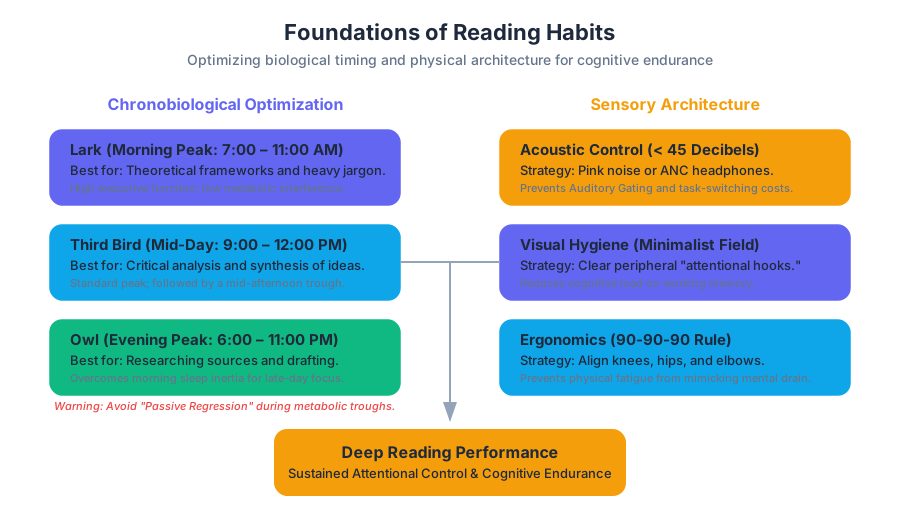
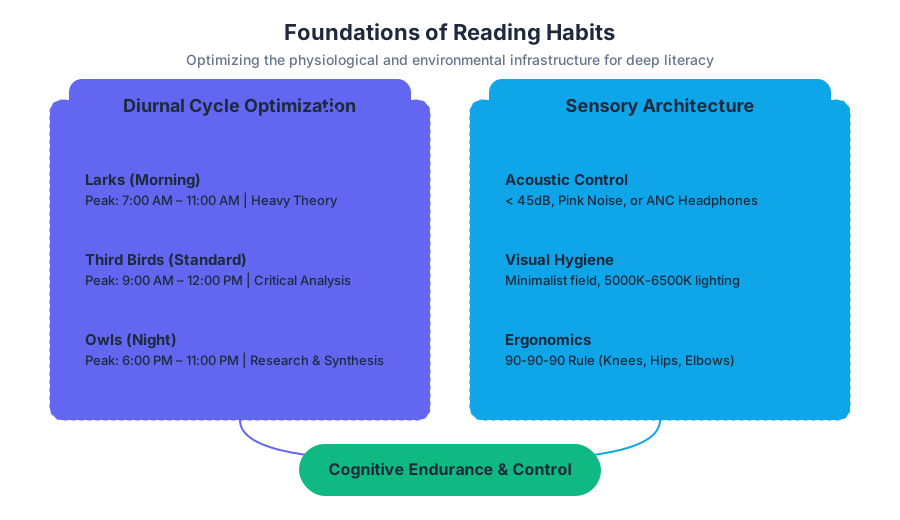
In the transition to college-level literacy, reading is no longer a passive act of consumption but a high-stakes cognitive performance. The "Foundations of Reading Habits" refers to the physiological, environmental, and psychological infrastructure required to sustain deep engagement with complex texts. Unlike recreational reading, academic reading demands a high degree of Attentional Control and Cognitive Endurance. To master this, one must optimize the biological timing of sessions, the physical architecture of the workspace, and the systematic elimination of cognitive "leakage" caused by distractions.
Diurnal Cycles and Chronobiological Optimization
What it is
A Diurnal Cycle (or Circadian Rhythm) is the roughly 24-hour internal clock, governed by the suprachiasmatic nucleus (SCN) in the hypothalamus, that regulates sleep-wake cycles, hormone release, and cognitive function. In the context of reading habits, it refers to the synchronization of high-density cognitive tasks—such as analyzing Jacob Lawrence’s Migration Series for economic determinism—with peak periods of mental alertness.
Why it matters
Cognitive performance is not a flat line; it is a wave. Research suggests that for most individuals, "executive function" (the ability to focus, plan, and inhibit impulses) peaks in the morning, dips in the mid-afternoon (the "post-lunch dip"), and may see a secondary recovery in the evening. Attempting to read a dense rhetorical analysis during a "trough" period results in Passive Regression, where the eye moves across the page without the brain encoding the information.
How it works: The Peak-Trough-Recovery Framework
Most learners fall into three categories of chronotypes:
- Larks (Morning People): Peak alertness occurs early; ideal for new, complex material.
- Owls (Night People): Peak alertness occurs late; morning hours are often characterized by "sleep inertia."
- Third Birds: The majority of the population who follow a standard morning peak, afternoon dip, and evening recovery.
| Chronotype | Peak Cognitive Period | Recommended Reading Task | Trough Period (Avoid Deep Work) |
|---|---|---|---|
| Lark | 7:00 AM – 11:00 AM | Theoretical frameworks, heavy jargon | 2:00 PM – 4:00 PM |
| Third Bird | 9:00 AM – 12:00 PM | Critical analysis, synthesis | 3:00 PM – 5:00 PM |
| Owl | 6:00 PM – 11:00 PM | Researching sources, drafting | 8:00 AM – 10:00 AM |
Concrete Example: Tracking Cognitive Flux
To determine an optimal reading schedule, a student can track their "Reading Velocity" (pages per hour) against their "Comprehension Score" (ability to summarize key points) over a seven-day period.
import matplotlib.pyplot as plt
import numpy as np

# Data: Hour of day vs. Subjective Focus Level (1-10)
hours = np.array([8, 10, 12, 14, 16, 18, 20, 22])
focus_levels = np.array([9, 8, 6, 3, 5, 7, 8, 4]) # Example 'Third Bird' pattern

def analyze_reading_window(hours, focus):
    peak_indices = np.where(focus >= 7)[0]
    trough_indices = np.where(focus <= 4)[0]

    print(f"Optimal Deep Reading Windows: {hours[peak_indices]}")
    print(f"Avoid Complex Texts During: {hours[trough_indices]}")

    plt.plot(hours, focus, marker='o', linestyle='-', color='b')
    plt.fill_between(hours, 7, 10, color='green', alpha=0.2, label='Deep Work Zone')
    plt.title("Circadian Rhythm vs. Cognitive Focus")
    plt.xlabel("Hour of Day (24h)")
    plt.ylabel("Focus Level")
    plt.legend()
    plt.show()

analyze_reading_window(hours, focus_levels)
Common Pitfalls: The "Heroic" All-Nighter
Many students believe that sheer willpower can overcome biological troughs. However, sleep deprivation leads to a buildup of Adenosine, which binds to receptors in the brain to slow down neural activity. Reading while sleep-deprived leads to "Micro-sleeps," where the brain goes offline for seconds at a time, rendering the reading of complex rhetoric impossible.
Optimal Study Environments and Sensory Architecture
What it is
An Optimal Study Environment is a physical space engineered to minimize Cognitive Load—the total amount of mental effort being used in the working memory. This involves managing lighting, acoustics, ergonomics, and "context-dependent memory" cues.
Why it matters
The brain associates specific environments with specific behaviors. If you read in bed, your brain associates that space with sleep, leading to drowsiness. If you read in a high-traffic cafe, your brain must constantly exert energy to filter out "background noise," a process known as Auditory Gating, which leaves less energy for text analysis.
How it works: The Three Pillars of Environment
- Acoustic Control: Utilizing "Pink Noise" or silence to prevent the Irrelevant Sound Effect, where speech-like sounds interfere with the phonological loop used in reading.
- Visual Hygiene: A "minimalist" field of vision. Every object in your peripheral vision is a potential "attentional hook."
- Ergonomics: The "90-90-90" rule (knees, hips, and elbows at 90 degrees) to prevent physical fatigue from masquerading as mental fatigue.
| Factor | Parameter | Impact on Reading | Optimization Strategy |
|---|---|---|---|
| Lighting | 5000K - 6500K (Cool White) | Increases alertness, reduces melatonin | Use "Daylight" LED bulbs for study lamps. |
| Sound | < 45 Decibels | Minimizes task-switching costs | Use ANC (Active Noise Canceling) headphones. |
| Temperature | 20°C - 22°C (68°F - 72°F) | Optimal for metabolic efficiency | Avoid overly warm rooms that induce lethargy. |
| Location | Consistency | Builds "Context-Dependent Memory" | Use the same desk for the same subject. |
Mathematical Representation of Cognitive Efficiency
The efficiency of a reading environment can be modeled by the ratio of Signal (the text) to Noise (environmental distractions).
\text{Reading Efficiency} (\eta) = \frac{C \cdot A}{L_{int} + L_{ext}}
Where:
C= Complexity of the text (e.g., Jargon density)A= Attentional capacity of the readerL_int= Internal Load (stress, hunger, fatigue)L_ext= External Load (noise, visual clutter, phone notifications)
Key Insight: To increase efficiency, it is often easier to decrease the denominator (distractions) than to increase the numerator (effort).
Distraction Management and Attentional Control
What it is
Distraction Management is the proactive defense of the "Attentional Spotlight." In the digital age, this primarily involves mitigating Technological Interference and the Switch-Cost Effect—the cognitive penalty incurred when moving between a primary task (reading) and a secondary task (checking a notification).
Why it matters
Every time a reader checks a smartphone, they lose approximately 20 minutes of "Deep Work" momentum. This is because of Attention Residue: a part of the brain remains focused on the previous distraction even after returning to the text. For a student analyzing Jacob Lawrence's use of "Migration Colors," a single text message can break the thread of visual-to-textual synthesis.
How it works: The "Digital Fortress" Strategy
- Physical Decoupling: Placing the smartphone in a separate room to eliminate "Proximity Anxiety."
- Application Layer Blocking: Using software to disable the "infinite scroll" of social media during study blocks.
- The "In-Box" Method: Keeping a notepad nearby to write down "tangential thoughts" (e.g., "I need to buy milk") so they can be offloaded from working memory without leaving the reading task.
Concrete Example: Bash Script for Focus Mode
For students reading on a computer, a simple script can be used to modify the hosts file to block distracting domains during a reading session.
#!/bin/bash
# FocusMode.sh - Blocks distracting sites for a set duration

DISTRACTING_SITES=("facebook.com" "twitter.com" "reddit.com" "instagram.com")
DURATION=$1 # Time in minutes

if [ -z "$DURATION" ]; then
    echo "Usage: sudo ./FocusMode.sh [duration_in_minutes]"
    exit 1
fi

echo "Entering Focus Mode for $DURATION minutes..."

for site in "${DISTRACTING_SITES[@]}"; do
    echo "127.0.0.1 $site" >> /etc/hosts
    echo "127.0.0.1 www.$site" >> /etc/hosts
done

sleep $((DURATION * 60))

# Restore hosts file (Assumes a backup exists at /etc/hosts.bak)
cp /etc/hosts.bak /etc/hosts
echo "Focus Mode ended. Distractions restored."
Reading Stamina and Cognitive Endurance
What it is
Reading Stamina is the ability to maintain focus on a challenging text for an extended period without cognitive collapse. It is a "plastic" trait, meaning it can be developed through progressive overload, much like physical strength.
Why it matters
College-level texts are often non-linear and dense with Jargon (specialized language). A student with low stamina will find themselves "skimming" the last five pages of a chapter, missing the nuanced arguments regarding Economic Determinism or Rhetorical Purpose. Building stamina allows for "Deep Reading," where the reader can hold multiple layers of meaning in their mind simultaneously.
How it works: The Progressive Overload Model
To build stamina, a reader must move through stages of increasing difficulty and duration.
| Stage | Duration | Text Complexity | Goal |
|---|---|---|---|
| Baseline | 15 Minutes | Narrative/Journalism | Establish a habit of "no-phone" reading. |
| Intermediate | 30 Minutes | Textbook Chapters | Practice active annotation and "Topic Sentence Scanning." |
| Advanced | 60+ Minutes | Peer-reviewed Journals | Synthesize multiple sources; identify author bias/tone. |
| Elite | 2-3 Hours | Primary Source Archives | Deep immersion; cross-referencing multiple complex texts. |
Variations: The Pomodoro Technique vs. Flow State
- Pomodoro: 25 minutes of reading followed by a 5-minute break. Best for students struggling with high anxiety or very low stamina.
- Flow State: Uninterrupted 90-minute blocks. Best for complex synthesis and "The Writing Process" (drafting/revising).
Common Pitfalls: The "Speed Reading" Myth
Many students attempt to increase stamina by increasing speed. However, for academic texts, speed is often the enemy of comprehension. Lexical Access (recognizing words) is fast, but Semantic Integration (understanding the meaning) is slow. If you read faster than you can integrate, your stamina is being wasted on "empty" reading.
"Reading is to the mind what exercise is to the body." — Sir Richard Steele. In an academic context, this means that the "burn" you feel when struggling with a dense paragraph is actually the process of neural pathways strengthening.
Synthesis: Creating a Reading Routine
The ultimate goal of understanding these foundations is to move from "accidental reading" to "intentional literacy." This involves a three-step pipeline:
- Pre-Reading (The Sleuth Phase): Before the "Deep Dive," spend 5 minutes examining titles, author credentials, and visual aids. This builds a Schema (a mental map) that reduces the cognitive load during the actual reading.
- Active Engagement: Use a pen or digital annotation tool. Do not just highlight; write "Why" in the margins. If the text mentions "Jacob Lawrence," and you don't know who he is, stop and look him up immediately to maintain Contextual Comprehension.
- Post-Reading Reflection: Spend 2 minutes summarizing the "Main Point" vs. the "Author's Purpose." This moves the information from short-term working memory to long-term storage.
Glossary of Key Terms
- Rhetoric: The art of persuasive communication.
- OER (Open Educational Resources): High-quality, openly licensed teaching and learning materials.
- Schema: A cognitive framework or concept that helps organize and interpret information.
- Jargon: Specialized language used by a particular profession or group that is difficult for others to understand.
- MLA 8th Edition: A standardized format for scholarly writing and citation, emphasizing "containers" and source attribution.
- Economic Determinism: The theory that economic forces (like labor shortages) are the primary driver of social and historical change.
Pre-Reading Strategies
Key concepts: Pre-reading · Title Analysis · Author Credentials · Visual Aids · Schema Building
Introduces the 'sleuthing' method of pre-reading to build a mental schema before diving into a text.
Pre-Reading Strategies
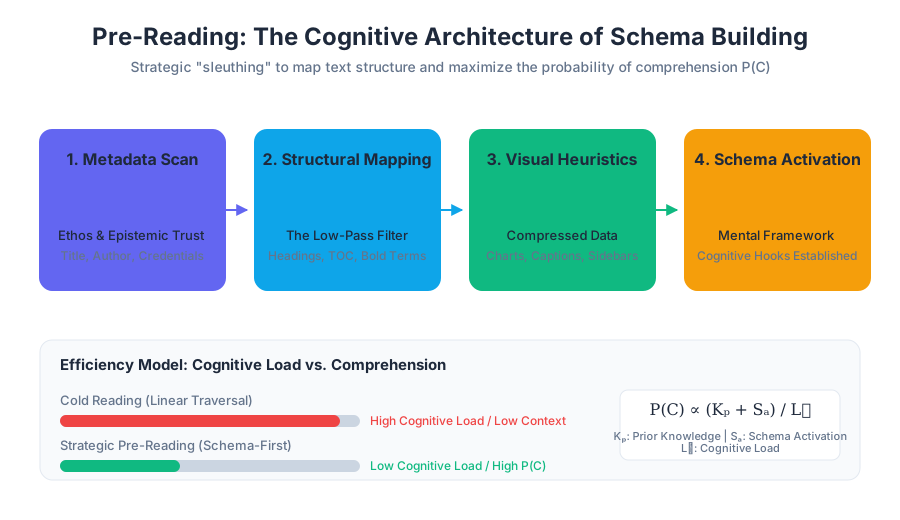
In the ecosystem of academic and professional literacy, "cold reading"—the act of diving into a complex text without prior context—is a computationally expensive and cognitively inefficient process. Pre-reading is the strategic deployment of heuristic "sleuthing" to gather visual, structural, and rhetorical clues before committing to a full-depth traversal of the material. By treating a text not as a linear stream of data but as a structured architecture to be surveyed, the reader builds a mental schema: a cognitive framework that facilitates faster information retrieval and deeper comprehension.
The Cognitive Architecture of Schema Building
At its core, pre-reading is an exercise in Schema Building. In cognitive psychology, a schema is a mental structure of preconceived ideas, a framework representing some aspect of the world, or a system of organizing and perceiving new information.
Definition: Schema Building The process of activating prior knowledge and creating "mental hooks" upon which new information can be hung. Without an established schema, new data points lack relational context, leading to rapid decay in short-term memory.
When a reader engages in pre-reading, they are essentially performing a "low-pass filter" scan of the document. They identify the "high-frequency" structures—titles, headings, and bolded terms—to map the boundaries of the subject matter. This reduces the cognitive load during the actual reading phase because the brain is no longer struggling to identify where it is in the argument; it is merely filling in the details of an already-mapped territory.
The Mechanics of Information Extraction
The efficiency of pre-reading can be modeled as a trade-off between time spent and the "probability of comprehension" ($P(C)$). If $K_p$ represents prior knowledge and $S_d$ represents the structural density of the text, pre-reading aims to maximize the initial state of $K_p$ before the intensive reading process begins.
| Reading Mode | Goal | Speed | Depth of Processing |
|---|---|---|---|
| Pre-reading | Structural mapping & Schema activation | Very High (>1000 wpm) | Surface/Relational |
| Skimming | Identification of main gist | High (400-700 wpm) | Intermediate/Gist |
| Active Reading | Critical analysis & synthesis | Moderate (100-300 wpm) | Deep/Analytical |
| Scanning | Locating specific data points | Variable | Targeted/Minimal |
Phase 1: Metadata and Epistemic Authority
The first stage of pre-reading involves analyzing the "wrapper" of the text: the title and the author's credentials. This is not merely a formality; it is a critical evaluation of the text's Ethos and its intended scope.
Title and Heading Analysis
Titles in academic and professional contexts are rarely poetic; they are descriptive. A title like "Economic Determinism and Ambition in the Migration Series by Jacob Lawrence" provides a roadmap of the entire argument. It identifies the Subject (Jacob Lawrence's Migration Series), the Theoretical Lens (Economic Determinism), and the Counter-Argument/Nuance (Ambition).
Author Credentials and Epistemic Trust
Understanding who wrote the text is as important as what is written. In the age of Information Literacy, checking credentials allows the reader to identify potential biases, the author's field of expertise, and the "conversation" the author is participating in.
| Credibility Marker | Significance | Red Flags |
|---|---|---|
| Institutional Affiliation | Indicates the peer-review environment and research standards. | Lack of clear affiliation or "think tanks" with hidden agendas. |
| Publication History | Shows the author's long-term commitment to a specific niche. | Writing on a topic far outside their documented expertise. |
| Citations/References | Demonstrates the text's grounding in existing scholarship. | Heavy reliance on self-citation or outdated sources. |
| Tone and Language | Indicates the intended audience (Academic vs. General). | Overuse of inflammatory language or lack of nuance. |
Phase 2: Structural Decomposition and Visual Heuristics
Once the metadata is established, the reader moves to the Visual Aids and Structural Markers. This phase treats the text as a spatial object rather than a temporal one.
Visual Aids and Captions
Visual aids—charts, graphs, maps, and photographs—often contain the "compressed" essence of the author's data. For example, in an analysis of Jacob Lawrence’s Migration Series, the visual sequence of the sixty panels provides a narrative arc that text alone might struggle to convey. Captions are particularly high-value targets during pre-reading because they bridge the gap between abstract data (the image) and the author's interpretation (the text).
The "Big Picture" Heuristic
By examining pull-out quotes, sidebars, and bolded terms, a reader can identify the Jargon of the field. Jargon is not just "difficult words"; it is the specialized vocabulary that allows for precise communication within a discipline. Identifying these terms early prevents the "stumble effect" during deep reading.
# A conceptual Python implementation of a 'Pre-Reading' Text Analyzer
# This script simulates the extraction of structural clues from a document.

import re
from collections import Counter

class PreReadingSleuth:
    def __init__(self, text):
        self.text = text
        self.headings = []
        self.jargon_candidates = []

    def extract_structure(self):
        # Identify Markdown-style headings as structural anchors
        self.headings = re.findall(r'^#+\s(.*)', self.text, re.MULTILINE)
        return self.headings

    def find_high_value_terms(self):
        # Heuristic: Words in bold or italics are often key concepts (Schema hooks)
        bold_terms = re.findall(r'\*\*(.*?)\*\*', self.text)
        italic_terms = re.findall(r'\*(.*?)\*', self.text)
        self.jargon_candidates = list(set(bold_terms + italic_terms))
        return self.jargon_candidates

    def generate_schema_report(self):
        print(f"--- PRE-READING REPORT ---")
        print(f"Structural Anchors: {len(self.headings)} headings found.")
        for i, h in enumerate(self.headings):
            print(f"  {i+1}. {h}")
        print(f"\nKey Concepts to Research: {', '.join(self.jargon_candidates[:10])}")

# Example usage with a snippet of the 'Great Migration' text
sample_text = """
## The Great Migration
### Economic Determinism
The **boll weevil** infestation was a primary *push factor*.
### Collective Ambition
Migrants sought **agency** through the *Migration Series*...
"""
sleuth = PreReadingSleuth(sample_text)
sleuth.extract_structure()
sleuth.find_high_value_terms()
sleuth.generate_schema_report()
Phase 3: Rhetorical Analysis and Logical Flow
The final stage of pre-reading is the transition from what the text is to how it functions. This involves analyzing the Rhetoric—the art of persuasive communication.
Main Point vs. Author’s Purpose
A common pitfall is confusing the topic with the purpose.
- Topic: The Great Migration.
- Main Point: The Great Migration was driven by both economic necessity and a desire for agency.
- Purpose: To argue that Jacob Lawrence’s art captures a psychological reality that statistics miss.
Topic Sentence Scanning
The most effective way to map the logical flow of a text is to scan the Topic Sentences (usually the first sentence of each paragraph). In well-structured academic writing, the first sentence acts as a "mini-thesis" for the paragraph. By reading only these sentences, a reader can reconstruct the entire "skeleton" of the argument.
Theorem: The Topic Sentence Heuristic Given a text $T$ composed of paragraphs $P_1, P_2, ..., P_n$, the logical progression $L$ can be approximated by the sequence of the first sentences $S_{i,1}$ of each paragraph. $L \approx \sum_{i=1}^{n} S_{i,1}$
Variations and Extensions: Non-Linear Reference Usage
Not all texts are meant to be read from start to finish. The Word on College Reading and Writing emphasizes that college-level texts are often used as non-linear references.
The OER and Collaborative Context
In the context of Open Educational Resources (OER), texts are often modular. Pre-reading in a modular environment requires the reader to understand the "Container" (the larger work) and the "Source" (the specific chapter). This is reflected in MLA 8th Edition citations, which emphasize the "Container" logic.
| Citation Component | Pre-Reading Utility |
|---|---|
| Author | Establishes Ethos. |
| Title of Source | Defines the specific scope. |
| Title of Container | Defines the broader field or platform (e.g., a journal or website). |
| Publisher | Indicates the institutional backing. |
| Location (URL/DOI) | Provides the path for further verification. |
Mathematical Derivation of Information Density
We can quantify the "utility" of pre-reading by looking at the information density of different text segments. If $I(x)$ is the information content of a segment $x$:
$$I(\text{Title}) \gg I(\text{Heading}) \gg I(\text{Topic Sentence}) \gg I(\text{Body Sentence})$$
By focusing on high-$I$ segments, the reader achieves a "lossy compression" of the text that is sufficient for building the initial schema.
% Mathematical representation of the Pre-reading Efficiency Ratio (PER)
PER = \frac{\text{Information Gained (Schema Units)}}{\text{Time Invested (Seconds)}}

% A high PER is achieved by targeting elements where:
\nabla \text{Comprehension} \approx \text{max}
Common Pitfalls in Pre-Reading
Even experienced readers can fall into traps that negate the benefits of pre-reading:
- The "Skimming" Trap: Confusing pre-reading with skimming. Pre-reading is about structure; skimming is about content. If you are trying to understand the nuances of the argument during pre-reading, you are going too deep too fast.
- Ignoring the "Boring" Parts: Skipping the table of contents or the index. These are the "API documentation" of the book; they tell you exactly how the information is indexed.
- Confirmation Bias: Only looking for clues that support what you already know. True pre-reading should identify "known unknowns"—terms or concepts that you realize you don't understand.
- Passive Observation: Failing to take "pre-notes." A quick map or a list of questions generated during pre-reading significantly increases retention.
# Real-world usage: Using CLI tools to 'pre-read' a directory of research papers (PDFs)
# This extracts the metadata and titles to build a quick schema of a local library.

for file in *.pdf; do
    echo "--- Analysis for $file ---"
    # Extract Title using exiftool
    exiftool -Title "$file"
    # Extract the first 5 lines of text (often contains the abstract/intro)
    pdftotext "$file" -f 1 -l 1 - | head -n 5
    echo -e "\n"
done
Summary of the Pre-Reading Pipeline
To implement pre-reading effectively, follow this standardized pipeline:
- Examine the Metadata: Analyze the title, author, and publication date.
- Survey the Architecture: Read the Table of Contents and check the Index for key terms.
- Scan Visuals: Look at every image, graph, and table. Read their captions.
- Identify Structural Markers: Note headings, subheadings, and bolded/italicized jargon.
- Perform Topic Sentence Skimming: Read the first and last paragraph of the piece, and the first sentence of every paragraph in between.
- Synthesize the Schema: Write a one-sentence prediction of the author's main argument.
By following this protocol, the reader transforms from a passive consumer of text into an active "sleuth," ready to interrogate the material with precision and purpose.
Active Reading and Annotation
Key concepts: Annotation · Marginalia · Active Reading · Vocabulary Development · E-book tools
Covers the mechanics of annotation and the difference between passive highlighting and active marginalia.
Active Reading and Annotation
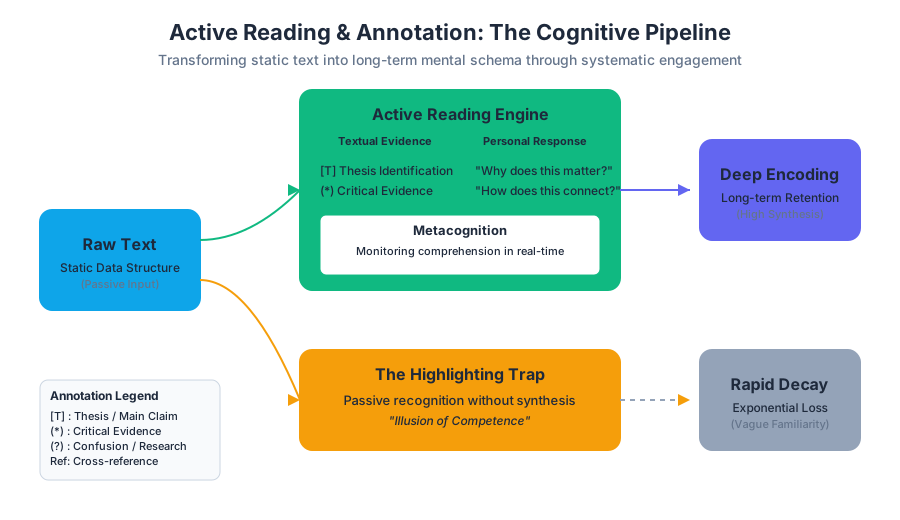
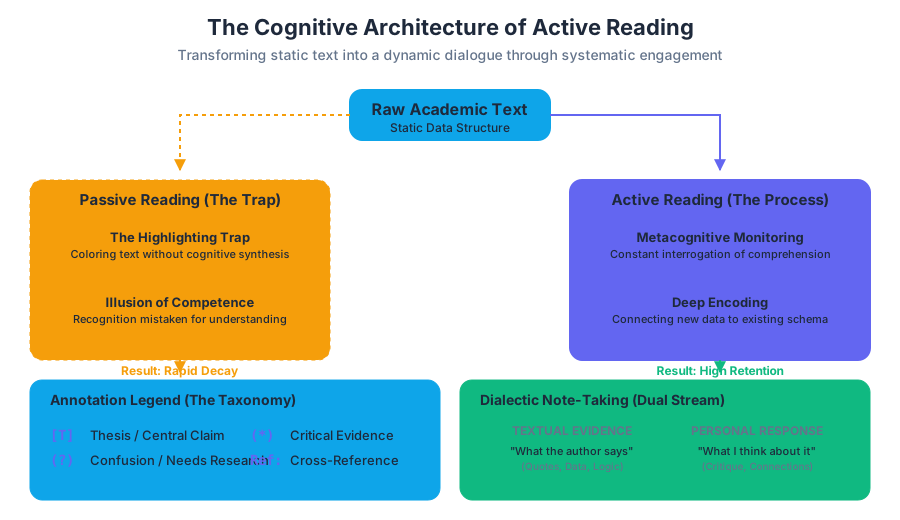
Active reading is the cognitive process of engaging with a text through deliberate interrogation, systematic marking, and recursive reflection. Unlike passive reading—where the eye traverses the page to absorb information through osmosis—active reading treats the text as a dynamic data structure that must be parsed, indexed, and integrated into the reader's existing mental schema.
At the heart of this process lies Annotation, the physical or digital act of inscribing the text with marginalia, symbols, and queries. Annotation transforms a static document into a "living" dialogue between the author and the reader. In a university setting, this is not merely a study habit; it is a foundational requirement for textual analysis, information literacy, and the synthesis of complex academic arguments.
The Cognitive Architecture of Active Reading
Active reading is governed by the principle of metacognition—thinking about one’s own thinking. When a reader engages in active reading, they are simultaneously processing the semantic content of the text and monitoring their level of comprehension.
The Highlighting Trap vs. Deep Encoding
A common pitfall for novice readers is "passive highlighting." Research in cognitive psychology suggests that the act of highlighting without accompanying marginalia provides a false sense of security, often referred to as the illusion of competence. The reader feels they have "captured" the information, but because the brain has not performed the heavy lifting of synthesis, the information remains in short-term storage and is quickly purged.
Definition: Deep Encoding The process by which new information is integrated into long-term memory by connecting it to existing knowledge through meaningful associations, such as paraphrasing or critical questioning.
| Feature | Passive Reading | Active Reading |
|---|---|---|
| Goal | Completion of the text | Comprehension and Synthesis |
| Physical Action | Continuous eye movement, occasional highlighting | Pausing, underlining, writing marginalia |
| Cognitive Load | Low (recognition-based) | High (generative-based) |
| Outcome | Vague familiarity | Structural understanding and recall |
| Retention | Exponential decay over 24 hours | High retention through "hooks" |
Annotation and Marginalia: The Taxonomy of Marks
Annotation is the specific practice of writing notes, questions, and symbols directly on the text. Marginalia refers specifically to the notes written in the margins. Effective annotation requires a systematic approach, often involving a personalized "key" or "legend" of symbols.
The Mechanics of Annotation
- Thesis Identification: Locating the central claim (the thesis statement) and marking it with a specific symbol (e.g.,
[T]). - Evidence Tracking: Identifying the data, quotes, or logic used to support the thesis.
- Structural Mapping: Marking transitions, introductions of new concepts, and conclusions.
- Interrogative Marking: Placing a
?next to confusing passages or areas that require further research.
A Standardized Annotation Legend
| Symbol | Meaning | Usage |
|---|---|---|
| Underline | Key Point | Used for major definitions or central arguments. |
| [Bracket] | Thesis/Claim | Used to isolate the author's primary objective. |
| (?) | Confusion | Marks a term or concept that needs a dictionary or instructor's help. |
| (*) | Critical Evidence | Highlights data or quotes that prove the author's point. |
| Ref: | Connection | Cross-references this passage to another page or external text. |
Dialectic Note-Taking: The Dual-Stream System
A Dialectic approach to reading involves a formal dialogue between the reader and the text. This is most commonly implemented through a two-column note-taking system. The term "dialectic" stems from the Greek dialektikē, referring to the art of investigating the truth through reasoned argument.
Implementation Algorithm
The reader divides a page into two vertical columns:
- Left Column (Textual Evidence): Direct quotes, summaries of the author's points, and specific page numbers. This represents "What the author says."
- Right Column (Personal Response): Questions, critiques, connections to other readings, and emotional or intellectual reactions. This represents "What I think about it."
Worked Example: Analyzing a Rhetorical Text
Suppose a student is reading a text on "The Ethics of AI."
| Textual Evidence (Left) | Personal Response (Right) |
|---|---|
| "The black-box nature of neural networks precludes true accountability" (p. 42). | If we can't see the 'why,' can we ever assign legal liability? Compare to 'Strict Liability' in tort law. |
| The author cites the 2018 COMPAS algorithm case as evidence of bias. | Is this bias inherent in the code or a reflection of the training data? The author seems to blame the math, not the data source. |
Technical Implementations: Digital Annotation and E-Book Systems
In the modern academic environment, much reading occurs via E-book readers (Kindle, Adobe Digital Editions) or web-based platforms. Digital annotation offers capabilities that physical paper cannot, such as full-text search, OCR (Optical Character Recognition), and metadata export.
Automated Text Analysis (Python Implementation)
For advanced students and researchers, "active reading" can be augmented by computational tools. The following Python script demonstrates a low-level implementation of a Readability Scorer, which helps a reader identify particularly dense passages that may require more intensive annotation.
import re
import math

class TextAnalyzer:
    """
    Analyzes text density to identify passages requiring
    high-intensity active reading (Gunning Fog Index).
    """
    def __init__(self, text):
        self.text = text
        self.sentences = re.split(r'[.!?]+', text)
        self.words = [w for w in re.findall(r'\w+', text) if w]

    def count_syllables(self, word):
        word = word.lower()
        count = 0
        vowels = "aeiouy"
        if word[0] in vowels:
            count += 1
        for index in range(1, len(word)):
            if word[index] in vowels and word[index - 1] not in vowels:
                count += 1
        if word.endswith("e"):
            count -= 1
        if count == 0:
            count += 1
        return count

    def calculate_fog_index(self):
        avg_sentence_len = len(self.words) / len(self.sentences)
        complex_words = [w for w in self.words if self.count_syllables(w) >= 3]
        percent_complex = (len(complex_words) / len(self.words)) * 100

        # Fog Index Formula: 0.4 * (avg_sentence_length + percentage_complex_words)
        return 0.4 * (avg_sentence_len + percent_complex)

# Example Usage
sample_text = "The epistemological framework of the dialectic method necessitates a rigorous interrogation of the text."
analyzer = TextAnalyzer(sample_text)
print(f"Complexity Score: {analyzer.calculate_fog_index():.2f}")
The Retention Decay Formula
The necessity of active reading can be modeled mathematically. Without active engagement (rehearsal and annotation), retention follows an exponential decay curve, often modeled as:
R = e^{-\frac{t}{S}}
Where:
Ris stability (retention)eis Euler's numbertis time elapsedSis the "strength" of the initial memory (determined by the depth of encoding during reading)
Active reading and annotation significantly increase the value of S, slowing the rate of decay.
Vocabulary Development and Lexical Density
Active reading requires the reader to identify and resolve "lexical gaps"—words they do not know. In a college-level text, missing even one key term can derail the comprehension of an entire paragraph.
The "Lookup and Link" Method
- Identify: Circle the unfamiliar word.
- Contextualize: Attempt to guess the meaning based on surrounding sentences.
- Verify: Use a dictionary to find the precise definition.
- Inscribe: Write the definition in the margin near the word. This creates a permanent link in the text's physical space.
Comparison of E-book Annotation Tools
| Tool | Platform | Best For | Export Format |
|---|---|---|---|
| Hypothes.is | Web/Browser | Collaborative reading | JSON / API |
| LiquidText | iPad/Mac | Visual mapping of ideas | PDF / Docx |
| Zotero | Desktop | Academic citations | BibTeX / Markdown |
| Kindle | Hardware/App | Linear narrative reading | Email / HTML |
From Reading to Writing: The Thesis Extraction Pipeline
The ultimate goal of active reading is to prepare the reader to produce their own text. Annotation serves as a "trail of breadcrumbs" that leads back to the author's core arguments.
The Extraction Workflow (CLI Example)
If a student uses digital tools and saves their annotations in a Markdown or text-based format, they can use command-line tools to quickly aggregate their thoughts for an essay draft.
# Extract all lines marked as 'Thesis' or 'Evidence' from a notes file
grep -E "\[T\]|\*" reading_notes.md > thesis_draft_outline.txt

# Count the frequency of recurring themes in marginalia
grep -oE "\[[A-Za-z]+\]" reading_notes.md | sort | uniq -c

# Search for specific vocabulary words marked with '?' to create a study list
grep "\?" reading_notes.md | awk -F' ' '{print $1, $2, $3}' > vocab_list.txt
Common Pitfalls and Anti-Patterns
Even with the best intentions, readers can fall into "pseudo-active" habits that mimic the appearance of work without the cognitive benefits.
- Over-Annotation: Marking every line. If everything is highlighted, nothing is highlighted. This dilutes the "signal-to-noise" ratio.
- Mechanical Marking: Underlining without thinking. This occurs when the reader is tired and goes through the motions of marking without actually processing the meaning.
- Ignoring the "Why": Writing "Interesting!" in the margin. This is a descriptive note, not an analytical one. An analytical note would explain why it is interesting or how it relates to the thesis.
- The "Dictionary Delay": Waiting until the end of a chapter to look up words. By then, the context of the word's usage is often lost.
Theorem of Selective Annotation The utility of an annotation is inversely proportional to the percentage of the page it covers. Optimal annotation targets the "pivots" of an argument—the specific points where the logic shifts or the evidence is presented.
Uncovering Deeper Meaning
Key concepts: Surface vs. Deeper Meaning · Themes and Symbols · Reader-Text Conversation · Personal Identity
Distinguishes between surface-level plot/facts and the deeper themes, symbols, and character interactions.
Uncovering Deeper Meaning
In the academic ecosystem, a text is not merely a sequence of characters or a static document; it is a dynamic vessel of information. While the colloquial definition of a text often limits it to books or essays, the academic definition expands this to include any medium that conveys meaning—films, songs, paintings, advertisements, and even architectural structures. To "read" a text at a college level is to engage in a process of hermeneutics, or the theory and methodology of interpretation. This process requires moving beyond the literal "surface" to extract the "buried treasure" of underlying themes, symbols, and rhetorical strategies.
The Architecture of Meaning: Surface vs. Deep
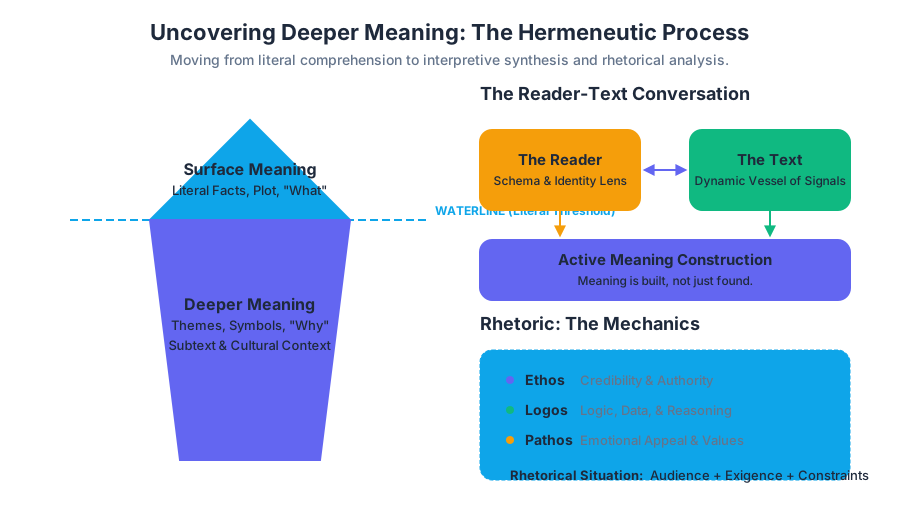
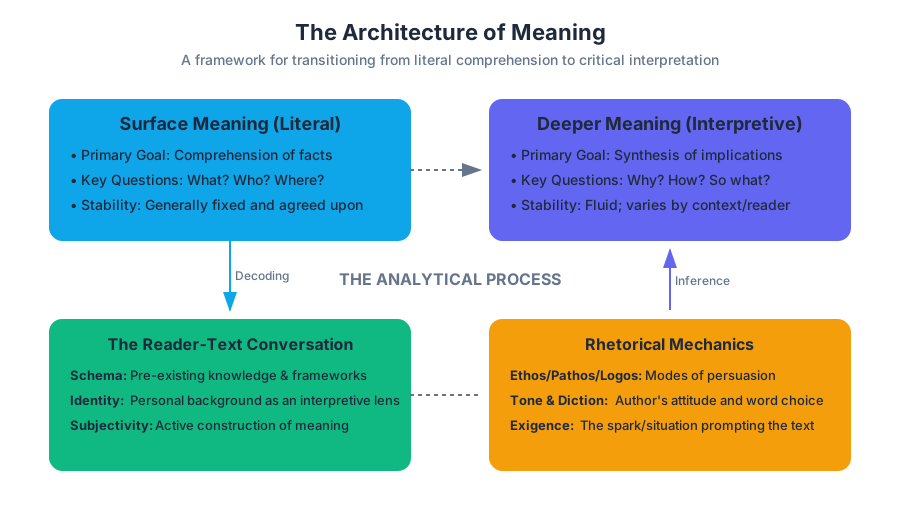
The distinction between Surface Meaning and Deeper Meaning is the foundation of critical analysis. Think of a text as an iceberg: the visible portion above the waterline represents the literal events, facts, and data, while the massive structure beneath represents the subtext, cultural context, and authorial intent.
Definition: Surface Meaning The literal, explicit content of a text. It answers the "what," "who," and "where" of a narrative or argument. In a technical document, this is the raw data; in a story, it is the plot.
Definition: Deeper Meaning The implicit, abstract themes and messages. It answers the "why" and "how." It involves identifying patterns, symbols, and the broader social or philosophical implications of the work.
Comparative Analysis of Meaning Layers
| Feature | Surface Meaning (Literal) | Deeper Meaning (Interpretive) |
|---|---|---|
| Primary Goal | Comprehension of facts and sequence. | Synthesis of themes and implications. |
| Key Questions | What happened? Who is involved? | Why does this matter? What does it symbolize? |
| Cognitive Load | Lower; focuses on decoding and recall. | Higher; focuses on evaluation and inference. |
| Stability | Generally fixed; most readers agree on facts. | Fluid; varies based on reader perspective and context. |
| Example (The Great Migration) | Millions of African Americans moved North. | A quest for agency amidst systemic economic determinism. |
The Reader-Text Conversation
Interpretation is not a passive reception of data; it is an active Reader-Text Conversation. This concept posits that meaning is not "found" in the text like a fossil, but is "constructed" through the interaction between the author’s signals and the reader’s schema (pre-existing knowledge and frameworks).
The Role of Personal Identity
Your personal background—including your gender, ethnicity, socioeconomic status, and life experiences—acts as a lens through which you view a text. This is why two readers can walk away from the same poem with radically different interpretations.
- Subjectivity: Acknowledging that your emotional response is a valid starting point for analysis.
- Self-Awareness: Critically questioning why you reacted to a specific passage. Is it because of the author’s tone, or a personal bias you hold?
- Identity Markers: Using gender-neutral language and inclusive pronouns in your own writing reflects an awareness of the diverse "conversation" happening in the modern academic sphere.
Rhetoric: The Mechanics of Persuasion
To uncover deeper meaning, one must understand Rhetoric—the art of speaking or writing effectively and persuasively. Analyzing rhetoric involves looking at how an author manipulates language to achieve a specific Author’s Purpose.
The Rhetorical Triangle and Beyond
While traditional rhetoric focuses on Ethos (credibility), Pathos (emotion), and Logos (logic), modern analysis also considers the Rhetorical Situation: the intersection of the audience, the exigence (the spark that prompted the writing), and the constraints (cultural or medium-based limitations).
Rhetorical Components Table
| Component | Definition | Analytical Focus |
|---|---|---|
| Main Point | The central claim or thesis. | Is the claim explicit or must it be inferred? |
| Author’s Purpose | The reason for writing (to inform, persuade, entertain). | What change does the author want to see in the audience? |
| Tone | The author's attitude toward the subject. | How do word choice and syntax convey emotion? |
| Audience Awareness | The intended recipient of the message. | What assumptions does the author make about the reader's knowledge? |
| Jargon | Specialized language used by a specific group. | Does the jargon exclude outsiders or establish authority? |
Implementation: Analyzing Textual Sentiment
In modern digital humanities, we can use computational tools to begin the "surface" analysis before diving into the "deep" interpretation. The following Python example demonstrates a basic implementation of sentiment and frequency analysis, which can highlight the "Tone" of a text.
import nltk
from nltk.sentiment import SentimentIntensityAnalyzer
from collections import Counter

# Low-level text analysis implementation
def analyze_text_structure(text_body):
    """
    Analyzes the surface-level emotional tone and word frequency
    to provide a baseline for deeper rhetorical analysis.
    """
    # Initialize NLTK tools
    sia = SentimentIntensityAnalyzer()
    words = nltk.word_tokenize(text_body.lower())

    # Filter for significant tokens (removing stop words in a real scenario)
    meaningful_words = [word for word in words if word.isalnum()]

    # Calculate Sentiment (Surface Tone)
    sentiment_score = sia.polarity_scores(text_body)

    # Calculate Word Frequency (Potential Themes)
    frequency_map = Counter(meaningful_words)

    return {
        "tone_metrics": sentiment_score,
        "top_keywords": frequency_map.most_common(5)
    }

# Example usage with a snippet regarding the Great Migration
sample_text = "The migrants were pushed by the boll weevil and pulled by the promise of northern wages."
results = analyze_text_structure(sample_text)
print(f"Tone Analysis: {results['tone_metrics']}")
print(f"Key Symbols/Terms: {results['top_keywords']}")
Case Study: Jacob Lawrence’s "Migration Series"
A prime example of uncovering deeper meaning is the analysis of Jacob Lawrence’s Migration Series. On the surface, these sixty tempera paintings depict the mass movement of African Americans from the rural South to the urban North. However, a deep dive reveals a complex interplay between Economic Determinism and Collective Ambition.
Symbols and Themes in Lawrence’s Work
Lawrence uses specific visual elements—Migration Colors (vibrant greens, yellows, and oranges) and Naturalism vs. Modernism—to convey the emotional weight of the journey.
- Push Factors: Labor shortages, crop failure (the boll weevil), and systemic violence.
- Pull Factors: The "promise" of the North, industrial jobs, and the hope for social equity.
- The Deeper Message: While the migrants were "pushed" by economic forces, Lawrence emphasizes their agency. They were not just victims of history; they were architects of their own destiny.
Technical Execution: The "Sleuth" Method
To move from passive reading to active analysis, one must adopt the mindset of a detective. This involves a non-linear approach to the text.
1. Pre-reading (The Investigation)
Before reading the first word, scan the text for visual clues.
- Title Analysis: What does the title suggest about the scope?
- Author Credentials: Is the author a journalist, a scientist, or a witness?
- Headings and Pull-outs: These often function as the "skeleton" of the argument.
- Visual Aids: Captions and charts often contain the densest information.
2. Annotation and Schema Building
Annotation is the physical manifestation of the reader-text conversation. By marking the text, you are "talking back" to the author.
- Vocabulary Development: Looking up unfamiliar words is non-negotiable. In college-level texts, a single misunderstood word can derail an entire argument.
- Note-taking: Summarizing paragraphs in the margins helps with information retention and forces you to synthesize the author's points.
3. Mathematical Representation of Interpretation
We can model the process of interpretation as a Bayesian update. Your initial understanding (Prior) is modified by new evidence found in the text (Likelihood), resulting in a new, deeper understanding (Posterior).
P(Meaning | Text) = \frac{P(Text | Meaning) \times P(Meaning)}{P(Text)}
In this model:
- $P(Meaning | Text)$ is the probability that your interpretation is correct given the textual evidence.
- $P(Meaning)$ is your Schema or prior knowledge.
- $P(Text | Meaning)$ is how well the specific words in the text support your interpretation.
Structural Integrity: Citation and Evidence
A deep-dive analysis is only as strong as the evidence supporting it. In academic writing, this requires rigorous Information Literacy and adherence to citation standards like MLA 8th Edition.
The Container System
MLA 8 introduced the concept of "containers." A source (like an article) is held within a container (like a journal), which might be held within a second container (like a database).
MLA 8th Edition Component Map
| Order | Element | Example |
|---|---|---|
| 1 | Author | De Souza, Michael. |
| 2 | Title of Source | "Economic Determinism in Art." |
| 3 | Title of Container | Journal of African American Studies |
| 4 | Other Contributors | edited by Sarah Miller, |
| 5 | Version | vol. 12, |
| 6 | Number | no. 4, |
| 7 | Publisher | Oxford UP, |
| 8 | Publication Date | 2016, |
| 9 | Location | pp. 45-60. |
Database Schema for Works Cited
If we were to represent a Works Cited page as a relational database, it might look like this:
CREATE TABLE Sources (
    source_id INT PRIMARY KEY,
    author_last VARCHAR(255),
    author_first VARCHAR(255),
    title_of_source TEXT NOT NULL,
    container_id INT,
    pub_date DATE,
    location_url_page TEXT,
    FOREIGN KEY (container_id) REFERENCES Containers(container_id)
);

CREATE TABLE Containers (
    container_id INT PRIMARY KEY,
    container_title VARCHAR(255),
    publisher VARCHAR(255),
    version_vol VARCHAR(50)
);

-- Example Query: Retrieve all sources from a specific container
SELECT author_last, title_of_source
FROM Sources
JOIN Containers ON Sources.container_id = Containers.container_id
WHERE Containers.container_title = 'The Word on College Reading and Writing';
Common Pitfalls in Analysis
Even experienced readers encounter obstacles when trying to uncover deeper meaning. Recognizing these "anti-patterns" is crucial for academic success.
- The Literal Trap: Focusing so much on "what happened" that you fail to see the symbolic significance.
- Confirmation Bias: Only noticing evidence that supports your pre-existing beliefs while ignoring counter-arguments in the text.
- Over-reading: Assigning deep symbolic meaning to every minor detail (e.g., "the curtains were blue because the author was depressed," when the author just liked the color blue).
- Ignoring the Rhetorical Situation: Analyzing a text without considering when it was written or who it was written for. A text from 1920 cannot be judged solely by 2024 social standards without acknowledging the historical context.
Conclusion: The Path to Mastery
Uncovering deeper meaning is a skill that improves with Reading Stamina and habit formation. By creating an optimal study environment, managing distractions, and engaging in daily reading practice across a variety of genres, you build the cognitive muscles required for high-level analysis. Whether you are analyzing a 60-panel painting series by Jacob Lawrence or a technical manual on systems architecture, the goal remains the same: to move past the surface and engage with the core ideas that shape our world.
Post-Reading and Reflection
Key concepts: Post-reading reflection · Minute paper · Dialectic Notes · Memory retention
Explains the importance of processing information after reading through journals and structured notes.
Post-Reading and Reflection
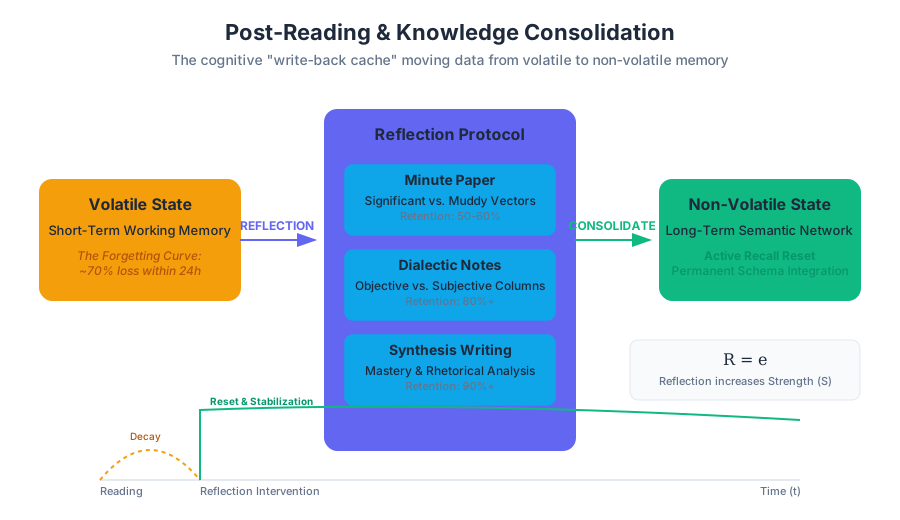
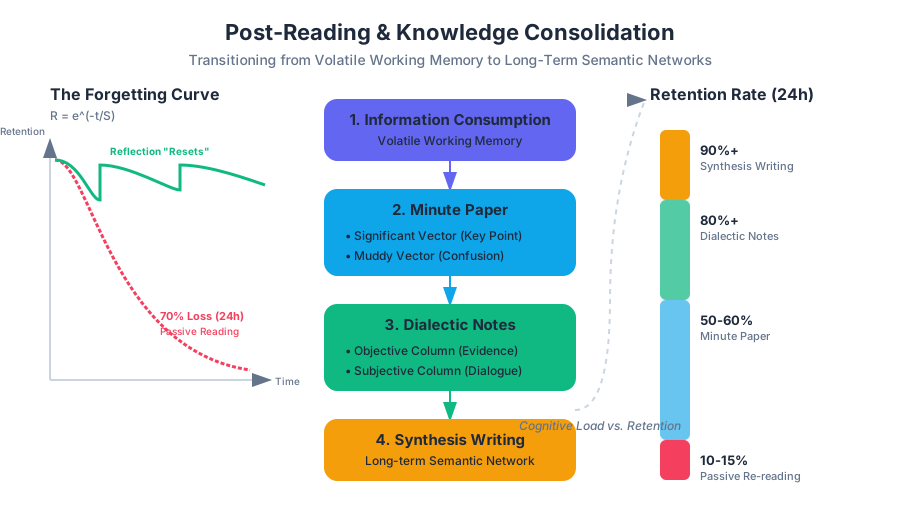
The cognitive process of reading does not terminate at the final period of a text. In high-level academic and professional contexts, the period immediately following the consumption of information—the Post-Reading and Reflection phase—is the most critical window for knowledge consolidation. Without a structured reflection protocol, the "Forgetting Curve" begins to degrade information retention almost immediately, often resulting in a loss of up to 70% of new data within 24 hours.
Post-reading is the "write-back cache" of the human cognitive architecture. It is the process of moving information from volatile short-term working memory into the non-volatile long-term semantic network. This phase involves synthesizing the author’s rhetoric, evaluating evidence, and reconciling new data with existing mental schemas.
The Cognitive Mechanics of Retention
To understand why post-reading reflection is mandatory, one must examine the mechanics of Memory Retention. Learning is not a passive recording; it is an active reconstruction. When we reflect, we are performing Active Recall, which strengthens the neural pathways associated with the information.
The Forgetting Curve Theorem: In the absence of active rehearsal or reflection, the strength of a memory trace ($S$) decays exponentially over time ($t$), expressed as $R = e^{-t/S}$, where $R$ is stability and $S$ is the relative strength of memory.
By intervening with reflection techniques immediately after reading, we effectively "reset" the decay curve, increasing the half-life of the information.
| Retention Method | Cognitive Load | Retention Rate (24h) | Primary Use Case |
|---|---|---|---|
| Passive Re-reading | Low | 10-15% | Surface-level familiarity |
| Highlighting | Low | 20% | Identification of key terms |
| Minute Paper | Medium | 50-60% | Immediate synthesis |
| Dialectic Notes | High | 80%+ | Deep critical analysis |
| Synthesis Writing | Very High | 90%+ | Mastery and application |
The Minute Paper: Rapid Synthesis
The Minute Paper is a high-efficiency heuristic used to capture the "essence" of a text before the details begin to blur. It is designed to force the reader to prioritize information hierarchy.
Implementation
A Minute Paper typically addresses two fundamental vectors:
- The Significant Vector: What was the most important thing you learned?
- The Muddy Vector: What remains the most confusing or "muddiest" point?
By identifying the "muddiest point," the reader engages in Metacognition—thinking about their own thinking. This identifies gaps in the mental model that require immediate "patching" through further research or discussion.
# A simple simulation of the Forgetting Curve and the impact of Reflection
import numpy as np
import matplotlib.pyplot as plt

def memory_decay(t, strength):
    """Calculates retention based on Ebbinghaus's formula."""
    return np.exp(-t / strength)

def simulate_reflection(days, reflection_points):
    time = np.linspace(0, days, 1000)
    retention = []
    current_strength = 1.0  # Initial strength

    for t in time:
        # If we hit a reflection point, we boost the strength
        if any(np.isclose(t, rp, atol=0.05) for rp in reflection_points):
            current_strength += 1.5

        # Calculate decay since last boost
        # Simplified for visualization: retention resets to 1.0 but decays slower
        decay_val = memory_decay(t % 1 if t > 0 else 0, current_strength)
        retention.append(decay_val)

    return time, retention

# Reflection at 0.5 days (Minute Paper) and 2 days (Dialectic Review)
t, r = simulate_reflection(7, [0.5, 2.0])
# Output would show retention spikes and slower decay slopes.
Dialectic Notes: The Epistemic Dialogue
Dialectic Notes (also known as Double-Entry Journals) represent a more rigorous, structural approach to reflection. This method moves beyond mere summary into the realm of Rhetorical Analysis.
The Dual-Column Structure
The page is divided into two distinct zones:
- The Objective Column (Left): Direct quotes, specific data points, and the author's primary claims. This represents the "textual evidence."
- The Subjective Column (Right): The reader's response, critiques, connections to other texts, and questions. This represents the "interrogative layer."
This structure forces a "dialogue" between the reader and the author. It prevents the reader from being a passive recipient of information and instead positions them as a peer reviewer.
| Left Column (The Text) | Right Column (The Reflection) |
|---|---|
| "Economic determinism was the primary driver of the Great Migration." | Does this ignore the 'Push' factors of social violence? How does Lawrence's art reflect this? |
| MLA 8th Edition focuses on 'Containers' for citations. | This modularity makes sense for digital media where the 'container' (e.g., a database) changes but the source doesn't. |
| Author uses a formal, academic tone with heavy jargon. | The jargon might alienate the general audience, suggesting the text is intended for a specialized 'in-group.' |
Synthesis and Rhetorical Analysis
Post-reading is where Synthesis occurs—the act of combining disparate elements to form a coherent whole. In the context of academic writing, such as the analysis of Jacob Lawrence’s Migration Series, synthesis involves looking at the "Migration Colors" and "Naturalism vs. Modernism" and connecting them to the socio-economic "Push and Pull Factors."
Rhetoric and Audience Awareness
Reflection must also account for Rhetoric: the art of persuasion. An expert reader reflects on:
- Author’s Purpose: Is the text meant to inform, persuade, or entertain?
- Audience Assumptions: What does the author assume the reader already knows?
- Tone and Language: How does the choice of words (jargon vs. plain language) influence the perceived Credibility (Ethos) of the piece?
Definition: Rhetorical Situation: The set of circumstances (Author, Audience, Topic, Purpose, and Context) that surround a piece of communication. Reflection is the process of deconstructing this situation.
\text{Synthesis} = \sum (\text{Textual Evidence}) + \text{Prior Knowledge} \times \text{Critical Reflection}
Information Literacy and Source Integrity
A key component of post-reading in the modern era is Information Literacy. This involves verifying the Evidence and Credibility of the source. After reading, one must reflect on the "Container" of the information—a concept central to MLA 8th Edition citation.
The Container Logic
In MLA 8, the "Container" is the larger work in which a source is found (e.g., a website containing an article, or a database containing a journal). Reflecting on the container helps the reader evaluate the source's authority.
# Example of a structured reflection entry in a digital Zettelkasten (Markdown/YAML)
---
title: "Economic Determinism in Jacob Lawrence"
date: 2023-10-27
source: "De Souza, Professor Miller"
tags: [Great-Migration, Art-History, Economics]
---

## Summary
The paper argues that while economic factors (labor shortages) were the catalyst,
the 'Migration Series' emphasizes collective ambition over mere determinism.

## Dialectic Reflection
- **Point**: Lawrence uses 60 panels to show sequence.
- **Counter-point**: Does the sequence imply an inevitable 'naturalism' or a
  constructed 'modernist' narrative?
- **Connection**: Relates to the 'Push/Pull' factors discussed in Sociology 101.

## Muddiest Point
How does the specific use of 'Migration Colors' (primary, bold) contrast
with the often bleak economic reality described in the captions?
Common Pitfalls in Post-Reading
Even experienced researchers fall into traps during the reflection phase.
- The Summary Trap: Writing a summary instead of a reflection. A summary repeats what the author said; a reflection analyzes how and why they said it.
- Confirmation Bias: Only reflecting on points that agree with your existing worldview.
- Delayed Reflection: Waiting too long to reflect. The "Minute Paper" must literally happen within minutes to capture the "Muddy Points" before they are forgotten.
- Ignoring Jargon: Skipping over specialized terms. Post-reading is the time to look up jargon and integrate it into your vocabulary.
Advanced Techniques: The Reading Journal and Zettelkasten
For long-term academic growth, Reading Journals provide a chronological record of intellectual development. Unlike Dialectic Notes, which are usually text-specific, a journal allows for cross-textual reflection.
The Zettelkasten Method
A "Slip-box" or Zettelkasten is a system where reflections are broken down into "atomic notes." Each note contains one idea, its source, and its connection to other notes. This transforms post-reading from a static exercise into a dynamic, growing "second brain."
| Feature | Reading Journal | Zettelkasten |
|---|---|---|
| Structure | Chronological | Networked/Linked |
| Scope | Broad reflections | Atomic ideas |
| Retrieval | Linear search | Tag/Link based |
| Goal | Processing experience | Knowledge production |
Final Synthesis: Connecting the Dots
Post-reading and reflection turn a "text" (which, as defined in college reading, can be anything from a book to a song) into Knowledge. Whether you are analyzing the "Great Migration" or learning "MLA 8th Edition" citation rules, the process is the same:
- Deconstruct the rhetoric.
- Analyze the evidence.
- Synthesize the main points.
- Reflect on the gaps in your understanding.
This habit of mind is what distinguishes a "student" from a "scholar." It is the difference between having read something and having learned it.
# A CLI-based workflow for triggering a post-reading reflection prompt
# Usage: ./reflect.sh "Title of the Article"

#!/bin/bash

ARTICLE_TITLE=$1
TIMESTAMP=$(date +"%Y-%m-%d %H:%M")
FILENAME="reflections/$(echo $ARTICLE_TITLE | tr ' ' '_').md"

mkdir -p reflections

cat <<EOF > "$FILENAME"
# Reflection: $ARTICLE_TITLE
Date: $TIMESTAMP

## 1. The Most Significant Point
-

## 2. The Muddiest Point (Confusion)
-

## 3. Rhetorical Analysis
- Purpose:
- Audience:
- Tone:

## 4. Connections
- How does this relate to previous readings?
EOF

vim "$FILENAME"
Rhetorical Analysis
Key concepts: Rhetoric · Author's Purpose · Tone and Bias · Evidence and Credibility · Jargon
Introduces rhetoric as the art of persuasion and provides tools for analyzing an author's purpose and tone.
Rhetorical Analysis
Rhetorical analysis is the systematic study of how writers and speakers use language to influence an audience. Rather than focusing solely on what a text says (its content), rhetorical analysis investigates how a text works (its delivery, structure, and persuasive strategies). In an academic context, rhetoric is not a pejorative term for "empty speech," but rather a sophisticated toolkit for navigating the "Rhetorical Situation"—the complex intersection of author, audience, message, and context.
The Foundations of Rhetorical Theory
At its core, rhetoric is the art of effective or persuasive communication. To analyze a text rhetorically is to deconstruct the choices an author makes to achieve a specific effect. This process requires moving beyond "linear reading" (reading for plot or basic information) and engaging in "critical reading," where the reader acts as a detective looking for the mechanics of persuasion.
Definition: The Rhetorical Situation The Rhetorical Situation consists of the Exigence (the spark or catalyst that prompts the writing), the Audience (the intended recipients of the message), the Constraints (the limitations or expectations of the medium/genre), and the Purpose (the desired outcome).
The Rhetorical Triangle
Persuasion is traditionally categorized into three primary modes of appeal, often referred to as the Aristotelian Triad. A balanced rhetorical strategy often leverages all three, though the weight of each depends on the audience and purpose.
| Appeal | Technical Term | Focus | Mechanism |
|---|---|---|---|
| Logic | Logos |
The Message | Facts, statistics, syllogisms, and rational reasoning. |
| Ethics | Ethos |
The Author | Credibility, authority, and the moral character of the speaker. |
| Emotion | Pathos |
The Audience | Values, beliefs, sympathies, and emotional triggers. |
Author's Purpose vs. Main Point
A common pitfall in rhetorical analysis is conflating the Main Point with the Author's Purpose. While they are intrinsically linked, they serve different functions within the text's architecture.
- Main Point (The "What"): The central claim, thesis, or primary information the author wants the reader to understand. It is the "payload" of the communication.
- Author's Purpose (The "Why"): The underlying intent behind the communication. Does the author want to inform, persuade, entertain, satirize, or call to action?
Distinguishing Content from Intent
To identify the purpose, one must look at the "action verbs" of the text. If a text provides a series of instructions on how to set up a server, the main point is the configuration steps, but the purpose is to instruct or enable. If a text argues that the Great Migration was driven by economic determinism, the main point is the historical causality, but the purpose may be to reframe a historical narrative or challenge existing scholarship.
Tone, Bias, and Semantic Choice
Tone refers to the author's attitude toward the subject matter or the audience. It is conveyed through Diction (word choice), Syntax (sentence structure), and Imagery. In rhetorical analysis, identifying tone is essential for uncovering Bias—the inclination toward a particular perspective that may inhibit neutral judgment.
Analyzing Tone via Sentiment and Diction
Authors select words not just for their denotation (literal meaning) but for their connotation (emotional associations). Consider the difference between describing a policy as "flexible" versus "inconsistent." Both might describe the same set of facts, but the rhetorical effect is polar opposite.
To analyze tone programmatically, one might look at the frequency of "loaded" terms. In the following Python example, we see a basic implementation of how one might begin to quantify the "rhetorical weight" of a text by analyzing word frequency against a known lexicon of biased terms.
import collections
import re

def analyze_rhetorical_weight(text, bias_lexicon):
    """
    Analyzes a text for rhetorical bias by comparing word usage
    against a predefined lexicon of 'loaded' terms.
    """
    # Normalize text: lowercase and remove non-alphanumeric characters
    words = re.findall(r'\w+', text.lower())
    word_counts = collections.Counter(words)

    analysis_report = {
        "total_words": len(words),
        "bias_hits": {},
        "intensity_score": 0.0
    }

    total_hits = 0
    for word, count in word_counts.items():
        if word in bias_lexicon:
            analysis_report["bias_hits"][word] = count
            # Weight the hit by the lexicon's intensity value
            total_hits += count * bias_lexicon[word]

    if len(words) > 0:
        analysis_report["intensity_score"] = (total_hits / len(words)) * 100

    return analysis_report

# Example Usage
lexicon = {"radical": 0.8, "disastrous": 0.9, "common-sense": 0.5, "elite": 0.7}
sample_text = "The radical and disastrous policies of the elite ignore common-sense solutions."
report = analyze_rhetorical_weight(sample_text, lexicon)
print(f"Rhetorical Intensity: {report['intensity_score']:.2f}%")
Evidence and Credibility (Ethos and Logos)
A text’s persuasiveness relies heavily on the quality of its Evidence. Rhetorical analysis evaluates evidence not just for its truth value, but for its relevance and sufficiency.
Types of Evidence and Their Rhetorical Functions
Different genres of writing demand different types of evidence. A peer-reviewed scientific paper relies on empirical data, while a personal essay may rely on anecdote.
| Evidence Type | Rhetorical Strength | Common Pitfalls |
|---|---|---|
| Statistical Data | High (Logos); provides a sense of objective scale. | Can be manipulated via "cherry-picking" or lack of context. |
| Expert Testimony | High (Ethos); leverages existing authority. | "Appeal to Authority" fallacy if the expert is outside their field. |
| Anecdotal Evidence | High (Pathos); makes abstract issues relatable. | Not statistically representative; can lead to overgeneralization. |
| Historical Precedent | Moderate; provides context and "lessons learned." | False analogies; assuming the past perfectly predicts the future. |
The Logic of Persuasion
In formal rhetorical analysis, we often look for the underlying logical structure. This can be represented as a Syllogism or an Enthymeme (a syllogism with an unstated assumption).
The mathematical representation of a logical rhetorical claim can be viewed through the lens of probability and Bayesian inference:
P(H|E) = \frac{P(E|H) \cdot P(H)}{P(E)}
In this context:
- $P(H|E)$ is the Credibility of the author's claim ($H$) given the evidence ($E$).
- $P(E|H)$ is the likelihood that we would see this evidence if the claim were true.
- $P(H)$ is the Prior Probability (the audience's existing belief or the claim's inherent plausibility).
- $P(E)$ is the total probability of the evidence occurring.
A rhetorician's goal is to maximize $P(H|E)$ by providing evidence that is highly likely under their claim but unlikely otherwise.
Jargon and Audience Awareness
Jargon is specialized language used by a particular profession or group. In rhetorical analysis, jargon is a double-edged sword.
- As an Ethos Builder: Using technical terms correctly signals to an expert audience that the author is a member of the "in-group." It provides precision and saves time.
- As a Barrier: When writing for a general audience, excessive jargon can alienate readers, creating a "Curse of Knowledge" where the author assumes the reader knows more than they do.
Audience Segmentation
Effective rhetoric requires "Audience Awareness"—the ability to tailor language to the specific knowledge base and values of the reader.
| Audience Type | Knowledge Level | Rhetorical Strategy |
|---|---|---|
| Lay Audience | Low to None | Define all terms; use analogies; focus on "big picture" implications. |
| Managerial | Moderate | Focus on decision-making data; use executive summaries; highlight ROI. |
| Expert/Technical | High | Use precise jargon; focus on methodology; provide raw data/code. |
To identify jargon in a text, a researcher might use a command-line approach to compare the text's vocabulary against a "General English" corpus.
# Extract unique words from a text file and compare against a common word list
# to identify potential technical jargon or specialized vocabulary.

cat document.txt | \
    tr '[:upper:]' '[:lower:]' | \
    grep -oE '\w+' | \
    sort | uniq > doc_words.txt

# Compare with a list of the 5000 most common English words
comm -23 doc_words.txt common_english_5000.txt > potential_jargon.txt

echo "Number of potential jargon terms: $(wc -l < potential_jargon.txt)"
head -n 10 potential_jargon.txt
Case Study: Rhetoric in Visual Text
Jacob Lawrence’s "Migration Series"
Rhetorical analysis is not limited to written words. In an academic sense, a "text" is anything that conveys meaning. Jacob Lawrence’s Migration Series (sixty panels of tempera paintings) serves as a profound example of visual rhetoric.
- Exigence: The mass movement of African Americans from the rural South to the urban North (The Great Migration).
- Main Point: The migration was a complex phenomenon driven by both "push" factors (crop failure, injustice) and "pull" factors (industrial jobs, hope).
- Rhetorical Strategy: Lawrence uses a consistent color palette (Migration Colors) to create a sense of unity across the sixty panels, mirroring the "collective ambition" of the migrants. By using a "Naturalism vs. Modernism" style, he strips away individual facial features in many panels, making the figures representative of a universal experience rather than specific individuals.
- Economic Determinism: The series rhetorically argues that economic forces—labor shortages during WWI—were the primary engine of change, yet it balances this "Logos" with the "Pathos" of the human struggle for dignity.
Common Pitfalls in Rhetorical Analysis
- Summary vs. Analysis: The most common mistake is simply summarizing what the author said instead of explaining how they said it. If your paragraph starts with "The author says..." and ends with a quote, it's likely summary. If it starts with "The author utilizes [strategy] to [effect]...", it is analysis.
- Assuming Intent: We cannot always know what an author was thinking, but we can analyze the effect of their choices. Use phrases like "The text suggests" or "The strategy functions to" rather than "The author thought."
- Ignoring the Counter-Argument: Strong rhetorical analysis looks at how an author handles opposing views. Does the author use a Prolepsis (anticipating an objection and answering it)? If they ignore counter-arguments entirely, their "Ethos" may be weakened for a skeptical audience.
- Misidentifying the Audience: Writing a technical manual for a child and writing it for a senior engineer requires different rhetoric. Failing to identify the intended audience leads to a flawed analysis of whether the text was "effective."
Synthesis: The Reading-Writing Loop
Rhetorical analysis is a recursive process. By deconstructing the work of others, writers become more intentional in their own drafting process. This involves:
- Pre-reading: Scanning titles, headings, and author credentials to build a "schema" (mental framework).
- Annotation: Engaging in a "conversation" with the text by marking up margins with observations on tone and evidence.
- Revision: Applying rhetorical awareness to one's own work—checking for gender-neutral language, ensuring jargon is appropriate for the audience, and verifying that the "Purpose" is clearly supported by the "Main Point."
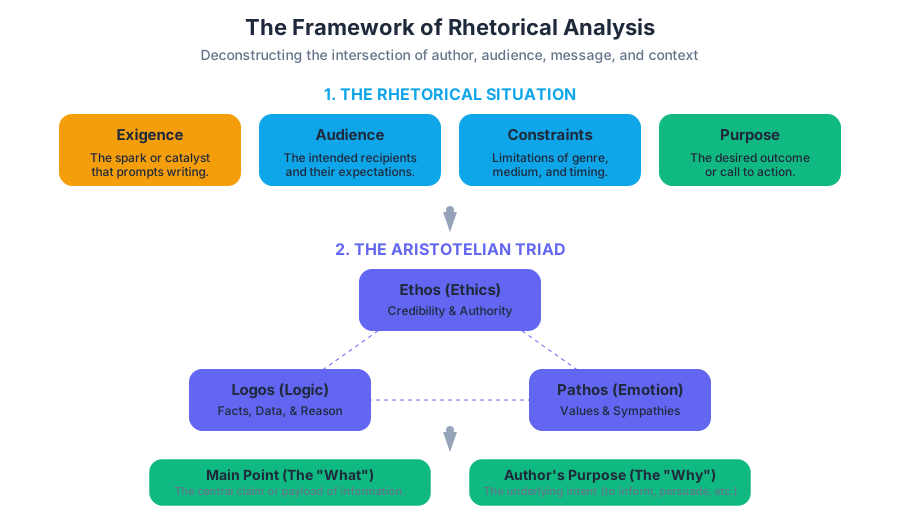
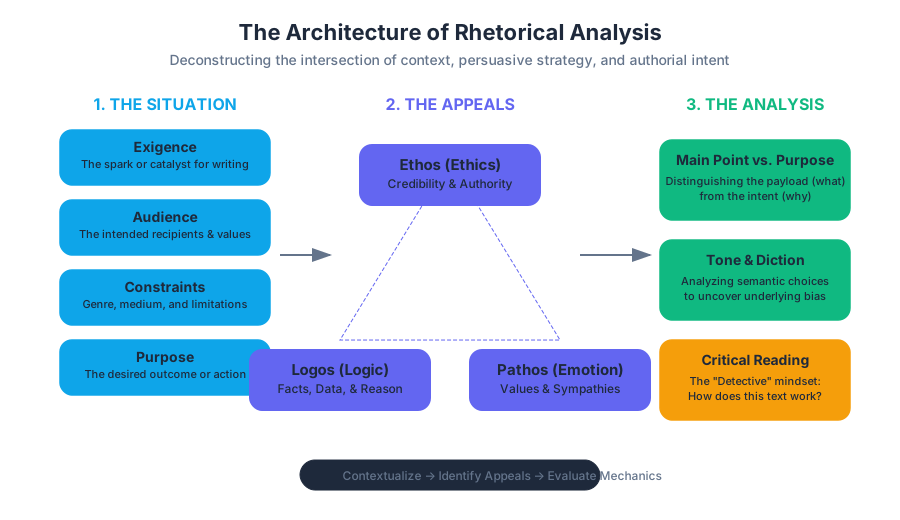
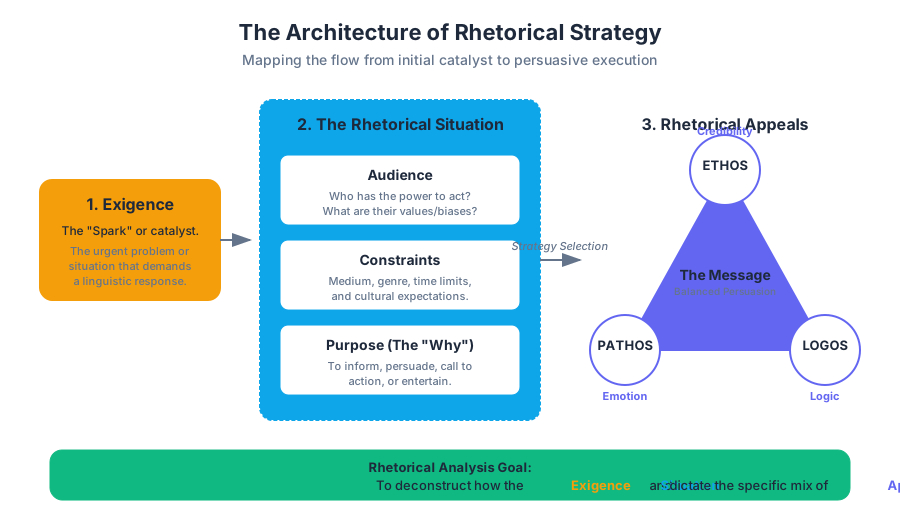
Textual Structure and Form
Key concepts: Form and Function · Organizational Patterns · Textual Anomalies · Paragraph Structure
Examines how the organization and physical layout of a text contribute to its overall message.
Textual Structure and Form
In the domain of academic literacy and information architecture, Textual Structure refers to the intentional arrangement of ideas, evidence, and transitions within a document to achieve a specific rhetorical objective. While "content" represents the raw data or message, "form" serves as the delivery mechanism that dictates how a reader processes that information. Understanding this relationship is not merely an exercise in labeling; it is a prerequisite for high-level critical reading and effective technical communication.
In an academic context, a text is defined broadly as any object that can be "read"—whether it is a traditional peer-reviewed journal article, a sequence of sixty paintings like Jacob Lawrence’s Migration Series, or a structured dataset. The structure of these texts is rarely accidental. It is a response to the constraints of the medium, the expectations of the audience, and the complexity of the subject matter.
Form and Function: The Architecture of Meaning
The principle of Form and Function posits that the physical or logical layout of a text should directly support its communicative purpose. In technical writing, form follows function to minimize cognitive load. In creative or rhetorical writing, form may be manipulated to create emphasis, tension, or a specific emotional resonance.
The Structural Axiom: The effectiveness of a text is proportional to the alignment between its organizational schema and the reader's cognitive "schema"—the mental framework used to organize and interpret information.
The Interplay of Medium and Message
Different media require different structural strategies. A non-linear reference tool, such as The Word on College Reading and Writing, is structured as an Open Educational Resource (OER), allowing users to jump between sections like "The Writing Process" and "Information Literacy" without losing context. This contrasts with a narrative essay, which relies on a linear progression to build an argument.
| Feature | Traditional Linear Text | Non-Linear/OER Text | Visual/Sequential Text (e.g., Lawrence) |
|---|---|---|---|
| Primary Goal | Argumentative Persuasion | Just-in-time Reference | Narrative Synthesis |
| Navigation | Sequential (Start to Finish) | Hyperlinked/Topical | Visual Flow/Captions |
| Structural Unit | The Paragraph | The Module/Section | The Panel/Image |
| Constraint | Logical Flow | Modular Independence | Spatial Continuity |
Organizational Patterns: The Logic of Arrangement
Writers employ specific Organizational Patterns to signal the relationship between ideas. Identifying these patterns during the "pre-reading" phase—a process where the reader acts as a "sleuth" to gather visual clues—allows for more efficient information extraction.
Common Structural Schemas
- Chronological: Arranging information according to a timeline. Essential for histories or process documentation.
- Thematic/Topical: Grouping ideas by category. Common in literature reviews and encyclopedic entries.
- Cause and Effect: Establishing a deterministic relationship between events.
- Compare and Contrast: Highlighting similarities and differences to evaluate two or more entities.
- Problem-Solution: Identifying a challenge and proposing a technical or social intervention.
Implementation: Paragraph Density and Structure
At the micro-level, the Academic Paragraph serves as the fundamental building block of structure. A robust paragraph typically follows a predictable lifecycle: the Topic Sentence (the claim), Supporting Evidence (the data), Analysis (the interpretation), and the Transition (the bridge to the next concept).
import re

def analyze_paragraph_structure(text_block):
    """
    A low-level heuristic tool to identify structural components
    of an academic paragraph based on sentence position and
    common transition markers.
    """
    sentences = re.split(r'(?<=[.!?]) +', text_block)
    if len(sentences) < 3:
        return {"status": "underdeveloped", "score": 0}

    structure_map = {
        "topic_sentence": sentences[0],
        "evidence_body": sentences[1:-1],
        "concluding_transition": sentences[-1]
    }

    # Calculate 'Structural Cohesion' based on transition keywords
    transitions = ['however', 'furthermore', 'consequently', 'similarly', 'in contrast']
    cohesion_count = sum(1 for s in sentences if any(t in s.lower() for t in transitions))

    return {
        "map": structure_map,
        "cohesion_index": cohesion_count / len(sentences),
        "sentence_count": len(sentences)
    }

# Example usage with a sample paragraph
sample = ("Textual structure is the backbone of clear communication. "
          "Furthermore, studies show that readers retain 40% more information "
          "when headers are used. Consequently, writers must prioritize layout.")
print(analyze_paragraph_structure(sample))
Textual Anomalies: Signal vs. Noise
A Textual Anomaly occurs when a writer intentionally breaks an established pattern. In the same way that a sudden silence in a musical piece draws attention, a structural break in a text signals a "pivot" or a point of maximum importance.
- Flashbacks/Flash-forwards: Disrupting chronological flow to provide necessary context or foreshadowing.
- Tone Shifts: Moving from objective jargon to personal anecdote to build pathos.
- Visual Interruptions: The use of pull-outs, bolded terms, or "Migration Colors" in a series to highlight a specific theme (e.g., the collective ambition in Lawrence's work).
| Anomaly Type | Description | Rhetorical Effect |
|---|---|---|
| Syntactic Variation | Shifting from long, complex sentences to short, punchy ones. | Increases urgency or emphasizes a core truth. |
| Typographic Break | Use of italics, bolding, or non-standard fonts. | Signals a definition or a shift in the "layer of meaning." |
| Structural Deviation | A sudden list in the middle of a narrative essay. | Facilitates rapid information scanning and highlights key data. |
Rhetoric and Audience Awareness
Structure is inextricably linked to Rhetoric—the art of persuasive communication. A writer’s choice of structure is dictated by their Audience Awareness. For instance, a text written for experts may use dense Jargon and a complex, non-linear structure, assuming the reader has the necessary Schema to navigate it. Conversely, a text for a general audience must use "Plain Language" and a highly guided, linear structure.
The Rhetorical Triangle in Structure
- Author’s Purpose: Is the goal to explain, describe, or persuade?
- Main Point vs. Evidence: The structure must ensure the main point is prominent, often placed in the "Introduction" or "Conclusion" (the serial position effect).
- Tone and Language: The "feel" of the text, established through word choice and structural rhythm.
\text{Structural Effectiveness} (E) = \frac{\sum (\text{Evidence} \times \text{Relevance})}{\text{Cognitive Load} (L)}
Where $L$ is a function of jargon density and structural complexity. As $L$ increases, $E$ decreases unless the reader's prior knowledge (Schema) compensates for the complexity.
Information Literacy: Metadata and Citations
In the modern academic landscape, the structure of a text extends beyond its prose to its Metadata—the citations and references that anchor it in a broader conversation. The MLA 8th Edition provides a "container-based" structure for these citations, emphasizing that the source of the information is as much a part of its structure as the content itself.
MLA 8th Edition: The Container System
Unlike previous editions that had rigid rules for every media type, MLA 8 uses a universal set of "Core Elements."
| Order | Element | Example |
|---|---|---|
| 1 | Author | Akanegbu, Anuli. |
| 2 | Title of Source | "50 Striking Statistics..." |
| 3 | Title of Container | EDTech |
| 4 | Other Contributors | (Translators, Editors) |
| 5 | Version | (Edition) |
| 6 | Number | vol. 2, no. 1 |
| 7 | Publisher | CDW |
| 8 | Publication Date | 12 July 2012 |
| 9 | Location | www.edtechmagazine.com/... |
Critical Reading: The Sleuth’s Methodology
To master textual structure, one must adopt the habits of a "sleuth." This involves Pre-reading and Active Engagement.
The Pre-reading Workflow
- Analyze the Title: What does it promise?
- Check Author Credentials: What is the "Ethos" or credibility?
- Skim Headings and Pull-outs: These are the "signposts" of the organizational pattern.
- Examine Visual Aids: Captions and images often summarize complex data (e.g., the "Migration Series" captions provide the narrative glue for the paintings).
- Scan Topic Sentences: This provides a "skeleton" of the argument before the meat is added.
Managing Distractions and Stamina
Reading complex structures requires Stamina. Academic texts are "dense"—every word is chosen for precision. Developing a routine, identifying one's Diurnal Cycle (optimal time of day), and creating a distraction-free environment are structural requirements for the reader, just as the topic sentence is for the writer.
# A simple CLI workflow for a "Sleuth" to extract structure from a Markdown OER
# 1. Fetch the document
curl -s https://openoregon.pressbooks.pub/wrd/ | \
# 2. Extract all Level 2 and Level 3 headers to see the organizational pattern
grep -E "^(##|###) " | \
# 3. Count occurrences to determine thematic density
sort | uniq -c | sort -nr
Common Pitfalls in Analyzing Structure
- Confusing Topic with Purpose: The topic is what the text is about (e.g., The Great Migration); the purpose is what the author wants to achieve (e.g., to argue that economic determinism was a primary driver).
- Ignoring the "Link" in Paragraphs: Many writers provide evidence but fail to "link" it back to the main claim, leaving the reader to do the heavy lifting.
- Over-reliance on Jargon: Using specialized language can obscure the structure for non-experts, leading to a "breakdown in communication."
- Linear Reading of Non-linear Texts: Attempting to read an OER or a reference book from cover to cover often leads to burnout and poor retention.
Case Study: Jacob Lawrence's Migration Series
The Migration Series serves as a masterclass in Visual Structure.
- Form: 60 panels with accompanying captions.
- Function: To portray the mass movement of African Americans from the rural South to the urban North.
- Structural Choice: By using a sequence, Lawrence creates a sense of "Collective Ambition." The repetition of colors and themes across panels acts as a structural "thread" that binds disparate geographic experiences into a single narrative arc.
-- A conceptual database schema for managing a Works Cited list
-- following the MLA 8th Edition container model.

CREATE TABLE Sources (
    source_id INT PRIMARY KEY,
    author_last VARCHAR(255),
    author_first VARCHAR(255),
    source_title TEXT NOT NULL,
    container_title TEXT,
    publisher VARCHAR(255),
    pub_date DATE,
    location_url TEXT
);

CREATE TABLE Annotations (
    annotation_id INT PRIMARY KEY,
    source_id INT,
    key_concept VARCHAR(100),
    summary_text TEXT,
    FOREIGN KEY (source_id) REFERENCES Sources(source_id)
);

INSERT INTO Sources (source_id, author_last, author_first, source_title, container_title, publisher, pub_date, location_url)
VALUES (1, 'De Souza', 'Michael', 'Economic Determinism and Ambition', 'African American Studies 202', 'University Press', '2016-05-15', 'http://example.edu/desouza');
Conclusion: The Synthesis of Form
Textual structure is not a static container but a dynamic system. Whether it is the "sleuth-like" pre-reading of an OER or the rhythmic analysis of a 60-panel art series, understanding how a text is built is the key to unlocking what it means. By recognizing organizational patterns, identifying textual anomalies, and respecting the relationship between form and function, readers and writers can navigate the increasingly complex landscape of college-level literacy with precision and clarity.
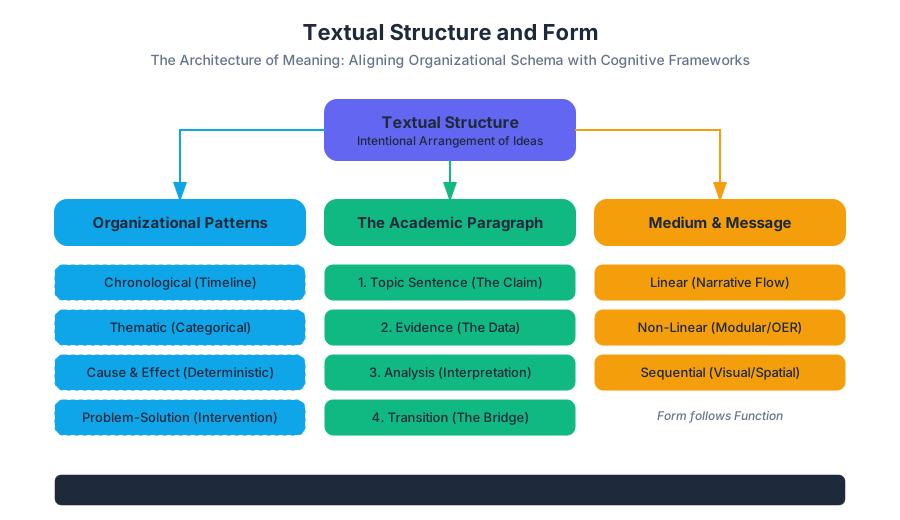
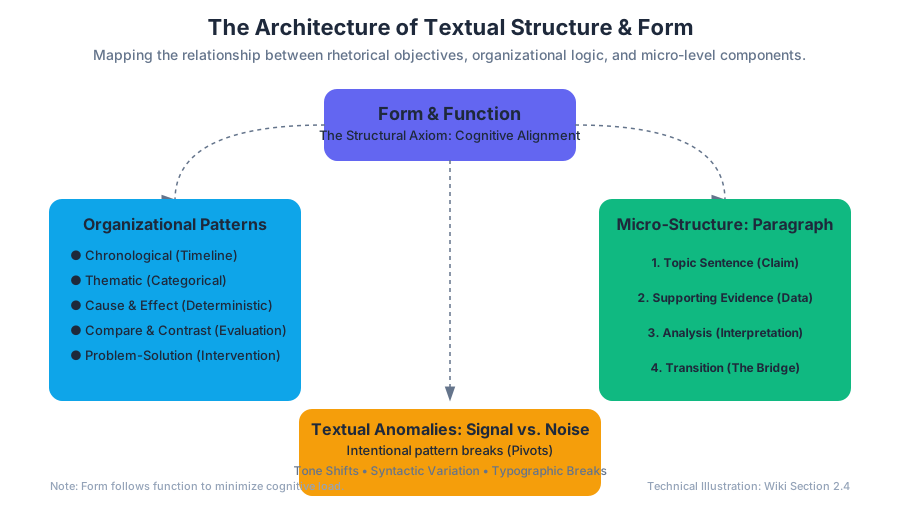
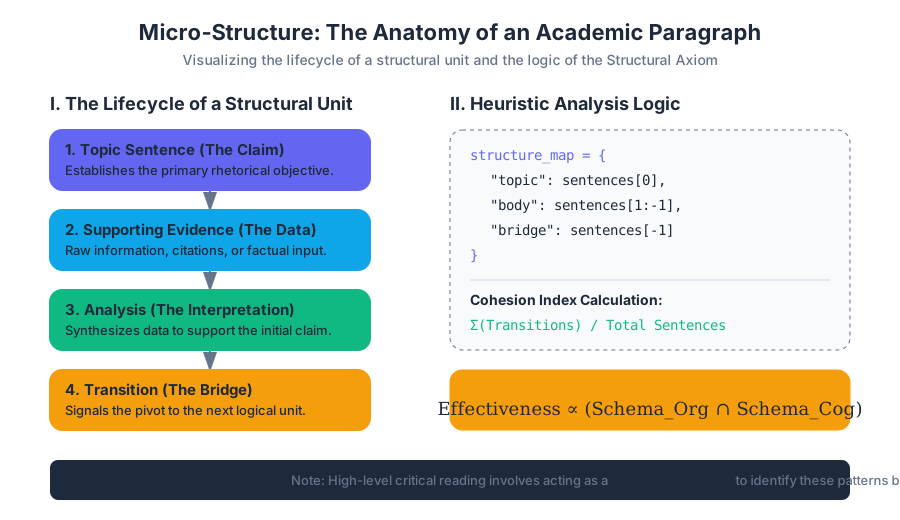
The Writing Process
Key concepts: Prewriting · Drafting · Revising · Reading to Write · Synthesis
Outlines the stages of writing from prewriting to revising, emphasizing the link between reading and writing.
The Writing Process
The writing process is not a linear progression from start to finish but a recursive, multi-stage system of cognitive labor. In an academic context, writing is the physical manifestation of critical thinking. It requires the integration of reading, analysis, synthesis, and iterative refinement. To master the writing process is to move away from the "one-and-done" mentality of high school assignments toward a sophisticated, professional workflow where the final product is the result of multiple layers of intellectual transformation.
The Foundation: Reading to Write
Expert writing begins long before a single word is typed into a document. It begins with Reading to Write—the practice of using critical reading tools to analyze the structure, rhetoric, and evidence of existing texts to inform one's own work. In the academic ecosystem, "text" is defined broadly.
Definition: Text In a scholarly context, a text is any object that conveys meaning and can be "read" or analyzed. This includes traditional media (books, journals, essays) and non-traditional media (films, paintings like Jacob Lawrence’s Migration Series, advertisements, or even source code).
Critical Reading and Annotation
To read critically is to move beyond mere information extraction. It involves identifying the Author's Purpose (the "why") versus the Main Point (the "what"). A reader must act as a "sleuth," looking for clues in the title, author credentials, and publication venue to build a mental Schema—a cognitive framework that allows the brain to organize new information efficiently.
| Strategy | Action | Objective |
|---|---|---|
| Pre-reading | Scanning titles, headings, and author bios. | Build initial schema and predict content. |
| Annotation | Marking margins with questions, definitions, and connections. | Active engagement; prevents "passive scanning." |
| Contextualization | Researching unfamiliar jargon or historical references immediately. | Ensure precision in comprehension. |
| Rhetorical Analysis | Identifying the target audience and the author's tone. | Understand how the text attempts to persuade. |
The Mechanics of Reading Analysis
When analyzing a text like De Souza’s critique of Jacob Lawrence, a writer must distinguish between Economic Determinism (the "push/pull" factors of the Great Migration) and the Collective Ambition of the subjects. This requires a high level of Information Literacy, or the ability to find, evaluate, and use information effectively.
# Example: A simple script to analyze lexical density and readability
# to help a writer assess the "Tone and Jargon" of their source material.

import re

def calculate_lexical_density(text):
    words = re.findall(r'\w+', text.lower())
    unique_words = set(words)
    if not words:
        return 0
    return (len(unique_words) / len(words)) * 100

def estimate_readability(text):
    # Simplified Flesch-Kincaid approach
    sentences = text.count('.') + text.count('!') + text.count('?')
    words = len(re.findall(r'\w+', text))
    syllables = len(re.findall(r'[aeiouy]+', text.lower()))

    if sentences == 0 or words == 0:
        return 0

    # Score interpretation: 90-100 (Easy), 0-30 (Academic/Difficult)
    score = 206.835 - 1.015 * (words / sentences) - 84.6 * (syllables / words)
    return score

sample_text = "The Migration series by Jacob Lawrence is a sequence of sixty paintings portraying the mass movement."
print(f"Lexical Density: {calculate_lexical_density(sample_text):.2f}%")
print(f"Readability Score: {estimate_readability(sample_text):.2f}")
The Rhetorical Framework
Before the first draft is written, the writer must establish the Rhetorical Situation. Writing is never done in a vacuum; it is a communication between a specific author and a specific audience for a specific reason.
Audience Awareness and Jargon
One of the most common pitfalls in college-level writing is the misuse of Jargon—specialized language used by a particular profession or group. While jargon can provide precision among experts, it creates a barrier for general audiences. Effective writers calibrate their language based on the "Audience Assumptions."
| Component | Description | Key Question |
|---|---|---|
| Purpose | The goal of the piece (to inform, persuade, or entertain). | What do I want the reader to do or think after reading? |
| Audience | The intended recipients of the message. | What does my reader already know? What are their biases? |
| Tone | The writer's attitude toward the subject. | Is the language formal, objective, or conversational? |
| Credibility | The evidence and logic used to support claims. | Why should the reader trust my perspective? |
Phase I: Prewriting and Discovery
Prewriting is the generative phase where the writer moves from "reading" to "thinking on paper." It is the most non-linear part of the process.
- Brainstorming/Clustering: Creating a visual map of ideas to see how concepts like "Push Factors" (crop failure) and "Pull Factors" (labor shortages) connect.
- Freewriting: Writing without stopping for a set period to bypass the "internal critic."
- Outlining: Establishing a logical hierarchy. A strong outline ensures that each paragraph serves the Thesis Statement—the central argument of the piece.
The Logic of Argumentation
Academic writing relies on Logical Reasoning. A writer must avoid logical fallacies and ensure that every claim is backed by Evidence. In the case of the Migration Series analysis, the evidence consists of both the visual elements of the paintings (colors, shapes) and the historical context of the 1940s.
% Mathematical representation of a Writing Argument (Logic)
% Let C = Claim, E = Evidence, W = Warrant (Connection)
% A valid argument A exists if:

A = \sum_{i=1}^{n} (C_i + E_i \cdot W_i) \implies T

% Where:
% T = Thesis Statement
% n = Number of supporting points
% W must validate that E actually supports C.
Phase II: Drafting and Iteration
The Drafting phase is about momentum. The goal is to translate the prewriting plan into a continuous narrative. Many students struggle with "Writer's Block" during this phase because they attempt to edit while they draft.
Key Insight: The Discovery Draft The first draft is often called a "Discovery Draft." Its primary purpose is to see if the ideas hold up when expanded into full paragraphs. It is expected to be "messy" and structurally incomplete.
Paragraph Construction
A formal academic paragraph should follow a standard architecture:
- Topic Sentence: The "mini-thesis" of the paragraph.
- Evidence/Quotes: Integrated source material.
- Analysis: The writer’s explanation of how the evidence supports the topic sentence.
- Transition: A bridge to the next concept.
Phase III: Revision and Global Refinement
There is a critical distinction between Revising and Editing. Most novice writers stop at editing (fixing typos), but professional-grade writing requires deep revision.
| Feature | Revision (Global) | Editing (Local) |
|---|---|---|
| Scope | Structural, logical, and conceptual. | Sentence-level, grammatical, and mechanical. |
| Actions | Moving paragraphs, deleting entire sections, changing the thesis. | Fixing commas, checking spelling, varying word choice. |
| Goal | Clarity of argument and flow of ideas. | Correctness and polish. |
| Timing | Should happen first. | Should happen last. |
Peer Review and Collaboration
Revision is often a collaborative process. Peer Review allows a writer to see their work through the eyes of the audience. It identifies "blind spots" where the writer assumed the reader had knowledge they did not actually possess.
Synthesis: Joining the Academic Conversation
Synthesis is the highest level of the writing process. It is the act of combining insights from multiple sources to create a new, original argument. It is not merely a summary of what others have said; it is a "conversation" where the writer acts as the moderator.
Source Integration and MLA 8th Edition
To maintain Academic Integrity and avoid Plagiarism, writers must use a standardized citation system. The MLA 8th Edition focuses on "Containers."
| Citation Component | Example |
|---|---|
| Author | De Souza, Michael. |
| Title of Source | "Economic Determinism in the Migration Series." |
| Title of Container | Journal of African American Studies. |
| Publisher | University of Oregon Press. |
| Location | pp. 45-60. |
When synthesizing, a writer might use a "Signal Phrase" to introduce a source: “While Akanegbu highlights the statistics of distance education, De Souza reminds us that the human element of ambition cannot be quantified.”
# A real-world usage example: Using Pandoc to compile a
# writing project from Markdown to a professional PDF
# with an automated bibliography (BibLaTeX).

pandoc paper_draft.md \
    --from=markdown \
    --to=latex \
    --output=final_submission.pdf \
    --citeproc \
    --bibliography=references.bib \
    --csl=modern-language-association.csl \
    --variable fontsize=12pt \
    --variable margin=1in
Overcoming Cognitive Friction
The writing process is physically and mentally taxing. Successful writers manage their environment and biological rhythms.
- Diurnal Cycles: Identifying whether one is more productive in the morning or evening.
- Distraction Management: Removing smartphones and digital notifications to enter a "Flow State."
- Stamina: Writing is a muscle. Building "Writing Stamina" involves consistent daily practice rather than "binge writing" before a deadline.
Common Pitfalls
- The "Thesaurus Syndrome": Using complex words incorrectly to sound "academic." This usually obscures meaning.
- Quote Dumping: Dropping a quote into a paragraph without explaining its relevance.
- Linear Rigidity: Refusing to change an outline even when the research suggests a better direction.
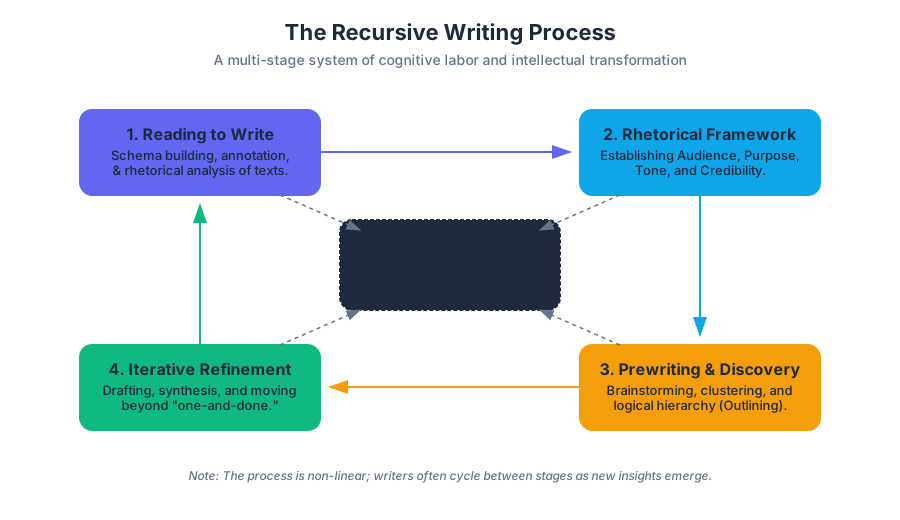
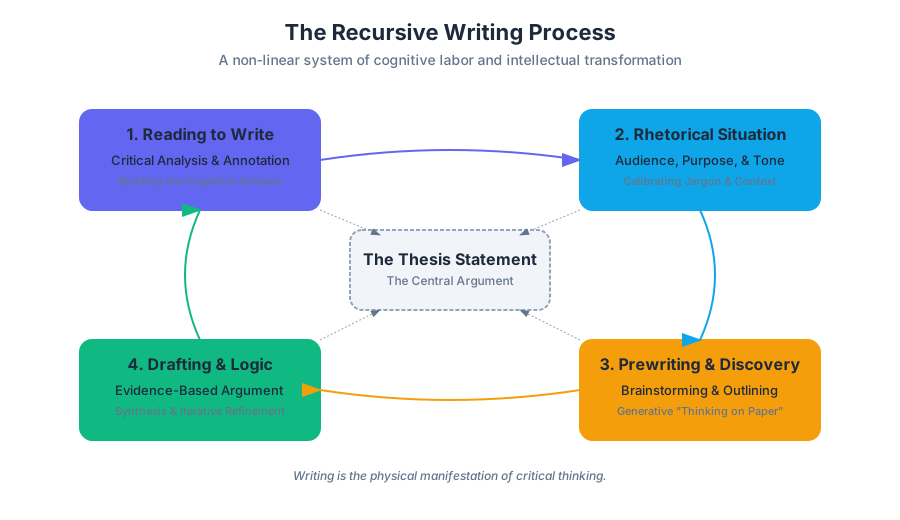
Style and Voice
Key concepts: Sentence length variation · Point of View (PoV) · Language Complexity · Dialect · Rhythm
Focuses on the 'sound' of writing, including sentence variety, point of view, and language complexity.
Style and Voice
The Architecture of Expression: An Overview
In the realm of academic and professional communication, Style is frequently misunderstood as mere "decoration" or "flair." In reality, style is the functional architecture of a text—the strategic arrangement of syntax, diction, and rhythm to achieve a specific rhetorical objective. While Voice represents the "personality" or "character" of the writing, style is the set of technical levers a writer pulls to project that voice.
As explored in The Word on College Reading and Writing, style is not an afterthought; it is the primary mechanism through which a writer establishes credibility (ethos), manages the reader’s cognitive load, and ensures that the author’s purpose is realized. Whether one is analyzing the economic determinism in Jacob Lawrence’s Migration Series or documenting a complex API, the stylistic choices—from sentence length to the use of gender-neutral pronouns—determine the text's accessibility and impact.
Sentence Length and Structural Rhythm
The variation of sentence length is the "breath" of a text. It controls the rhythm (the pattern of sounds and pauses) and the pacing (the speed at which the reader consumes information).
The Mechanics of Variation
- Short Sentences: These provide clarity, emphasis, and tension. They are often used for "punchy" declarations or to summarize a complex point.
- Long Sentences: These allow for nuance, description, and the connection of multiple ideas. They are essential for showing relationships between concepts, such as cause and effect.
- The Rhythmic Shift: A sudden short sentence after several long ones creates a "rhetorical stop," forcing the reader to pay attention to the concluding thought.
Definition: Syntactic Density The ratio of information-carrying words to the total number of sentences. High syntactic density often requires longer, more complex sentence structures to maintain logical flow.
| Sentence Type | Primary Function | Cognitive Load | Typical Use Case |
|---|---|---|---|
| Staccato (1-5 words) | Emphasis, urgency, or transition. | Low | Summarizing a major finding. |
| Telegraphic (5-10 words) | Clarity and directness. | Low-Medium | Defining a core term. |
| Medium (15-25 words) | Standard exposition. | Medium | Explaining a process or mechanism. |
| Periodic (30+ words) | Nuance, complexity, and buildup. | High | Synthesizing multiple sources or evidence. |
Implementation: Measuring Stylistic Complexity
To analyze style quantitatively, we can look at the Flesch-Kincaid Grade Level or simple sentence length distribution. Below is a low-level Python implementation designed to parse a text and output its stylistic "fingerprint."
import re
from statistics import mean, stdev

def analyze_style_metrics(text):
    """
    Analyzes sentence length variation and lexical diversity.
    A senior-level tool for stylistic auditing.
    """
    # Split by sentence boundaries (simplified)
    sentences = re.split(r'[.!?]+', text)
    sentences = [s.strip() for s in sentences if len(s.strip()) > 0]

    # Calculate word counts per sentence
    sentence_lengths = [len(s.split()) for s in sentences]

    # Calculate Lexical Diversity (Type-Token Ratio)
    words = re.findall(r'\w+', text.lower())
    unique_words = set(words)
    ttr = len(unique_words) / len(words) if words else 0

    metrics = {
        "sentence_count": len(sentences),
        "avg_length": mean(sentence_lengths),
        "std_deviation": stdev(sentence_lengths) if len(sentence_lengths) > 1 else 0,
        "lexical_diversity": ttr,
        "max_length": max(sentence_lengths),
        "min_length": min(sentence_lengths)
    }

    return metrics

# Example usage with a complex academic string
sample_text = (
    "Style is the way a writer expresses their ideas. It involves choices about "
    "sentence structure, perspective, and vocabulary. By varying these elements, "
    "a writer can control the reader's emotional response and intellectual engagement."
)

print(f"Stylistic Fingerprint: {analyze_style_metrics(sample_text)}")
Point of View (PoV) and Narrative Distance
Point of View is the perspective from which a text is written. In college-level writing, the choice of PoV is a strategic decision based on the audience and the rhetorical situation.
The PoV Spectrum
- First Person ("I", "We"): Establishes a personal connection or "eyewitness" authority. Common in reflective essays, memoirs, or collaborative research (e.g., "We found that...").
- Second Person ("You"): Directly addresses the reader. Primarily used in instructional materials, like The Word on College Reading and Writing, to guide the student through exercises.
- Third Person ("He", "She", "They", "It"): The standard for academic and objective writing. It creates narrative distance, suggesting that the information is being presented by a neutral observer rather than a biased participant.
| Point of View | Subjectivity Level | Common Contexts | Pitfalls |
|---|---|---|---|
| First Person Singular | High | Personal narratives, opinion pieces. | Can seem unprofessional in hard sciences. |
| First Person Plural | Medium | Scientific papers, collaborative reports. | "The Royal We" can feel pretentious. |
| Second Person | High | Tutorials, OER textbooks, speeches. | Can feel accusatory or overly informal. |
| Third Person Objective | Low | Research papers, news, documentation. | Can feel dry, "robotic," or detached. |
Mathematical Representation of Narrative Distance
We can conceptualize narrative distance ($D_n$) as a function of the frequency of personal pronouns ($P$) and the use of evaluative adjectives ($A$) relative to the total word count ($W$):
D_n = 1 - \left( \frac{\sum P + \sum A}{W} \right)
Where a higher $D_n$ indicates a more objective, "distant" style typical of formal academic discourse.
Language Complexity and the Jargon Threshold
Language Complexity refers to the sophistication of vocabulary and the density of specialized terminology, often called jargon. While jargon is necessary for precision within a specific field (e.g., "economic determinism" in art history), it can become a barrier to understanding when writing for a general audience.
The "Curse of Knowledge"
Writers often suffer from the "curse of knowledge"—the inability to remember what it was like not to know a specific concept. Effective style involves audience awareness, where the writer calibrates their language complexity to the reader's expected knowledge base.
Balancing Precision and Accessibility
- Define Terms: If a technical term is necessary, define it immediately (e.g., "Rhetoric is the art of persuasive communication").
- Use Plain Language: Replace "utilize" with "use" or "subsequent to" with "after" unless the complex version adds specific value.
- Inclusive Language: Modern style guides, including OER (Open Educational Resources) like The Word, emphasize gender-neutral language (using "they/them" as a singular pronoun) to ensure the text is inclusive of all readers.
| Complexity Level | Vocabulary Type | Sentence Structure | Target Audience |
|---|---|---|---|
| Foundational | Common usage, no jargon. | Simple/Compound. | General public, K-12. |
| Intermediate | Defined technical terms. | Varied. | Undergraduates, non-specialists. |
| Expert | High-density jargon. | Complex/Subordinated. | Peer reviewers, senior engineers. |
Dialect, Punctuation, and Identity
Style is also a vehicle for Identity. Dialect—the regional or social variety of a language—can be used in narrative writing to ground a story in a specific place or culture. In the analysis of Jacob Lawrence’s Migration Series, the "voice" of the paintings is often described through the lens of Naturalism vs. Modernism. While these are visual styles, they mirror linguistic styles:
- Naturalism: Direct, "unfiltered" representation (similar to plain, objective prose).
- Modernism: Abstract, rhythmic, and symbolic (similar to poetic or highly stylized prose).
The Role of Punctuation in Voice
Punctuation is the "notation" of writing. It tells the reader when to pause, when to stop, and how to inflection.
- The Semicolon: Connects two independent but related thoughts; suggests a sophisticated, "academic" voice.
- The Dash: Creates a sharp break or adds an emphatic afterthought; suggests a more dynamic, conversational voice.
Configuration: Enforcing Style via Linting
In professional technical writing, style is often enforced via "linters" that check for specific patterns. Below is a configuration snippet for Vale, an open-source style linter, showing how to enforce gender-neutral language and avoid jargon.
# .vale.ini configuration for Academic Style
StylesPath = styles
MinAlertLevel = suggestion

[*.md]
BasedOnStyles = Vale, Proselint

# Custom Rule: Avoid Gendered Pronouns
GenderNeutral.Pronouns = error

# Custom Rule: High Complexity Warning
Complexity.Jargon = warning

# Example rule definition
# styles/Complexity/Jargon.yml:
# message: "Try to avoid '%s'. Use a simpler alternative if possible."
# level: warning
# tokens:
#   - utilize
#   - cognize
#   - facilitate
Rhetorical Voice and Persuasion
As defined in the source materials, Rhetoric is the art of persuasive communication. Style is the primary tool of rhetoric. A writer's "voice" is often a blend of three classical appeals:
- Ethos (Credibility): Established through precise language, correct MLA/APA citations, and a professional tone.
- Pathos (Emotion): Established through vivid imagery, rhythmic sentence variation, and evocative word choice.
- Logos (Logic): Established through clear organizational structures, evidence-based claims, and "if-then" syntactic patterns.
Comparing Persuasive Styles
| Style Approach | Focus | Key Stylistic Markers | Effect on Reader |
|---|---|---|---|
| Authoritative | Ethos | Formal diction, passive voice (sometimes), complex syntax. | Trust in the author's expertise. |
| Empathetic | Pathos | First/Second person, sensory details, varied rhythm. | Emotional resonance/connection. |
| Analytical | Logos | Third person, data-heavy, "plain" language, clear transitions. | Intellectual conviction. |
Modern Stylistic Standards: Inclusivity and OER
The shift toward Open Educational Resources (OER) has fundamentally changed stylistic expectations in academia. Because OER materials are designed to be accessible to a global, diverse audience, the "voice" of these texts (like The Word on College Reading and Writing) tends to be:
- Collaborative: Often written by multiple authors, leading to a "polyvocal" but unified style.
- Inclusive: Aggressively uses gender-neutral pronouns and avoids culturally specific idioms that might alienate non-native speakers.
- Non-Linear: Designed as a reference tool where style must remain consistent across disparate modules so the reader can jump in anywhere.
Data Analysis: Querying Stylistic Trends in a Corpus
If we were to analyze a database of academic papers to see the shift toward inclusive language, we might use a SQL query like the one below to track the usage of the singular "they."
-- Query to track the evolution of the singular 'they' in academic journals
SELECT
    publication_year,
    COUNT(*) AS total_papers,
    SUM(CASE WHEN text_content LIKE '% they %' AND (text_content LIKE '% student %' OR text_content LIKE '% author %') THEN 1 ELSE 0 END) AS singular_they_usage
FROM
    academic_corpus
WHERE
    publication_year BETWEEN 2000 AND 2024
GROUP BY
    publication_year
ORDER BY
    publication_year DESC;
Common Pitfalls in Style and Voice
Even senior writers fall into stylistic traps. Recognizing these is the first step toward a "polished" voice.
- The "Thesaurus Syndrome": Using overly complex words where a simple one would suffice. This often obscures meaning rather than enhancing it.
- Passive Voice Overuse: While common in science ("The solution was heated"), excessive passive voice makes writing feel sluggish and hides the "actor" of the sentence.
- Tone Inconsistency: Shifting from a formal, academic tone to a casual, "slangy" tone within the same paragraph.
- Ignoring the "Container": In MLA 8th edition style, the "container" (the larger work a source is found in) dictates the citation style. Similarly, the "container" of your writing (blog vs. thesis) should dictate your style.
Key Insight: The Goal of Style Style is successful when it becomes "transparent"—meaning the reader is so engaged with the ideas that they don't notice the mechanics of the writing, yet those mechanics are what make the engagement possible.
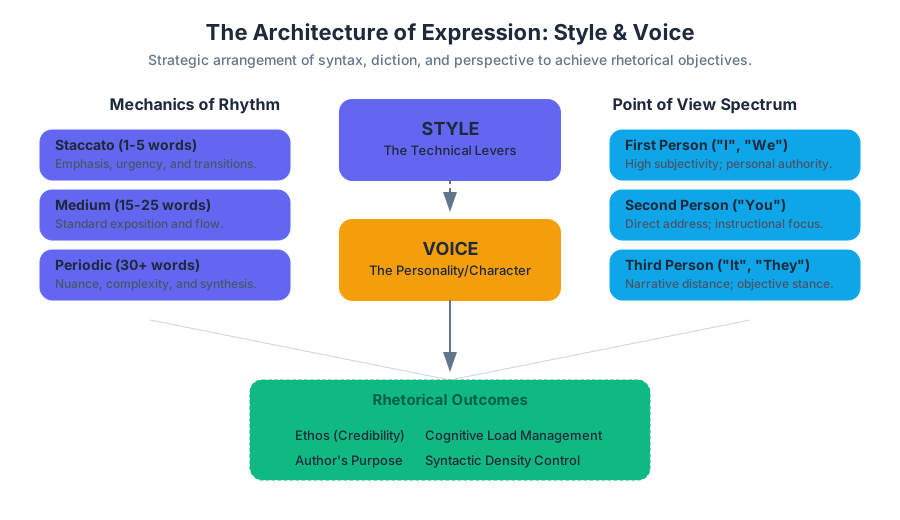
Summarizing and Critiquing
Key concepts: Summarizing · Objective Writing · Critiquing · Cultural Context · Evaluation
Teaches the difference between objective summary, analysis, and constructive critique.
Summarizing and Critiquing: The Architecture of Academic Engagement
In the landscape of higher education, the ability to interact with a text—defined broadly as any artifact conveying meaning—is the fundamental currency of scholarship. This interaction is not a monolithic act but a tripartite process consisting of Summarizing, Analyzing, and Critiquing. While a novice reader might conflate these, the expert practitioner recognizes them as distinct cognitive layers: reporting what is there, explaining how it functions, and evaluating its validity within a broader cultural and intellectual context.
The Foundational Layer: Defining the "Text"
In an academic environment, a text is any object that can be "read" for meaning. This extends beyond the traditional printed page to include visual art, films, musical compositions, and digital media. The process of engagement begins with Schema Building, a cognitive heuristic where the reader uses pre-reading strategies to create a mental framework before deep-diving into the content.
Pre-reading and the "Sleuth" Methodology
Effective reading is non-linear. Before consuming a text from start to finish, a scholar acts as a "sleuth," gathering visual and structural clues to predict the author's trajectory. This involves analyzing titles, author credentials, headings, and topic sentences.
| Element | Analytical Purpose | Schema Contribution |
|---|---|---|
| Author Credentials | Establishes Ethos and potential bias. |
Determines the level of specialized jargon to expect. |
| Abstract/Introduction | Identifies the Thesis or central claim. |
Provides the "map" for the subsequent data. |
| Visual Aids/Captions | Highlights data peaks or emotional anchors. | Connects abstract concepts to concrete representations. |
| Topic Sentences | Reveals the logical skeleton of the argument. | Allows for rapid skimming to locate specific evidence. |
1. Objective Summarizing: The Art of Condensation
Summarizing is the process of distilling a text to its essential components while maintaining strict objectivity. A successful summary does not "talk back" to the author; it functions as a high-fidelity, low-resolution version of the original work.
The Mechanics of the Summary
To summarize effectively, one must distinguish between the Main Point (the "what") and the Author’s Purpose (the "why").
- Main Point: The primary assertion or finding.
- Author’s Purpose: The rhetorical intent—to persuade, to inform, to entertain, or to provoke action.
Definition: Objective Summary A neutral restatement of a source's central ideas and major supporting details, stripped of the reader's personal opinion, bias, or external critique.
Implementation: Algorithmic Text Distillation
In computational linguistics, we can model the "Summary" as a function that maximizes information density while minimizing character count. Below is a Python implementation of a basic extractive summarization logic using word frequency scoring to identify "key" sentences.
import re
from collections import Counter

def extractive_summary(text, limit=2):
    """
    A low-level implementation of a frequency-based summarization algorithm.
    Identifies 'jargon' and 'keywords' to rank sentence importance.
    """
    # Tokenize and clean
    words = re.findall(r'\w+', text.lower())
    # Filter out common stop words (simplified)
    stop_words = {'the', 'and', 'is', 'in', 'it', 'of', 'to', 'a', 'with', 'for'}
    keywords = [w for w in words if w not in stop_words]

    # Calculate frequency distribution
    freq_map = Counter(keywords)

    # Score sentences based on keyword density
    sentences = text.split('.')
    sentence_scores = []
    for i, sent in enumerate(sentences):
        score = sum(freq_map[w.lower()] for w in re.findall(r'\w+', sent))
        sentence_scores.append((i, score))

    # Sort by score and return top 'limit' sentences in original order
    top_indices = sorted(sentence_scores, key=lambda x: x[1], reverse=True)[:limit]
    summary_indices = sorted([idx for idx, score in top_indices])

    return '. '.join([sentences[i].strip() for i in summary_indices]) + '.'

# Example usage with academic-style text
sample_text = "The Great Migration was driven by economic determinism. Labor shortages in the North acted as a pull factor. Meanwhile, crop failures in the South acted as a push factor. Jacob Lawrence captured this movement in his Migration Series."
print(extractive_summary(sample_text))
2. Rhetorical Analysis: Deconstructing the "How"
While a summary reports what was said, Analysis explains how the author attempted to achieve their goal. This requires an understanding of Rhetoric—the art of persuasive communication.
The Rhetorical Triangle and Jargon
Analysis involves interrogating the author's Audience Awareness. An author writing for a peer-reviewed journal will use specialized jargon—technical language specific to a field—to establish credibility and precision. However, if that same author uses jargon for a general audience, it may function as a barrier to entry, potentially indicating a lack of audience awareness or an attempt to obscure weak reasoning with "big words."
| Analytical Lens | Key Question | Indicator |
|---|---|---|
| Tone | What is the author's attitude? | Word choice (connotative vs. denotative). |
| Evidence | How is the claim supported? | Use of statistics, anecdotes, or expert testimony. |
| Logic | Does the conclusion follow the premises? | Presence of logical fallacies or sound syllogisms. |
| Credibility | Why should we trust this source? | Citations, publisher reputation, and author history. |
Mathematical Representation of Rhetorical Velocity
We can conceptualize the "persuasiveness" of a text ($P$) as a function of the strength of its evidence ($E$), the alignment with audience values ($A$), and the clarity of its delivery ($C$).
P \approx \int_{t_0}^{t_f} (E \cdot A \cdot C) \, dt
Where $t$ represents the progression of the text from introduction to conclusion.
3. Critiquing: The Evaluative Layer
Critiquing is the most advanced form of engagement. It is a constructive evaluation that asks: Is this right? Is it complete? What are the underlying assumptions? A critique does not necessarily mean "finding fault"; it means judging the merits and limitations of the work.
Case Study: Economic Determinism in Jacob Lawrence’s Migration Series
Consider an analysis of Jacob Lawrence’s sixty-panel artwork. A summary would state that the series depicts the mass movement of African Americans from the rural South to the urban North. An analysis would focus on Lawrence’s use of "Migration Colors" (vibrant, primary tones) and recurring motifs to create a sense of collective rhythm.
A critique, however, would engage with the concept of Economic Determinism—the theory that social phenomena are determined by economic factors.
- Push Factors: Crop failures, Jim Crow laws, lack of opportunity.
- Pull Factors: Labor shortages in Northern factories, the promise of higher wages.
The critic might argue that while Lawrence acknowledges these deterministic forces, his work ultimately emphasizes Collective Ambition and human agency, suggesting that the migrants were not merely "pushed" like chess pieces but were active participants in their own liberation.
Evaluating Evidence and Credibility
A critique must rigorously examine the Evidence. In the age of Information Literacy, checking the "Works Cited" page is a primary critical act.
| Evidence Type | Strength | Weakness |
|---|---|---|
| Statistical Data | High (if sample size is large). | Can be manipulated or lack context. |
| Anecdotal Evidence | High emotional impact. | Low generalizability; "the plural of anecdote is not data." |
| Peer-Reviewed Research | Gold standard for reliability. | Can be slow to update; paywalls limit access. |
4. Information Literacy and Source Attribution
To critique effectively, one must understand the provenance of information. Modern scholarship relies on standardized citation formats, such as MLA 8th Edition, to ensure transparency and prevent plagiarism.
The MLA 8th Edition Framework
The 8th edition moved away from static rules for every media type and toward a universal set of Core Elements. This "Container" system allows for the citation of anything from a YouTube video to a traditional book.
# A CLI-style representation of the MLA 8th Edition 'Container' logic
# Usage: cite --author "Name" --title "Work" --container "Journal/Site"

author="Akanegbu, Anuli."
title="\"50 Striking Statistics about Distance Education.\""
container="EDTech,"
publisher="CDW,"
date="12 July 2012,"
location="www.edtechmagazine.com/higher/article/..."

echo "${author} ${title} ${container} ${publisher} ${date} ${location}."
Structured Data for Citations
In a database-driven research environment, citations are often stored as JSON or SQL entities to facilitate automatic formatting.
-- Schema for a Research Management System
CREATE TABLE citations (
    id INTEGER PRIMARY KEY AUTOINCREMENT,
    author_last VARCHAR(255),
    author_first VARCHAR(255),
    work_title TEXT NOT NULL,
    container_title TEXT,
    publisher VARCHAR(255),
    pub_date DATE,
    url TEXT,
    access_date DATE,
    citation_style VARCHAR(50) DEFAULT 'MLA_8'
);

INSERT INTO citations (author_last, author_first, work_title, container_title, publisher, pub_date, url)
VALUES ('De Souza', 'Michael', 'Economic Determinism and Ambition', 'African American Studies 202', 'University Press', '2016-05-15', 'https://scholar.example.edu/desouza');
5. Common Pitfalls in Summarizing and Critiquing
Even experienced writers fall into traps when moving between these three modes.
- The "Opinion Creep" in Summaries: Including phrases like "The author wrongly suggests..." in a summary. This violates the principle of objectivity.
- Parroting vs. Interrogating: Summarizing a source and then moving on without analyzing how the argument was built or critiquing its validity.
- Jargon Overload: Using the source's specialized language in your own critique without defining it, which obscures your own analytical voice.
- Ignoring Cultural Context: Critiquing a historical text (like a 1942 "We Can Do It" poster) using 21st-century norms without acknowledging the original rhetorical situation.
Synthesis: The Writing Process
Engagement with texts is not a one-off event but a recursive process.
- Prewriting: Creating the schema and "sleuthing" the text.
- Drafting: Generating the summary and initial analysis.
- Revising: Strengthening the critique, checking for logical fallacies, and ensuring proper source integration.
By mastering the triad of Summarizing, Analyzing, and Critiquing, the scholar moves from being a passive consumer of information to an active contributor to the academic conversation.
- Text: Any artifact (written, visual, auditory) that conveys meaning and can be analyzed.
- Rhetoric: The art of using language effectively and persuasively.
- Jargon: Specialized language used by a particular profession or group; can be a barrier to general audiences.
- Economic Determinism: The theory that social and political structures are determined by economic conditions.
- Schema: A mental framework or "map" used to organize and interpret new information.
- MLA 8th Edition: A citation style that uses a "container" system to provide a flexible framework for all source types.
- Push/Pull Factors: Economic or social forces that drive migration (Push = negative local conditions; Pull = positive distant conditions).
- Question: What is the primary difference between a summary and a critique?
- Answer: A summary is an objective report of the text's main ideas, while a critique is an evaluative judgment of the text's reasoning and evidence.
- Question: Why is "pre-reading" considered a non-linear strategy?
- Answer: Because it involves skipping ahead to headings, topic sentences, and visual aids to build a schema before reading the text sequentially.
- Question: In the context of Jacob Lawrence's Migration Series, what would be considered a "Pull Factor"?
- Answer: Labor shortages in Northern factories that promised higher wages and better opportunities.
- Question: How does the MLA 8th Edition "Container" system differ from previous versions?
- Answer: It uses a universal set of core elements rather than specific rules for every individual media type.
- Question: What is the risk of using excessive jargon when writing for a general audience?
- Answer: It can alienate the reader, obscure the main point, and suggest a lack of audience awareness.
Study Guide: Summarizing and Critiquing
I. Core Definitions
- Summarizing: Condensing the "What" and "Why" (Main Point and Purpose) into a neutral, objective brief.
- Analyzing: Deconstructing the "How" (Rhetoric, Tone, Evidence, Jargon).
- Critiquing: Evaluating the "So What?" (Validity, Assumptions, Cultural Context).
II. The Reading Process
- Environment: Identify your diurnal cycle (best time of day) and minimize distractions.
- Sleuthing: Analyze titles, credentials, and structural markers (headings).
- Active Engagement: Annotate, look up unfamiliar words immediately, and identify the thesis.
III. Rhetorical Analysis Checklist
- Audience: Who is the intended reader?
- Ethos: Is the author credible?
- Logos: Is the reasoning sound?
- Pathos: Does the author use emotional appeals?
- Jargon: Is the technical language appropriate for the audience?
IV. Evaluation Criteria for Critique
- Relevance: Is the evidence current and applicable?
- Sufficiency: Is there enough evidence to support the claim?
- Bias: Does the author acknowledge counter-arguments or alternative perspectives?
- Context: How does the cultural or historical setting influence the message?
V. Citation Essentials (MLA 8)
- Core Elements: Author, Title of Source, Title of Container, Other Contributors, Version, Number, Publisher, Publication Date, Location.
- Goal: Provide a clear path for the reader to locate the original source.
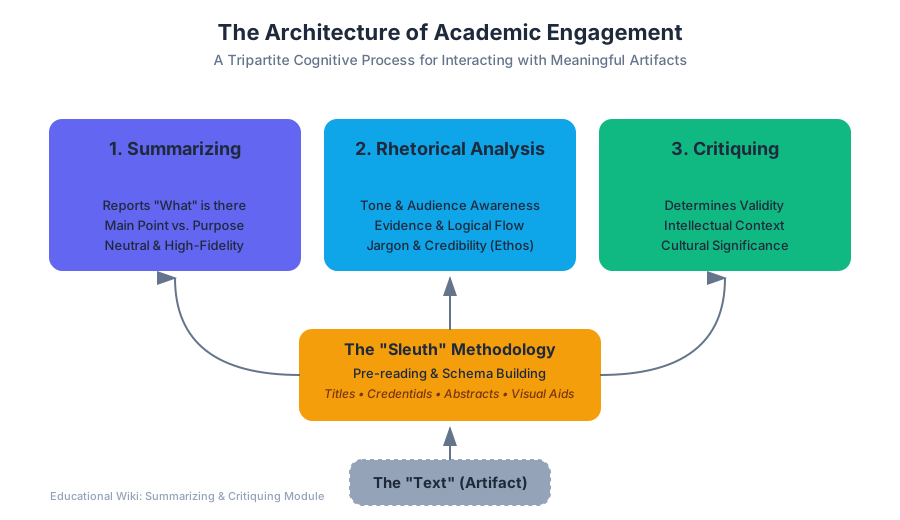
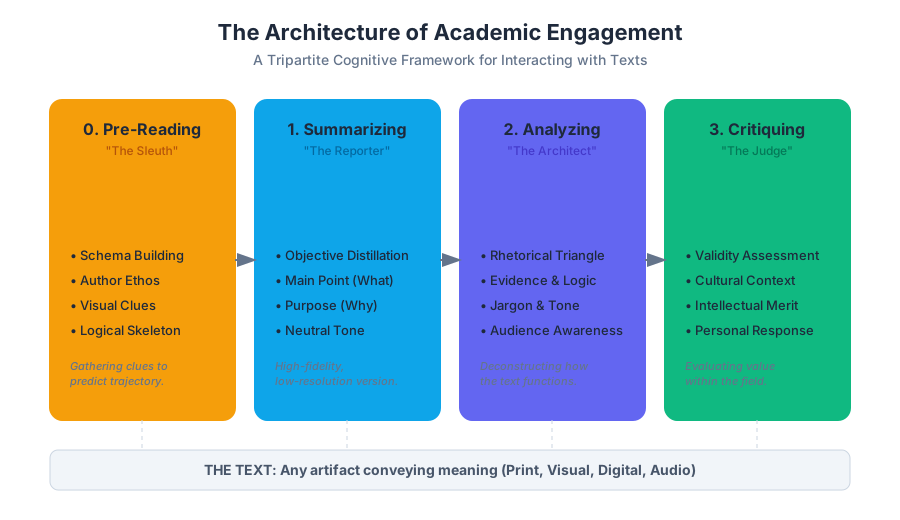
Information Literacy and MLA
Key concepts: MLA 8th Edition · Works Cited Page · Source Attribution · Plagiarism · Container Titles
Covers the essentials of source attribution using MLA 8th edition and the importance of avoiding plagiarism.
Information Literacy and MLA
Information literacy is the foundational meta-competency of the modern academic and professional landscape. It is defined not merely as the ability to read, but as the integrated set of skills encompassing the discovery of information, the understanding of how information is produced and valued, and the use of information in creating new knowledge and participating ethically in communities of learning.
In the context of higher education, this literacy manifests through the mastery of MLA (Modern Language Association) Style, specifically the 8th and 9th editions, which moved away from rigid, format-specific rules toward a flexible, universal framework. This shift mirrors the evolution of the digital "text"—recognizing that a "text" is no longer just a bound book, but any vehicle for meaning, including podcasts, data visualizations, and social media threads.
The Architecture of Information Literacy
Information literacy operates as a pipeline, moving from the initial recognition of a "need to know" to the ethical dissemination of a synthesized argument. To navigate this pipeline, a researcher must act as a "sleuth," a metaphor derived from the pre-reading strategies used to build schema—the mental frameworks that allow us to categorize and retain new data.
The Reading-Writing Feedback Loop
Strong writing is inextricably linked to diverse reading habits. The process is non-linear; it involves constant recursion between the stages of the writing process: Prewriting, Drafting, and Revising.
| Phase | Objective | Key Activities |
|---|---|---|
| Pre-reading | Schema Building | Analyzing titles, author credentials, skimming headings, and scanning topic sentences. |
| Active Engagement | Information Extraction | Annotation, looking up jargon, and identifying the author's purpose. |
| Critical Reflection | Evaluation | Assessing evidence credibility and identifying rhetorical bias. |
| Synthesis | Knowledge Creation | Integrating source material into an original argument via MLA attribution. |
"In an academic context, a text is anything that conveys meaning. While we focus on printed works, the skills of information literacy apply equally to visual and auditory media, requiring the same rigor in extraction and analysis."
Rhetoric and the Art of Persuasion
At the heart of information literacy lies Rhetoric: the study and practice of effective, persuasive communication. Understanding rhetoric allows a researcher to deconstruct a source's "Main Point" versus its "Author's Purpose." While the main point is the what (the thesis), the purpose is the why (to inform, to provoke, to sell, or to change policy).
The Rhetorical Framework
To evaluate a source, one must analyze the interaction between the author, the audience, and the text itself.
| Rhetorical Element | Definition | Critical Question |
|---|---|---|
| Logos | Logical reasoning and evidence. | Is the data current and statistically significant? |
| Ethos | The credibility and character of the author. | Does the author have the requisite expertise or "jargon" mastery? |
| Pathos | Emotional appeal to the audience. | Does the language use "loaded" terms to bypass critical thinking? |
| Kairos | The timeliness of the argument. | Why is this argument being made now? |
Jargon and Audience Awareness
A common pitfall in academic writing is the misuse of jargon—specialized language used by a particular profession or group. While jargon provides precision within a field (e.g., "economic determinism" in history), it can act as a barrier to a general audience. Information literacy requires the writer to calibrate their language to the "Audience Awareness" level of their readers, ensuring that technical terms are defined or replaced with accessible equivalents when necessary.
The MLA 8th Edition Framework: The Logic of Containers
The MLA 8th Edition revolutionized citation by introducing the concept of Containers. Previously, scholars had to memorize different formats for a book, a journal, and a website. The 8th Edition replaced this with a universal set of Core Elements that can be applied to any source.
The Container Concept
A Container is the "larger work" that holds the source. For example:
- An essay (Source) is inside a book (Container).
- An episode (Source) is inside a TV series (Container), which might be on a streaming service (Container 2).
- An article (Source) is inside a journal (Container 1), which is inside a database (Container 2).
The 9 Core Elements
MLA citations follow a specific order. If an element is missing, it is simply omitted.
| Order | Element | Example | Punctuation |
|---|---|---|---|
| 1 | Author | De Souza, Michael. | Period |
| 2 | Title of Source | "Economic Determinism." | Quotation marks/Period |
| 3 | Title of Container | Journal of Migration. | Italics/Comma |
| 4 | Other Contributors | edited by Sarah Miller, | Comma |
| 5 | Version | 2nd ed., | Comma |
| 6 | Number | vol. 12, no. 4, | Comma |
| 7 | Publisher | Oxford UP, | Comma |
| 8 | Publication Date | 2018, | Comma |
| 9 | Location | pp. 45-60. | Period |
Implementation in Code: Automating MLA Logic
To understand the logic of MLA, we can view it as a data-parsing problem. Below is a Python implementation that structures source data into a formatted MLA string based on the presence of core elements.
def generate_mla_citation(author, title, container, vol=None, issue=None, publisher=None, year=None, location=None):
    """
    Constructs an MLA 8th Edition citation string from provided components.
    Handles optional elements and correct punctuation.
    """
    citation = f"{author}. "
    citation += f'"{title}." '

    if container:
        citation += f"*{container}*, "

    # Handle volume and number (Issue)
    if vol:
        citation += f"vol. {vol}, "
    if issue:
        citation += f"no. {issue}, "

    if publisher:
        citation += f"{publisher}, "

    if year:
        citation += f"{year}, "

    if location:
        citation += f"{location}."

    # Clean up trailing commas if location was missing
    return citation.strip().rstrip(',') + "."

# Example: Citing a Journal Article
print(generate_mla_citation(
    author="Akanegbu, Anuli",
    title="50 Striking Statistics about Distance Education",
    container="EDTech",
    publisher="CDW",
    year="12 July 2012",
    location="www.edtechmagazine.com/higher/article/2012"
))
Source Attribution and Plagiarism Prevention
Source Attribution is the practice of clearly identifying where outside information comes from. This serves two purposes: it gives credit to the original creator (Ethos) and it allows the reader to follow the "academic conversation" back to the source.
Plagiarism: Intentional vs. Accidental
Plagiarism is not always a deliberate act of theft. It often occurs due to poor note-taking or a misunderstanding of how to integrate sources.
- Global Plagiarism: Submitting an entire work that is not your own.
- Patchwork Plagiarism: Stitching together phrases and ideas from multiple sources without citation.
- Incremental Plagiarism: Failing to give credit for a specific quote or paraphrase within an otherwise original work.
The Mechanics of Integration
To avoid plagiarism, writers use Signal Phrases and In-Text Citations.
Theorem of Attribution: A citation is required whenever you use a direct quote, a paraphrase of a specific idea, or a fact that is not "common knowledge."
In the following example, we see how a researcher might use a BibTeX structure to manage these citations before rendering them in a document.
@article{lawrence2016migration,
  author = {De Souza, Michael},
  title = {Economic Determinism and Ambition in the Migration Series},
  journal = {African American Studies Quarterly},
  volume = {202},
  year = {2016},
  pages = {15-30},
  note = {Analysis of Jacob Lawrence's 60-panel sequence}
}

% Usage in text:
% According to De Souza, the "Migration Series" represents the collective
% ambition of a people moving toward economic agency (16).
Case Study: Analyzing Jacob Lawrence’s "Migration Series"
To see information literacy in action, we can examine the analysis of Jacob Lawrence’s Migration Series. This 60-panel artwork serves as a "text" that requires both visual and historical literacy.
Push and Pull Factors
The analysis identifies Push Factors (reasons to leave, such as crop failure and Jim Crow laws) and Pull Factors (reasons to move, such as labor shortages in the North). This is an exercise in Economic Determinism—the theory that economic forces determine social and political structures.
Naturalism vs. Modernism
The researcher must distinguish between:
- Naturalism: Depicting the harsh, "natural" reality of poverty and labor.
- Modernism: Using bold colors and abstract shapes to convey the "Collective Ambition" and energy of the Great Migration.
By citing Lawrence's captions alongside the visual panels, the researcher practices Source Integration, weaving together primary visual evidence with secondary historical analysis.
Real-World API Usage for Research
Modern researchers often use APIs to pull citation data directly from repositories like CrossRef or PubMed. This ensures accuracy in the "Location" and "Publisher" elements of the MLA citation.
# Using curl to fetch metadata for a specific DOI (Digital Object Identifier)
# This returns JSON data which can be mapped to MLA Core Elements.

curl -L -H "Accept: application/vnd.citationstyles.bibliographic+json" \
"https://api.crossref.org/works/10.1145/3313831.3376227" | jq '{
  author: .author[0].family,
  title: .title,
  container: ."container-title",
  year: .issued."date-parts"[0][0]
}'
Common Pitfalls in MLA and Information Literacy
- The "Database as Publisher" Error: In MLA 8, the database (like JSTOR or EBSCO) is a Container, not the publisher. The publisher is the entity that produced the journal (e.g., Oxford University Press).
- Over-Quoting: Relying too heavily on direct quotes can weaken your "Authorial Voice." Effective information literacy prioritizes paraphrasing—re-stating the author's idea in your own words while still providing an in-text citation.
- Ignoring the Diurnal Cycle: Information literacy includes self-regulation. Research shows that reading efficiency is tied to one's Diurnal Cycle (circadian rhythm). Attempting to read dense academic texts during "low-energy" troughs leads to poor retention and "passive reading."
- Failure to Annotate: Reading without a pen (or digital highlighter) is a passive act. Annotation is the process of "talking back" to the text, which is essential for critical analysis.
Summary of Information Literacy Workflow
- Sleuthing: Pre-read the text for visual clues and author credentials.
- Environment Optimization: Minimize distractions (put the smartphone in another room).
- Active Reading: Annotate and look up unfamiliar vocabulary immediately.
- Rhetorical Analysis: Determine the author's purpose and the logic of their evidence.
- MLA Mapping: Identify the Source and its Container(s).
- Ethical Integration: Use signal phrases to weave sources into the argument.
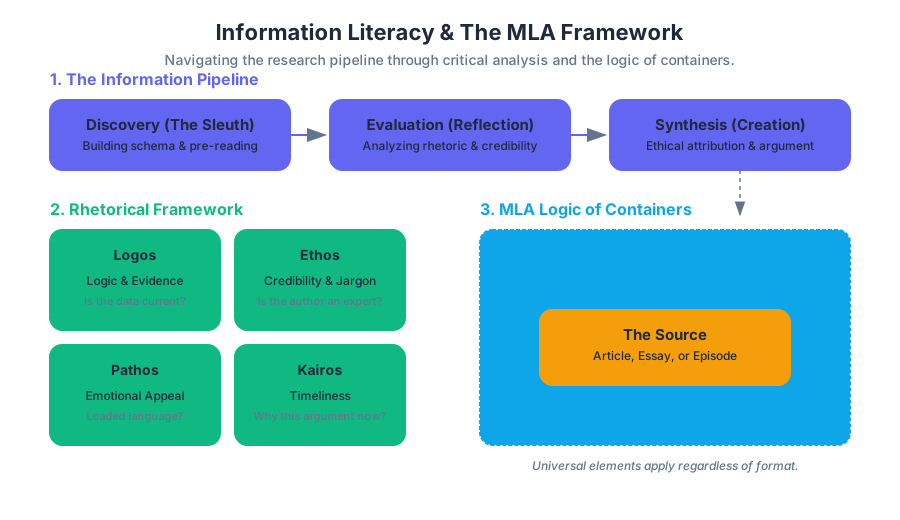
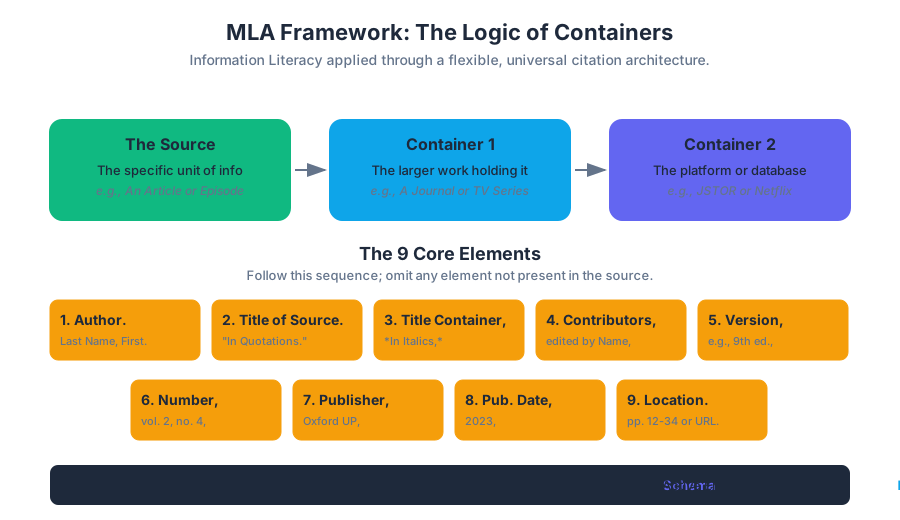
Case Study: The Migration Series
Key concepts: Great Migration · Economic Determinism · Push and Pull Factors · Visual Analysis
An application of textual analysis using Jacob Lawrence's artwork to explore economic and social drivers of the Great Migration.
Case Study: The Migration Series
The Migration Series (1940–1941) by Jacob Lawrence represents a seminal intersection of visual art, social history, and rhetorical argument. As a case study in academic analysis, it serves as a "text" that demands the same rigorous decoding strategies as a peer-reviewed essay or a historical manifesto. By examining the sixty-panel sequence through the lenses of Economic Determinism, Push and Pull Factors, and Visual Rhetoric, we can synthesize complex historical movements into a cohesive narrative of Collective Ambition.
The Visual Text: Redefining "Reading"
In the context of college-level literacy, a text is defined as any object that conveys meaning and can be "read" or interpreted. While traditional literacy focuses on the written word, academic analysis extends to visual media. Jacob Lawrence’s series functions as a non-linear reference tool, much like the structure of The Word on College Reading and Writing, where meaning is layered across multiple panels, captions, and stylistic choices.
Visual Analysis vs. Traditional Reading
To analyze the Migration Series, one must apply the "Sleuth" methodology: examining visual clues, identifying the "author's" (Lawrence's) purpose, and building a mental schema of the Great Migration.
| Feature | Traditional Text (Written) | Visual Text (Migration Series) |
|---|---|---|
| Primary Unit | Sentence / Paragraph | Panel / Composition |
| Contextual Clues | Headings, Topic Sentences | Color Palettes, Geometric Shapes |
| Narrative Flow | Linear (Beginning to End) | Sequential / Modular |
| Evidence | Citations, Data, Quotes | Visual Symbols, Captions, Juxtaposition |
| Rhetoric | Logical Argument (Logos) | Emotional & Visual Persuasion (Pathos/Ethos) |
Economic Determinism: The Engine of Migration
A central theme in the analysis of Lawrence’s work is Economic Determinism. This theory posits that economic forces—rather than purely social or political ones—are the primary drivers of historical change and human behavior. In the Migration Series, Lawrence illustrates how the movement of six million African Americans from the rural South to the urban North was "determined" by the material conditions of labor and survival.
Push and Pull Factors
The migration was not a random event but a calculated response to specific environmental and economic variables. These are categorized into Push Factors (conditions that force individuals to leave) and Pull Factors (conditions that attract individuals to a new location).
Definition: The Gravity Model of Migration In social science, the movement between two locations is often modeled by the "Gravity Model," where the volume of migration ($M_{ij}$) is proportional to the "mass" (economic opportunity) of the destination and inversely proportional to the "friction" (distance/cost) between them.
| Category | Factor | Description in Lawrence's Panels |
|---|---|---|
| Push | Boll Weevil Infestation | Crop failure leading to total loss of income for sharecroppers. |
| Push | Systemic Violence | The threat of lynching and legal disenfranchisement (Jim Crow). |
| Pull | Labor Shortages | WWI created a vacuum in Northern factories as European immigration ceased. |
| Pull | Educational Access | The promise of better schools and social mobility in the North. |
Mathematical Representation of Migration Drivers
To understand the "determinism" in economic terms, we can look at the migration flow as a function of wage differentials and risk.
M_{flow} = \int_{t_0}^{t_1} \frac{(W_{north} - W_{south}) - C_{migration}}{R_{social}} dt
Where:
- $W$: Real wages in the respective region.
- $C$: The sunk cost of relocation.
- $R$: The social risk/friction factor (e.g., segregation, violence).
Visual Rhetoric and the "Migration Colors"
Lawrence did not just document history; he used Rhetoric—the art of persuasive communication—to argue for the agency of the migrants. His use of Modernism (simplified forms, bold colors) over Naturalism (photorealistic representation) allowed him to emphasize universal themes of struggle and hope.
The Unified Palette
Lawrence used a technique of "simultaneous composition," laying out all sixty panels and applying one color at a time across the entire series. This created a visual "rhythm" that mirrors the collective nature of the movement.
# Conceptualizing Lawrence's Simultaneous Composition Algorithm
class MigrationSeries:
    def __init__(self, total_panels=60):
        self.panels = [{"id": i, "layers": []} for i in range(total_panels)]
        self.palette = ["Casein Yellow", "Ochre", "Deep Blue", "Earth Red"]

    def apply_color_layer(self, color):
        """
        Simulates Lawrence's method of applying one color
        across all panels to ensure visual unity.
        """
        for panel in self.panels:
            # Logic: Apply specific color to pre-sketched areas
            coverage = self.calculate_composition_logic(panel['id'], color)
            panel['layers'].append({"color": color, "coverage": coverage})
            print(f"Applied {color} to Panel {panel['id']}")

    def calculate_composition_logic(self, panel_id, color):
        # Simplified representation of geometric distribution
        return (panel_id * len(color)) % 100

# Execution
series = MigrationSeries()
for paint in series.palette:
    series.apply_color_layer(paint)
Synthesis: Collective Ambition vs. Individual Hardship
While Economic Determinism explains the "why," the concept of Collective Ambition explains the "how." Lawrence’s series portrays the migrants not as passive victims of economic shifts, but as active participants in a grand, coordinated exodus.
Naturalism vs. Modernism in Analysis
- Naturalism: Would focus on the gritty, specific details of a single family's poverty.
- Modernism (Lawrence’s Approach): Uses sharp angles and "flat" perspectives to show the scale of the movement. In Panel 1, the crowds at the train station are depicted as a sea of shapes, emphasizing the collective nature of the journey.
"The Migration Series is more than a historical record; it is a rhetorical intervention that reframes the African American experience from one of subjugation to one of strategic movement." — Synthesis of De Souza & Miller
Academic Integrity and Citation (MLA 8th Edition)
When analyzing the Migration Series in a college essay, proper attribution is required. Following the MLA 8th Edition guidelines found in The Word on College Reading and Writing, students must treat the artwork as a source within a "container" (the museum or the digital archive).
MLA Citation Structure for Art
| Component | Example for Lawrence's Work |
|---|---|
| Author | Lawrence, Jacob. |
| Title of Source | The Migration Series. |
| Date of Creation | 1940-41. |
| Container (Museum) | The Phillips Collection, Washington D.C. / MoMA, New York. |
| Location (URL) | www.phillipscollection.org/collection/migration-series |
Example Works Cited Entry (SQL Representation)
To manage a large volume of sources for a research paper, one might use a database structure to track citation components.
-- Schema for managing Art Citations in a Research Database
CREATE TABLE WorksCited (
    id INTEGER PRIMARY KEY,
    author_last VARCHAR(255),
    author_first VARCHAR(255),
    work_title VARCHAR(255),
    container_title VARCHAR(255),
    publisher VARCHAR(255),
    pub_year INTEGER,
    location_url TEXT
);

INSERT INTO WorksCited (author_last, author_first, work_title, container_title, pub_year, location_url)
VALUES ('Lawrence', 'Jacob', 'The Migration Series', 'The Phillips Collection', 1941, 'https://www.phillipscollection.org/migration-series');

-- Query to generate an MLA-style string
SELECT
    author_last || ', ' || author_first || '. "' || work_title || '." ' || container_title || ', ' || pub_year || '.'
AS mla_citation
FROM WorksCited;
Common Pitfalls in Analyzing the Series
- Ignoring the Captions: Each panel has a specific caption written by Lawrence. To ignore the text is to ignore half of the rhetorical argument.
- Over-emphasizing Pathos: While the series is emotional, focusing only on the "sadness" misses the Economic Determinism—the logical, material reasons for the move.
- Misidentifying the Medium: Lawrence used tempera on gesso on composition board, not oil on canvas. This choice of medium contributes to the "flat," matte look that defines the series' aesthetic.
- Linear Fallacy: Assuming the panels must be read strictly 1-60. While they tell a story, Lawrence’s simultaneous creation method suggests they are a singular, unified "text" where themes recur non-linearly.
Critical Reflection: The "Active Reading" of Art
As suggested in The Word on College Reading and Writing, strong writing is rooted in Active Engagement. When viewing the Migration Series, the "reader" should:
- Annotate: Take notes on recurring symbols (e.g., the railroad, the hammer, the open door).
- Research: Look up unfamiliar terms mentioned in captions (e.g., "labor agents," "boll weevil").
- Contextualize: Connect the 1940s perspective of Lawrence to the 1910s events he is depicting.
Technical Summary: The Analysis Pipeline
To perform a deep-dive analysis of the Migration Series, follow this pipeline:
- Pre-reading (Sleuthing): Scan the panels for dominant colors and shapes.
- Information Extraction: Identify the specific "Push" or "Pull" factor in a given panel.
- Rhetorical Decoding: Determine how the composition (geometry, scale) supports the caption's claim.
- Synthesis: Connect individual panels to the overarching theme of Economic Determinism.
- Citation: Document the source using MLA 8th Edition standards to maintain academic integrity.
Source Materials
- download?type=print_pdf
- download?type=pdf
- The Word on College Reading and Writing
- The Word on College Reading and Writing
- The Word on College Reading and Writing
- The Word on College Reading and Writing
- The Word on College Reading and Writing
- The Word on College Reading and Writing
- Log In
- The Word on College Reading and Writing
- The Word on College Reading and Writing
- this example
Study The Word on College Reading and Writing with AI — Free on Lykke
Sign up for free to generate personalized flashcards, quizzes, and study guides from this course. Chat with an AI tutor that knows the material.
Get Started FreeView this course wiki on Lykke · Browse all public course wikis