From the free course The Word on College Reading and Writing on Lykke
Information Literacy and MLA
Key concepts: MLA 8th Edition · Works Cited Page · Source Attribution · Plagiarism · Container Titles
Covers the essentials of source attribution using MLA 8th edition and the importance of avoiding plagiarism.
Information Literacy and MLA
Information literacy is the foundational meta-competency of the modern academic and professional landscape. It is defined not merely as the ability to read, but as the integrated set of skills encompassing the discovery of information, the understanding of how information is produced and valued, and the use of information in creating new knowledge and participating ethically in communities of learning.
In the context of higher education, this literacy manifests through the mastery of MLA (Modern Language Association) Style, specifically the 8th and 9th editions, which moved away from rigid, format-specific rules toward a flexible, universal framework. This shift mirrors the evolution of the digital "text"—recognizing that a "text" is no longer just a bound book, but any vehicle for meaning, including podcasts, data visualizations, and social media threads.
The Architecture of Information Literacy
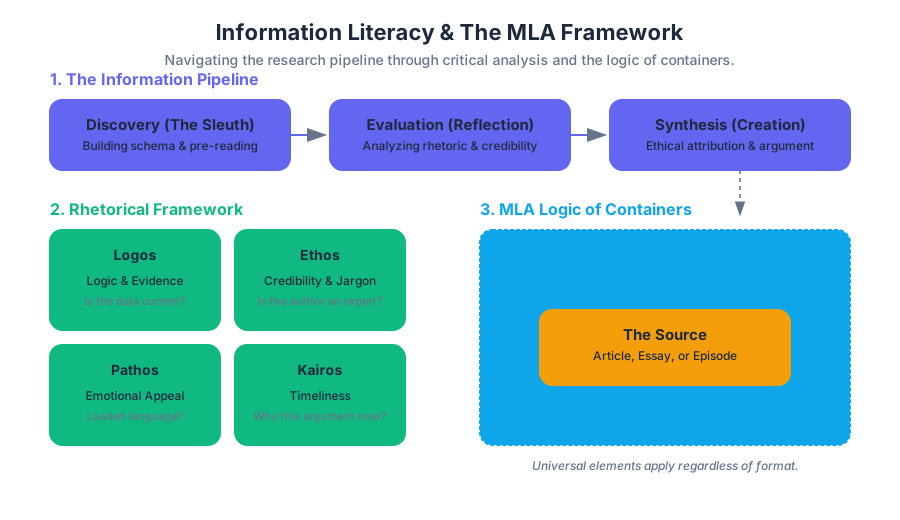
Information literacy operates as a pipeline, moving from the initial recognition of a "need to know" to the ethical dissemination of a synthesized argument. To navigate this pipeline, a researcher must act as a "sleuth," a metaphor derived from the pre-reading strategies used to build schema—the mental frameworks that allow us to categorize and retain new data.
The Reading-Writing Feedback Loop
Strong writing is inextricably linked to diverse reading habits. The process is non-linear; it involves constant recursion between the stages of the writing process: Prewriting, Drafting, and Revising.
| Phase | Objective | Key Activities |
|---|---|---|
| Pre-reading | Schema Building | Analyzing titles, author credentials, skimming headings, and scanning topic sentences. |
| Active Engagement | Information Extraction | Annotation, looking up jargon, and identifying the author's purpose. |
| Critical Reflection | Evaluation | Assessing evidence credibility and identifying rhetorical bias. |
| Synthesis | Knowledge Creation | Integrating source material into an original argument via MLA attribution. |
"In an academic context, a text is anything that conveys meaning. While we focus on printed works, the skills of information literacy apply equally to visual and auditory media, requiring the same rigor in extraction and analysis."
Rhetoric and the Art of Persuasion
At the heart of information literacy lies Rhetoric: the study and practice of effective, persuasive communication. Understanding rhetoric allows a researcher to deconstruct a source's "Main Point" versus its "Author's Purpose." While the main point is the what (the thesis), the purpose is the why (to inform, to provoke, to sell, or to change policy).
The Rhetorical Framework
To evaluate a source, one must analyze the interaction between the author, the audience, and the text itself.
| Rhetorical Element | Definition | Critical Question |
|---|---|---|
| Logos | Logical reasoning and evidence. | Is the data current and statistically significant? |
| Ethos | The credibility and character of the author. | Does the author have the requisite expertise or "jargon" mastery? |
| Pathos | Emotional appeal to the audience. | Does the language use "loaded" terms to bypass critical thinking? |
| Kairos | The timeliness of the argument. | Why is this argument being made now? |
Jargon and Audience Awareness
A common pitfall in academic writing is the misuse of jargon—specialized language used by a particular profession or group. While jargon provides precision within a field (e.g., "economic determinism" in history), it can act as a barrier to a general audience. Information literacy requires the writer to calibrate their language to the "Audience Awareness" level of their readers, ensuring that technical terms are defined or replaced with accessible equivalents when necessary.
The MLA 8th Edition Framework: The Logic of Containers
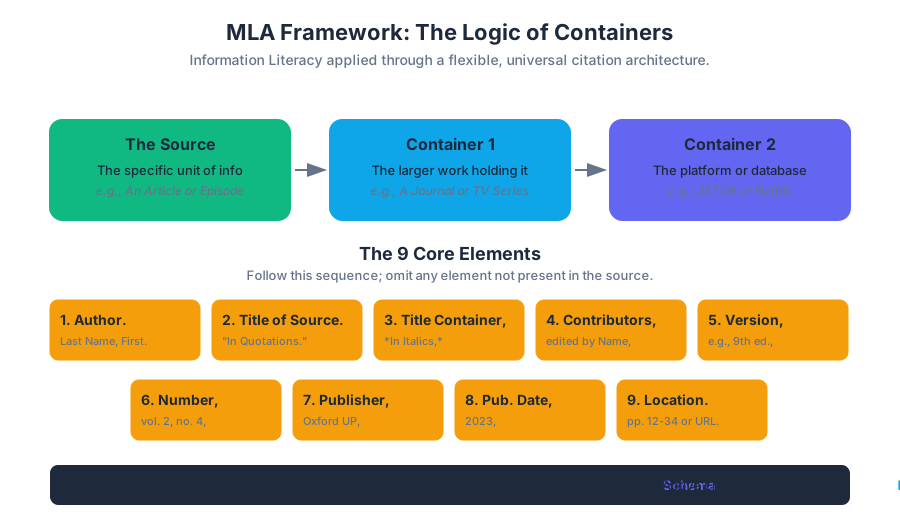
The MLA 8th Edition revolutionized citation by introducing the concept of Containers. Previously, scholars had to memorize different formats for a book, a journal, and a website. The 8th Edition replaced this with a universal set of Core Elements that can be applied to any source.
The Container Concept
A Container is the "larger work" that holds the source. For example:
- An essay (Source) is inside a book (Container).
- An episode (Source) is inside a TV series (Container), which might be on a streaming service (Container 2).
- An article (Source) is inside a journal (Container 1), which is inside a database (Container 2).
The 9 Core Elements
MLA citations follow a specific order. If an element is missing, it is simply omitted.
| Order | Element | Example | Punctuation |
|---|---|---|---|
| 1 | Author | De Souza, Michael. | Period |
| 2 | Title of Source | "Economic Determinism." | Quotation marks/Period |
| 3 | Title of Container | Journal of Migration, | Italics/Comma |
| 4 | Other Contributors | edited by Sarah Miller, | Comma |
| 5 | Version | 2nd ed., | Comma |
| 6 | Number | vol. 12, no. 4, | Comma |
| 7 | Publisher | Oxford UP, | Comma |
| 8 | Publication Date | 2018, | Comma |
| 9 | Location | pp. 45-60. | Period |
Source Attribution and Plagiarism Prevention
Source Attribution is the practice of clearly identifying where outside information comes from. This serves two purposes: it gives credit to the original creator (Ethos) and it allows the reader to follow the "academic conversation" back to the source.
Plagiarism: Intentional vs. Accidental
Plagiarism is not always a deliberate act of theft. It often occurs due to poor note-taking or a misunderstanding of how to integrate sources.
- Global Plagiarism: Submitting an entire work that is not your own.
- Patchwork Plagiarism: Stitching together phrases and ideas from multiple sources without citation.
- Incremental Plagiarism: Failing to give credit for a specific quote or paraphrase within an otherwise original work.
The Mechanics of Integration
To avoid plagiarism, writers use Signal Phrases and In-Text Citations.
Theorem of Attribution: A citation is required whenever you use a direct quote, a paraphrase of a specific idea, or a fact that is not "common knowledge."
In the following example, we see how a researcher might use a BibTeX structure to manage these citations before rendering them in a document.
@article{lawrence2016migration,
  author = {De Souza, Michael},
  title = {Economic Determinism and Ambition in the Migration Series},
  journal = {African American Studies Quarterly},
  volume = {202},
  year = {2016},
  pages = {15-30},
  note = {Analysis of Jacob Lawrence's 60-panel sequence}
}

% Usage in text:
% According to De Souza, the "Migration Series" represents the collective
% ambition of a people moving toward economic agency (16).
Case Study: Analyzing Jacob Lawrence’s "Migration Series"
To see information literacy in action, we can examine the analysis of Jacob Lawrence’s Migration Series. This 60-panel artwork serves as a "text" that requires both visual and historical literacy.
Push and Pull Factors
The analysis identifies Push Factors (reasons to leave, such as crop failure and Jim Crow laws) and Pull Factors (reasons to move, such as labor shortages in the North). This is an exercise in Economic Determinism—the theory that economic forces determine social and political structures.
Naturalism vs. Modernism
The researcher must distinguish between:
- Naturalism: Depicting the harsh, "natural" reality of poverty and labor.
- Modernism: Using bold colors and abstract shapes to convey the "Collective Ambition" and energy of the Great Migration.
By citing Lawrence's captions alongside the visual panels, the researcher practices Source Integration, weaving together primary visual evidence with secondary historical analysis.
Common Pitfalls in MLA and Information Literacy
- The "Database as Publisher" Error: In MLA 8, the database (like JSTOR or EBSCO) is a Container, not the publisher. The publisher is the entity that produced the journal (e.g., Oxford University Press).
- Over-Quoting: Relying too heavily on direct quotes can weaken your "Authorial Voice." Effective information literacy prioritizes paraphrasing—re-stating the author's idea in your own words while still providing an in-text citation.
- Ignoring the Diurnal Cycle: Information literacy includes self-regulation. Research shows that reading efficiency is tied to one's Diurnal Cycle (circadian rhythm). Attempting to read dense academic texts during "low-energy" troughs leads to poor retention and "passive reading."
- Failure to Annotate: Reading without a pen (or digital highlighter) is a passive act. Annotation is the process of "talking back" to the text, which is essential for critical analysis.
Summary of Information Literacy Workflow
- Sleuthing: Pre-read the text for visual clues and author credentials.
- Environment Optimization: Minimize distractions (put the smartphone in another room).
- Active Reading: Annotate and look up unfamiliar vocabulary immediately.
- Rhetorical Analysis: Determine the author's purpose and the logic of their evidence.
- MLA Mapping: Identify the Source and its Container(s).
- Ethical Integration: Use signal phrases to weave sources into the argument.
Source Materials
Study The Word on College Reading and Writing on Lykke
This course page is free to open: signed out, you can read its first two sections, and signing in, on any plan, opens the rest. The free Lykke Chrome extension syncs your own Canvas courses, so ChatGPT, Claude and Muse can answer from your classes and deadlines. It only reads Canvas.
Add the free extensionSign in to open every sectionAll sections of The Word on College Reading and Writing · Browse more course pages