From the free course The Word on College Reading and Writing on Lykke
Foundations of Reading Habits
Key concepts: Diurnal Cycles · Optimal Study Environments · Distraction Management · Reading Stamina
Explores how to optimize the reading environment and manage personal biological cycles for better focus.
Foundations of Reading Habits
In the transition to college-level literacy, reading is no longer a passive act of consumption but a high-stakes cognitive performance. The "Foundations of Reading Habits" refers to the physiological, environmental, and psychological infrastructure required to sustain deep engagement with complex texts. Unlike recreational reading, academic reading demands a high degree of Attentional Control and Cognitive Endurance. To master this, one must optimize the biological timing of sessions, the physical architecture of the workspace, and the systematic elimination of cognitive "leakage" caused by distractions.
Diurnal Cycles and Chronobiological Optimization
What it is
A Diurnal Cycle (or Circadian Rhythm) is the roughly 24-hour internal clock, governed by the suprachiasmatic nucleus (SCN) in the hypothalamus, that regulates sleep-wake cycles, hormone release, and cognitive function. In the context of reading habits, it refers to the synchronization of high-density cognitive tasks—such as analyzing Jacob Lawrence’s Migration Series for economic determinism—with peak periods of mental alertness.
Why it matters
Cognitive performance is not a flat line; it is a wave. Research suggests that for most individuals, "executive function" (the ability to focus, plan, and inhibit impulses) peaks in the morning, dips in the mid-afternoon (the "post-lunch dip"), and may see a secondary recovery in the evening. Attempting to read a dense rhetorical analysis during a "trough" period results in Passive Regression, where the eye moves across the page without the brain encoding the information.
How it works: The Peak-Trough-Recovery Framework
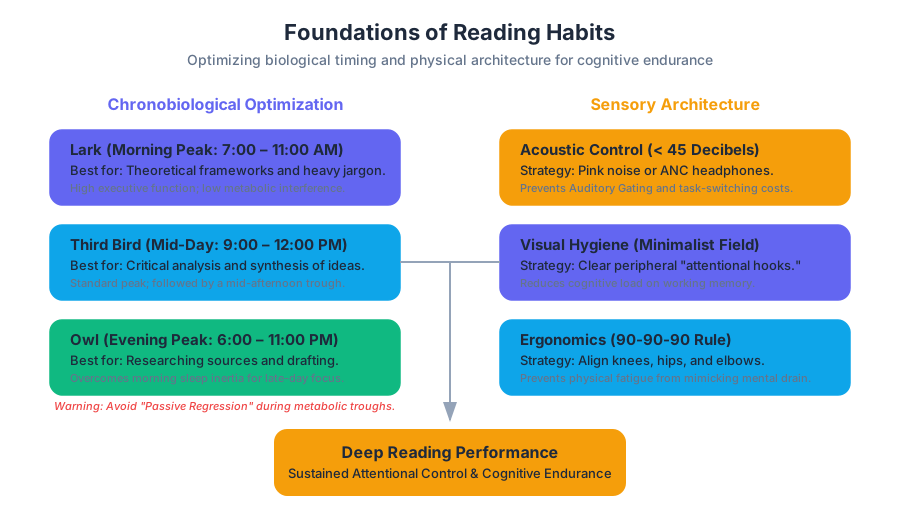
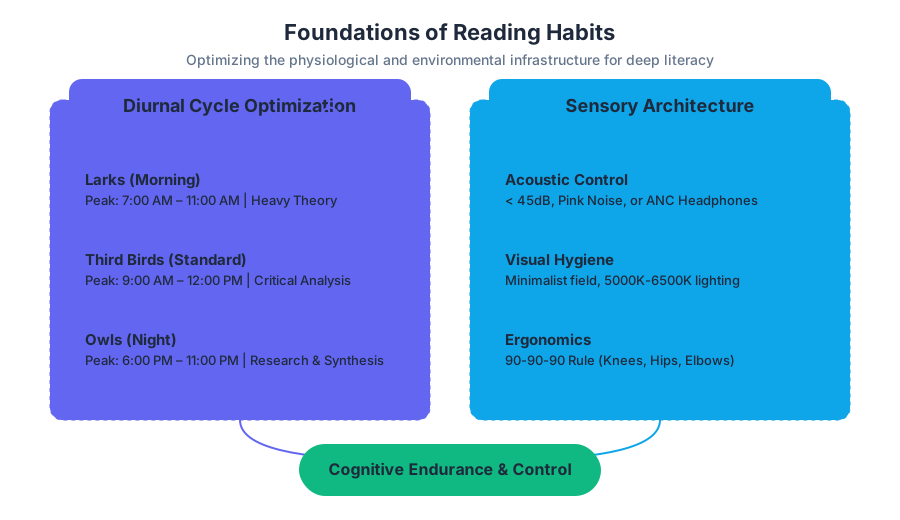
Most learners fall into three categories of chronotypes:
- Larks (Morning People): Peak alertness occurs early; ideal for new, complex material.
- Owls (Night People): Peak alertness occurs late; morning hours are often characterized by "sleep inertia."
- Third Birds: The majority of the population who follow a standard morning peak, afternoon dip, and evening recovery.
| Chronotype | Peak Cognitive Period | Recommended Reading Task | Trough Period (Avoid Deep Work) |
|---|---|---|---|
| Lark | 7:00 AM – 11:00 AM | Theoretical frameworks, heavy jargon | 2:00 PM – 4:00 PM |
| Third Bird | 9:00 AM – 12:00 PM | Critical analysis, synthesis | 3:00 PM – 5:00 PM |
| Owl | 6:00 PM – 11:00 PM | Researching sources, drafting | 8:00 AM – 10:00 AM |
Concrete Example: Tracking Cognitive Flux
To determine an optimal reading schedule, a student can track their "Reading Velocity" (pages per hour) against their "Comprehension Score" (ability to summarize key points) over a seven-day period.
Common Pitfalls: The "Heroic" All-Nighter
Many students believe that sheer willpower can overcome biological troughs. However, sleep deprivation leads to a buildup of Adenosine, which binds to receptors in the brain to slow down neural activity. Reading while sleep-deprived leads to "Micro-sleeps," where the brain goes offline for seconds at a time, rendering the reading of complex rhetoric impossible.
Optimal Study Environments and Sensory Architecture
What it is
An Optimal Study Environment is a physical space engineered to minimize Cognitive Load—the total amount of mental effort being used in the working memory. This involves managing lighting, acoustics, ergonomics, and "context-dependent memory" cues.
Why it matters
The brain associates specific environments with specific behaviors. If you read in bed, your brain associates that space with sleep, leading to drowsiness. If you read in a high-traffic cafe, your brain must constantly exert energy to filter out "background noise," a process known as Auditory Gating, which leaves less energy for text analysis.
How it works: The Three Pillars of Environment
- Acoustic Control: Utilizing "Pink Noise" or silence to prevent the Irrelevant Sound Effect, where speech-like sounds interfere with the phonological loop used in reading.
- Visual Hygiene: A "minimalist" field of vision. Every object in your peripheral vision is a potential "attentional hook."
- Ergonomics: The "90-90-90" rule (knees, hips, and elbows at 90 degrees) to prevent physical fatigue from masquerading as mental fatigue.
| Factor | Parameter | Impact on Reading | Optimization Strategy |
|---|---|---|---|
| Lighting | 5000K - 6500K (Cool White) | Increases alertness, reduces melatonin | Use "Daylight" LED bulbs for study lamps. |
| Sound | < 45 Decibels | Minimizes task-switching costs | Use ANC (Active Noise Canceling) headphones. |
| Temperature | 20°C - 22°C (68°F - 72°F) | Optimal for metabolic efficiency | Avoid overly warm rooms that induce lethargy. |
| Location | Consistency | Builds "Context-Dependent Memory" | Use the same desk for the same subject. |
Mathematical Representation of Cognitive Efficiency
The efficiency of a reading environment can be modeled by the ratio of Signal (the text) to Noise (environmental distractions).
\text{Reading Efficiency} (\eta) = \frac{C \cdot A}{L_{int} + L_{ext}}
Where:
C= Complexity of the text (e.g., Jargon density)A= Attentional capacity of the readerL_int= Internal Load (stress, hunger, fatigue)L_ext= External Load (noise, visual clutter, phone notifications)
Key Insight: To increase efficiency, it is often easier to decrease the denominator (distractions) than to increase the numerator (effort).
Distraction Management and Attentional Control
What it is
Distraction Management is the proactive defense of the "Attentional Spotlight." In the digital age, this primarily involves mitigating Technological Interference and the Switch-Cost Effect—the cognitive penalty incurred when moving between a primary task (reading) and a secondary task (checking a notification).
Why it matters
Every time a reader checks a smartphone, they lose approximately 20 minutes of "Deep Work" momentum. This is because of Attention Residue: a part of the brain remains focused on the previous distraction even after returning to the text. For a student analyzing Jacob Lawrence's use of "Migration Colors," a single text message can break the thread of visual-to-textual synthesis.
How it works: The "Digital Fortress" Strategy
- Physical Decoupling: Placing the smartphone in a separate room to eliminate "Proximity Anxiety."
- Application Layer Blocking: Using software to disable the "infinite scroll" of social media during study blocks.
- The "In-Box" Method: Keeping a notepad nearby to write down "tangential thoughts" (e.g., "I need to buy milk") so they can be offloaded from working memory without leaving the reading task.
Reading Stamina and Cognitive Endurance
What it is
Reading Stamina is the ability to maintain focus on a challenging text for an extended period without cognitive collapse. It is a "plastic" trait, meaning it can be developed through progressive overload, much like physical strength.
Why it matters
College-level texts are often non-linear and dense with Jargon (specialized language). A student with low stamina will find themselves "skimming" the last five pages of a chapter, missing the nuanced arguments regarding Economic Determinism or Rhetorical Purpose. Building stamina allows for "Deep Reading," where the reader can hold multiple layers of meaning in their mind simultaneously.
How it works: The Progressive Overload Model
To build stamina, a reader must move through stages of increasing difficulty and duration.
| Stage | Duration | Text Complexity | Goal |
|---|---|---|---|
| Baseline | 15 Minutes | Narrative/Journalism | Establish a habit of "no-phone" reading. |
| Intermediate | 30 Minutes | Textbook Chapters | Practice active annotation and "Topic Sentence Scanning." |
| Advanced | 60+ Minutes | Peer-reviewed Journals | Synthesize multiple sources; identify author bias/tone. |
| Elite | 2-3 Hours | Primary Source Archives | Deep immersion; cross-referencing multiple complex texts. |
Variations: The Pomodoro Technique vs. Flow State
- Pomodoro: 25 minutes of reading followed by a 5-minute break. Best for students struggling with high anxiety or very low stamina.
- Flow State: Uninterrupted 90-minute blocks. Best for complex synthesis and "The Writing Process" (drafting/revising).
Common Pitfalls: The "Speed Reading" Myth
Many students attempt to increase stamina by increasing speed. However, for academic texts, speed is often the enemy of comprehension. Lexical Access (recognizing words) is fast, but Semantic Integration (understanding the meaning) is slow. If you read faster than you can integrate, your stamina is being wasted on "empty" reading.
"Reading is to the mind what exercise is to the body." — Sir Richard Steele. In an academic context, this means that the "burn" you feel when struggling with a dense paragraph is actually the process of neural pathways strengthening.
Synthesis: Creating a Reading Routine
The ultimate goal of understanding these foundations is to move from "accidental reading" to "intentional literacy." This involves a three-step pipeline:
- Pre-Reading (The Sleuth Phase): Before the "Deep Dive," spend 5 minutes examining titles, author credentials, and visual aids. This builds a Schema (a mental map) that reduces the cognitive load during the actual reading.
- Active Engagement: Use a pen or digital annotation tool. Do not just highlight; write "Why" in the margins. If the text mentions "Jacob Lawrence," and you don't know who he is, stop and look him up immediately to maintain Contextual Comprehension.
- Post-Reading Reflection: Spend 2 minutes summarizing the "Main Point" vs. the "Author's Purpose." This moves the information from short-term working memory to long-term storage.
Glossary of Key Terms
- Rhetoric: The art of persuasive communication.
- OER (Open Educational Resources): High-quality, openly licensed teaching and learning materials.
- Schema: A cognitive framework or concept that helps organize and interpret information.
- Jargon: Specialized language used by a particular profession or group that is difficult for others to understand.
- MLA 8th Edition: A standardized format for scholarly writing and citation, emphasizing "containers" and source attribution.
- Economic Determinism: The theory that economic forces (like labor shortages) are the primary driver of social and historical change.
Source Materials
Study The Word on College Reading and Writing on Lykke
This course page is free to open: signed out, you can read its first two sections, and signing in, on any plan, opens the rest. The free Lykke Chrome extension syncs your own Canvas courses, so ChatGPT, Claude and Muse can answer from your classes and deadlines. It only reads Canvas.
Add the free extensionSign in to open every sectionAll sections of The Word on College Reading and Writing · Browse more course pages