From the free course The Word on College Reading and Writing on Lykke
Active Reading and Annotation
Key concepts: Annotation · Marginalia · Active Reading · Vocabulary Development · E-book tools
Covers the mechanics of annotation and the difference between passive highlighting and active marginalia.
Active Reading and Annotation
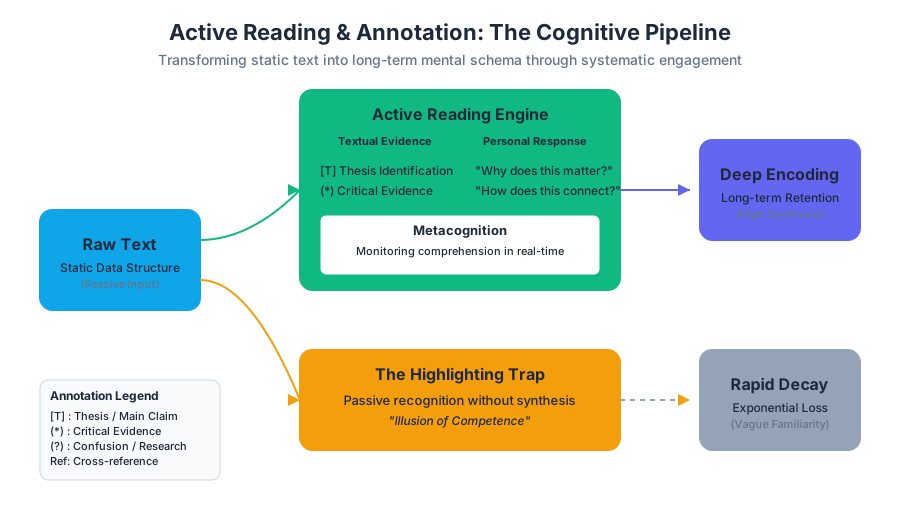
Active reading is the cognitive process of engaging with a text through deliberate interrogation, systematic marking, and recursive reflection. Unlike passive reading—where the eye traverses the page to absorb information through osmosis—active reading treats the text as a dynamic data structure that must be parsed, indexed, and integrated into the reader's existing mental schema.
At the heart of this process lies Annotation, the physical or digital act of inscribing the text with marginalia, symbols, and queries. Annotation transforms a static document into a "living" dialogue between the author and the reader. In a university setting, this is not merely a study habit; it is a foundational requirement for textual analysis, information literacy, and the synthesis of complex academic arguments.
The Cognitive Architecture of Active Reading
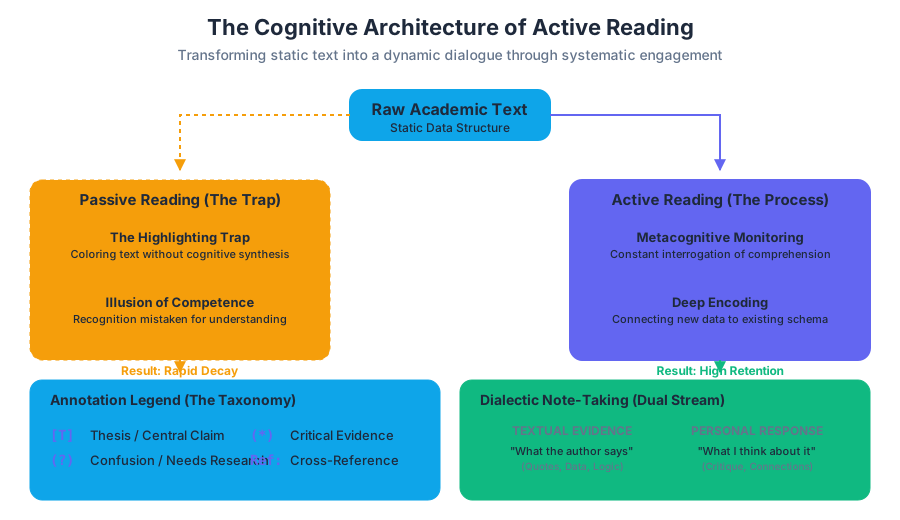
Active reading is governed by the principle of metacognition—thinking about one’s own thinking. When a reader engages in active reading, they are simultaneously processing the semantic content of the text and monitoring their level of comprehension.
The Highlighting Trap vs. Deep Encoding
A common pitfall for novice readers is "passive highlighting." Research in cognitive psychology suggests that the act of highlighting without accompanying marginalia provides a false sense of security, often referred to as the illusion of competence. The reader feels they have "captured" the information, but because the brain has not performed the heavy lifting of synthesis, the information remains in short-term storage and is quickly purged.
Definition: Deep Encoding The process by which new information is integrated into long-term memory by connecting it to existing knowledge through meaningful associations, such as paraphrasing or critical questioning.
| Feature | Passive Reading | Active Reading |
|---|---|---|
| Goal | Completion of the text | Comprehension and Synthesis |
| Physical Action | Continuous eye movement, occasional highlighting | Pausing, underlining, writing marginalia |
| Cognitive Load | Low (recognition-based) | High (generative-based) |
| Outcome | Vague familiarity | Structural understanding and recall |
| Retention | Exponential decay over 24 hours | High retention through "hooks" |
Annotation and Marginalia: The Taxonomy of Marks
Annotation is the specific practice of writing notes, questions, and symbols directly on the text. Marginalia refers specifically to the notes written in the margins. Effective annotation requires a systematic approach, often involving a personalized "key" or "legend" of symbols.
The Mechanics of Annotation
- Thesis Identification: Locating the central claim (the thesis statement) and marking it with a specific symbol (e.g.,
[T]). - Evidence Tracking: Identifying the data, quotes, or logic used to support the thesis.
- Structural Mapping: Marking transitions, introductions of new concepts, and conclusions.
- Interrogative Marking: Placing a
?next to confusing passages or areas that require further research.
A Standardized Annotation Legend
| Symbol | Meaning | Usage |
|---|---|---|
| Underline | Key Point | Used for major definitions or central arguments. |
| [Bracket] | Thesis/Claim | Used to isolate the author's primary objective. |
| (?) | Confusion | Marks a term or concept that needs a dictionary or instructor's help. |
| (*) | Critical Evidence | Highlights data or quotes that prove the author's point. |
| Ref: | Connection | Cross-references this passage to another page or external text. |
Dialectic Note-Taking: The Dual-Stream System
A Dialectic approach to reading involves a formal dialogue between the reader and the text. This is most commonly implemented through a two-column note-taking system. The term "dialectic" stems from the Greek dialektikē, referring to the art of investigating the truth through reasoned argument.
Implementation Algorithm
The reader divides a page into two vertical columns:
- Left Column (Textual Evidence): Direct quotes, summaries of the author's points, and specific page numbers. This represents "What the author says."
- Right Column (Personal Response): Questions, critiques, connections to other readings, and emotional or intellectual reactions. This represents "What I think about it."
Worked Example: Analyzing a Rhetorical Text
Suppose a student is reading a text on "The Ethics of AI."
| Textual Evidence (Left) | Personal Response (Right) |
|---|---|
| "The black-box nature of neural networks precludes true accountability" (p. 42). | If we can't see the 'why,' can we ever assign legal liability? Compare to 'Strict Liability' in tort law. |
| The author cites the 2018 COMPAS algorithm case as evidence of bias. | Is this bias inherent in the code or a reflection of the training data? The author seems to blame the math, not the data source. |
Technical Implementations: Digital Annotation and E-Book Systems
In the modern academic environment, much reading occurs via E-book readers (Kindle, Adobe Digital Editions) or web-based platforms. Digital annotation offers capabilities that physical paper cannot, such as full-text search, OCR (Optical Character Recognition), and metadata export.
The Retention Decay Formula
The necessity of active reading can be modeled mathematically. Without active engagement (rehearsal and annotation), retention follows an exponential decay curve, often modeled as:
R = e^{-\frac{t}{S}}
Where:
Ris stability (retention)eis Euler's numbertis time elapsedSis the "strength" of the initial memory (determined by the depth of encoding during reading)
Active reading and annotation significantly increase the value of S, slowing the rate of decay.
Vocabulary Development and Lexical Density
Active reading requires the reader to identify and resolve "lexical gaps"—words they do not know. In a college-level text, missing even one key term can derail the comprehension of an entire paragraph.
The "Lookup and Link" Method
- Identify: Circle the unfamiliar word.
- Contextualize: Attempt to guess the meaning based on surrounding sentences.
- Verify: Use a dictionary to find the precise definition.
- Inscribe: Write the definition in the margin near the word. This creates a permanent link in the text's physical space.
Comparison of E-book Annotation Tools
| Tool | Platform | Best For | Export Format |
|---|---|---|---|
| Hypothes.is | Web/Browser | Collaborative reading | JSON / API |
| LiquidText | iPad/Mac | Visual mapping of ideas | PDF / Docx |
| Zotero | Desktop | Academic citations | BibTeX / Markdown |
| Kindle | Hardware/App | Linear narrative reading | Email / HTML |
From Reading to Writing: The Thesis Extraction Pipeline
The ultimate goal of active reading is to prepare the reader to produce their own text. Annotation serves as a "trail of breadcrumbs" that leads back to the author's core arguments.
Common Pitfalls and Anti-Patterns
Even with the best intentions, readers can fall into "pseudo-active" habits that mimic the appearance of work without the cognitive benefits.
- Over-Annotation: Marking every line. If everything is highlighted, nothing is highlighted. This dilutes the "signal-to-noise" ratio.
- Mechanical Marking: Underlining without thinking. This occurs when the reader is tired and goes through the motions of marking without actually processing the meaning.
- Ignoring the "Why": Writing "Interesting!" in the margin. This is a descriptive note, not an analytical one. An analytical note would explain why it is interesting or how it relates to the thesis.
- The "Dictionary Delay": Waiting until the end of a chapter to look up words. By then, the context of the word's usage is often lost.
Theorem of Selective Annotation The utility of an annotation is inversely proportional to the percentage of the page it covers. Optimal annotation targets the "pivots" of an argument—the specific points where the logic shifts or the evidence is presented.
Source Materials
Study The Word on College Reading and Writing on Lykke
This course page is free to open: signed out, you can read its first two sections, and signing in, on any plan, opens the rest. The free Lykke Chrome extension syncs your own Canvas courses, so ChatGPT, Claude and Muse can answer from your classes and deadlines. It only reads Canvas.
Add the free extensionSign in to open every sectionAll sections of The Word on College Reading and Writing · Browse more course pages