From the free course Technical Writing on Lykke
Workplace Documentation and Reporting
Key concepts: Progress Reports · Incident Reporting · Conflict Resolution · Stakeholder Reassurance · Professional Conduct
Examines specific types of workplace reports, including progress reports and incident reports.
Workplace Documentation and Reporting
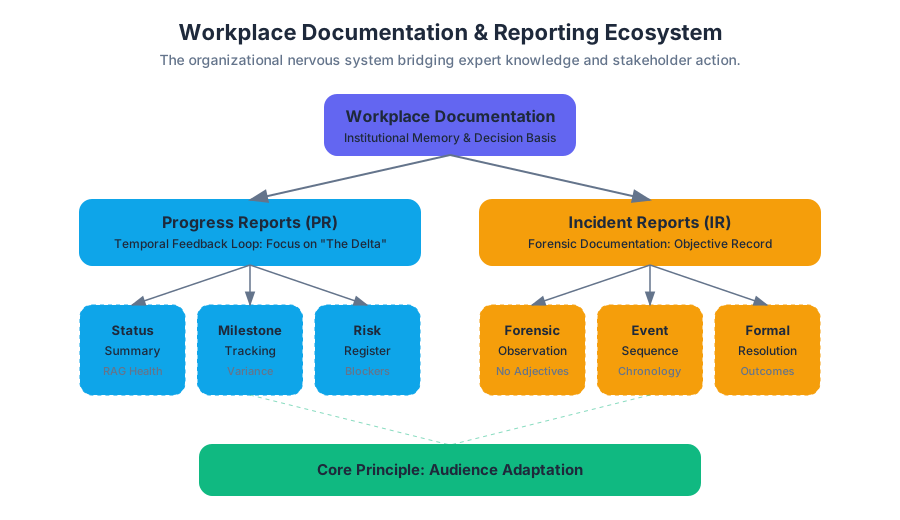
Workplace documentation is the systematic process of recording, organizing, and communicating specialized information within a professional environment. Far from being a mere administrative burden, it serves as the "nervous system" of an organization—transmitting vital signals between stakeholders, archiving institutional memory, and providing a factual basis for decision-making. In the context of technical writing, documentation is the bridge between expert knowledge (Subject Matter Experts or SMEs) and the diverse audiences who must act upon that knowledge.
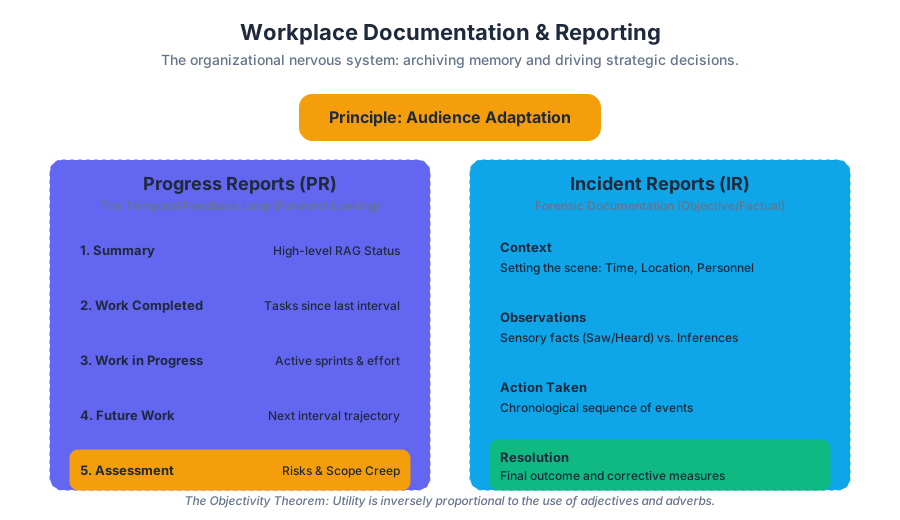
Effective workplace reporting is governed by the principle of Audience Adaptation. A senior engineer, a project manager, and a financial stakeholder all require different levels of granularity and different rhetorical appeals. This article explores the mechanics of progress reports, the forensic precision of incident reporting, the nuances of professional conduct in conflict resolution, and the overarching goal of stakeholder reassurance.
Progress Reports: The Temporal Feedback Loop
A Progress Report (PR) is a periodic communication that synchronizes the current state of a project with its planned trajectory. It is defined by its focus on the "Delta"—the difference between what was promised in the initial proposal and what has been achieved at the time of writing.
Why It Matters
Progress reports solve the problem of Information Asymmetry. Without regular updates, stakeholders may experience "project anxiety," leading to micromanagement or the withdrawal of funding. PRs provide a structured mechanism for:
- Reassuring Stakeholders: Demonstrating that the project is under control.
- Early Detection: Identifying "scope creep" or technical bottlenecks before they become catastrophic.
- Course Correction: Allowing management to reallocate resources based on early findings.
Mechanics of the Progress Report
The standard structure of a PR follows a chronological and thematic logic:
- Summary: A high-level overview for executives.
- Work Completed: Tasks finished since the last report.
- Work in Progress: Current active sprints or investigations.
- Future Work: Tasks scheduled for the next interval.
- Assessment/Problems: A candid evaluation of risks and unexpected hurdles.
| Component | Purpose | Key Metric |
|---|---|---|
| Status Summary | High-level health check | Red/Amber/Green (RAG) status |
| Milestone Tracking | Comparison against the baseline | Variance (Days ahead/behind) |
| Resource Utilization | Tracking budget and man-hours | Burn rate |
| Risk Register | Identifying potential blockers | Probability vs. Impact score |
Implementation Example: Automated Status Aggregation
In modern enterprise environments, progress reports are often derived from task management systems. Below is a Python implementation that aggregates task data to generate a structured status report.
import datetime

class ProjectStatus:
    def __init__(self, project_name, tasks):
        self.project_name = project_name
        self.tasks = tasks  # List of dicts: {'name': str, 'status': str, 'hours': int}

    def generate_report(self):
        completed = [t for t in self.tasks if t['status'] == 'Done']
        ongoing = [t for t in self.tasks if t['status'] == 'In Progress']

        report = f"### Progress Report: {self.project_name}\n"
        report += f"Date: {datetime.date.today()}\n\n"

        report += "#### 1. Completed Tasks\n"
        for t in completed:
            report += f"- {t['name']} ({t['hours']} hrs)\n"

        report += "\n#### 2. Work in Progress\n"
        for t in ongoing:
            report += f"- {t['name']}\n"

        total_hours = sum(t['hours'] for t in self.tasks)
        report += f"\n**Total Effort to Date:** {total_hours} man-hours"
        return report

# Example Usage
tasks_db = [
    {'name': 'Database Migration', 'status': 'Done', 'hours': 40},
    {'name': 'API Documentation', 'status': 'In Progress', 'hours': 15},
    {'name': 'UI Refactor', 'status': 'Done', 'hours': 25}
]
print(ProjectStatus("Project Phoenix", tasks_db).generate_report())
Incident Reporting: Forensic Documentation
An Incident Report is a formal document that records an extraordinary event—such as an accident, a security breach, or a workplace conflict—that deviates from standard operations. Unlike progress reports, which are forward-looking, incident reports are forensic and objective.
The Anatomy of Objectivity
The primary goal of an incident report is to provide a factual record that can withstand legal or administrative scrutiny. This requires the writer to distinguish between observations (what was seen/heard) and inferences (what was assumed).
The Objectivity Theorem: The utility of an incident report is inversely proportional to the number of adjectives and adverbs used by the author.
Worked Example: The Sodexo Incident
Consider a real-world scenario documented in campus security records: a conflict between student demonstrators and a food service representative. A poor report might say, "An angry manager rudely destroyed a student's sign." A professional report, however, focuses on the sequence of events:
- Context: A focus group session was held at the Student Union Building.
- Action: The representative admitted to tearing a student's sign during a period of frustration.
- Resolution: A formal apology was issued, and campus police issued a warning regarding conduct.
Incident Data Schema
To ensure consistency, organizations often use standardized schemas for incident logging.
# Incident Report Schema (Open Incident Standard)
incident_id: "IR-2023-0404"
timestamp: "2023-04-04T13:10:00Z"
location: "Student Union Building, Room 202"
severity_level: 2 # 1: Minor, 2: Moderate, 3: Critical
participants:
  - role: "Subject"
    id: "EMP-992"
    action: "Destruction of property (signage)"
  - role: "Complainant"
    id: "STU-441"
    action: "Demonstration/Protest"
narrative: |
  During a focus group session, the subject engaged in a verbal
  disagreement with the complainant. The subject proceeded to
  physically tear a placard held by the complainant.
resolution_status: "Closed - Warning Issued"
Conflict Resolution and Professional Conduct
In the workplace, documentation is often the final stage of Conflict Resolution. Professional conduct dictates that disagreements are handled with "tact, skill, and an awareness that what you write may be there forever."
The Interest-Based Relational (IBR) Approach
When documenting or resolving conflicts, technical professionals should move away from "positions" (what people want) to "interests" (why they want it).
| Strategy | Focus | Outcome |
|---|---|---|
| Competing | Power and authority | Win/Loss (High tension) |
| Avoiding | Delaying the issue | Unresolved (Low tension) |
| Collaborating | Mutual interest | Win/Win (High effort) |
| Compromising | Middle ground | Partial satisfaction (Medium effort) |
Professionalism in Digital Spaces
Professional communication requires an understanding of Netiquette and the permanence of the written word. In technical writing, this extends to how we comment on code, how we respond to peer reviews, and how we document errors.
Stakeholder Reassurance and Persuasion
While technical writing is often seen as purely informational, it is fundamentally persuasive. Every report aims to persuade the reader that the project is viable, the team is competent, and the risks are managed.
The Proposal as a Pitch
A Proposal is a document designed to secure approval or funding for a project. It identifies a specific problem and offers a structured solution. The success of a proposal hinges on Audience Analysis:
- Primary Audience: The decision-maker with the authority to say "Yes."
- Secondary Audience: The technical experts who will vet the feasibility.
- Tertiary Audience: Those affected by the change (e.g., end-users).
Mathematical Modeling of Stakeholder Impact
Stakeholder management can be modeled as a function of Power ($P$) and Interest ($I$). The strategy for communication ($C$) is determined by the quadrant in which the stakeholder resides.
$$ C(P, I) = \begin{cases} \text{Manage Closely} & \text{if } P > \text{high}, I > \text{high} \ \text{Keep Satisfied} & \text{if } P > \text{high}, I < \text{low} \ \text{Keep Informed} & \text{if } P < \text{low}, I > \text{high} \ \text{Monitor} & \text{if } P < \text{low}, I < \text{low} \end{cases} $$
SQL Example: Stakeholder Communication Matrix
To manage large projects, technical writers may query internal databases to ensure the right reports reach the right people.
-- Query to identify high-power, high-interest stakeholders for a specific project
SELECT
    s.name,
    s.email,
    p.project_name,
    p.status_color
FROM
    Stakeholders s
JOIN
    ProjectAssignments pa ON s.id = pa.stakeholder_id
JOIN
    Projects p ON pa.project_id = p.id
WHERE
    s.power_rating >= 8
    AND s.interest_rating >= 8
    AND p.id = 'PROJ-PHOENIX';
Information Literacy and Document Design
A document’s effectiveness is not just in its content but in its Information Literacy and Design. Technical writers must be able to find, evaluate, and synthesize information from diverse sources.
The CRAP Principles of Design
In the "Open Oregon" technical writing framework, document readability is enhanced by four key principles:
- Contrast: Use color and size to highlight important information (e.g., warnings).
- Repetition: Maintain consistent formatting (e.g., all level-3 headings look the same).
- Alignment: Ensure every element has a visual connection to another element.
- Proximity: Group related items together to reduce cognitive load.
Source Evaluation (The CRAAP Test)
When researching for a technical report, sources must be vetted using the CRAAP criteria:
- Currency: Is the information up to date?
- Relevance: Does it specifically address the problem?
- Authority: Who is the author/organization?
- Accuracy: Is the data verifiable?
- Purpose: Is there a bias or commercial intent?
Common Pitfalls in Workplace Documentation
Even experienced writers fall into traps that undermine the credibility of their reports.
| Pitfall | Description | Correction |
|---|---|---|
| The "Kitchen Sink" Error | Including every minor detail in a progress report. | Use executive summaries and appendices. |
| Passive Aggression | Using incident reports to "settle scores." | Stick to observable actions and direct quotes. |
| Jargon Overload | Writing for experts when the audience is management. | Define terms or use analogies. |
| Vague Timelines | Using terms like "soon" or "eventually." | Use ISO 8601 dates (YYYY-MM-DD). |
Case Study: The Maintenance of External Links
In technical documentation, a common failure point is the "Link Rot." As noted in the Technical Writing textbook (McMurrey et al.), authors must implement procedures for reporting and fixing broken external links. This is an exercise in Intellectual Property management and User Experience (UX).
# A simple bash script to check for broken links in a documentation directory
#!/bin/bash

DOC_DIR="./docs"
LOG_FILE="link_errors.log"

echo "Starting link check in $DOC_DIR..." > $LOG_FILE

grep -rPo 'http(s)?://[^)]+' $DOC_DIR | while read -r line; do
    url=$(echo $line | cut -d: -f2-3)
    status=$(curl -o /dev/null -s -w "%{http_code}" "$url")

    if [ "$status" -ne 200 ]; then
        echo "BROKEN: $url (Status: $status) in $line" >> $LOG_FILE
    fi
done

echo "Check complete. Errors logged to $LOG_FILE."
Conclusion: The Professionalism of the Record
Workplace documentation is more than a trail of paper or a collection of digital files; it is a professional asset. By mastering progress reports, incident logs, and persuasive proposals, the technical writer ensures that the organization remains transparent, accountable, and efficient. Whether you are translating a complex algorithm for a stakeholder or documenting a sensitive workplace conflict, the goal remains the same: clarity, objectivity, and professional integrity.
- Audience Analysis: The process of adapting a document to the specific needs, background, and authority of the reader.
- CRAP Principles: Contrast, Repetition, Alignment, and Proximity—the four pillars of document design.
- Information Asymmetry: A situation where one party has more or better information than another, which progress reports aim to resolve.
- Forensic Objectivity: A writing style that focuses strictly on observable facts and data, avoiding emotional or subjective language.
- Stakeholder Reassurance: The psychological goal of reporting, intended to maintain trust and support for a project.
- SME (Subject Matter Expert): An individual with deep technical knowledge who provides the raw information for technical writers.
- Which principle of document design suggests that related items should be grouped together to reduce cognitive load?
- (A) Contrast
- (B) Alignment
- (C) Proximity
- (D) Repetition
- In an incident report, which of the following is considered an "observation" rather than an "inference"?
- (A) "The employee seemed angry."
- (B) "The employee raised their voice to approximately 80 decibels."
- (C) "The employee was clearly frustrated by the software."
- (D) "The employee intended to cause a disturbance."
- What is the primary function of a "Risk Register" in a progress report?
- (A) To list all completed tasks.
- (B) To identify potential blockers and their impact on the project.
- (C) To track the project's budget.
- (D) To provide an executive summary.
- According to the IBR approach to conflict resolution, what should be the primary focus?
- (A) Defending one's position.
- (B) Asserting authority.
- (C) Identifying mutual interests.
- (D) Avoiding the conflict entirely.
Key Concepts to Master:
- The Progress Report Structure: Understand the difference between "Work Completed," "Work in Progress," and "Future Work." Know how to use RAG (Red, Amber, Green) statuses.
- Incident Reporting Ethics: Practice converting subjective statements into objective observations. Remember the "Objectivity Theorem."
- Audience Tiers: Be able to identify Primary, Secondary, and Tertiary audiences for any given document.
- Document Design: Memorize the CRAP principles and be able to apply them to a layout.
- Information Literacy: Understand the CRAAP test for source evaluation and how it applies to workplace research.
- Professional Conduct: Learn the nuances of interest-based negotiation and digital netiquette.
Further Reading:
- Technical Writing by Allison Gross et al. (Open Oregon Educational Resources).
- The CRAAP Test (Meriam Library, CSU Chico).
- Interest-Based Relational (IBR) Approach (Fisher and Ury, "Getting to Yes").
Source Materials
Study Technical Writing on Lykke
This course page is free to open: signed out, you can read its first two sections, and signing in, on any plan, opens the rest. The free Lykke Chrome extension syncs your own Canvas courses, so ChatGPT, Claude and Muse can answer from your classes and deadlines. It only reads Canvas.
Add the free extensionSign in to open every sectionAll sections of Technical Writing · Browse more course pages