From the free course Technical Writing on Lykke
Information Literacy and Research
Key concepts: Information Literacy · Primary vs. Secondary Sources · Information Timeline · Peer Review Process · Iterative Research
Teaches the skills necessary to find, evaluate, and synthesize information for professional use.
Information Literacy and Research
Information literacy is the foundational framework for navigating the modern "infosphere." It is defined not merely as the ability to locate data, but as a set of integrated abilities encompassing the reflective discovery of information, the understanding of how information is produced and valued, and the use of information in creating new knowledge and participating ethically in communities of learning.
In the context of technical writing and professional communication, information literacy acts as the "signal processing" layer. It allows a writer to filter through the noise of raw data, social media, and anecdotal evidence to find the high-fidelity signals required to build authoritative documents such as technical reports, feasibility studies, and proposals.
The Taxonomy of Information Sources
To conduct rigorous research, one must first categorize information based on its proximity to the event or data point in question. This classification determines the weight a source carries in a professional argument.
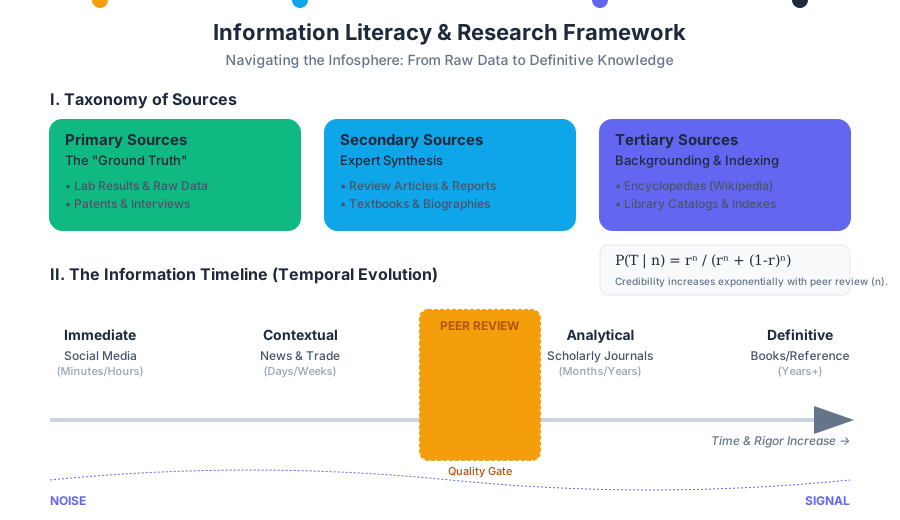
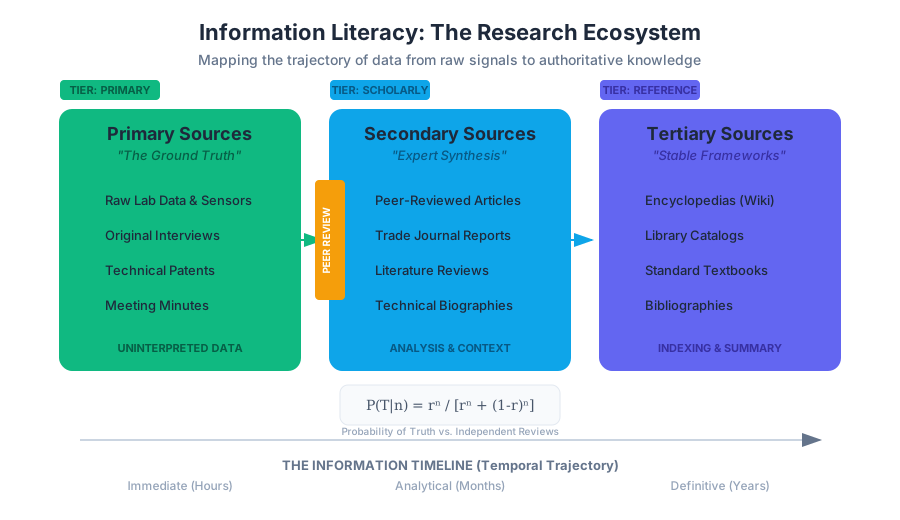
Primary, Secondary, and Tertiary Sources
The distinction between these sources is based on the degree of filtration and interpretation applied to the original data.
| Source Type | Definition | Examples in Technical Context | Role in Research |
|---|---|---|---|
| Primary | Original, uninterpreted data or first-hand accounts. | Lab results, raw sensor data, patents, meeting minutes, original interviews. | Provides the "ground truth" for analysis. |
| Secondary | Interpretations, analyses, or summaries of primary data. | Review articles, textbooks, technical reports analyzing external data, biographies. | Provides context, expert synthesis, and historical perspective. |
| Tertiary | Collections or indexes of primary and secondary sources. | Encyclopedias, bibliographies, library catalogs, Wikipedia. | Useful for initial "backgrounding" and finding primary/secondary leads. |
Publication Tiers: Popular, Professional, and Scholarly
Beyond the source's proximity to data, we must evaluate the intent and rigor of the publication. Technical writers must navigate these tiers to ensure their audience—whether experts or nonspecialists—receives information at the appropriate level of complexity.
| Feature | Popular (General Public) | Professional (Trade/Technical) | Scholarly (Academic) |
|---|---|---|---|
| Audience | General public, nonspecialists. | Practitioners, technicians, engineers. | Researchers, professors, experts. |
| Authorship | Journalists or staff writers. | Industry professionals or specialists. | Ph.D. researchers or subject matter experts. |
| Review Process | Editorial review (style/fact-checking). | Editorial review (relevance/utility). | Double-blind peer review. |
| Purpose | To inform, entertain, or sell. | To update on industry trends/tools. | To advance theoretical or empirical knowledge. |
| References | Rarely cited formally. | Occasional industry citations. | Extensive, formal bibliographies. |
Definition: Information Literacy "The ability to recognize when information is needed and have the ability to locate, evaluate, and use effectively the needed information." — Association of College and Research Libraries (ACRL)
The Information Timeline
Information is not static; it evolves over a temporal trajectory. Understanding the Information Timeline is critical for technical writers to avoid using "stale" or "premature" data. When a significant event occurs (e.g., a new cybersecurity breach or a breakthrough in battery chemistry), information propagates through different channels at different speeds.
- The Immediate Phase (Minutes/Hours): Social media (X/Twitter), live news feeds, and blog posts. These are high-speed but low-veracity. They lack context and are prone to the "first-to-report" error bias.
- The Contextual Phase (Days/Weeks): News magazines and trade journals. These sources begin to synthesize the "why" and "how," providing a professional perspective on the event's impact on specific industries.
- The Analytical Phase (Months/Years): Scholarly journals. This is where the Peer Review Process occurs. The data is scrutinized by independent experts, ensuring the findings are reproducible and methodologically sound.
- The Definitive Phase (Years+): Books and Encyclopedias. These provide the most stable, long-term theoretical frameworks, though they may lack the cutting-edge updates of journals.
The Peer Review Process: The Gold Standard of Credibility
In technical and scholarly research, the peer review process serves as a quality-control gatekeeper. It is a rigorous system designed to minimize bias and maximize the reliability of published findings.
Mechanics of Peer Review
- Submission: A researcher submits a manuscript to a journal editor.
- Initial Screening: The editor checks for alignment with the journal's scope and basic quality.
- Blind Review: The manuscript is sent to 2–4 anonymous experts (peers) in the same field.
- Feedback Loop: Reviewers provide critiques, identify flaws in methodology, and suggest revisions.
- Decision: The editor decides to Accept, Revise and Resubmit, or Reject the paper.
Mathematical Representation of Credibility
We can model the probability of a finding being "true" ($P(T)$) based on the number of independent peer reviews ($n$) and the average reliability of a reviewer ($r$).
P(T | n) = \frac{r^n}{r^n + (1-r)^n}
Note: As $n$ increases, the probability of catching a systemic error increases exponentially, assuming reviewers are truly independent.
Iterative Research: The Non-Linear Workflow
Research is rarely a straight line from "Question" to "Answer." Instead, it is an iterative process where each discovery informs the next query. This is particularly relevant when drafting Proposals or Technical Reports.
The Iterative Loop
- Backgrounding: Using tertiary sources (encyclopedias) to define the scope and terminology.
- Primary Querying: Searching scholarly databases (IEEE Xplore, PubMed) using specific Boolean operators.
- Evaluation: Assessing the "Authority, Accuracy, Objectivity, Currency, and Coverage" (AAOCC) of the results.
- Refinement: Narrowing or broadening the research question based on the volume and quality of found data.
- Synthesis: Integrating the research into the document (e.g., the "Discussion" section of a memo or the "Background" section of a proposal).
Implementation: Algorithmic Information Retrieval
In the modern research environment, we often use programmatic tools to manage and filter information. Below is a Python implementation of a basic TF-IDF (Term Frequency-Inverse Document Frequency) logic, which is the underlying principle behind how many research databases rank the relevance of scholarly articles.
import math
from collections import Counter

def calculate_tfidf(term, document, all_documents):
    """
    Calculates the TF-IDF weight of a term in a document.
    Higher weights indicate terms that are more characteristic of a specific paper.
    """
    # Term Frequency: How often the word appears in the current document
    tf = document.count(term) / len(document)

    # Inverse Document Frequency: How rare the word is across all documents
    num_docs_with_term = sum(1 for doc in all_documents if term in doc)

    # Avoid division by zero
    if num_docs_with_term == 0:
        return 0

    idf = math.log(len(all_documents) / num_docs_with_term)

    return tf * idf

# Example: Analyzing three research abstracts
abstract_a = "lithium battery degradation in electric vehicles".split()
abstract_b = "thermal management of lithium ion cells".split()
abstract_c = "economic impact of electric vehicle adoption".split()
corpus = [abstract_a, abstract_b, abstract_c]

# Finding the importance of 'degradation' in Abstract A
score = calculate_tfidf("degradation", abstract_a, corpus)
print(f"TF-IDF Score for 'degradation': {score:.4f}")
Research Integration in Technical Writing
Information literacy is the engine that drives Audience Analysis and Proposal Development. A technical writer must adapt their research findings to the specific needs of their readers.
Audience-Specific Research Needs
| Audience Category | Primary Research Need | Preferred Source Type | Level of Detail |
|---|---|---|---|
| Experts | Theoretical validation, raw data. | Scholarly Journals, Patents. | High (formulas, raw data). |
| Technicians | Practical application, troubleshooting. | Trade Journals, Manuals. | Medium (procedures, specs). |
| Executives | Bottom-line impact, feasibility. | Professional Reports, White Papers. | Low (summaries, ROI). |
| Nonspecialists | General understanding, safety. | Popular Magazines, FAQs. | Very Low (analogies, basics). |
The Proposal Context
When writing a Proposal (a formal bid to complete a project), research integration is mandatory. A proposal must prove that the writer has "done their homework." This involves:
- Solicited vs. Unsolicited Contexts: If responding to a Request for Proposals (RFP), the research must directly map to the technical requirements outlined in the RFP.
- Feasibility: Using research to prove that the proposed solution is technically and economically viable.
- Scholarly Backing: Professional proposals often fail if they rely solely on "popular" sources. Integrating peer-reviewed data lends the author an "Ethos" (credibility) that is difficult to challenge.
Advanced Querying: Boolean and Proximity Logic
To move beyond "basic search," researchers use structured query languages. This ensures the results are precise and minimize the Information Overload common in broad searches.
-- Example: Querying a Research Metadata Database (PostgreSQL)
-- Goal: Find highly-cited papers on 'Solid State Batteries' published after 2020
-- that are NOT focused on 'Consumer Electronics'.

SELECT
    title,
    authors,
    citation_count,
    publication_year
FROM
    scholarly_articles
WHERE
    (abstract @@ to_tsquery('solid & state & battery'))
    AND publication_year > 2020
    AND NOT (keywords @> ARRAY['smartphone', 'laptop'])
ORDER BY
    citation_count DESC
LIMIT 50;
Common Pitfalls in Professional Research
- The "Wikipedia Trap": Using tertiary sources as final citations. Wikipedia is a map, not the destination. Always follow the citations to the primary source.
- Confirmation Bias: Searching only for data that supports your proposal's hypothesis while ignoring contradictory evidence. In technical writing, ignoring "safety and liability" data can lead to professional negligence.
- Ignoring the Timeline: Using a 10-year-old scholarly article for a fast-moving field like AI or cybersecurity.
- Misjudging Audience: Providing an executive with a 50-page deep dive into chemical equations when they only requested a cost-benefit analysis.
Professional Etiquette and Ethics in Research (Netiquette)
Information literacy extends to how we interact with information and its creators.
- Digital Permanence: Every search query, downloaded paper, and internal memo leaves a digital footprint. Professionalism in research includes respecting the privacy of data and the intellectual property of authors.
- Attribution: Failing to cite a source in a technical report isn't just an academic error; it can be a legal liability. Proper attribution protects the organization from plagiarism charges.
- Objectivity: Memos and reports must remain objective. Research should be presented without "flaming" (hostile language) or emotional bias, focusing instead on the Declaration-Discussion-Summary structure.
Practical Example: The Research Pipeline for a Feasibility Report
Imagine a technical writer tasked with proposing a transition to hydrogen-powered forklifts for a logistics company.
- Step 1 (Tertiary): Consult an encyclopedia or "Introduction to Hydrogen Fuel Cells" to understand the basic chemistry.
- Step 2 (Professional/Trade): Read Logistics Management or Material Handling 24/7 to see how other warehouses have implemented this technology.
- Step 3 (Scholarly): Search the Journal of Power Sources for peer-reviewed data on the degradation rates of hydrogen fuel cells in high-duty-cycle environments.
- Step 4 (Primary): Contact a vendor for a Request for Quote (RFQ) and raw specification sheets for specific forklift models.
- Step 5 (Synthesis): Combine these into a proposal, using the scholarly data to prove long-term viability and the trade data to prove industry relevance.
# A simple CLI workflow for a researcher using 'academic-cli'
# 1. Search for papers
academic search "hydrogen fuel cell forklift" --year-min 2018 --limit 5

# 2. Download the top PDF (assuming DOI is known)
academic download 10.1016/j.jpowsour.2021.230000 --output ./research/hydrogen_paper.pdf

# 3. Extract metadata for the bibliography
academic cite 10.1016/j.jpowsour.2021.230000 --format bibtex >> references.bib
Source Materials
Study Technical Writing on Lykke
This course page is free to open: signed out, you can read its first two sections, and signing in, on any plan, opens the rest. The free Lykke Chrome extension syncs your own Canvas courses, so ChatGPT, Claude and Muse can answer from your classes and deadlines. It only reads Canvas.
Add the free extensionSign in to open every sectionAll sections of Technical Writing · Browse more course pages