From the free course Spring 2026 - Math 354 - Sections 02/04 on Lykke
Assessment and Mastery-Based Learning
Key concepts: Mastery Rubric · Self-Reflection · Error Classification · Conceptual Understanding
Guidelines on how student performance is evaluated through rubrics and self-reflection.
Assessment and Mastery-Based Learning
Mastery-based learning (MBL) represents a paradigm shift from traditional normative grading to a competency-centric model. In the context of mathematical optimization and linear programming (LP), this approach acknowledges that "getting the right answer" is often secondary to the robustness of the underlying logic and the precision of the execution. In professional optimization environments, a single sign error in a constraint matrix can lead to an infeasible solution or, worse, a feasible but incorrect "optimal" result that costs millions in misallocated resources.
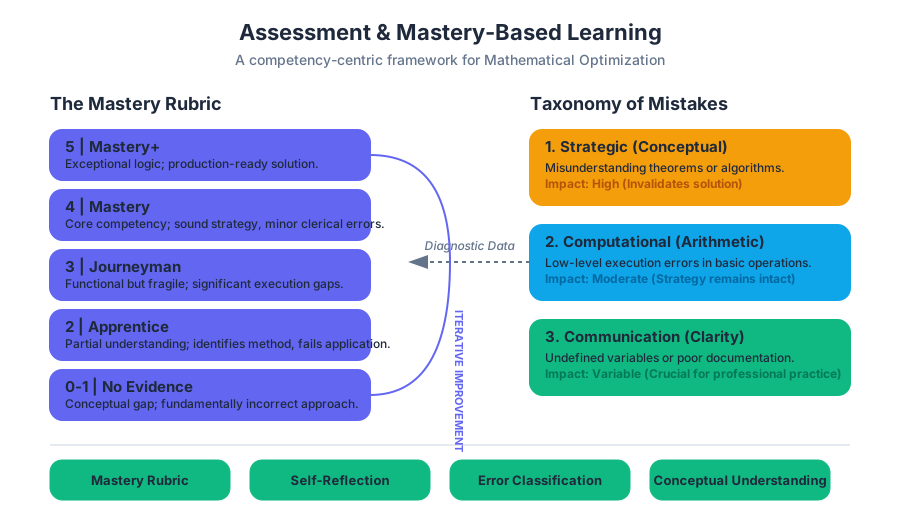
The mastery framework employed here focuses on four pillars: the Mastery Rubric, Self-Reflection, Error Classification, and Conceptual Understanding. By decoupling the learning process from the pressure of accumulating points, students are encouraged to treat errors not as failures, but as diagnostic data points for iterative improvement.
The Mastery Rubric: Defining Competence
The core of the assessment system is a non-linear 5-point scale. Unlike traditional grading where a 3/5 might represent a 60% (D-grade), in a mastery system, each level represents a qualitative state of understanding. This scale prioritizes the structural integrity of the mathematical argument over the final numerical output.
The 5-Point Mastery Scale
| Level | Designation | Description | Technical Criteria |
|---|---|---|---|
| 5 | Mastery+ | Exceptional execution | Flawless logic, optimal notation, and clear communication. The solution is "production-ready." |
| 4 | Mastery | Core competency achieved | The student demonstrates a full grasp of the concept. Minor "clerical" errors (e.g., $2+3=6$) may exist, but the strategy is sound. |
| 3 | Journeyman | Functional but fragile | The student understands the algorithm but makes significant execution errors or lacks clarity in the formal proof/derivation. |
| 2 | Apprentice | Partial understanding | The student identifies the correct method (e.g., Gauss-Jordan) but fails to apply it correctly or misses critical constraints. |
| 0-1 | No Evidence | Conceptual gap | The student either did not attempt the problem or used a fundamentally incorrect approach (e.g., treating a non-linear problem as linear). |
The Mastery Principle: A student who correctly sets up a complex Linear Programming Problem (LPP) in standard form but makes an arithmetic error in the final pivot is often closer to "Mastery" than a student who guesses the correct answer without providing a logical derivation.
Error Classification: The Taxonomy of Mistakes
To achieve mastery, one must move beyond the binary of "right vs. wrong" and into the realm of error diagnostics. In this course, errors are categorized into three distinct buckets. This classification allows students to identify whether their struggle is with the math (arithmetic), the logic (strategy), or the language (communication).
1. Strategic (Conceptual) Errors
These are the most critical. A strategic error occurs when the student misunderstands the underlying theorem or algorithm.
- Example: Failing to convert a "greater than or equal to" constraint by multiplying by $-1$ when moving to standard form.
- Impact: High. These errors invalidate the entire solution path.
2. Computational (Arithmetic) Errors
These are "low-level" errors. They occur when the student knows exactly what to do but fails in the execution of basic operations.
- Example: Adding $R_1 + R_2$ in a Gauss-Jordan elimination and getting the wrong sum in one column.
- Impact: Moderate. While the result is wrong, the student’s "Strategic Mastery" remains intact.
3. Communication (Clarity) Errors
Optimization is a collaborative field. If a model cannot be read or verified by another engineer, it is useless.
- Example: Using variables like $x, y, z$ without defining what they represent in the physical world (e.g., "let $x$ be the number of units produced").
- Impact: Variable. Crucial for professional practice and "Mastery+" designation.
Implementation: Gauss-Jordan and LPP Conversion
Mastery is best demonstrated through the foundational tools of Linear Programming: Gauss-Jordan Elimination and LPP Normalization. Before one can use the Simplex Method, one must master the transformation of systems of equations.
Standard vs. Canonical Form
In the study of Linear Programming Problems (LPPs), we distinguish between different "shapes" a problem can take. Mastery requires the ability to fluidly convert between these forms.
| Feature | Standard Form | Canonical Form |
|---|---|---|
| Objective | Maximize $Z = \mathbf{c}^T\mathbf{x}$ | Maximize $Z = \mathbf{c}^T\mathbf{x}$ |
| Constraints | All constraints are equations ($=$) | All constraints are inequalities ($\le$) |
| Variables | All variables are non-negative ($x_i \ge 0$) | All variables are non-negative ($x_i \ge 0$) |
| Right-Hand Side | $b_i$ must be non-negative | No restriction on $b_i$ sign |
The Algorithm: LPP to Standard Form
- Objective Function: If minimizing $f(x)$, convert to maximizing $-f(x)$.
- Inequalities:
- For $\sum a_{ij}x_j \le b_i$, add a slack variable $s_i$.
- For $\sum a_{ij}x_j \ge b_i$, subtract a surplus variable $e_i$.
- Unrestricted Variables: If $x_k$ is unrestricted in sign, replace it with $x_k' - x_k''$, where $x_k', x_k'' \ge 0$.
- Negative RHS: If $b_i < 0$, multiply the entire constraint by $-1$ (and flip the inequality sign before adding slack/surplus).
Code Implementation: The Computational Layer
To understand the difference between Strategic and Computational mastery, consider the implementation of a row reduction step. A student with strategic mastery knows that we must eliminate all non-zero entries in a column except for the pivot. A student with computational mastery ensures that floating-point errors do not accumulate.
Block 1: Low-Level Implementation (Python/NumPy)
This snippet demonstrates a single pivot step in the Gauss-Jordan method, the engine behind LPP solving.
import numpy as np

def pivot_element(matrix, row, col):
    """
    Performs a single pivot operation on a matrix in-place.
    Strategic Goal: Transform the column 'col' into a unit vector.
    """
    matrix = matrix.astype(float)
    pivot_val = matrix[row, col]

    if pivot_val == 0:
        raise ValueError("Cannot pivot on a zero element. Strategic Error: Invalid pivot choice.")

    # Normalize the pivot row
    matrix[row] = matrix[row] / pivot_val

    # Eliminate other entries in the column
    for r in range(len(matrix)):
        if r != row:
            factor = matrix[r, col]
            matrix[r] = matrix[r] - factor * matrix[row]

    return matrix

# Example: A 2x3 augmented matrix for a system of equations
tableau = np.array([[2, 4, 8],
                    [1, 1, 3]])

# Pivot on element (0,0)
result = pivot_element(tableau, 0, 0)
print(result)
# Output: [[1, 2, 4], [0, -1, -1]]
Block 2: Mathematical Derivation (LaTeX Pseudocode)
The transformation of a general LPP into Standard Form can be expressed as a formal mapping.
\text{Given a general LPP:} \\
\text{Optimize } Z = \sum_{j=1}^n c_j x_j \\
\text{Subject to: } \sum_{j=1}^n a_{ij} x_j \le b_i \quad (i \in I_{slack}) \\
\sum_{j=1}^n a_{ij} x_j \ge b_i \quad (i \in I_{surplus}) \\
x_j \ge 0 \quad (j \in J) \\

\text{Transformation Rule } \mathcal{T}: \\
\forall i \in I_{slack} \implies \sum a_{ij} x_j + s_i = b_i, \quad s_i \ge 0 \\
\forall i \in I_{surplus} \implies \sum a_{ij} x_j - e_i = b_i, \quad e_i \ge 0 \\
\text{If } b_i < 0 \implies \text{Multiply by } -1 \text{ before adding variables.}
Block 3: Real-World Usage (CLI/Optimization Solver)
In practice, mastery involves knowing how to interface with industry-standard solvers like GLPK (GNU Linear Programming Kit).
# Solving an LPP defined in MathProg (.mod) or MPS format
# -m: read model file
# --output: write solution to file

glpsol --math production_plan.mod --output results.txt

# Example output snippet showing the 'Mastery' of the solver:
# Status: INTEGER OPTIMAL
# Objective: z = 1450.000000 (MAXimum)
Self-Reflection: The Metacognitive Bridge
The most unique aspect of this assessment model is the Self-Reflection Worksheet. After an assignment is returned with feedback, students do not simply look at their grade. They must perform a post-mortem on their work.
The Reflection Process
- Discrepancy Analysis: Compare the submitted solution to the provided "Mastery" solution.
- Error Tagging: For every point lost, the student must tag it as Strategic, Computational, or Communication.
- Correction: Re-solve the specific sub-problem that was missed.
- Synthesis: Write a brief statement on what "Conceptual Understanding" was missing during the first attempt.
"I realized that my error in Problem 2 wasn't just a sign flip (Computational). I didn't realize that the variable $x_2$ was unrestricted, which meant my entire initial tableau was missing a column (Strategic). Next time, I will check variable bounds before setting up the matrix." — Example Student Reflection
Common Pitfalls in Mastery Learning
Even with a clear rubric, students often fall into specific traps that hinder their progress toward Mastery.
- The "Arithmetic Shield": Attributing all errors to "silly math mistakes." Often, what looks like an arithmetic error is actually a failure to organize work (Communication) or a misunderstanding of the pivot rules (Strategic).
- Notation Neglect: Using shorthand that makes sense to the student but violates formal mathematical syntax. In MBL, notation is thinking.
- Ignoring Chapter 0: Many students skip the Linear Algebra review (Gauss-Jordan, Matrix Inversion). However, LP is built entirely on these foundations. Without Chapter 0 mastery, the Simplex method becomes a "black box" rather than a logical progression.
Comparison of Error Impacts
| Error Type | Immediate Result | Long-term Consequence | Mastery Recovery Path |
|---|---|---|---|
| Computational | Wrong number | Minor frustration | Practice mental math or use verification steps |
| Strategic | Wrong logic | Fundamental misunderstanding of the domain | Re-read lecture notes; attend TA office hours |
| Communication | Unreadable work | Professional failure; inability to debug | Study formal proofs; use standard templates |
Conclusion: The Path to Professionalism
Mastery-based learning in optimization is not about perfection; it is about accountability. By forcing a distinction between different types of errors and requiring self-reflection, the system prepares students for the high-stakes environment of mathematical modeling. In the Hill Center Room 628 or via Zoom, the goal of the TA and instructor is to guide students through this iterative loop—moving from the "Apprentice" who follows recipes to the "Master" who understands the chemistry of the algorithm.
Source Materials
Study Spring 2026 - Math 354 - Sections 02/04 on Lykke
This course page is free to open: signed out, you can read its first two sections, and signing in, on any plan, opens the rest. The free Lykke Chrome extension syncs your own Canvas courses, so ChatGPT, Claude and Muse can answer from your classes and deadlines. It only reads Canvas.
Add the free extensionSign in to open every sectionAll sections of Spring 2026 - Math 354 - Sections 02/04 · Browse more course pages