From the free course Psychology as Science on Lykke
Sensation and Perception
Key concepts: Multi-Modal Perception · Inattentional Blindness · Vestibular System · Eyewitness Testimony Biases
Explores how our sensory organs receive stimuli and how our brains interpret that data to create our reality.
Sensation and Perception
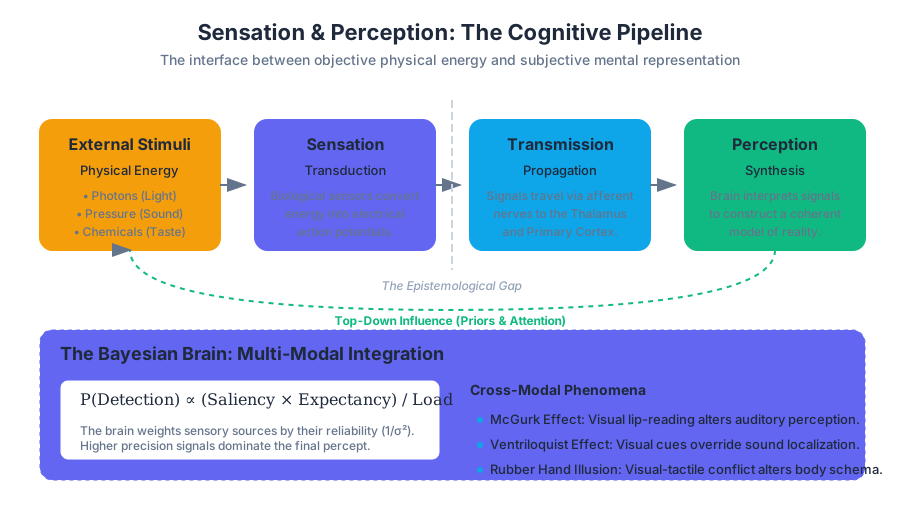
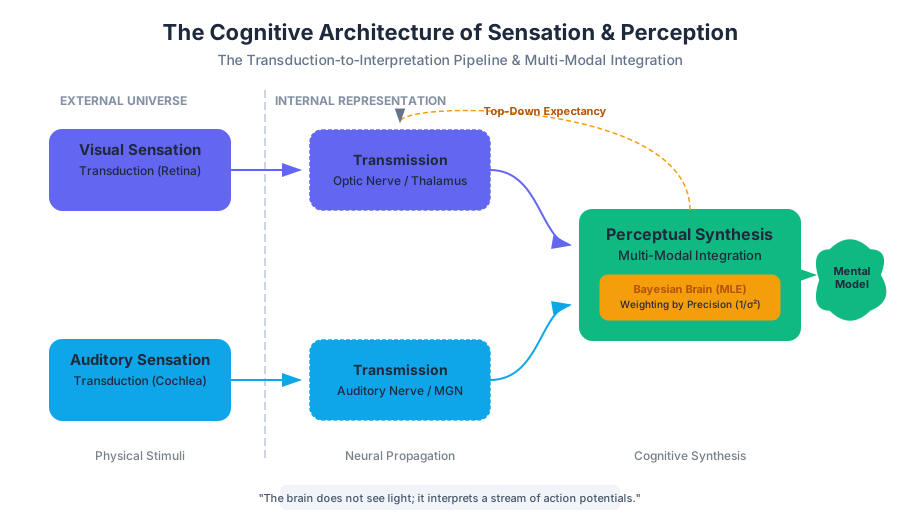
In the hierarchy of cognitive architecture, Sensation and Perception represent the interface between the external objective universe and the internal subjective experience. While often used interchangeably in colloquial speech, they represent distinct computational stages: sensation is the transduction of physical energy (photons, pressure waves, chemical concentrations) into neural impulses, whereas perception is the high-level synthesis and interpretation of those signals to construct a coherent model of reality.
The Transduction-to-Interpretation Pipeline
The human brain does not "see" light; it interprets a stream of action potentials generated by the retina. This creates a fundamental epistemological gap: our experience of the world is a "controlled hallucination" constrained by sensory input.
| Stage | Process | Biological Component | Output |
|---|---|---|---|
| Sensation | Transduction | Sensory Receptors (Rods/Cones, Hair Cells) | Neural Impulses (Action Potentials) |
| Transmission | Propagation | Afferent Pathways (Optic Nerve, Thalamus) | Signal Arrival in Primary Cortex |
| Perception | Synthesis | Association Areas (Ventral/Dorsal Streams) | Mental Representation / Object Recognition |
Definition: Transduction The process by which foreign physical energy is converted into an electrical signal (neural impulse) that the nervous system can process. This is the "analog-to-digital" conversion of the biological world.
Multi-Modal Perception: The Bayesian Brain
While we often study senses in isolation, the brain is fundamentally a multi-modal processor. It does not process sound and vision in silos; rather, it integrates these streams to reduce uncertainty and resolve ambiguities.
The Principle of Inverse Effectiveness
The brain relies more on multi-modal integration when the individual sensory signals are weak or noisy. If you are in a quiet room, you don't need to see a speaker's lips to understand them. In a loud bar, your brain automatically integrates visual lip movements with auditory fragments to reconstruct the speech—a phenomenon known as the McGurk Effect.
Maximum Likelihood Estimation (MLE) in Perception
Modern cognitive science models multi-modal perception using Bayesian inference. The brain treats each sense as a "source" with a certain degree of variance ($\sigma^2$). It weights the more reliable sense more heavily.
Cross-Modal Phenomena
- The Ventriloquist Effect: The tendency to localize a sound source to a visible moving object, even if the sound originates elsewhere.
- Rubber Hand Illusion: A multi-modal conflict where visual and tactile synchronization causes the brain to "adopt" a prosthetic limb into its body schema.
Inattentional Blindness: The Cost of Focus
Perception is a resource-constrained process. We cannot process every bit of data hitting our receptors. Inattentional Blindness is the failure to notice a fully visible, but unexpected, stimulus when attention is directed elsewhere.
The Mechanism of Selective Attention
Attention acts as a filter or a "spotlight." When the cognitive load of a primary task is high, the brain suppresses "irrelevant" sensory inputs to prevent overflow. This is not a failure of the eyes (sensation), but a failure of the "internal renderer" (perception).
Factors Influencing Detection
- Task Difficulty: Higher cognitive load increases the likelihood of missing unexpected stimuli.
- Spatial Proximity: Objects closer to the focus of attention are more likely to be noticed.
- Feature Similarity: If you are looking for "black shirts," you are more likely to notice an unexpected black object than a bright red one.
P(Detection) \propto \frac{Saliency \times Expectancy}{CognitiveLoad}
Comparison: Inattentional vs. Change Blindness
| Feature | Inattentional Blindness | Change Blindness |
|---|---|---|
| Stimulus | A new, unexpected object appears. | A feature of an existing object changes. |
| Requirement | High focus on a different task. | A visual disruption (flicker, blink, or cut). |
| Memory | Failure of awareness/encoding. | Failure of memory comparison. |
The Vestibular System: The Sixth Sense
Often overlooked, the Vestibular System is the sensory apparatus responsible for balance, spatial orientation, and coordinating movement with balance. It is located within the inner ear and works in tandem with the visual system and proprioception.
Anatomy and Mechanics
The system consists of two primary types of sensors:
- Semicircular Canals: Three fluid-filled loops oriented in the X, Y, and Z axes. They detect rotational acceleration (angular momentum) via the movement of endolymph fluid against hair cells in the ampulla.
- Otolith Organs (Utricle and Saccule): These detect linear acceleration and gravity. They contain small calcium carbonate crystals (otoconia) that shift when you tilt your head or accelerate in a car, pulling on hair cells.
The Vestibulo-Ocular Reflex (VOR)
The VOR is one of the fastest reflexes in the human body. It uses vestibular input to rotate the eyes in the opposite direction of head movement, stabilizing the image on the retina. Without VOR, your vision would "blur" every time you took a step.
Common Pitfalls: Sensory Conflict
Motion Sickness occurs when there is a mismatch between the vestibular system and the visual system. For example, when reading in a car:
- Vestibular: Senses acceleration and bumps (movement).
- Visual: Senses a static book (no movement).
- Result: The brain interprets this conflict as a sign of neurotoxin ingestion (hallucination) and induces nausea to expel the "poison."
Eyewitness Testimony Biases: The Fragility of Memory
Perception does not end when the stimulus disappears; it transitions into memory. However, memory is not a video recording; it is a reconstructive process. In the context of the legal system, this leads to significant Eyewitness Testimony Biases.
The Misinformation Effect
Proposed by Elizabeth Loftus, this effect demonstrates that memory can be altered by post-event information. If an eyewitness is asked "How fast was the car going when it smashed into the pole?" they will report higher speeds than if the word "hit" was used.
Sources of Bias
- Schema-Driven Processing: We fill in gaps in our memory using "schemas" (mental templates of how the world usually works). If we see a robbery, we might "remember" the thief having a gun even if they didn't, because our "robbery schema" includes weapons.
- Weapon Focus: The presence of a weapon narrows attention (Inattentional Blindness for other details), making the witness less likely to remember the perpetrator's face.
- Own-Race Bias: Individuals are statistically better at recognizing faces of their own race, likely due to increased experience with those facial features.
| Bias Type | Description | Impact on Testimony |
|---|---|---|
| Source Monitoring Error | Forgetting where a piece of info came from. | Witness "remembers" a face from a mugshot as being at the crime scene. |
| Leading Questions | Wording that suggests a specific answer. | Distorts the original memory trace. |
| Confirmation Bias | Seeking info that fits an existing belief. | Witness identifies a suspect they already suspect is guilty. |
Database Representation of Testimony Reliability
In forensic psychology, tracking these variables is crucial for assessing the probability of a "false positive" identification.
Synthesis: The "Controlled Hallucination"
The study of sensation and perception reveals a startling truth: we do not perceive the world as it is, but as it is useful for us to perceive it. Our brains integrate multi-modal data to resolve noise, ignore "irrelevant" data through inattentional blindness, maintain balance via the vestibular system, and reconstruct past events through a biased lens of memory.
Understanding these mechanisms is not just a matter of biological curiosity; it has profound implications for:
- AI/Robotics: How we build sensors and "perceptual" algorithms for autonomous vehicles.
- Law: How we evaluate the reliability of human memory in courtrooms.
- Human Factors: How we design cockpits and interfaces to prevent inattentional blindness in high-stakes environments.
Source Materials
Study Psychology as Science on Lykke
This course page is free to open: signed out, you can read its first two sections, and signing in, on any plan, opens the rest. The free Lykke Chrome extension syncs your own Canvas courses, so ChatGPT, Claude and Muse can answer from your classes and deadlines. It only reads Canvas.
Add the free extensionSign in to open every sectionAll sections of Psychology as Science · Browse more course pages