From the free course Psychology as Science on Lykke
Psychology as Science
Key concepts: Scientific Method · Replication Crisis · Experimental vs. Correlational Research · Statistical Inference · History of Psychology
Introduces the scientific method, the history of the discipline, and the critical challenges facing modern psychological research.
Psychology as Science
Psychology is the rigorous scientific study of the mind and behavior. While often perceived by the public through the lens of "folk psychology" or "intuition," the discipline operates as a "hub science" that integrates biological, social, and physical methodologies to understand internal mental processes and external actions. The transition of psychology from philosophical speculation to an empirical science was marked by the adoption of the Scientific Method, a commitment to Falsifiability, and the development of sophisticated Statistical Inference techniques.
The Evolution of Psychological Science
The history of psychology is a narrative of shifting paradigms, moving from the subjective analysis of consciousness to the objective measurement of behavior, and finally to the integrated study of brain, mind, and environment.
From Philosophy to the Laboratory
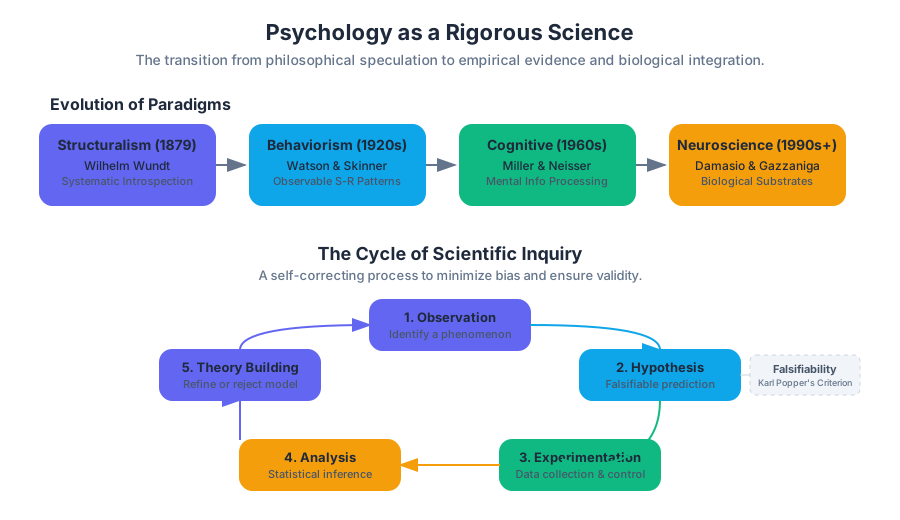
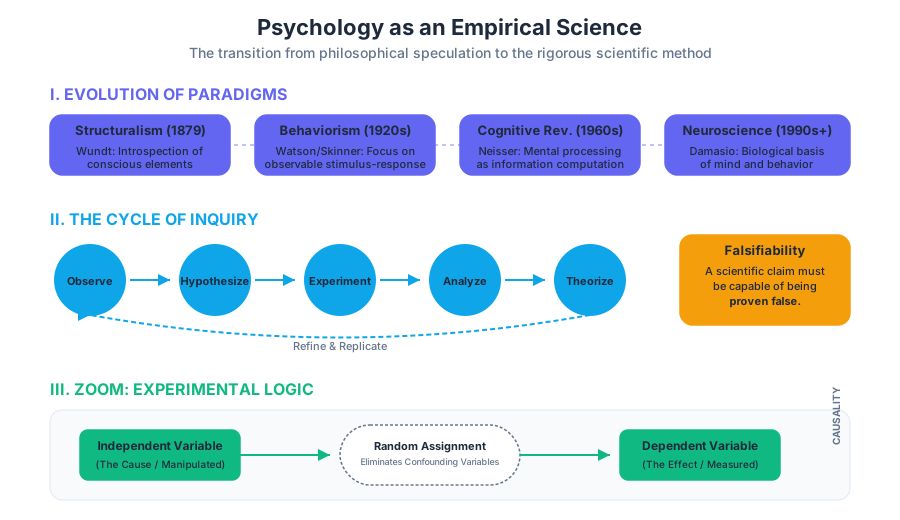
The formal "birth" of psychology as a science is generally dated to 1879, when Wilhelm Wundt established the first psychological laboratory at the University of Leipzig. Wundt’s approach, Structuralism, attempted to use Introspection to break down mental processes into their most basic components. This was quickly challenged by William James and Functionalism, which focused on the purpose of consciousness and behavior in the context of evolution and adaptation.
The Rise of Behaviorism and the Cognitive Revolution
By the early 20th century, the "subjective" nature of introspection led to the rise of Behaviorism, championed by John B. Watson and B.F. Skinner. Behaviorists argued that for psychology to be a true science, it must limit itself to observable, measurable behaviors. This "Black Box" approach was eventually superseded in the 1950s and 60s by the Cognitive Revolution, which utilized the metaphor of the computer to study internal states like memory, attention, and decision-making through objective, experimental means.
| Era | Primary Focus | Key Figures | Methodological Shift |
|---|---|---|---|
| Structuralism (1870s) | Basic elements of consciousness | Wilhelm Wundt, Edward Titchener | Systematic Introspection |
| Functionalism (1880s) | Purpose and adaptation of the mind | William James | Observation and Evolutionary Theory |
| Psychoanalysis (1900s) | Unconscious drives and childhood | Sigmund Freud | Case Studies and Clinical Interview |
| Behaviorism (1920s-50s) | Observable stimulus-response | Watson, Skinner, Pavlov | Controlled Laboratory Experiments |
| Cognitive Science (1960s+) | Mental processing and information | Miller, Chomsky, Neisser | Computer Modeling and Reaction Time |
| Neuroscience (1990s+) | Biological substrates of behavior | Damasio, Gazzaniga | fMRI, EEG, and Optogenetics |
The Scientific Method in Psychology
The scientific method is the engine of psychological inquiry. It is a cyclical process designed to minimize bias and ensure that conclusions are based on evidence rather than anecdote.
The Cycle of Inquiry
- Observation: Identifying a phenomenon (e.g., "People seem to remember the first items in a list better than the middle ones").
- Hypothesis Formation: A testable, falsifiable prediction (e.g., "If a participant is given a list of 20 words, they will recall the first five more accurately than the middle five").
- Experimentation/Data Collection: Systematically testing the hypothesis under controlled conditions.
- Analysis: Using statistics to determine if the results are due to chance.
- Theory Building/Refinement: Integrating the findings into a broader framework (e.g., The Multi-Store Model of Memory).
Definition: Falsifiability Proposed by Karl Popper, falsifiability is the principle that for a claim to be scientific, it must be possible to conceive of an observation or an argument which could negate it. "Invisible spirits cause depression" is not a scientific claim because it cannot be falsified.
Research Designs: Experimental vs. Correlational
The most critical distinction in psychological research is between designs that can establish Causality and those that can only establish Association.
Experimental Research
In an Experiment, the researcher actively manipulates one variable (the Independent Variable or IV) to see its effect on another (the Dependent Variable or DV). To ensure the effect is caused by the IV, researchers use Random Assignment to distribute participant characteristics (confounds) equally across groups.
Correlational Research
Correlational Research measures the relationship between two variables without manipulating them. While useful for prediction and studying variables that cannot be ethically manipulated (e.g., the effects of smoking on lung health), it suffers from two major limitations:
- Directionality Problem: Does X cause Y, or does Y cause X?
- Third Variable Problem: Does an unmeasured variable Z cause both X and Y?
| Feature | Experimental | Correlational |
|---|---|---|
| Goal | Determine Causality (A causes B) | Identify Relationships (A relates to B) |
| Manipulation | High (Researcher controls IV) | None (Naturalistic observation) |
| Assignment | Random Assignment to conditions | No assignment (pre-existing groups) |
| Internal Validity | High (Controls for confounds) | Low (Subject to third-variable bias) |
| External Validity | Can be lower (Artificial lab setting) | Often higher (Real-world data) |
Statistical Inference: Quantifying Uncertainty
Psychologists use Statistical Inference to determine whether the results of a study represent a true effect in the population or are merely the result of "sampling error" (random noise).
The Null Hypothesis Significance Testing (NHST) Framework
The standard approach involves the Null Hypothesis ($H_0$), which posits that there is no effect. Researchers calculate a p-value—the probability of obtaining results at least as extreme as the observed ones, assuming the null hypothesis is true.
The Alpha Level ($\alpha$) By convention, psychologists set $\alpha = .05$. If $p < .05$, the result is deemed "statistically significant," meaning there is less than a 5% chance the results occurred by chance alone.
Mathematical Foundation: The t-Statistic
The $t$-test is commonly used to compare the means of two groups. The formula represents the ratio of the "Signal" (difference between means) to the "Noise" (variability within groups).
t = \frac{\bar{X}_1 - \bar{X}_2}{\sqrt{\frac{s_1^2}{n_1} + \frac{s_2^2}{n_2}}}
Where:
- $\bar{X}$: Sample mean
- $s^2$: Sample variance
- $n$: Sample size
The Replication Crisis and Open Science
In the early 2010s, psychology faced a reckoning known as the Replication Crisis. Several high-profile studies failed to replicate when independent labs attempted to reproduce the results. This led to a deep investigation into "Questionable Research Practices" (QRPs).
Common Pitfalls and QRPs
- p-hacking: Manipulating data or analyses until a non-significant result becomes significant ($p < .05$).
- HARKing: "Hypothesizing After the Results are Known"—presenting a post-hoc discovery as if it were the original prediction.
- The File Drawer Problem: The tendency for journals to only publish positive results, while "null" results remain unpublished and invisible.
- Small Sample Sizes: Studies with low "Power" are more likely to produce false positives or over-estimate effect sizes.
The Path Forward: Open Science
The discipline has responded by adopting Open Science practices to increase transparency and reliability.
- Preregistration: Researchers submit their hypotheses and analysis plans to a public registry before collecting data.
- Registered Reports: A journal commits to publishing a study based on the quality of the methodology, regardless of whether the results are significant.
- Open Data/Materials: Sharing raw data and code so others can verify the findings.
Psychophysiological Methods
To bridge the gap between the "mind" and the "biological basis of behavior," psychologists employ various psychophysiological tools. These methods vary in their Spatial Resolution (how precisely they locate an effect in the brain) and Temporal Resolution (how precisely they track the timing of an effect).
Key Modalities
- EEG (Electroencephalography): Measures electrical activity on the scalp. High temporal resolution (milliseconds) but low spatial resolution.
- fMRI (Functional Magnetic Resonance Imaging): Measures blood oxygenation levels (BOLD signal). High spatial resolution but low temporal resolution (seconds).
- Skin Conductance (GSR): Measures sweat gland activity as a proxy for sympathetic nervous system arousal.
- Eye Tracking: Measures gaze patterns to infer attentional focus.
| Method | Measure | Spatial Resolution | Temporal Resolution | Invasiveness |
|---|---|---|---|---|
| EEG | Electrical voltage | Low | Excellent | Non-invasive |
| fMRI | Blood oxygenation | Excellent | Low | Non-invasive |
| PET | Radioactive tracer | Moderate | Very Low | Invasive |
| TMS | Magnetic pulses | Moderate | Moderate | Non-invasive (Active) |
| Lesion Studies | Tissue damage | High (Localized) | N/A | Natural/Accidental |
Real-World Research: Ecological Validity
While laboratory experiments provide high Internal Validity (certainty about cause and effect), they often lack Ecological Validity (the degree to which findings generalize to real-world settings).
Field Experiments and Naturalistic Observation
To combat this, researchers use Ambulatory Assessment or Experience Sampling Methods (ESM). In ESM, participants receive prompts on their smartphones throughout the day to report their moods, behaviors, or social interactions in real-time. This captures the "messiness" of human life that a sterile lab environment might miss.
The Ethics of Psychological Science
Because psychology involves human and animal subjects, it is governed by strict ethical guidelines enforced by Institutional Review Boards (IRB).
- Informed Consent: Participants must know what the study involves and that they can leave at any time.
- Deception: Must be justified and followed by a thorough Debriefing.
- Confidentiality: Data must be protected and anonymized.
Source Materials
Study Psychology as Science on Lykke
This course page is free to open: signed out, you can read its first two sections, and signing in, on any plan, opens the rest. The free Lykke Chrome extension syncs your own Canvas courses, so ChatGPT, Claude and Muse can answer from your classes and deadlines. It only reads Canvas.
Add the free extensionSign in to open every sectionAll sections of Psychology as Science · Browse more course pages