From the free course Psychology as Science on Lykke
Psychological Disorders and Treatments
Key concepts: ADHD · Mood Disorders · Personality Disorders · Schizophrenia · Psychodynamic Perspective
An overview of mental health conditions, their classification, and the various therapeutic approaches used to treat them.
Psychological Disorders and Treatments
Psychopathology is the scientific study of mental disorders, including their theoretical underpinnings, etiology, progression, symptomatology, and treatment. Unlike physical ailments with clear biomarkers, psychological disorders are often defined by a constellation of behaviors, cognitive patterns, and emotional responses that deviate from cultural norms and cause significant functional impairment or distress.
The Framework of Mental Illness: Taxonomy and Diagnosis
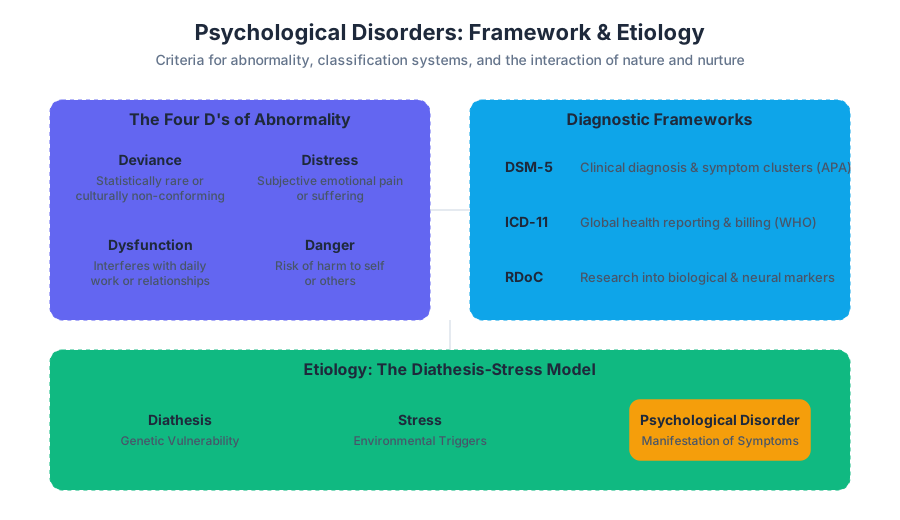
To treat psychological disorders, we must first categorize them. The modern standard relies on the Diagnostic and Statistical Manual of Mental Disorders (DSM-5) and the International Classification of Diseases (ICD-11). These frameworks move away from purely theoretical "neuroses" toward a descriptive, evidence-based approach.
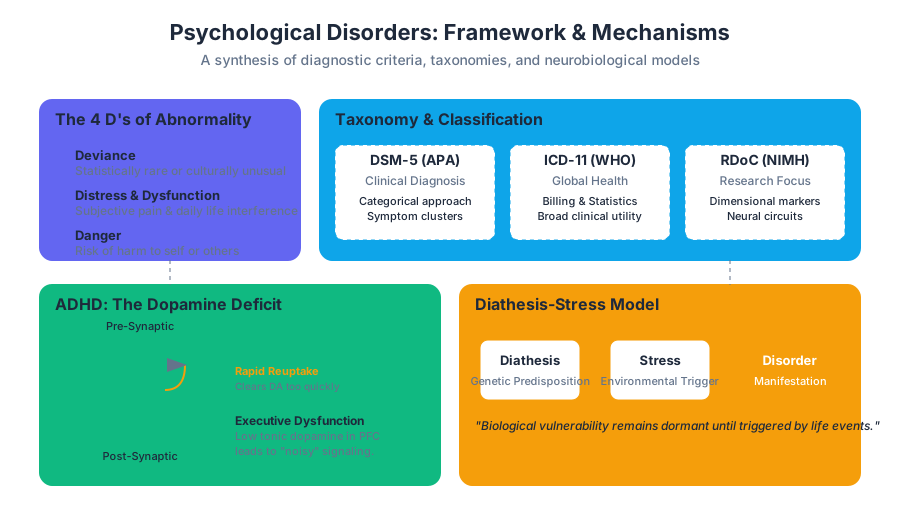
Definition: The Four D's of Abnormality To be classified as a disorder, a condition generally meets four criteria: Deviance (statistically rare), Distress (unpleasant to the individual), Dysfunction (interferes with daily life), and Danger (risk to self or others).
| Feature | DSM-5 (APA) | ICD-11 (WHO) | RDoC (NIMH) |
|---|---|---|---|
| Primary Use | Clinical diagnosis (North America) | Global health reporting/billing | Research into biological markers |
| Structure | Categorical (Yes/No diagnosis) | Categorical with some dimensions | Dimensional (Neural circuits) |
| Focus | Symptom clusters | Broad clinical utility | Genetic and neural underpinnings |
Neurodevelopmental Disorders: ADHD
Attention-Deficit/Hyperactivity Disorder (ADHD) is a neurodevelopmental condition characterized by persistent patterns of inattention, hyperactivity, and impulsivity that interfere with functioning or development.
What it is
ADHD is not merely "high energy"; it is a deficit in executive function—the brain's command-and-control center located in the prefrontal cortex (PFC). It is one of the most heritable psychological disorders, with genetic factors accounting for approximately 70-80% of the variance in traits.
How it works: The Dopamine Deficit Hypothesis
The primary mechanism involves dysregulation of the mesocorticolimbic dopamine pathway. In neurotypical brains, dopamine acts as a signal-to-noise stabilizer. In ADHD brains, low tonic levels of dopamine lead to a "noisy" environment where the brain constantly seeks external stimulation to reach a baseline level of arousal.
Common Pitfalls
A frequent misconception is that ADHD is a "childhood disorder" that individuals outgrow. While hyperactivity often diminishes with age, executive dysfunction (time blindness, emotional dysregulation) frequently persists into adulthood, requiring lifelong management strategies.
Mood Disorders: Depression and Bipolarity
Mood disorders involve serious disturbances in emotional state that transcend normal fluctuations in "happiness" or "sadness."
Major Depressive Disorder (MDD)
MDD is defined by at least two weeks of depressed mood or anhedonia (loss of interest in pleasure), accompanied by vegetative symptoms (sleep/appetite changes).
Bipolar and Related Disorders
Bipolar disorder is characterized by the presence of Mania or Hypomania. Unlike MDD, which is unipolar, Bipolar involves a "switch" mechanism.
| Disorder | Key Symptom | Duration Requirement | Biological Marker |
|---|---|---|---|
| MDD | Persistent low mood | 2+ Weeks | HPA-axis hyperactivity |
| Bipolar I | Full Manic Episode | 1+ Week | Ventricular enlargement |
| Bipolar II | Hypomania + Depression | 4+ Days (Hypomania) | Genetic overlap with Schizophrenia |
| Cyclothymia | Mild mood swings | 2+ Years | Chronic sub-threshold instability |
The Diathesis-Stress Model
The onset of mood disorders is best explained by the Diathesis-Stress Model, which posits that a biological vulnerability (diathesis) remains dormant until triggered by environmental stressors.
P(\text{Disorder}) = \sigma(\beta_0 + \beta_1 \cdot \text{Genetic\_Vulnerability} + \beta_2 \cdot \text{Environmental\_Stress} + \epsilon)
Where:
- $\sigma$ is the logistic function.
- $\beta_1$ represents the weight of heritability (high in Bipolar, moderate in MDD).
- $\beta_2$ represents the impact of trauma or life events.
Schizophrenia Spectrum Disorders
Schizophrenia is a chronic and severe mental disorder affecting how a person thinks, feels, and behaves. It is often described as a "split" from reality, though it is distinct from "split personality" (Dissociative Identity Disorder).
Symptom Categories
- Positive Symptoms (Added behaviors): Hallucinations (auditory are most common), delusions (persecutory, grandiose), and disorganized speech.
- Negative Symptoms (Removed behaviors): Avolition (lack of drive), Alogia (poverty of speech), and Flat Affect.
- Cognitive Symptoms: Deficits in working memory and executive control.
Neuroanatomy and Neurochemistry
The Dopamine Hypothesis suggests that overactivity in the mesolimbic pathway causes positive symptoms, while underactivity in the mesocortical pathway causes negative symptoms. Structural imaging often shows enlarged lateral ventricles, indicating a loss of surrounding brain tissue.
Clinical Data Representation
In a clinical research environment, tracking the efficacy of antipsychotics (like Haloperidol vs. Clozapine) requires structured data to correlate dosage with symptom reduction (measured via the PANSS scale).
Personality Disorders: The Enduring Pattern
Personality disorders are characterized by an enduring pattern of inner experience and behavior that deviates markedly from the expectations of the individual's culture. These patterns are inflexible and pervasive.
The Cluster System
The DSM-5 organizes the ten personality disorders into three clusters based on shared descriptive characteristics.
| Cluster | Description | Key Examples |
|---|---|---|
| Cluster A | Odd, Eccentric | Paranoid, Schizoid, Schizotypal |
| Cluster B | Dramatic, Emotional, Erratic | Antisocial, Borderline, Narcissistic, Histrionic |
| Cluster C | Anxious, Fearful | Avoidant, Dependent, Obsessive-Compulsive (OCPD) |
Borderline Personality Disorder (BPD)
BPD is marked by instability in interpersonal relationships, self-image, and affect. It is often rooted in early childhood trauma and a biological sensitivity to emotional stimuli. The gold-standard treatment is Dialectical Behavior Therapy (DBT), which balances acceptance with change.
Antisocial Personality Disorder (ASPD) and Psychopathy
While related, these are not identical. ASPD is a behavioral diagnosis in the DSM-5 (disregard for the rights of others). Psychopathy is a personality construct involving a lack of empathy, shallow affect, and boldness.
The Psychodynamic Perspective
While modern psychiatry emphasizes biology and behavior, the Psychodynamic Perspective—descended from Sigmund Freud—remains influential in understanding the "why" behind psychological distress.
Core Tenets
- The Unconscious: Much of our behavior is driven by thoughts and feelings outside of our conscious awareness.
- Developmental Origins: Early childhood experiences, particularly with primary caregivers (Attachment Theory), shape adult personality.
- Defense Mechanisms: The ego uses strategies like Repression, Projection, and Sublimation to manage anxiety arising from internal conflicts.
Modern Evolution: Object Relations
Modern psychodynamic theory focuses on "Object Relations"—how we internalize mental representations of significant others ("objects"). If a child internalizes an "unreliable object," they may struggle with trust and intimacy in adulthood, potentially manifesting as a personality disorder.
Insight: Transference In therapy, the patient often redirects feelings for a significant person in their life onto the therapist. This transference is not an error but a vital diagnostic tool to see the patient's internal world in real-time.
Treatment Modalities: A Multi-Modal Approach
Effective treatment rarely relies on a single method. Instead, it utilizes a "biopsychosocial" approach.
1. Psychopharmacology
Medications alter brain chemistry to manage symptoms.
- SSRIs (Selective Serotonin Reuptake Inhibitors): Used for Depression and Anxiety. They prevent the reabsorption of serotonin, increasing its availability in the synapse.
- Antipsychotics: Block dopamine receptors ($D_2$ receptors) to reduce hallucinations.
- Mood Stabilizers: Such as Lithium, used to prevent manic "overshoot" in Bipolar disorder.
2. Psychotherapy
- Cognitive Behavioral Therapy (CBT): Focuses on identifying and changing "cognitive distortions" (e.g., catastrophizing).
- Exposure Therapy: The primary treatment for phobias and PTSD, involving controlled interaction with the feared stimulus to achieve extinction.
3. Neuromodulation
For treatment-resistant cases, direct intervention in brain activity may be necessary.
- ECT (Electroconvulsive Therapy): Highly effective for severe, suicidal depression.
- TMS (Transcranial Magnetic Stimulation): Uses magnetic fields to stimulate nerve cells in the PFC.
A Triage Logic for Treatment
In modern healthcare systems, "Stepped Care" models determine the intensity of treatment.
Summary of Connections
Psychological disorders are not isolated silos. They exist on a continuum and often show high comorbidity (the presence of two or more disorders). For example, a patient with ADHD may develop MDD due to the chronic stress of executive failure, or a patient with BPD may experience transient psychotic symptoms during periods of extreme stress.
Understanding these conditions requires a synthesis of:
- Neurobiology: The hardware (neurotransmitters, brain structures).
- Cognition: The software (thought patterns, biases).
- Environment: The network (social support, trauma, culture).
Source Materials
Study Psychology as Science on Lykke
This course page is free to open: signed out, you can read its first two sections, and signing in, on any plan, opens the rest. The free Lykke Chrome extension syncs your own Canvas courses, so ChatGPT, Claude and Muse can answer from your classes and deadlines. It only reads Canvas.
Add the free extensionSign in to open every sectionAll sections of Psychology as Science · Browse more course pages