From the free course Psychology as Science on Lykke
Emotions and Motivation
Key concepts: Affective Neuroscience · Drive States · Self-Efficacy · Emotional Intelligence · Self-Regulation
Examines the internal forces that drive behavior and the biological and cultural functions of emotional states.
Emotions and Motivation
The study of emotions and motivation represents the "engine room" of human psychology. While cognitive psychology often focuses on the "hardware" of memory and the "software" of logic, the study of emotions and motivation examines the energy and direction that drive these systems. This domain bridges the gap between low-level biological imperatives (homeostasis) and high-level social achievements (self-actualization).
Affective Neuroscience: The Biological Architecture of Feeling
Affective Neuroscience is the subfield of neuroscience that examines how the brain creates emotional responses. It integrates findings from animal research, human neuroimaging, and clinical psychology to map the neural circuits responsible for our "feelings."
The Primary Emotional Systems
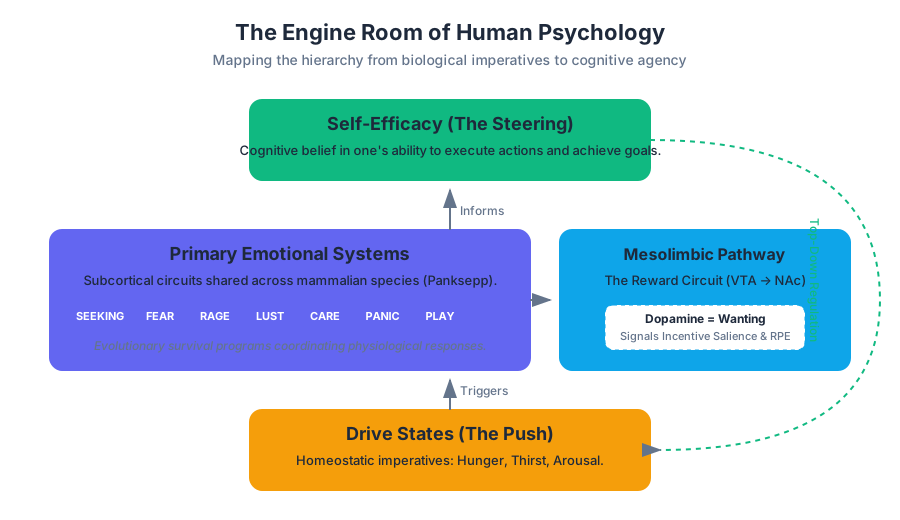
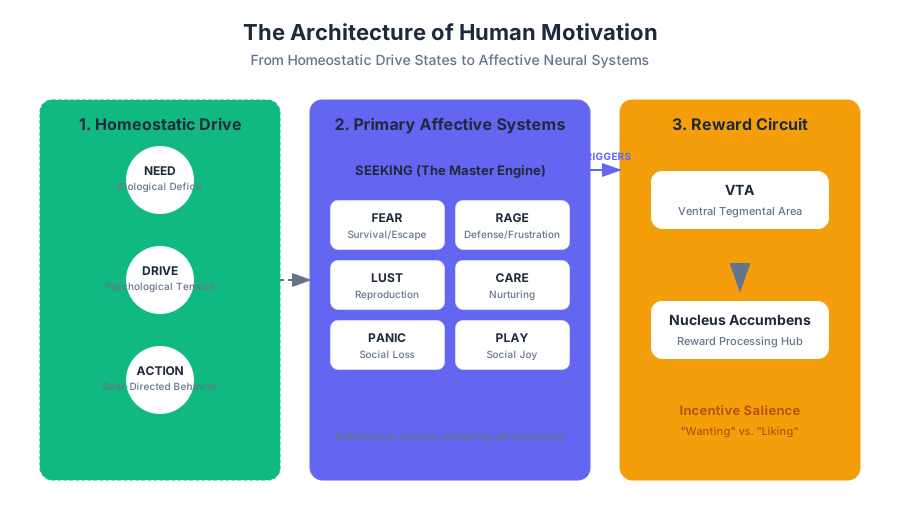
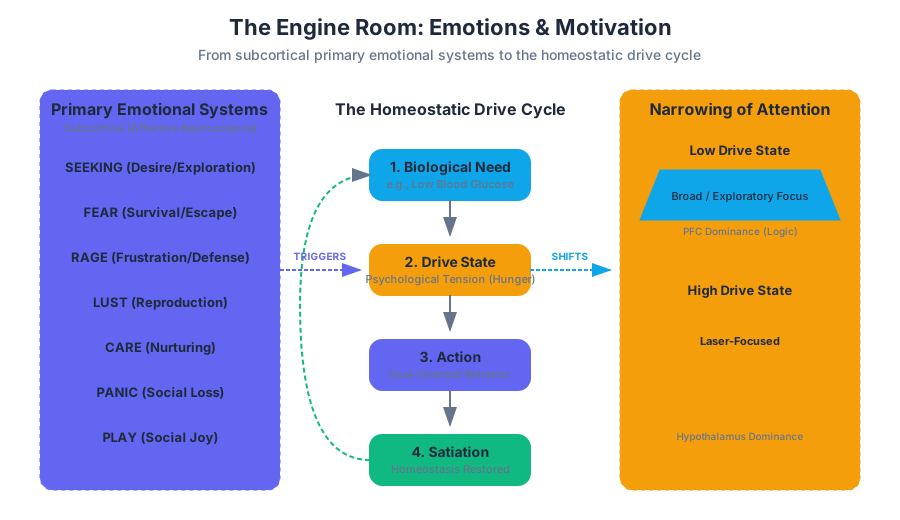
Jaak Panksepp, a pioneer in the field, identified seven "primary-process" emotional systems shared across mammalian species. These systems are subcortical, meaning they reside deep within the brain, beneath the conscious "thinking" layers of the cortex.
| System | Brain Region Focus | Function | Evolutionary Purpose |
|---|---|---|---|
| SEEKING | Nucleus Accumbens, VTA | Exploration, anticipation, desire | Foraging for resources, learning |
| FEAR | Amygdala, Periaqueductal Gray | Response to physical danger | Survival through escape or freezing |
| RAGE | Medial Amygdala, Hypothalamus | Response to frustration/restraint | Defending resources or territory |
| LUST | Preoptic area, Hypothalamus | Sexual desire and reproduction | Species propagation |
| CARE | Anterior Cingulate, Oxytocin circuits | Nurturing and maternal care | Survival of offspring |
| PANIC/GRIEF | Thalamus, Dorsal Cingulate | Social loss and separation distress | Maintaining social bonds |
| PLAY | Thalamic nuclei, Somatosensory cortex | Social joy and rough-and-tumble play | Learning social boundaries and skills |
Definition: Affective Neuroscience is the study of the neural mechanisms of emotion. It posits that emotions are not merely "feelings" but are evolved survival programs that coordinate physiological, behavioral, and cognitive responses to environmental challenges.
Neural Implementation of Reward
The most studied circuit in affective neuroscience is the Mesolimbic Dopamine Pathway. This "reward circuit" connects the Ventral Tegmental Area (VTA) to the Nucleus Accumbens. Contrary to popular belief, dopamine is not the "pleasure molecule"; rather, it is the "wanting" molecule. It signals Incentive Salience—the degree to which a stimulus is worth pursuing.
Drive States: The Homeostatic Imperative
Drive States are affective experiences that motivate organisms to fulfill goals that are beneficial to their survival and reproduction. These states (such as hunger, thirst, or sexual arousal) function through a mechanism of Homeostasis—the body’s tendency to maintain a stable internal environment.
The Mechanics of Drive
Drive states differ from general emotions in their physiological specificity. They are typically triggered by internal signals (e.g., low blood glucose) rather than external stimuli (e.g., a predator).
- Biological Need: A physiological deprivation (e.g., lack of water).
- Drive: A psychological state of tension or arousal (e.g., thirst).
- Action: Behavior directed toward reducing the drive (e.g., drinking).
- Satiation: The reduction of the drive and return to homeostasis.
The Narrowing of Attention
A critical feature of drive states is the Narrowing of Attention. As a drive state intensifies, it collapses the individual's "temporal horizon."
- Present-Biased: Future goals (saving money, studying) become irrelevant compared to the immediate need (eating).
- Self-Centered: The needs of others are ignored in favor of the self.
- Object-Focused: The environment is scanned exclusively for "drive-relevant" cues.
| Feature | Low Drive State | High Drive State |
|---|---|---|
| Attention Width | Broad / Exploratory | Narrow / Laser-focused |
| Time Preference | Delayed Gratification | Immediate Gratification |
| Decision Logic | Multi-attribute utility | Single-attribute (Drive fulfillment) |
| Neural Dominance | Prefrontal Cortex (PFC) | Hypothalamus / Amygdala |
Self-Efficacy: The Cognitive Architecture of Agency
While drive states provide the push, Self-Efficacy provides the steering. Developed by Albert Bandura, self-efficacy is the belief in one’s ability to succeed in specific situations or accomplish a task.
The Four Sources of Self-Efficacy
Self-efficacy is not a global personality trait (like self-esteem) but a task-specific belief system built from four primary sources:
- Performance Accomplishments (Mastery): The most powerful source. Success builds a robust belief in efficacy; failure undermines it.
- Vicarious Experiences (Modeling): Seeing people similar to oneself succeed through sustained effort.
- Verbal Persuasion: Encouragement from others (though this is easily undermined by subsequent failure).
- Physiological States: Interpreting "butterflies in the stomach" as excitement (high efficacy) rather than anxiety (low efficacy).
Mathematical Representation of Efficacy
In computational psychology, self-efficacy can be modeled as a confidence interval over an agent's expected performance.
\begin{aligned}
\text{Self-Efficacy } (\mathcal{E}) &= P(\text{Success} | \text{Effort}, \text{History}) \\
\mathcal{E}_{t+1} &= \mathcal{E}_t + \kappa \cdot (\text{Outcome}_t - \text{Expected}_t) \cdot \text{Attribution}_t
\end{aligned}
Where:
Outcome - Expectedis the performance gap.Attributionis a weight (0 to 1) representing how much the individual credits themselves versus luck for the outcome.
Key Insight: High self-efficacy leads to "Challenge-Seeking" behavior. When faced with a setback, high-efficacy individuals increase their effort, whereas low-efficacy individuals give up or experience "learned helplessness."
Emotional Intelligence (EI): The Regulatory Framework
Emotional Intelligence refers to the ability to recognize, understand, and manage our own emotions while recognizing, understanding, and influencing the emotions of others.
The Four-Branch Model (Mayer & Salovey)
The most scientifically rigorous model of EI treats it as a standard intelligence (Ability EI) rather than a personality trait.
- Perception of Emotion: The ability to identify emotions in faces, music, and stories.
- Use of Emotion to Facilitate Thinking: Using emotions to prioritize thinking and generate creative solutions (e.g., using a "sad" mood to perform meticulous proofreading).
- Understanding Emotions: Recognizing the "vocabulary" of emotions—how they transition (e.g., how irritation turns into rage).
- Management of Emotions: The ability to remain open to feelings and modulate them in oneself and others to promote personal and social goals.
Ability vs. Trait EI
There is a significant debate in the literature regarding the measurement of EI:
| Type | Measurement Method | Pros | Cons |
|---|---|---|---|
| Ability EI | Performance tests (e.g., MSCEIT) | Objective; correlates with IQ | Hard to score; "correct" answers are subjective |
| Trait EI | Self-report surveys | Easy to administer; predicts job performance | Subjective; susceptible to "faking good" |
Self-Regulation: The Executive Control of Action
Self-Regulation is the process by which we alter our responses (thoughts, emotions, impulses, and behaviors) to bring them into alignment with standards such as goals, ideals, or social norms.
The Dual-Process Model
Self-regulation is often described as a battle between two systems:
- The "Hot" System (Impulsive): Emotional, simple, reflexive, and fast. Centered in the amygdala.
- The "Cool" System (Reflective): Cognitive, complex, slow, and deliberative. Centered in the Prefrontal Cortex (PFC).
The Process Model of Emotion Regulation (James Gross)
Regulation can occur at different points in the "emotion-generative" process. This is vital for clinical interventions.
- Situation Selection: Avoiding a person who makes you angry.
- Situation Modification: Changing the environment (e.g., hiding the cookies).
- Attentional Deployment: Distracting yourself from a stressful stimulus.
- Cognitive Change (Reappraisal): Reinterpreting the meaning of an event (e.g., "He didn't cut me off because he's a jerk; he's probably rushing to the hospital").
- Response Modulation: Suppressing the outward expression of emotion (e.g., "poker face").
Synthesis: The Interaction of Systems
These concepts do not exist in isolation. They form a complex, interlocking system that determines human behavior.
- Drive States generate the initial energy.
- Affective Neuroscience provides the underlying hardware (the "Hot" system).
- Self-Efficacy determines whether that energy is channeled into action or stifled by doubt.
- Emotional Intelligence allows the individual to navigate the social consequences of their actions.
- Self-Regulation acts as the "Cool" executive, ensuring that the organism doesn't just react to the loudest drive, but acts in accordance with long-term values.
Common Pitfalls and Misconceptions
- The "Ego Depletion" Controversy: For years, it was believed that self-regulation was a finite resource (like a battery). Recent replication failures suggest that "willpower" might be more about motivation and beliefs about willpower than a physical resource.
- Dopamine = Pleasure: As noted, dopamine is about anticipation and pursuit. Opioids and endocannabinoids are more closely linked to the actual "liking" or pleasure of a stimulus.
- High Self-Esteem vs. High Self-Efficacy: You can have high self-esteem (liking yourself) but low self-efficacy (believing you are incompetent at a specific task). Efficacy is the better predictor of actual performance.
- Affective Neuroscience: The study of how the brain's structures and chemicals create emotional experiences.
- Incentive Salience: The "wanting" or motivational value of a stimulus, primarily driven by dopamine.
- Homeostasis: The biological process of maintaining internal stability (e.g., temperature, glucose levels).
- Narrowing of Attention: The psychological phenomenon where intense drive states focus the mind exclusively on immediate needs.
- Self-Efficacy: A person's belief in their ability to succeed in a specific task or situation.
- Cognitive Reappraisal: A self-regulation strategy involving changing the way one thinks about a stimulus to change its emotional impact.
- Trait Emotional Intelligence: Emotional intelligence viewed as a constellation of personality traits, measured via self-report.
- Ability Emotional Intelligence: Emotional intelligence viewed as a set of mental skills, measured via performance tests.
-
Which brain circuit is most responsible for "wanting" and incentive salience?
- A) The Amygdala
- B) The Mesolimbic Dopamine Pathway
- C) The Prefrontal Cortex
- D) The Cerebellum Correct: B
-
According to Albert Bandura, what is the most influential source of self-efficacy?
- A) Verbal Persuasion
- B) Vicarious Experiences
- C) Mastery Experiences (Performance Accomplishments)
- D) Physiological Arousal Correct: C
-
In the "Process Model of Emotion Regulation," which strategy involves changing the meaning of a situation?
- A) Situation Selection
- B) Response Modulation
- C) Cognitive Reappraisal
- D) Attentional Deployment Correct: C
-
How do intense drive states affect a person's temporal horizon?
- A) They expand it, making the person think more about the future.
- B) They have no effect on time perception.
- C) They narrow it, making the person focus on immediate gratification.
- D) They make the person focus exclusively on the past. Correct: C
-
Which of Panksepp's primary emotional systems is associated with social loss and separation distress?
- A) FEAR
- B) RAGE
- C) PANIC/GRIEF
- D) SEEKING Correct: C
DeepWiki Study Guide: Emotions and Motivation
Core Concepts to Master
- The Amygdala-PFC Balance: Understand how the "Hot" system (emotional reactivity) and the "Cool" system (executive control) interact during self-regulation.
- Dopamine vs. Opioids: Be able to distinguish between the "wanting" (dopamine) and "liking" (opioid) systems in the brain.
- Bandura’s Efficacy Model: Memorize the four sources of self-efficacy and be able to provide a real-world example for each.
- Homeostatic Feedback Loops: Explain how a physiological deficit leads to a drive state and how satiation closes the loop.
- EI Branches: List the four branches of the Mayer-Salovey model and explain why "Perception" is the foundation for "Management."
Application Exercises
- Case Study: Analyze a person struggling with a diet. Use the "Narrowing of Attention" and "Process Model of Emotion Regulation" to explain why they failed and how they could use "Situation Modification" to succeed next time.
- Neuroanatomy Mapping: Draw a simple diagram of the brain and label the Nucleus Accumbens, Amygdala, and Prefrontal Cortex. Assign one "Key Concept" from this article to each region.
- Efficacy Audit: Identify a task you are currently avoiding. Which of the four sources of self-efficacy is lacking? Design a "Mastery Experience" (a small, winnable sub-task) to boost your efficacy.
Connections to Other Modules
- Cognition: How does high arousal (from a drive state) interfere with Working Memory?
- Development: How does the development of the Prefrontal Cortex in adolescence affect the ability to self-regulate?
- Psychological Disorders: How might a dysfunction in the SEEKING system relate to depression (anhedonia)?
Source Materials
Study Psychology as Science on Lykke
This course page is free to open: signed out, you can read its first two sections, and signing in, on any plan, opens the rest. The free Lykke Chrome extension syncs your own Canvas courses, so ChatGPT, Claude and Muse can answer from your classes and deadlines. It only reads Canvas.
Add the free extensionSign in to open every sectionAll sections of Psychology as Science · Browse more course pages