From the free course Psychology as Science on Lykke
Developmental Psychology
Key concepts: Attachment Theory · Cognitive Development · Emerging Adulthood · Identity Exploration · Aging
Traces the physical, cognitive, and social changes that occur throughout the human lifespan.
Developmental Psychology
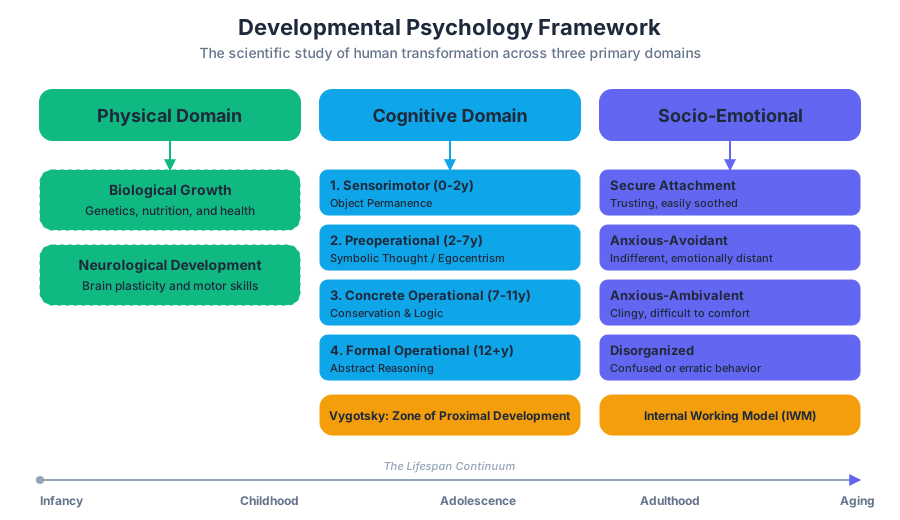
Developmental psychology is the scientific study of how and why human beings change over the course of their life. Originally concerned with infants and children, the field has expanded to include adolescence, adult development, aging, and the entire lifespan. It examines the transformation of psychological processes across three primary domains: physical (biological growth and change), cognitive (mental processes, language, and intelligence), and socio-emotional (personality, emotions, and relationships).
Attachment Theory
Attachment Theory is a psychological, evolutionary, and ethological framework concerning the interest of relationships between humans. The core premise is that infants need to develop a relationship with at least one primary caregiver for normal social and emotional development.
What it is
Formulated by John Bowlby and expanded by Mary Ainsworth, attachment is defined as a "lasting psychological connectedness between human beings." It posits that the bond between infant and caregiver is not merely a product of feeding but a biological imperative for safety and security.
The Internal Working Model (IWM): A mental representation of the self, the caregiver, and the relationship. This cognitive framework acts as a template for future relationships; if a child receives consistent care, they develop an IWM of the self as worthy of love and others as trustworthy.
How it works: The Strange Situation
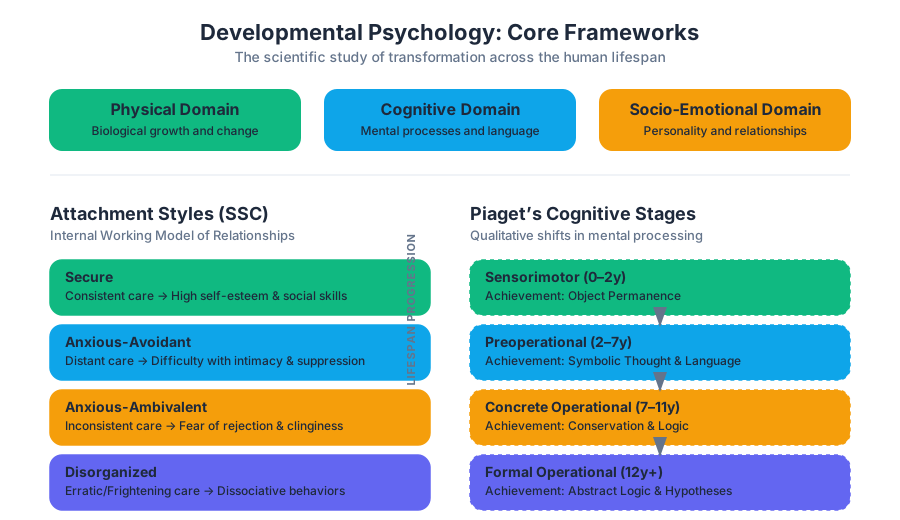
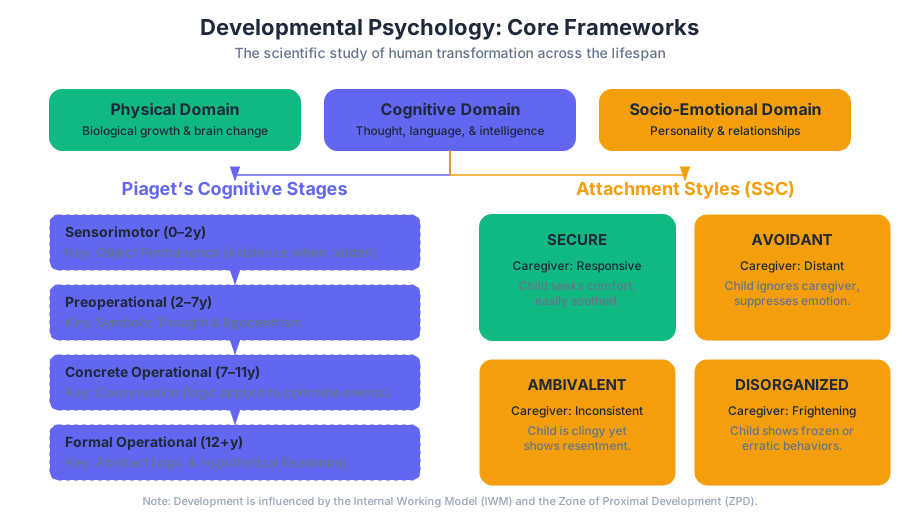
Mary Ainsworth developed the Strange Situation Classification (SSC) to observe attachment relationships between a caregiver and a child. Through a series of eight episodes involving separations and reunions, researchers categorize children into specific attachment styles.
| Attachment Style | Caregiver Behavior | Child's Response to Reunion | Long-term Implications |
|---|---|---|---|
| Secure | Consistent, responsive, sensitive to needs. | Seeks comfort, easily soothed, returns to play. | High self-esteem, strong social skills, healthy relationships. |
| Anxious-Avoidant | Distant, disengaged, or intrusive. | Ignores or avoids caregiver; shows little emotion. | Difficulty with intimacy, emotional suppression. |
| Anxious-Ambivalent | Inconsistent, sometimes responsive, sometimes neglectful. | Distressed on separation; seeks comfort but shows resentment/anger. | Dependency, "clinginess," fear of rejection. |
| Disorganized | Frightening, abusive, or highly erratic. | Confused, frozen, or contradictory behaviors. | High risk for dissociative disorders and aggression. |
Cognitive Development
Cognitive Development refers to the evolution of the ability to think, reason, and understand. The field is dominated by Jean Piaget’s Stage Theory, though it has been refined by Vygotsky’s sociocultural perspective and modern Information Processing theories.
Piaget’s Stages of Development
Piaget proposed that children move through four discrete stages, characterized by qualitatively different ways of thinking. This process is driven by Schemas (mental frameworks), Assimilation (fitting new info into existing schemas), and Accommodation (changing schemas to fit new info).
| Stage | Age Range | Key Achievement | Description |
|---|---|---|---|
| Sensorimotor | 0–2 years | Object Permanence | Understanding that objects exist even when not visible. |
| Preoperational | 2–7 years | Symbolic Thought | Use of language and symbols; marked by egocentrism and lack of conservation. |
| Concrete Operational | 7–11 years | Conservation | Logical thinking about concrete events; understanding that volume/mass remains constant despite shape changes. |
| Formal Operational | 12+ years | Abstract Logic | Ability to reason about hypothetical situations and abstract concepts. |
Vygotsky and the Social Context
Lev Vygotsky argued that Piaget neglected the role of social interaction. He introduced the Zone of Proximal Development (ZPD)—the gap between what a learner can do without help and what they can do with support (Scaffolding).
Mathematical Representation of the ZPD
The ZPD can be conceptualized as a function of a learner's current competence ($C$) and the complexity of a task ($T$), moderated by the quality of scaffolding ($S$).
Learning\_Potential = \int_{C}^{C+S} f(T) \,dT
Where:
- $C$: Current independent mastery level.
- $S$: The "Scaffold" or external assistance provided by a More Knowledgeable Other (MKO).
- $T$: The task difficulty. Learning is optimized when $C < T \leq C+S$.
Common Pitfalls
- Underestimating Children: Modern research (e.g., Baillergeon) shows infants understand object permanence much earlier than Piaget thought.
- Cultural Bias: Piaget’s "Formal Operational" stage is often not reached by adults in cultures where formal Western schooling is absent.
Emerging Adulthood
Emerging Adulthood is a developmental stage occurring between the ages of 18 and 25 (and potentially up to 29). It was proposed by Jeffrey Arnett to account for the shifting demographics in industrialized nations where marriage and parenthood are delayed.
The Five Features of Emerging Adulthood
- Identity Exploration: Trying out various possibilities in love and work.
- Instability: Frequent changes in residence, jobs, and relationships.
- Self-Focused: Having few social obligations and great autonomy.
- Feeling In-Between: Not feeling like an adolescent, but not quite an adult.
- Possibilities: A time of high hopes and optimism about the future.
Why It Matters
This stage is a product of the "Knowledge Economy," which requires longer periods of education. It represents a luxury of time that allows for deeper identity consolidation but can also lead to "quarter-life crises" and prolonged anxiety.
Identity Exploration
While identity formation begins in childhood, it becomes a central task during adolescence and emerging adulthood. Erik Erikson’s stage of Identity vs. Role Confusion provides the foundation for this concept.
Marcia’s Identity Statuses
James Marcia expanded Erikson’s work by defining four identity statuses based on two dimensions: Crisis/Exploration (searching for options) and Commitment (investing in a choice).
| Status | Exploration? | Commitment? | Description |
|---|---|---|---|
| Identity Achievement | Yes | Yes | Has explored options and made a self-chosen commitment. |
| Moratorium | Yes | No | Currently in the midst of a crisis/exploration; no commitment yet. |
| Foreclosure | No | Yes | Commitment made without exploration (often adopting parents' values). |
| Identity Diffusion | No | No | No exploration and no commitment; lack of direction. |
Identity Transition Logic
STATE_MACHINE IdentityFormation:
    INITIAL_STATE = IDENTITY_DIFFUSION

    TRANSITION on "Start Exploration":
        IF state == IDENTITY_DIFFUSION OR state == FORECLOSURE:
            NEW_STATE = MORATORIUM

    TRANSITION on "Make Commitment":
        IF state == MORATORIUM:
            NEW_STATE = IDENTITY_ACHIEVEMENT
        IF state == IDENTITY_DIFFUSION:
            NEW_STATE = FORECLOSURE  // Commitment without exploration

    TRANSITION on "Crisis/Doubt":
        IF state == IDENTITY_ACHIEVEMENT:
            NEW_STATE = MORATORIUM   // "MAMA" cycle (Moratorium-Achievement-Moratorium-Achievement)
Aging and Late Adulthood
Development does not stop at 25. Aging is a lifelong process involving biological, cognitive, and social changes. Gerontologists distinguish between Primary Aging (biological factors like molecular changes) and Secondary Aging (aging influenced by lifestyle and disease).
Cognitive Changes in Aging
A common misconception is that all cognitive functions decline with age. In reality, the trajectory depends on the type of intelligence.
- Fluid Intelligence: The ability to solve new problems and process information quickly. This typically peaks in early adulthood and declines steadily.
- Crystallized Intelligence: Accumulated knowledge, vocabulary, and expertise. This tends to remain stable or even increase well into late adulthood.
| Cognitive Domain | Trajectory | Mechanism |
|---|---|---|
| Processing Speed | Decline | Reduction in white matter integrity and neurotransmitter efficiency. |
| Working Memory | Decline | Reduced inhibitory control; difficulty filtering irrelevant info. |
| Semantic Memory | Stable/Increase | Continued acquisition of facts and language. |
| Emotional Regulation | Increase | Socioemotional Selectivity Theory: Older adults prioritize positive affect. |
Socioemotional Selectivity Theory (SST)
Proposed by Laura Carstensen, SST suggests that as people perceive their time horizon shrinking, they shift their goals from knowledge-acquisition (future-oriented) to emotional-meaning (present-oriented). This explains why social circles often shrink in old age—not because of isolation, but because of a deliberate preference for deep, meaningful relationships over broad, superficial ones.
Parental Development
Developmental psychology also examines the Parental Development—the psychological changes adults undergo as they transition into and move through parenthood.
- The Transition to Parenthood: Often marked by a temporary dip in marital satisfaction but an increase in "meaning in life."
- Parenting Styles (Baumrind):
- Authoritative: High warmth, high demandingness (Optimal).
- Authoritarian: Low warmth, high demandingness.
- Permissive: High warmth, low demandingness.
- Uninvolved: Low warmth, low demandingness.
- The Empty Nest: Contrary to popular belief, most parents experience an increase in life satisfaction once their children leave the home, as they rediscover their own identities and reduce daily stressors.
Common Pitfalls in Aging Research
- Cohort Effects: Differences between age groups may be due to the era they grew up in (e.g., education levels, nutrition) rather than biological aging.
- The Deficit Myth: The assumption that aging is purely a process of loss. In reality, many older adults report higher levels of subjective well-being than younger adults (the "Paradox of Aging").
Summary of Developmental Trajectories
| Concept | Primary Focus | Key Mechanism | Peak/Critical Period |
|---|---|---|---|
| Attachment | Emotional Security | Internal Working Model | 0–24 months |
| Cognition | Logical Reasoning | Schema/Equilibration | Adolescence (Formal Ops) |
| Identity | Self-Definition | Exploration & Commitment | 18–25 years |
| Aging | Functional Capacity | Selective Optimization | Late Adulthood |
Developmental psychology reveals that the "self" is not a static entity but a dynamic system in constant flux, shaped by the interplay of biology, individual agency, and the social environment. From the first attachment bond to the final stages of life review, the human experience is defined by the capacity for growth and adaptation.
Source Materials
Study Psychology as Science on Lykke
This course page is free to open: signed out, you can read its first two sections, and signing in, on any plan, opens the rest. The free Lykke Chrome extension syncs your own Canvas courses, so ChatGPT, Claude and Muse can answer from your classes and deadlines. It only reads Canvas.
Add the free extensionSign in to open every sectionAll sections of Psychology as Science · Browse more course pages