From the free course Psychology as Science on Lykke
Cognition and Language
Key concepts: Attention · Theory of Mind · Language Use · Social Cognition · Conformity and Obedience
An investigation into how humans process information, use language, and navigate social environments through cognitive frameworks.
Cognition and Language: The Architecture of Human Interaction
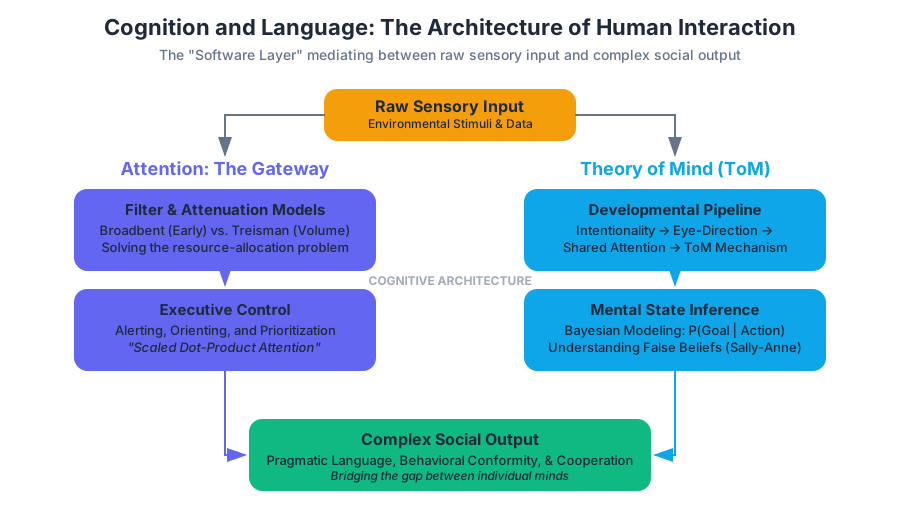
Cognitive psychology serves as the "software layer" of the human experience, mediating between raw sensory input and complex social output. While neuroanatomy provides the hardware, the study of Cognition and Language explores the algorithms governing how we filter information, model the internal states of others, and utilize symbolic systems to bridge the gap between individual minds. This section examines the mechanisms of attention, the development of a "Theory of Mind," the pragmatic use of language, and the social pressures that dictate behavioral conformity.
Attention: The Cognitive Gateway
Attention is the selective cognitive process of prioritizing specific environmental stimuli or internal thoughts while suppressing competing distractors. It is not a single "beam" of light but a complex suite of mechanisms including alerting, orienting, and executive control.
What it is
In computational terms, attention is a resource-allocation problem. Because the brain’s processing capacity is finite (constrained by metabolic costs and neural bandwidth), it must implement a "bottleneck" to prevent information overload.
Definition: Attention is the active processing of a subset of available information, characterized by the withdrawal from some things in order to deal effectively with others.
How it Works: Filter Models
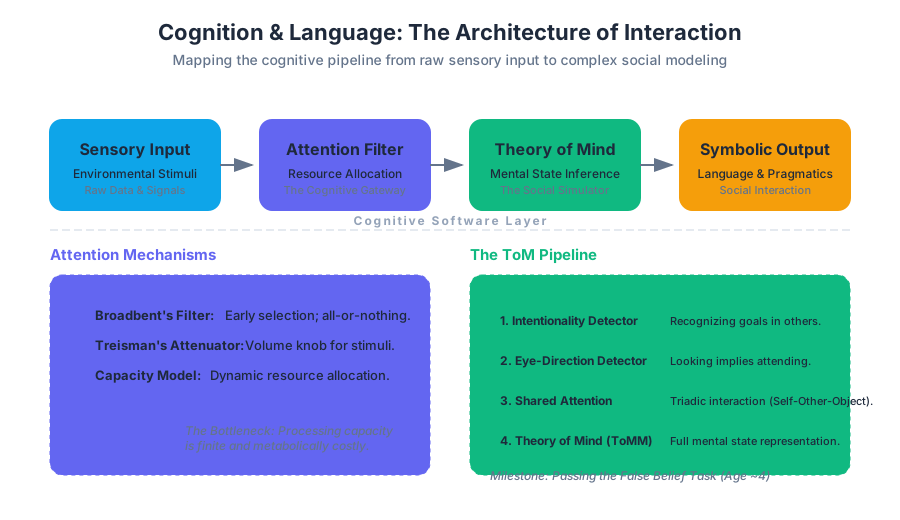
Historically, psychologists have debated where the "filter" occurs. Broadbent’s Filter Model suggests early selection (filtering based on physical characteristics), while Treisman’s Attenuation Model suggests that unattended information is not blocked but "turned down," allowing highly relevant stimuli (like one's name) to break through.
| Model | Selection Point | Mechanism | Handling of Unattended Stimuli |
|---|---|---|---|
| Broadbent | Early | All-or-nothing filter | Completely blocked; no semantic processing. |
| Treisman | Early/Intermediate | Attenuator (Volume knob) | Weakened, but can reach threshold if salient. |
| Deutsch-Norman | Late | Selection after recognition | All stimuli processed for meaning; only some enter awareness. |
| Capacity Model | Variable | Resource allocation | Depends on the "budget" of cognitive effort available. |
Common Pitfalls: Inattentional Blindness
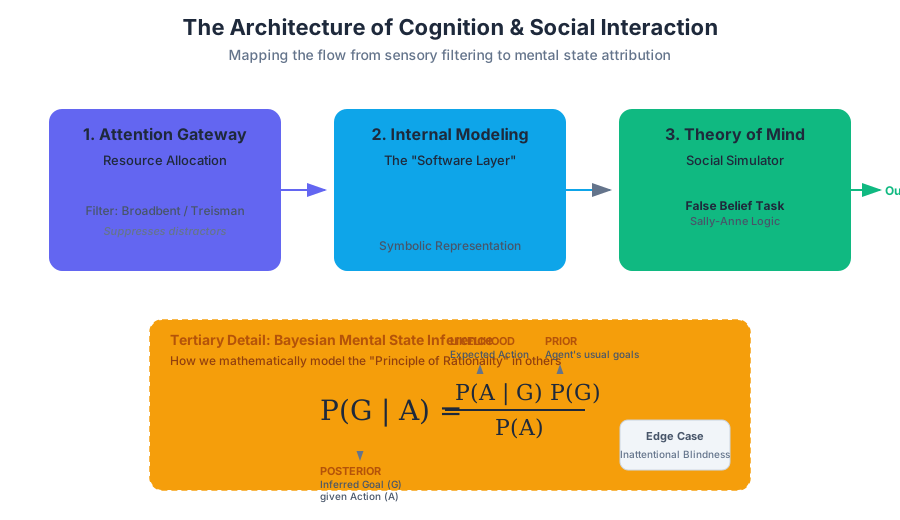
A common misconception is that we "see" everything in our visual field. However, Inattentional Blindness—the failure to notice a fully visible but unexpected object because attention was engaged on another task—demonstrates that perception is a function of attention, not just optical input.
Theory of Mind (ToM): The Social Simulator
Theory of Mind (ToM) is the cognitive capacity to attribute mental states—beliefs, desires, intentions, and knowledge—to oneself and others. It is the foundation of social intelligence, allowing humans to predict and interpret the behavior of peers.
Why it Matters
Without ToM, social interaction would be a series of inexplicable physical movements. ToM allows us to understand that someone might act based on a False Belief (a belief that contradicts reality), which is a milestone in child development typically reached around age four.
The Developmental Pipeline
The acquisition of ToM follows a predictable trajectory, often mapped via the "False Belief Task" (e.g., the Sally-Anne test).
- Intentionality Detector: Recognizing that others have goals.
- Eye-Direction Detector: Understanding that "looking" implies "attending."
- Shared Attention Mechanism: Three-way interaction between self, other, and an object.
- Theory of Mind Mechanism (ToMM): The full ability to represent the mental states of others.
Mathematical Representation of Mental State Inference
We can model ToM using Bayesian inference, where an observer $O$ estimates the probability of an agent's goal $G$ given their observed actions $A$.
P(G | A) = \frac{P(A | G) P(G)}{P(A)}
The Principle of Rationality: Observers assume agents will take the most efficient path to their goal, given their (potentially limited) knowledge.
Logic Representation: Modeling Beliefs
To represent ToM in a multi-agent system, we use modal logic to distinguish between "Truth" and "Belief."
Language and Language Use: The Cooperative Protocol
Language is more than a set of grammatical rules (Syntax); it is a dynamic social tool (Pragmatics). While linguistics often focuses on the structure of sentences, cognitive psychology focuses on Language Use—how we use words to achieve social goals.
Gricean Maxims: The Rules of Cooperation
Philosopher H.P. Grice proposed that conversation is governed by the Cooperative Principle. We assume our interlocutors are trying to be helpful and clear.
| Maxim | Description | Violation Example |
|---|---|---|
| Quantity | Be as informative as required, but no more. | Giving a 10-minute history of clocks when asked for the time. |
| Quality | Do not say what you believe to be false or lack evidence for. | Spreading a rumor you know is likely untrue. |
| Relation | Be relevant. | Responding to "How are you?" with "The sky is blue." |
| Manner | Be clear, brief, and orderly; avoid ambiguity. | Using overly technical jargon with a layperson. |
Social Cognition in Language
Language use requires constant "audience design." We adjust our speech based on what we assume the listener knows (their Common Ground). This is a direct application of Theory of Mind to communication.
Social Cognition: Processing the Human Environment
Social Cognition refers to the mental processes that people use to make sense of the social world. It involves how we perceive, remember, and interpret information about ourselves and others.
Heuristics and Biases
Because social environments are complex, we rely on mental shortcuts (Heuristics).
- Availability Heuristic: Estimating the frequency of an event based on how easily examples come to mind (e.g., fearing shark attacks more than heart disease).
- Representativeness Heuristic: Categorizing someone based on how much they fit a "prototype" (stereotyping).
- Fundamental Attribution Error: The tendency to over-emphasize personality traits and under-emphasize situational factors when explaining others' behavior.
Dual-Process Theory
Social cognition is often divided into two systems:
- System 1 (Automatic): Fast, intuitive, and non-conscious (e.g., reading a facial expression).
- System 2 (Controlled): Slow, analytical, and conscious (e.g., deciding how to word a difficult email).
Conformity and Obedience: The Mechanics of Influence
While cognition often focuses on the individual, Conformity and Obedience examine how the social collective overrides individual judgment.
Conformity: The Asch Paradigm
Conformity is the change in beliefs or behavior in order to fit in with a group. Solomon Asch’s experiments showed that individuals would provide an obviously wrong answer (e.g., which line is longer) simply because the rest of the group did.
Obedience: The Milgram Experiment
Obedience is following orders from an authority figure. Stanley Milgram demonstrated that a significant majority of people (approx. 65%) would administer what they believed were lethal electric shocks to a stranger if instructed to do so by a "scientist" in a lab coat.
Factors Influencing Social Pressure
The strength of social influence depends on several variables, often summarized by Social Impact Theory.
| Factor | Description | Effect on Influence |
|---|---|---|
| Strength | The status or power of the influencing source. | Higher status = More influence. |
| Immediacy | Physical or temporal proximity of the source. | Closer proximity = More influence. |
| Number | The total number of people in the group. | Influence increases with group size (up to a point). |
| Unanimity | Whether the group is in total agreement. | A single dissenter drastically reduces conformity. |
Common Pitfalls: The "Bystander Effect"
A common misconception is that people don't help in emergencies because they are "apathetic." In reality, the Bystander Effect is a cognitive failure caused by Diffusion of Responsibility (assuming someone else will act) and Pluralistic Ignorance (looking to others to see if they look worried).
Synthesis: The Integrated Cognitive Loop
The concepts in this section do not exist in isolation. They form a feedback loop that defines the human social experience:
- Attention filters the environment for social cues (a frown, a pointed finger).
- Social Cognition interprets those cues using schemas and heuristics.
- Theory of Mind simulates the internal state of the person providing the cues.
- Language is used to negotiate meaning and establish common ground.
- Conformity/Obedience pressures regulate the final behavioral output to ensure group cohesion.
- Attention: The process of selectively concentrating on specific stimuli.
- Theory of Mind (ToM): The ability to attribute mental states to others.
- False Belief Task: A test used to determine if a child understands that others can have incorrect beliefs.
- Pragmatics: The study of how context contributes to meaning in language use.
- Gricean Maxims: Four rules (Quantity, Quality, Relation, Manner) that guide cooperative conversation.
- Fundamental Attribution Error: Overestimating internal traits and underestimating situational factors in others.
- System 1 vs. System 2: The distinction between fast, intuitive thinking and slow, deliberate thinking.
- Diffusion of Responsibility: The tendency for individuals to feel less accountable when in a large group.
-
Which model of attention suggests that unattended information is "turned down" rather than completely blocked?
- A) Broadbent's Filter Model
- B) Treisman's Attenuation Model
- C) Deutsch-Norman Late Selection Model
- Answer: B
-
At what approximate age do children typically pass the "False Belief Task"?
- A) 18 months
- B) 2 years
- C) 4 years
- D) 7 years
- Answer: C
-
If a speaker is being intentionally vague to avoid answering a question, which Gricean Maxim are they violating?
- A) Quality
- B) Quantity
- C) Manner
- D) Relation
- Answer: C
-
In the Milgram experiment, what factor most significantly reduced the level of obedience?
- A) Moving the experiment to a less prestigious office building.
- B) Having the "teacher" touch the "learner's" hand.
- C) The presence of a second authority figure who disagreed with the first.
- Answer: C
-
The "Availability Heuristic" leads people to judge the frequency of an event based on:
- A) How closely it matches a prototype.
- B) How much effort it takes to think about it.
- C) How easily examples come to mind.
- Answer: C
Core Themes to Remember:
- The Resource Constraint: Attention is necessary because the brain cannot process everything.
- The Social Mirror: Theory of Mind allows us to "see" inside others, which is essential for language and social harmony.
- The Cooperative Principle: Language relies on the assumption that we are trying to be understood.
- The Power of the Situation: Conformity and obedience show that social context often overrides individual logic.
Key Researchers:
- Donald Broadbent & Anne Treisman: Attention.
- Simon Baron-Cohen: Theory of Mind.
- H.P. Grice: Language Pragmatics.
- Daniel Kahneman: Social Cognition (Dual-Process).
- Solomon Asch & Stanley Milgram: Social Influence.
Source Materials
Study Psychology as Science on Lykke
This course page is free to open: signed out, you can read its first two sections, and signing in, on any plan, opens the rest. The free Lykke Chrome extension syncs your own Canvas courses, so ChatGPT, Claude and Muse can answer from your classes and deadlines. It only reads Canvas.
Add the free extensionSign in to open every sectionAll sections of Psychology as Science · Browse more course pages