From the free course Psychology as Science on Lykke
Biological Basis of Behavior
Key concepts: Neuroanatomy · Neurons and Neural Communication · Epigenetics · Behavioral Endocrinology · Natural and Sexual Selection
Explores the physiological foundations of behavior, including neuroanatomy, the nervous system, and the endocrine system.
Biological Basis of Behavior
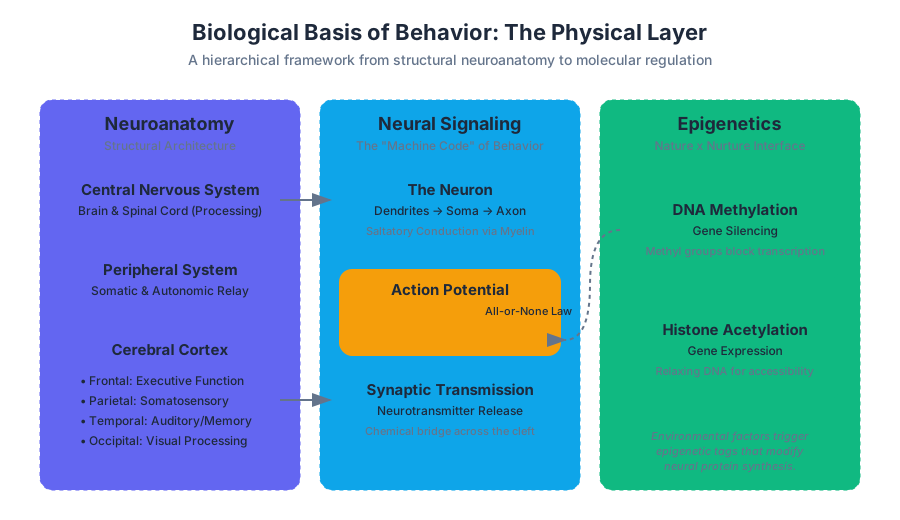
The biological basis of behavior represents the "physical layer" of the human experience. In the same way that software performance is constrained by the underlying CPU architecture and memory bandwidth, human cognition, emotion, and social interaction are fundamentally products of biological substrates. This field synthesizes neuroanatomy, electrophysiology, molecular biology, and evolutionary theory to explain why we think, feel, and act the way we do.
Neuroanatomy: The Structural Architecture
Neuroanatomy is the study of the physical organization of the nervous system. It is traditionally divided into two primary systems: the Central Nervous System (CNS), consisting of the brain and spinal cord, and the Peripheral Nervous System (PNS), which connects the CNS to the rest of the body.
The Central Nervous System (CNS)
The CNS acts as the primary processing hub. The brain is organized hierarchically, with "lower" structures handling autonomic survival functions and "higher" structures managing complex cognition.
| Region | Primary Components | Functional Specialization |
|---|---|---|
| Hindbrain | Medulla, Pons, Cerebellum | Autonomic functions (breathing, heart rate), motor coordination, and balance. |
| Midbrain | Tectum, Tegmentum | Sensory processing (visual/auditory triggers), reticular formation (arousal). |
| Forebrain | Cerebral Cortex, Thalamus, Limbic System | High-level executive function, sensory relay, emotional processing, and memory. |
The Cerebral Cortex and Localization of Function
The cerebral cortex is divided into four lobes, each associated with distinct functional domains. While the brain exhibits high levels of neuroplasticity (the ability to reorganize itself), certain areas are highly specialized.
- Frontal Lobe: Home to the Prefrontal Cortex (PFC), responsible for executive functions, planning, and impulse control. It also contains the motor cortex.
- Parietal Lobe: Processes somatosensory information (touch, temperature, pain) and spatial awareness.
- Temporal Lobe: Essential for auditory processing, language comprehension (Wernicke’s area), and memory formation.
- Occipital Lobe: Dedicated almost exclusively to visual processing.
Neurons and Neural Communication: The Signaling Protocol
Behavior is the result of billions of specialized cells called neurons communicating via electrochemical signals. This process is the "machine code" of the brain.
Anatomy of a Neuron
- Dendrites: Branch-like structures that receive incoming signals from other neurons.
- Soma (Cell Body): Integrates incoming signals and contains the nucleus.
- Axon: A long fiber that carries the electrical impulse (action potential) away from the soma.
- Myelin Sheath: A fatty insulating layer that increases signal transmission speed via saltatory conduction.
- Axon Terminals: The exit point where neurotransmitters are released into the synapse.
The Action Potential
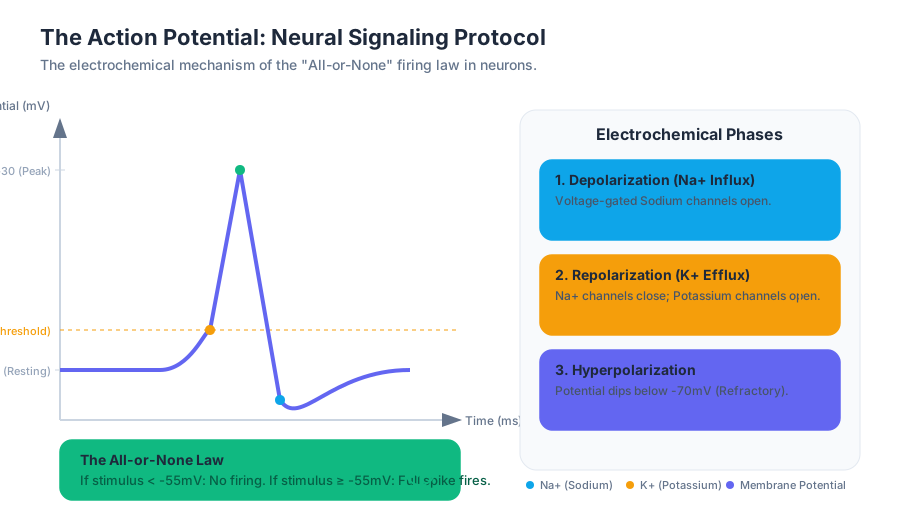
The Action Potential is an "all-or-nothing" electrical discharge. It occurs when the neuron's membrane potential reaches a specific threshold (typically -55mV), causing a rapid influx of Sodium ($Na^+$) ions and a subsequent efflux of Potassium ($K^+$) ions.
The All-or-None Law: A neuron either fires completely or not at all. The intensity of a stimulus is communicated not by the "size" of the electrical pulse, but by the frequency of firing (rate coding).
Synaptic Transmission
These chemicals bind to receptors on the postsynaptic neuron, acting like a key in a lock to either excite or inhibit the next cell.
Epigenetics: The Interface of Nature and Nurture
For decades, the "Nature vs. Nurture" debate suggested a binary choice. Epigenetics has rendered this distinction obsolete by showing how the environment directly influences gene expression without altering the underlying DNA sequence.
Mechanisms of Epigenetic Change
Epigenetic modifications act as "tags" on the genome, determining which genes are "turned on" (expressed) or "turned off" (silenced).
| Mechanism | Action | Resulting Effect |
|---|---|---|
| DNA Methylation | Addition of a methyl group to DNA bases. | Typically silences gene expression by preventing transcription. |
| Histone Acetylation | Modification of the proteins (histones) DNA wraps around. | Relaxes DNA structure, making genes more accessible for expression. |
| Non-coding RNA | RNA molecules that do not code for proteins. | Can intercept and degrade mRNA, preventing protein synthesis. |
Behavioral Implications
Studies in rodents (e.g., Weaver et al., 2004) demonstrated that high-quality maternal care (licking and grooming) leads to decreased DNA methylation of the glucocorticoid receptor gene. This makes the offspring more resilient to stress in adulthood. In humans, similar mechanisms are implicated in how childhood trauma increases the risk for later psychiatric disorders.
\text{Phenotype} (P) = \text{Genotype} (G) + \text{Environment} (E) + (G \times E) + \text{Epigenetic State} (\epsilon)
Key Insight: Epigenetic changes can be heritable. This means the environmental stressors experienced by a parent can potentially influence the biological predispositions of their offspring through "transgenerational epigenetic inheritance."
Behavioral Endocrinology: The Chemical Messengers
While the nervous system uses electrical impulses for rapid communication, the Endocrine System uses hormones for slower, longer-lasting, and more widespread signaling.
The HPA Axis
The Hypothalamic-Pituitary-Adrenal (HPA) Axis is the body's primary stress response system.
- Hypothalamus releases CRH (Corticotropin-releasing hormone).
- Pituitary Gland releases ACTH (Adrenocorticotropic hormone).
- Adrenal Glands release Cortisol, which increases blood sugar and suppresses non-essential functions (like digestion) to prepare for "fight or flight."
Major Hormones and Behavior
| Hormone | Source | Primary Behavioral Influence |
|---|---|---|
| Oxytocin | Hypothalamus/Pituitary | Social bonding, trust, maternal behavior, and "tend-and-befriend" response. |
| Testosterone | Gonads/Adrenals | Dominance seeking, aggression (context-dependent), and libido. |
| Cortisol | Adrenal Cortex | Stress management, arousal, and metabolic regulation. |
| Estradiol | Ovaries | Cognitive function, mood regulation, and reproductive behavior. |
Evolutionary Psychology: Natural and Sexual Selection
The biological basis of behavior is not random; it is the result of millions of years of evolutionary pressure. Evolutionary Psychology posits that the human mind consists of "evolved psychological mechanisms" designed to solve specific problems faced by our ancestors.
Natural Selection
Traits that increase an organism's chances of survival to reproductive age are more likely to be passed on. In a psychological context, this includes:
- Fear responses: Rapid detection of snakes or spiders.
- Food preferences: Cravings for high-calorie fats and sugars (adaptive in environments of scarcity).
Sexual Selection
Some traits evolve not because they aid survival, but because they aid reproductive success.
- Intrasexual Competition: Traits that help one compete with members of the same sex (e.g., physical size, aggression).
- Intersexual Selection: Traits that attract the opposite sex (e.g., complex song in birds, or perhaps creativity and humor in humans).
Inclusive Fitness and Altruism
Why do humans help others at a cost to themselves? Hamilton’s Rule ($rb > c$) suggests that altruism is biologically viable if the benefit to a relative ($b$), weighted by the degree of genetic relatedness ($r$), exceeds the cost to the individual ($c$).
Common Pitfalls and Misconceptions
- Biological Determinism: The mistaken belief that because a behavior has a biological basis, it is unchangeable. In reality, the brain is highly plastic, and environmental interventions can alter biological trajectories.
- The "One Gene, One Behavior" Fallacy: Most behaviors are polygenic, meaning they are influenced by hundreds or thousands of genes, each with a tiny effect, interacting with the environment.
- Localization Overstatement: While we speak of "the fear center" (amygdala), no brain region acts in isolation. Behavior emerges from network connectivity rather than isolated "modules."
- Misunderstanding Evolutionary "Fitness": In biology, fitness refers to reproductive success, not physical strength or "superiority." An anxious individual might have higher "fitness" in a dangerous environment because they are more likely to survive and reproduce.
Synthesis: The Integrated Biological Model
To understand any behavior—for example, a person’s reaction to a social rejection—we must look at all these layers simultaneously:
- Evolutionary: Why did humans evolve a need for social belonging? (Survival in groups).
- Endocrine: What happens to cortisol levels when we are rejected? (Stress response).
- Neuroanatomical: Which areas activate? (The Anterior Cingulate Cortex, which also processes physical pain).
- Neural: What is the neurotransmitter balance? (Drop in dopamine/opioid activity).
- Epigenetic: How does this person's history of attachment (nurture) influence their current receptor sensitivity (nature)?
By viewing behavior through this multi-layered biological lens, we move away from simplistic explanations and toward a rigorous, scientific understanding of the human condition.
Source Materials
Study Psychology as Science on Lykke
This course page is free to open: signed out, you can read its first two sections, and signing in, on any plan, opens the rest. The free Lykke Chrome extension syncs your own Canvas courses, so ChatGPT, Claude and Muse can answer from your classes and deadlines. It only reads Canvas.
Add the free extensionSign in to open every sectionAll sections of Psychology as Science · Browse more course pages