From the free course Psychology 2e on Lykke
Mental Health, Disorders, and Therapy
Key concepts: DSM-5 · Psychological Disorders · Psychotherapy · Biomedical Therapy
A detailed look at psychological disorders using the DSM-5 framework and the various therapeutic approaches used to treat them.
Mental Health, Disorders, and Therapy: A Systems Engineering Perspective on the Human Mind
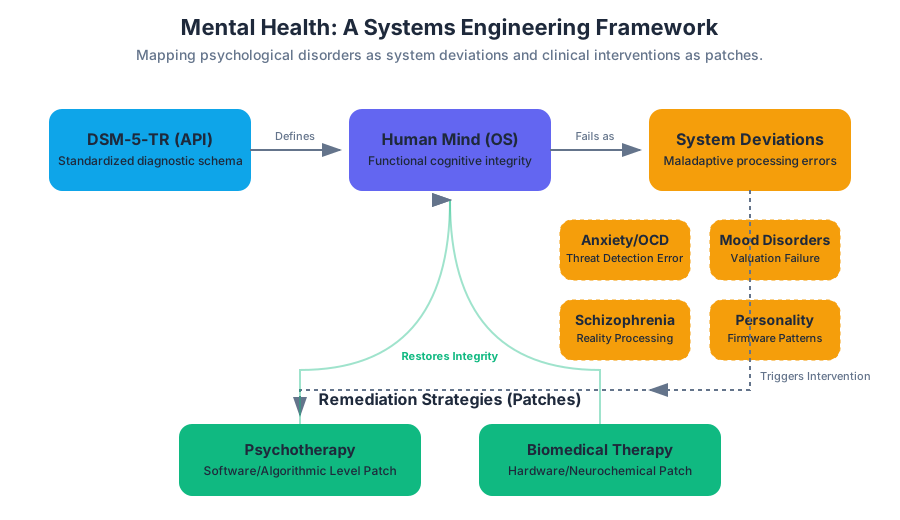
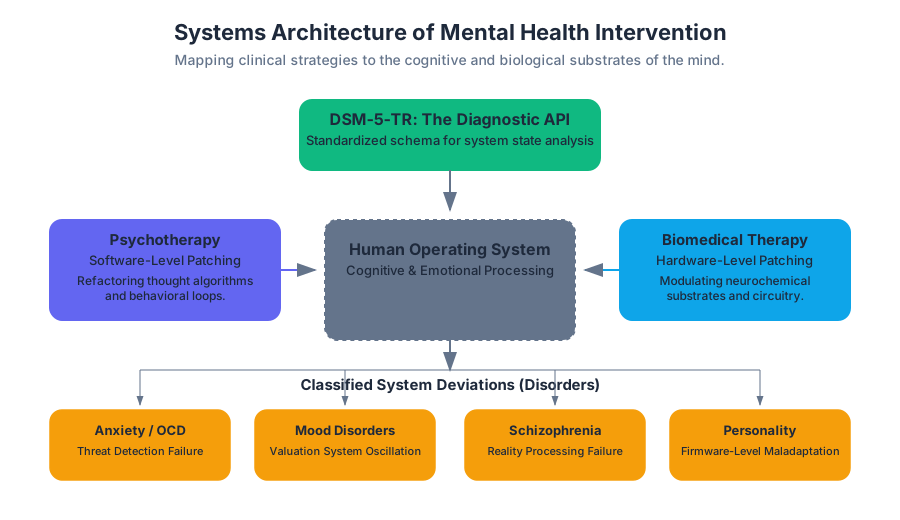
Mental health is the functional integrity of the human cognitive and emotional operating system. When we discuss Psychological Disorders, we are essentially describing persistent, maladaptive deviations from normative psychological processing that result in significant distress or impairment. To manage these deviations, the clinical field employs two primary "patching" strategies: Psychotherapy (addressing the software/algorithmic level of thought and behavior) and Biomedical Therapy (addressing the hardware/neurochemical substrate).
The Diagnostic Framework: DSM-5-TR
The Diagnostic and Statistical Manual of Mental Disorders (DSM-5-TR) serves as the authoritative "API documentation" for mental health professionals. Published by the American Psychiatric Association, it provides a standardized language and set of criteria for diagnosing mental disorders.
Evolution of the Schema
The DSM has evolved from a psychoanalytic, prose-heavy document (DSM-I) into a highly structured, evidence-based taxonomy. The current version, the DSM-5-TR (Text Revision), moved away from the previous "multiaxial system" to a non-axial documentation of diagnosis, reflecting a more integrated view of mental and physical health.
Definition: Psychological Disorder A syndrome characterized by clinically significant disturbance in an individual's cognition, emotion regulation, or behavior that reflects a dysfunction in the psychological, biological, or developmental processes underlying mental functioning.
| Feature | DSM-IV-TR (Legacy) | DSM-5 / DSM-5-TR (Modern) |
|---|---|---|
| Structure | Multiaxial (Axis I-V) | Non-axial (Unified diagnosis) |
| Approach | Categorical (Yes/No) | Increasing use of Dimensional scales |
| Organization | By onset age (Childhood vs. Adult) | Developmental lifespan approach |
| Key Change | Asperger's as distinct | Autism Spectrum Disorder (ASD) |
| Grief | "Bereavement Exclusion" for MDD | Exclusion removed; focus on clinical severity |
Taxonomy of Major Psychological Disorders
Disorders are categorized based on their primary symptomatic "output." Understanding these requires looking at both the phenomenological experience (what the patient feels) and the underlying systemic failure.
1. Anxiety and Obsessive-Compulsive Disorders
These disorders represent an over-active "threat detection" system. In Generalized Anxiety Disorder (GAD), the system is in a constant state of high-alert without a specific trigger. In Phobias, the trigger is hyper-specific. Obsessive-Compulsive Disorder (OCD) involves a "logic loop" where intrusive thoughts (obsessions) trigger repetitive behaviors (compulsions) to neutralize the perceived threat.
2. Mood Disorders: The Valuation System
Mood disorders affect the "hedonic tone" of the individual.
- Major Depressive Disorder (MDD): A persistent state of low energy, anhedonia (inability to feel pleasure), and negative cognitive bias.
- Bipolar Disorder: A system-level oscillation between extreme lows (depression) and pathological highs (Mania), characterized by pressured speech, decreased need for sleep, and grandiosity.
3. Schizophrenia: The Reality Processing Failure
Schizophrenia is a profound disintegration of thought, perception, and affect. It is characterized by Positive Symptoms (additions to reality, like hallucinations and delusions) and Negative Symptoms (subtractions from reality, like social withdrawal and flat affect).
4. Personality Disorders: The Firmware Level
These are enduring, inflexible patterns of inner experience and behavior that deviate markedly from cultural expectations. Because they are "ego-syntonic" (the person feels their behavior is normal), they are notoriously difficult to treat.
| Cluster | Key Characteristic | Examples |
|---|---|---|
| Cluster A | Odd, Eccentric | Paranoid, Schizoid, Schizotypal |
| Cluster B | Dramatic, Emotional, Erratic | Antisocial, Borderline, Histrionic, Narcissistic |
| Cluster C | Anxious, Fearful | Avoidant, Dependent, Obsessive-Compulsive (Personality) |
Implementing Diagnostic Logic
In modern clinical informatics, the criteria from the DSM-5 are often translated into screening algorithms.
Psychotherapy: The Software Intervention
Psychotherapy, or "talk therapy," aims to modify the cognitive algorithms and behavioral patterns of the individual.
Cognitive-Behavioral Therapy (CBT)
CBT is the current "gold standard" for many disorders. It operates on the Cognitive Triad: Thoughts, Feelings, and Behaviors are interconnected. By changing one (usually thoughts or behaviors), you can force a state change in the others.
The Logic of Cognitive Restructuring
In CBT, we identify "Cognitive Distortions" (bugs in the logic) such as Catastrophizing or All-or-Nothing Thinking. The therapeutic process is akin to debugging code:
- Identify the Trigger (Input)
- Identify the Automatic Thought (Processing)
- Evaluate the Evidence (Unit Testing)
- Generate an Alternative Thought (Refactoring)
Mathematical Representation of Behavioral Activation
In treating depression, we often use Behavioral Activation. We can model the probability of a "Positive State" ($P(S_+)$) as a function of the frequency of rewarding activities ($A$) and the reinforcement sensitivity ($k$):
P(S_+) = \frac{1}{1 + e^{-k(A - \theta)}}
Where $\theta$ is the threshold of activity required to overcome anhedonia.
Biomedical Therapy: The Hardware Intervention
When the "software" interventions are insufficient, or when the disorder has a clear biological etiology (like the dopamine dysregulation in Schizophrenia), we turn to biomedical interventions.
Psychopharmacology
Drugs act as exogenous modulators of synaptic transmission. They generally work via four mechanisms:
- Agonism: Mimicking a neurotransmitter.
- Antagonism: Blocking a receptor.
- Reuptake Inhibition: Preventing the "recycling" of neurotransmitters, keeping them in the synapse longer.
- Enzyme Inhibition: Preventing the breakdown of neurotransmitters.
| Drug Class | Mechanism | Primary Use Case | Example |
|---|---|---|---|
| SSRIs | Selective Serotonin Reuptake Inhibition | Depression, Anxiety | Fluoxetine (Prozac) |
| Benzodiazepines | GABA Agonism (Inhibitory) | Acute Anxiety, Panic | Diazepam (Valium) |
| Antipsychotics | Dopamine (D2) Antagonism | Schizophrenia, Bipolar | Haloperidol, Risperidone |
| Mood Stabilizers | Ion channel modulation / GSK-3 inhibition | Bipolar Disorder | Lithium Carbonate |
Advanced Biological Interventions
For treatment-resistant cases, clinicians may use:
- Electroconvulsive Therapy (ECT): Inducing a controlled seizure to "reboot" brain chemistry. Highly effective for severe depression.
- Transcranial Magnetic Stimulation (TMS): Using magnetic fields to stimulate specific cortical regions (e.g., the prefrontal cortex).
- Deep Brain Stimulation (DBS): Surgical implantation of electrodes (the "pacemaker for the brain").
Data Integrity and the Replication Crisis
A critical component of modern psychology (as emphasized in the OpenStax 2e update) is the Replication Crisis. Many classic studies in social and clinical psychology failed to replicate when subjected to rigorous, large-scale testing. This has led to a shift toward:
- Open Educational Resources (OER): Ensuring transparent access to data.
- Pre-registration: Forcing researchers to state their hypotheses and analysis plans before gathering data to prevent "p-hacking."
- Diversity and Representation: Recognizing that a "standard" human model based solely on WEIRD (Western, Educated, Industrialized, Rich, and Democratic) populations is scientifically insufficient.
Clinical Workflow: A Real-World Pipeline
In a modern clinical setting, the process of moving from "distress" to "remission" follows a structured pipeline. This can be viewed as a series of state transitions.
Common Pitfalls in Understanding Mental Health
- The "Chemical Imbalance" Myth: While neurotransmitters are involved, it is rarely as simple as a "low level" of a single chemical. It is usually a complex failure of neural circuits and feedback loops.
- The Dunning-Kruger Effect in Diagnosis: Self-diagnosis via internet "symptom checkers" often ignores the Differential Diagnosis—the process of ruling out other conditions (like thyroid issues causing depression-like symptoms).
- Stigma vs. Science: Viewing mental illness as a "character flaw" rather than a systemic biological/psychological dysfunction.
Summary of Treatment Efficacy
Research indicates that for many moderate-to-severe conditions, a Combined Approach (Psychotherapy + Biomedical Therapy) yields the best long-term outcomes. Psychotherapy provides the skills for long-term "maintenance," while medication can lower the "activation energy" required for the patient to engage in therapy.
The Biopsychosocial Model The most robust framework for understanding mental health. It posits that health and illness are determined by a dynamic interaction between Biological (genes, neurochemistry), Psychological (stress, trauma, patterns of thought), and Social (socioeconomic status, culture, relationships) factors.
Further Reading and Resources
- DSM-5-TR Diagnostic Criteria - American Psychiatric Association.
- The Replication Crisis in Psychology - Open Science Framework (OSF).
- Psychology 2e - OpenStax, Rice University.
Source Materials
Study Psychology 2e on Lykke
This course page is free to open: signed out, you can read its first two sections, and signing in, on any plan, opens the rest. The free Lykke Chrome extension syncs your own Canvas courses, so ChatGPT, Claude and Muse can answer from your classes and deadlines. It only reads Canvas.
Add the free extensionSign in to open every section