From the free course Psychology 2e on Lykke
Foundations of Psychological Science
Key concepts: Replication Crisis · Research Ethics · Scientific Method · History of Psychology
An introduction to the history of psychology, scientific research methods, and the critical importance of the replication crisis in modern science.
Foundations of Psychological Science
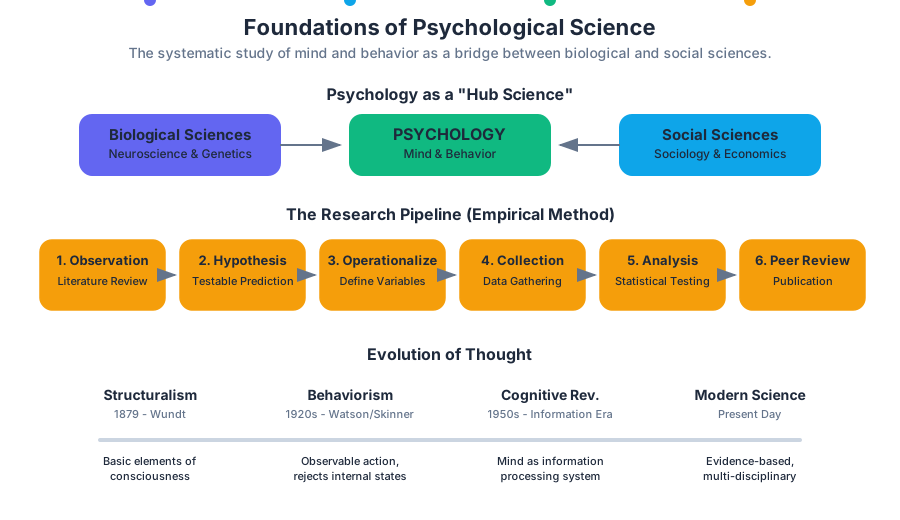
Psychology is the rigorous, systematic study of the mind and behavior. While often perceived by the public through the lens of clinical therapy or "pop-psychology" tropes, the discipline functions as a "hub science" that bridges the gap between the biological sciences (neuroscience, genetics) and the social sciences (sociology, economics). The foundations of psychological science rest upon a commitment to empirical evidence, ethical scrutiny, and a self-correcting methodological framework designed to parse the complexities of human cognition and action.
The History of Psychology: From Philosophy to Empirical Science
The evolution of psychology is characterized by a transition from speculative philosophy to a laboratory-based science. Before the late 19th century, questions regarding the nature of the mind were the domain of philosophers like René Descartes and John Locke. The formal "birth" of psychology as a distinct scientific discipline is generally attributed to Wilhelm Wundt and William James.
Structuralism vs. Functionalism
Wundt, often called the father of psychology, established the first psychological laboratory in Leipzig, Germany, in 1879. His approach, Structuralism, sought to map the "periodic table" of the mind by breaking down conscious experience into its basic components using Introspection. Conversely, William James, influenced by Darwinian evolution, proposed Functionalism. This school of thought focused not on what the mind is, but what it does—how mental activities help an organism fit into its environment.
| School of Thought | Key Proponent | Core Methodology | Primary Objective |
|---|---|---|---|
| Structuralism | Wilhelm Wundt | Introspection | Identifying the basic elements of consciousness. |
| Functionalism | William James | Observation/Evolutionary Theory | Understanding how mental processes aid adaptation. |
| Psychoanalysis | Sigmund Freud | Case Studies/Clinical Interview | Exploring the influence of the unconscious mind. |
| Behaviorism | B.F. Skinner / John Watson | Controlled Experimentation | Studying observable behavior, rejecting internal states. |
| Humanism | Carl Rogers / Abraham Maslow | Qualitative Interview | Emphasizing personal growth and self-actualization. |
The Cognitive Revolution
By the 1950s, the dominance of Behaviorism—which viewed the mind as a "black box" that could not be scientifically studied—was challenged. The Cognitive Revolution re-integrated the study of internal mental processes (memory, perception, language) by utilizing metaphors from the emerging field of computer science. This shift allowed psychologists to treat the mind as an information-processing system.
The Scientific Method in Psychology
The Scientific Method is the standardized protocol used by psychologists to generate knowledge. It is an iterative process that relies on Empiricism—the belief that knowledge comes from sensory experience and evidence.
The Research Pipeline
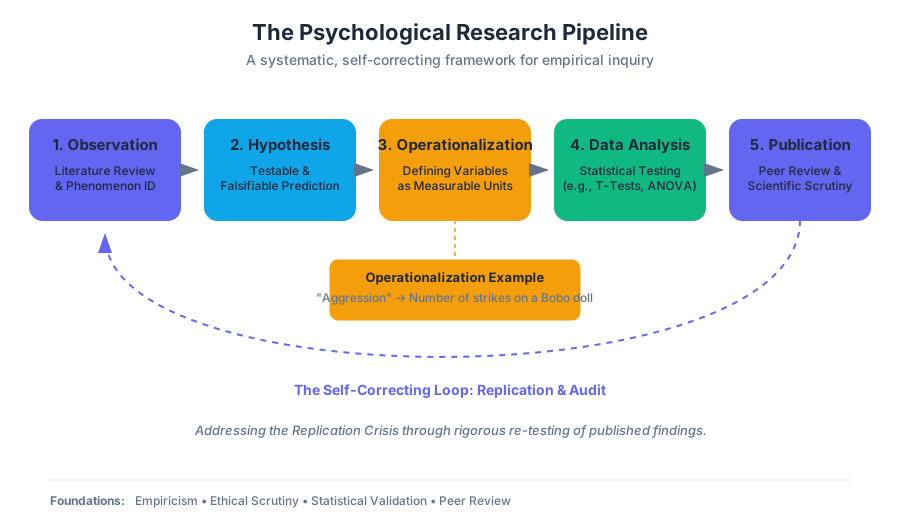
- Observation and Literature Review: Identifying a phenomenon and reviewing existing data.
- Hypothesis Formulation: Creating a testable, falsifiable prediction.
- Operationalization: Defining abstract variables in measurable terms.
- Data Collection: Executing the experimental or observational design.
- Data Analysis: Using statistical tools to test the hypothesis.
- Peer Review and Publication: Subjecting findings to the scrutiny of the scientific community.
Definition: Operationalization The process of strictly defining variables into measurable factors. For example, "intelligence" might be operationalized as a score on the WAIS-IV exam, while "aggression" might be operationalized as the number of times a subject strikes a Bobo doll.
The Replication Crisis: A Systemic Audit
The Replication Crisis refers to a methodological crisis in which the results of many scientific studies are difficult or impossible to replicate upon being conducted a second time. This issue came to the forefront in the early 2010s, particularly following the "Reproducibility Project: Psychology," which found that only about 36% of replicated studies produced significant results, compared to 97% of the original studies.
Causes of the Crisis
The crisis is not attributed to a single factor but to a cluster of systemic incentives and statistical misunderstandings:
- P-hacking: The practice of manipulating data or statistical analyses until non-significant results become significant (typically $p < .05$).
- HARKing (Hypothesizing After Results are Known): Presenting a post-hoc hypothesis as if it were the original hypothesis after seeing the data.
- Publication Bias: The tendency for journals to publish only "positive" results (findings that support a hypothesis), leading to the "File Drawer Problem."
- Low Statistical Power: Studies with small sample sizes are less likely to detect true effects and more likely to produce "fluke" significant results.
Mathematical Foundations of the P-Value
The $p$-value is the probability of observing results at least as extreme as those measured, assuming the null hypothesis ($H_0$) is true.
p = P(D | H_0)
Where:
- $D$ is the observed data.
- $H_0$ is the hypothesis that there is no effect.
A common pitfall is the Inverse Deterministic Fallacy, where researchers mistakenly believe $p = 0.05$ means there is a 95% chance the hypothesis is true. In reality, the $p$-value only speaks to the data's compatibility with the null hypothesis, not the truth of the alternative hypothesis.
Research Ethics: The Moral Guardrails
Psychological research involves sentient beings, necessitating a robust ethical framework to prevent harm. Modern ethics are governed by the Belmont Report (1979), which established three core principles: Respect for Persons, Beneficence, and Justice.
The Institutional Review Board (IRB)
Any institution receiving federal funding must maintain an Institutional Review Board (IRB). This committee reviews research proposals to ensure they meet ethical standards before any data collection begins.
| Ethical Requirement | Description | Application |
|---|---|---|
| Informed Consent | Participants must be told what to expect and that they can withdraw at any time. | Signed documents before the study. |
| Deception | Misleading participants about the study's purpose is allowed only if necessary and harmless. | Must be justified to the IRB. |
| Debriefing | Participants must be told the true purpose of the study after it concludes. | Essential if deception was used. |
| Confidentiality | Data must be kept private and anonymous where possible. | Encrypted storage, no identifying names. |
| Animal Welfare | Research on non-human animals must minimize pain and distress. | Governed by the IACUC. |
Diversity and Representation in Research
A significant criticism of foundational psychological science is its reliance on WEIRD populations (Western, Educated, Industrialized, Rich, and Democratic). Research conducted almost exclusively on American college students was often generalized to the entire human species, ignoring cultural and socioeconomic variances.
The DSM-5 and Research Currency
The Diagnostic and Statistical Manual of Mental Disorders (DSM-5) represents the evolution of how we categorize psychological phenomena. Unlike earlier versions, the DSM-5 moves toward a dimensional approach to diagnosis, recognizing that many mental health conditions exist on a spectrum rather than as binary "present/absent" categories.
Modern psychology emphasizes Research Currency—the need for findings to be updated as societal norms and technologies change. For example, the impact of social media on adolescent development is a field that requires constant updating, as the "stimulus" (the app interface and algorithm) changes faster than traditional peer-review cycles.
Common Pitfalls in Psychological Reasoning
- Correlation vs. Causation: This is the most frequent error. Just because two variables (e.g., ice cream sales and drowning incidents) move together does not mean one causes the other. A third variable (e.g., temperature) usually drives both.
- The Barnum Effect: The tendency for people to believe that generic personality descriptions (like horoscopes) apply specifically to them.
- Confirmation Bias: The tendency to search for, interpret, and recall information in a way that confirms one's pre-existing beliefs.
- Over-reliance on Anecdotes: Prioritizing a single compelling story over statistical data from a large sample.
Example: Calculating Correlation Coefficient ($r$)
To quantify the relationship between two variables, we use Pearson's $r$.
The output $r$ ranges from -1.0 to +1.0:
- +1.0: Perfect positive correlation.
- 0.0: No linear relationship.
- -1.0: Perfect negative correlation.
Summary of Foundations
The foundations of psychological science are built on the tension between the subjective nature of the mind and the objective requirements of the scientific method. By acknowledging the history of the field, adhering to strict ethical guidelines, and aggressively addressing the replication crisis through open science practices, psychology continues to evolve as a robust and essential discipline for understanding the human condition.
Source Materials
Study Psychology 2e on Lykke
This course page is free to open: signed out, you can read its first two sections, and signing in, on any plan, opens the rest. The free Lykke Chrome extension syncs your own Canvas courses, so ChatGPT, Claude and Muse can answer from your classes and deadlines. It only reads Canvas.
Add the free extensionSign in to open every section