From the free course Psychology 2e on Lykke
Biological and Cognitive Bases of Behavior
Key concepts: Biopsychology · Neuroscience · Sensation and Perception · Cognitive Psychology
Explores the physical structures of the brain, the nervous system, and the cognitive processes of sensation, perception, and memory.
Biological and Cognitive Bases of Behavior
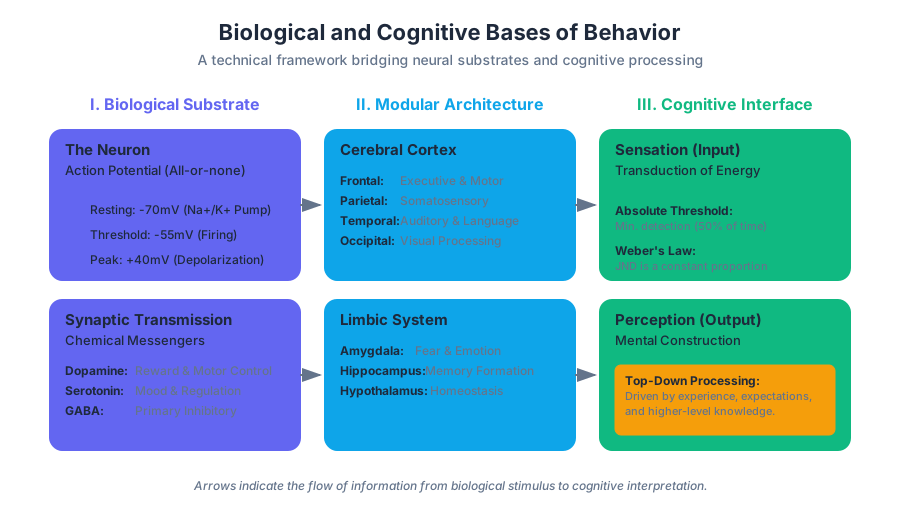
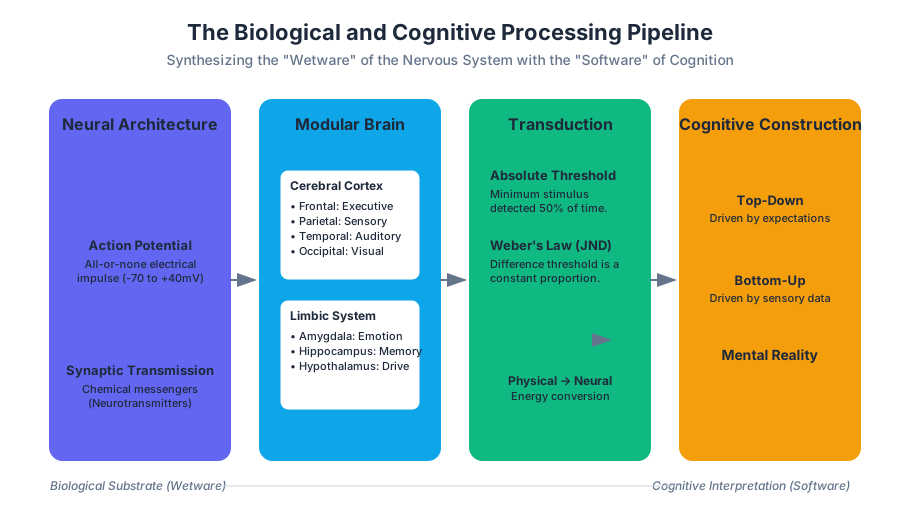
The human experience is an emergent property of biological substrates and computational processes. To understand behavior, we must bridge the gap between the "wetware" of the nervous system and the "software" of cognitive processing. This article synthesizes the foundational principles of biopsychology, neuroscience, sensation, perception, and cognitive psychology, providing a technical framework for how humans interact with and interpret the world.
Biopsychology and the Architecture of the Nervous System
Biopsychology (also known as behavioral neuroscience) is the application of biological principles to the study of physiological, genetic, and developmental mechanisms of behavior in humans and other animals. At its core, it posits that every thought, feeling, and action is the result of electrochemical events within the nervous system.
The Neuron: The Fundamental Unit of Processing
The nervous system is composed of approximately 86 billion neurons. Unlike standard cells, neurons are specialized for high-speed communication.
Definition: The Action Potential An action potential is a rapid, temporary change in the electrical potential across a neuron's membrane. It is an "all-or-none" event, meaning the signal does not lose strength as it travels down the axon.
The communication cycle follows a precise sequence:
- Resting Potential: The neuron maintains a charge of approximately -70mV relative to the outside, maintained by the sodium-potassium pump.
- Depolarization: Stimuli cause sodium ($Na^+$) channels to open, allowing positive ions to rush in. If the threshold of excitation (~ -55mV) is reached, the action potential fires.
- Repolarization: Potassium ($K^+$) channels open, and $K^+$ rushes out, restoring the negative charge.
- Hyperpolarization: The cell briefly becomes more negative than the resting state, creating a refractory period where it cannot fire again immediately.
Neurochemistry and Synaptic Transmission
Neurons do not physically touch; they communicate across the synapse via neurotransmitters. These chemical messengers bind to specific receptors on the postsynaptic neuron, acting like a key in a lock.
| Neurotransmitter | Primary Function | Associated Disorders |
|---|---|---|
| Dopamine | Reward, motivation, motor control | Parkinson's (low), Schizophrenia (high) |
| Serotonin | Mood regulation, sleep, appetite | Depression, Anxiety |
| GABA | Primary inhibitory transmitter; reduces excitability | Anxiety, Insomnia |
| Glutamate | Primary excitatory transmitter; learning/memory | Seizures, Neurodegeneration |
| Acetylcholine | Muscle activation, attention, memory | Alzheimer's |
Neuroanatomy: The Modular Brain
The brain is organized into specialized structures that handle different aspects of behavior. Modern neuroscience rejects strict phrenology but acknowledges functional localization—the idea that specific areas are optimized for specific tasks.
The Cerebral Cortex and Lobes
The "gray matter" of the brain is divided into four main lobes, each with distinct responsibilities:
- Frontal Lobe: Contains the motor cortex (movement), prefrontal cortex (executive function, decision making), and Broca's area (speech production).
- Parietal Lobe: Contains the somatosensory cortex, processing touch, temperature, and pain.
- Temporal Lobe: Processes auditory information and contains Wernicke's area (speech comprehension).
- Occipital Lobe: Dedicated almost entirely to visual processing.
The Limbic System: The Emotional Core
Deep within the brain lies the limbic system, which governs emotion and memory:
- Amygdala: Processes fear and emotional salience.
- Hippocampus: Essential for the formation of new long-term memories.
- Hypothalamus: Regulates homeostasis (hunger, thirst, temperature) and the endocrine system.
Sensation and Perception: The Interface of Reality
While often used interchangeably, sensation and perception are distinct stages of a single pipeline.
Sensation: The Physical Input
Sensation is the process by which our sensory receptors and nervous system receive and represent stimulus energies from our environment. This involves transduction—the conversion of physical energy (like light waves or sound vibrations) into neural impulses.
Key metrics in sensation:
- Absolute Threshold: The minimum stimulation needed to detect a particular stimulus 50% of the time.
- Difference Threshold (JND): The minimum difference between two stimuli required for detection 50% of the time (governed by Weber’s Law, which states the JND is a constant proportion of the original stimulus).
Perception: The Mental Construct
Perception is the process of organizing and interpreting sensory information, enabling us to recognize meaningful objects and events. This is heavily influenced by:
- Bottom-up processing: Starting with the raw sensory data and building up to a final perception.
- Top-down processing: Using prior knowledge, expectations, and context to interpret sensory data.
Signal Detection Theory (SDT)
SDT provides a mathematical framework for understanding how we make decisions under conditions of uncertainty. It separates "sensitivity" (how well you can see the signal) from "bias" (how likely you are to say "yes").
\text{The probability of a 'Hit' vs. a 'False Alarm' is defined by:} \\
d' = Z(\text{Hit Rate}) - Z(\text{False Alarm Rate}) \\
\text{where } d' \text{ is the sensitivity index and } Z \text{ is the z-score of the normal distribution.}
| Stimulus Present? | Response: "Yes" | Response: "No" |
|---|---|---|
| Yes | Hit | Miss (Type II Error) |
| No | False Alarm (Type I Error) | Correct Rejection |
Cognitive Psychology: The Information Processing Model
Cognitive psychology views the human mind as a complex information-processing system, similar to a computer. It focuses on how we acquire, process, store, and retrieve information.
Memory Systems
Memory is not a single "video recording" but a multi-stage construction process. The Atkinson-Shiffrin Model describes three distinct stages:
- Sensory Memory: Brief storage of sensory events (e.g., iconic/visual for <1s, echoic/auditory for 3-4s).
- Short-Term / Working Memory: A temporary storage system that processes incoming sensory memory. It has a capacity of roughly $7 \pm 2$ items (Miller's Law), though modern research suggests it may be closer to 4 "chunks."
- Long-Term Memory (LTM): The continuous storage of information. LTM is divided into Explicit (declarative) and Implicit (non-declarative) memory.
| Memory Type | Sub-type | Description | Example |
|---|---|---|---|
| Explicit | Episodic | Experienced events | Your 10th birthday party |
| Explicit | Semantic | Knowledge and facts | The capital of France |
| Implicit | Procedural | Skills and actions | How to ride a bicycle |
| Implicit | Emotional | Conditioned responses | Fear when seeing a spider |
Cognitive Pitfalls and Heuristics
Humans are not perfectly rational actors. We use heuristics (mental shortcuts) to make decisions quickly, which can lead to systematic errors or cognitive biases.
- Availability Heuristic: Judging the likelihood of an event based on how easily examples come to mind (e.g., fearing shark attacks more than car accidents).
- Confirmation Bias: The tendency to search for, interpret, and recall information in a way that confirms one's pre-existing beliefs.
- Anchoring: Relying too heavily on the first piece of information offered when making decisions.
Modern Challenges: The Replication Crisis and Diversity
The field of psychology is currently undergoing a significant "software update" regarding its methodology and scope.
The Replication Crisis
In the early 2010s, researchers discovered that many classic findings in social and cognitive psychology were difficult or impossible to replicate. This led to a push for:
- Open Science: Sharing raw data and code.
- Preregistration: Publicly documenting a study's hypothesis and analysis plan before data collection to prevent "p-hacking."
- Larger Sample Sizes: Increasing statistical power to ensure results are not due to chance.
Diversity and Representation
Historically, psychological research was conducted primarily on WEIRD populations (Western, Educated, Industrialized, Rich, and Democratic). Modern biopsychology and cognitive science are increasingly focused on:
- Cross-cultural validity: Testing if cognitive models hold true across different cultures.
- Neurodiversity: Recognizing that variations in brain function (e.g., Autism, ADHD) are natural variations rather than purely "disorders" to be "fixed."
Analyzing Cognitive Data
In a professional research environment, cognitive data (like reaction times or fMRI voxels) is processed using standardized pipelines.
To manage the massive amounts of data generated by these studies, researchers often use relational databases to track participants and trial results.
Summary of Theoretical Perspectives
The study of behavior is not a monolith; different schools of thought prioritize different levels of analysis.
| Perspective | Focus | Key Question |
|---|---|---|
| Biological | Genetics, Neurochemistry, Brain Structure | How do neurotransmitters influence depression? |
| Cognitive | Mental processes, Memory, Perception | How do we transform sensory input into meaning? |
| Evolutionary | Adaptation and Natural Selection | Why did humans evolve the capacity for language? |
| Behavioral | Observable stimulus-response patterns | How does reinforcement affect learning? |
Core Vocabulary for Mastery
- Neuroplasticity: The brain's ability to change and adapt as a result of experience or injury.
- Long-Term Potentiation (LTP): The strengthening of synaptic connections through frequent activation; the biological basis of learning.
- Transduction: The conversion of physical energy into neural signals.
- Gestalt Principles: Rules governing how we organize small parts into a meaningful whole (e.g., proximity, similarity, closure).
- Executive Function: High-level cognitive processes (planning, inhibition, working memory) managed by the prefrontal cortex.
- Selective Attention: The ability to focus on one stimulus while filtering out others (the "Cocktail Party Effect").
By integrating these biological and cognitive frameworks, we move closer to a unified understanding of the human mind—not as a mysterious "ghost in the machine," but as an incredibly sophisticated biological computer capable of self-reflection and complex interaction with its environment.
Source Materials
Study Psychology 2e on Lykke
This course page is free to open: signed out, you can read its first two sections, and signing in, on any plan, opens the rest. The free Lykke Chrome extension syncs your own Canvas courses, so ChatGPT, Claude and Muse can answer from your classes and deadlines. It only reads Canvas.
Add the free extensionSign in to open every section