From the free course Principles of Public Speaking on Lykke
The Value of Public Speaking
Key concepts: Personal Development · Professional Employability · Civic Engagement · Self-Confidence · Critical Thinking
Exploration of how public speaking serves as a foundational skill for personal growth, professional advancement, and civic participation.
The Value of Public Speaking
Public speaking is the systematic practice of oral communication delivered to a live audience with the intent to inform, persuade, or entertain. Far from being a mere "soft skill," public speaking represents the intersection of Rhetoric, Cognitive Psychology, and Logical Formalism. In the classical tradition, it was the cornerstone of the Trivium (Grammar, Logic, and Rhetoric), serving as the primary interface between an individual’s internal thoughts and the external social world.
In a modern technical and professional context, public speaking functions as a high-bandwidth protocol for information transfer. While written documentation provides persistence, oral presentation provides salience, nuance, and immediate feedback loops. This article explores the multidimensional value of public speaking through the lenses of personal development, professional utility, and civic necessity.
1. The Rhetorical Foundation: The Mechanics of Persuasion
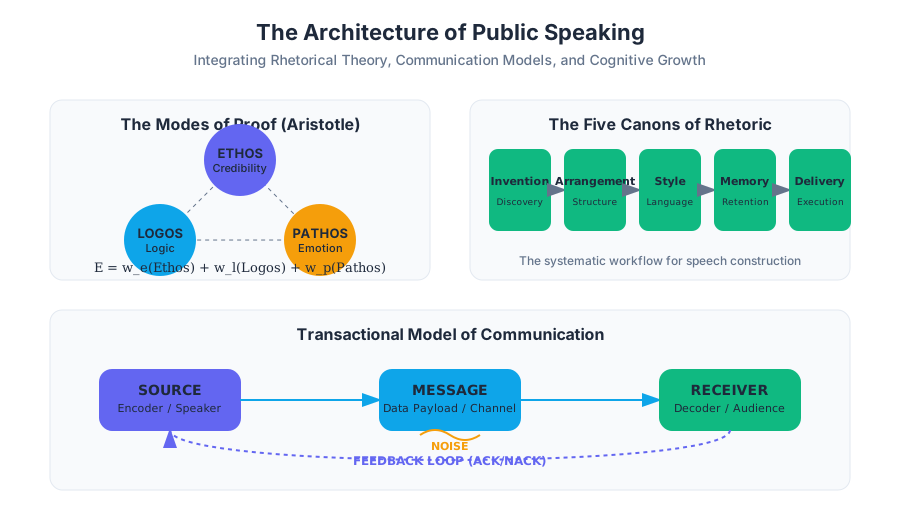
At its core, public speaking is governed by Rhetoric, defined by Aristotle as "the faculty of observing in any given case the available means of persuasion." To understand its value, one must first understand its structural components, traditionally categorized into the Five Canons of Rhetoric: Invention, Arrangement, Style, Memory, and Delivery.
1.1 Invention (Inventio) and the Modes of Proof
Invention is the process of developing arguments. It is not "invention" in the sense of creating something from nothing, but rather the discovery of the best possible "proofs" for a given audience. These proofs are categorized into three pillars:
- Ethos (Credibility): The perceived character and authority of the speaker.
- Logos (Logic): The internal consistency and evidentiary strength of the argument.
- Pathos (Emotion): The alignment of the message with the audience's emotional state or values.
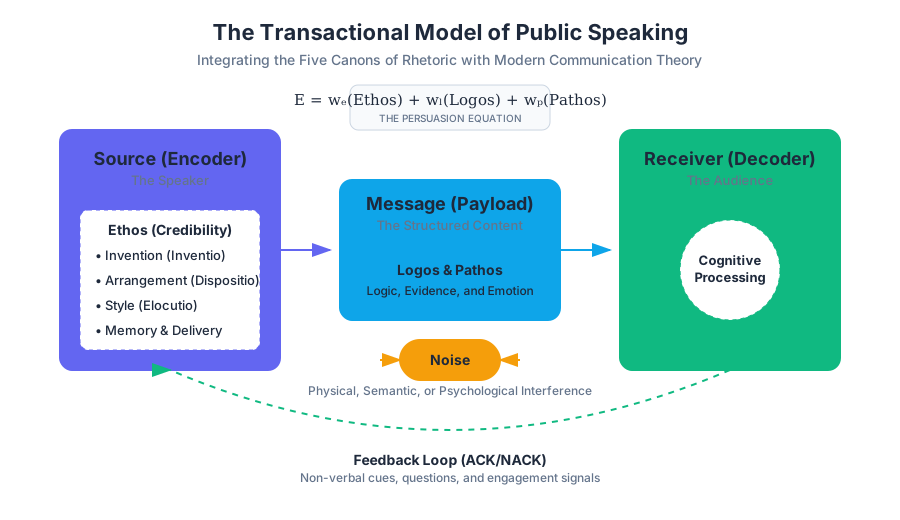
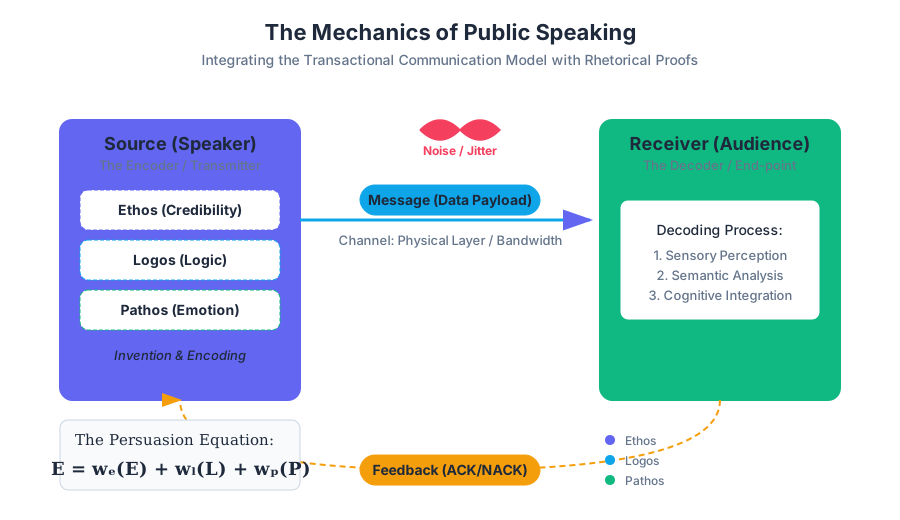
The Persuasion Equation: The effectiveness of a speech $E$ can be modeled as a function of the three proofs, where $w$ represents the weight assigned by the specific audience context: $$E = w_e(\text{Ethos}) + w_l(\text{Logos}) + w_p(\text{Pathos})$$
1.2 The Communication Model
Public speaking is best understood via the Transactional Model of Communication, which posits that sending and receiving happen simultaneously. Unlike a simple "pipe" model, the transactional model accounts for Noise (semantic, physical, or psychological) and Context.
| Component | Definition | Technical Analogy |
|---|---|---|
| Source | The speaker encoding the message. | Encoder / Transmitter |
| Channel | The medium (voice, visual aids, video). | Physical Layer / Bandwidth |
| Message | The structured content and intent. | Data Payload |
| Receiver | The audience decoding the message. | Decoder / End-point |
| Feedback | Non-verbal cues (nodding, frowning). | ACK/NACK Signals |
| Noise | Distractions or misunderstandings. | Signal Interference / Jitter |
2. Personal Development: Cognitive and Psychological Growth
The value of public speaking to the individual is often transformative. It serves as a "forcing function" for mental clarity and emotional regulation.
2.1 Managing Glossophobia and Self-Confidence
Glossophobia (speech anxiety) is a physiological response triggered by the sympathetic nervous system. Public speaking training utilizes Systematic Desensitization—a behavioral therapy technique where the speaker is gradually exposed to the stressor in a controlled environment.
The "Instruction, Imitation, and Practice" model is the primary pedagogical framework here:
- Instruction: Learning the theoretical constraints of speech.
- Imitation: Analyzing "Great Speeches" to reverse-engineer successful patterns.
- Practice: Low-stakes execution to build "muscle memory" in the prefrontal cortex.
2.2 Cognitive Load and Articulation
Public speaking requires the speaker to manage high Cognitive Load. One must simultaneously retrieve information from long-term memory, monitor audience feedback, and maintain physical posture. This "multitasking" strengthens the executive functions of the brain.
3. Professional Employability: The Communication Stack
In the modern labor market, technical proficiency is a baseline, but communication is the differentiator. Employers consistently rank "Oral Communication" as a top-tier requirement for leadership roles.
3.1 The "Employability Gap"
Many graduates possess high "Hard Skills" (coding, accounting, engineering) but suffer from a "Soft Skill" deficit. Public speaking bridges this gap by allowing the professional to:
- Translate Complexity: Explaining a $O(n \log n)$ algorithm to a non-technical stakeholder.
- Influence Strategy: Pitching a new product line to executives.
- Lead Teams: Articulating a vision that inspires collective action.
3.2 Comparison of Speech Types in Professional Settings
Different professional scenarios require different rhetorical "configurations."
| Speech Type | Primary Goal | Key Metric | Example |
|---|---|---|---|
| Informative | Knowledge Transfer | Retention Rate | Technical Demo / Onboarding |
| Persuasive | Behavioral Change | Conversion / Buy-in | Sales Pitch / Budget Request |
| Special Occasion | Community Building | Emotional Resonance | Award Acceptance / Keynote |
| Impromptu | Agility | Coherence | Q&A Session / Stand-up Meeting |
Mathematical Derivation: The Value of Clarity
In a professional setting, the "Cost of Miscommunication" ($C_m$) can be modeled as: $$C_m = (N \times T \times R) + D$$ Where:
- $N$ = Number of employees receiving the message.
- $T$ = Time spent clarifying the message.
- $R$ = Hourly rate of employees.
- $D$ = Opportunity cost of delays.
Effective public speaking minimizes $T$, directly impacting the bottom line.
4. Civic Engagement and the Public Sphere
Public speaking is the "engine" of democracy. Without the ability to articulate grievances, propose solutions, and debate policy, the democratic process stalls.
4.1 The Public Sphere
The philosopher Jürgen Habermas defined the Public Sphere as a virtual or physical space where individuals come together to discuss social problems. Public speaking is the primary tool used to navigate this sphere. It allows for:
- Advocacy: Representing the interests of the marginalized.
- Accountability: Challenging those in power through public discourse.
- Deliberation: The slow process of reaching consensus through reasoned argument.
4.2 Ethics in Communication
Because public speaking is powerful, it carries a heavy ethical burden. The "Ethical Speaker" must avoid:
- Demagoguery: Appealing to prejudices rather than reason.
- Plagiarism: Stealing the intellectual labor of others.
- Deception: Intentionally misrepresenting facts (violating Logos).
\text{Ethical Impact} = \frac{\text{Accuracy of Information} \times \text{Transparency of Intent}}{\text{Self-Interest Bias}}
5. Critical Thinking: The Logic of Persuasion
Public speaking is not just about how you say something, but what you are saying. The process of organizing a speech is essentially an exercise in Formal Logic.
5.1 Arrangement (Dispositio)
The arrangement of a speech determines its logical flow. A standard "Linear Logic" structure includes:
- Introduction: Attention-getter, Thesis, and Preview.
- Body: Categorical, Chronological, or Cause-Effect points.
- Conclusion: Summary and Memorable Closing.
5.2 Avoiding Logical Fallacies
A critical thinker uses public speaking to identify and avoid "bugs" in reasoning.
| Fallacy | Description | Public Speaking Context |
|---|---|---|
| Ad Hominem | Attacking the person, not the argument. | Debates and political speeches. |
| Straw Man | Misrepresenting an opponent's position. | Persuasive rebuttals. |
| False Dilemma | Presenting only two options when more exist. | Policy proposals. |
| Slippery Slope | Claiming one small step leads to disaster. | Fear-based rhetoric. |
6. Common Pitfalls in Public Speaking
Even experienced speakers fall into traps that degrade the value of their communication.
- The "Data Dump" (Logos Overload): Providing too much information without a narrative thread. This exceeds the audience's working memory capacity.
- The "Style over Substance" Trap: Using flashy visuals or charismatic delivery to mask a lack of logical depth.
- Ignoring the "Audience Analysis": Failing to adjust the "encoding" of the message to the specific "decoding" capabilities of the audience (e.g., using jargon with laypeople).
- The "Reading" Fallacy: Reading a script verbatim rather than using an extemporaneous delivery. This breaks the feedback loop of the Transactional Model.
Worked Example: Audience Analysis Adjustment
Suppose you are explaining "Cloud Computing."
- Audience A (CFOs): Focus on Ethos (cost savings, risk mitigation). Use high-level metaphors.
- Audience B (Engineers): Focus on Logos (latency, redundancy, API integration). Use technical specifications.
- Audience C (General Public): Focus on Pathos/Analogy (the "utility" like water or electricity). Use relatable stories.
7. Conclusion: The Compounding Returns of Oral Mastery
The value of public speaking is cumulative. Each successful presentation builds not only the speaker's confidence but also their "Rhetorical Capital"—the trust and authority they hold within their professional and civic circles. By mastering the canons of rhetoric and applying them with ethical rigor, individuals transform from passive observers of information into active architects of the future.
Whether it is a 30-second "elevator pitch" or a 60-minute keynote, the principles remain the same: Invention provides the substance, Arrangement provides the logic, and Delivery provides the connection.
- Ethos: The rhetorical appeal based on the character or credibility of the speaker.
- Logos: The rhetorical appeal based on logic, evidence, and reason.
- Pathos: The rhetorical appeal based on emotion and the audience's values.
- Glossophobia: The clinical term for the fear of public speaking.
- Transactional Model: A communication model where sending and receiving occur simultaneously.
- Invention (Inventio): The first canon of rhetoric; the process of discovering arguments.
- Gunning Fog Index: A formula for calculating the readability of a text.
- Public Sphere: A domain of social life where public opinion can be formed.
- Extemporaneous: A style of delivery that is prepared and practiced but not read or memorized.
- Which canon of rhetoric is primarily concerned with the logical organization of a speech?
- A) Style
- B) Invention
- C) Arrangement
- D) Delivery
- In the Transactional Model of Communication, what does "Noise" represent?
- A) Only loud physical sounds.
- B) Anything that interferes with the message being received as intended.
- C) The feedback given by the audience.
- D) The channel through which the message travels.
- Why is "Instruction, Imitation, and Practice" considered an effective model for learning public speaking?
- A) It bypasses the need for critical thinking.
- B) It focuses solely on memorization.
- C) It combines theoretical knowledge with behavioral conditioning.
- D) It is the only way to eliminate glossophobia entirely.
- An engineer explaining a technical bug to a CEO should prioritize which rhetorical proof?
- A) High-level Pathos
- B) Dense Logos with raw code
- C) Ethos and translated Logos (impact on business)
- D) Style and Memory
- What is the primary ethical danger of "Demagoguery"?
- A) It is boring for the audience.
- B) It prioritizes emotional manipulation over reasoned debate.
- C) It requires too much preparation.
- D) It uses too many logical fallacies.
Core Objectives:
- Understand the historical and theoretical roots of Rhetoric (Aristotle's Five Canons).
- Identify the three modes of proof (Ethos, Pathos, Logos) and how to balance them.
- Analyze the personal, professional, and civic benefits of oral communication.
- Recognize the Transactional Model of Communication and the role of "Noise" and "Feedback."
- Develop strategies for managing speech anxiety through the "Instruction, Imitation, Practice" framework.
Key Formulas to Remember:
- The Persuasion Weighting: $E = w_eE + w_lL + w_pP$
- The Cost of Miscommunication: $C_m = (N \times T \times R) + D$
Practical Application:
- When preparing your next presentation, use the YAML structure provided in Section 5 to ensure you have a "Hook," "Thesis," and "Call to Action."
- Run your transcript through a readability analyzer to ensure your "Fog Index" matches your audience's expertise level.
Source Materials
Study Principles of Public Speaking on Lykke
This course page is free to open: signed out, you can read its first two sections, and signing in, on any plan, opens the rest. The free Lykke Chrome extension syncs your own Canvas courses, so ChatGPT, Claude and Muse can answer from your classes and deadlines. It only reads Canvas.
Add the free extensionSign in to open every sectionAll sections of Principles of Public Speaking · Browse more course pages