From the free course Principles of Public Speaking on Lykke
The Communication Process and Models
Key concepts: Linear Model of Communication · Transactional Model of Communication · Encoding and Decoding · Noise (Physical, Physiological, Psychological, Cultural) · Worldview
A deep dive into the mechanics of communication, contrasting linear and transactional models and identifying the elements that influence message delivery.
The Communication Process and Models
Communication is often colloquially defined as the exchange of information. However, in the rigorous context of communication theory and rhetoric, it is understood as a complex, multi-layered process of meaning-making. It is the primary mechanism through which human beings construct social reality, coordinate action, and share internal states. To master public speaking, one must move beyond the "common sense" understanding of talking and instead view communication as a system susceptible to entropy, interference, and structural constraints.
The Linear Model of Communication: The Transmission Paradigm
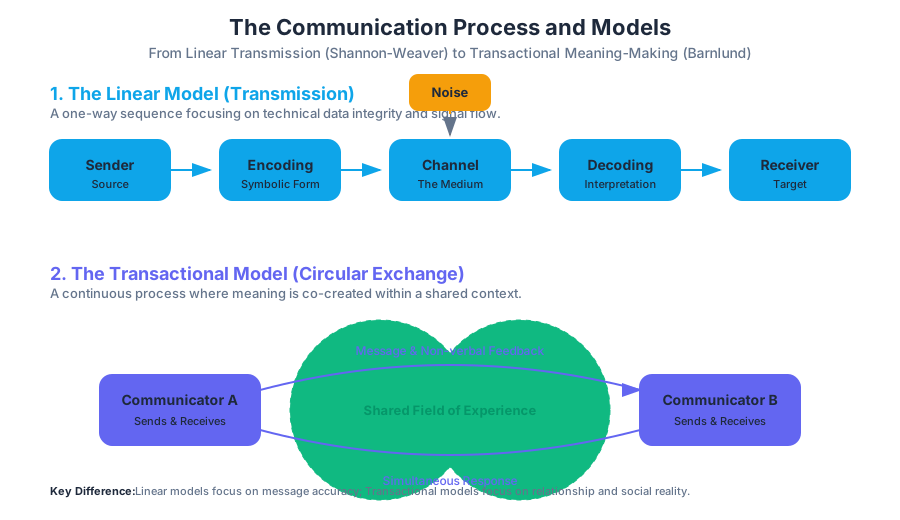
The Linear Model of Communication, often associated with the Shannon-Weaver Model (1949), views communication as a one-way process. Originally developed to improve technical communication (specifically telephone and radio), it treats the human voice much like a radio signal traveling from a transmitter to a receiver.
What it is
In this model, communication is a linear sequence:
- Sender: The source of the message.
- Encoding: The process of converting thoughts into a symbolic form (words, gestures).
- Message: The actual content being sent.
- Channel: The medium through which the message travels (airwaves, fiber optic cables, paper).
- Decoding: The process by which the receiver interprets the symbols.
- Receiver: The target of the message.
- Noise: Any interference that degrades the message.
Why it Matters
The Linear Model is the foundation of Information Theory. It introduced the concept of "noise" as a measurable variable and highlighted the importance of the "channel." In public speaking, this model helps us understand the basic mechanics of a lecture or a broadcast where immediate feedback is limited.
Common Pitfalls
The primary flaw of the Linear Model is its passivity. It assumes the receiver is a static vessel waiting to be filled with information. It ignores the fact that the receiver is actively interpreting the message based on their own context, and it fails to account for the "feedback loop" that characterizes most human interactions.
The Transactional Model of Communication: The Circular Exchange
The Transactional Model, pioneered by Dean Barnlund (1970), represents a paradigm shift. It posits that communication is not something people do to each other, but something they create with each other.
What it is
In the Transactional Model, the roles of "Sender" and "Receiver" are blurred. Participants are referred to as Communicators who send and receive messages simultaneously.
Definition: The Transactional Model is a continuous process where participants are simultaneously engaged in the sending and receiving of messages, influenced by their past experiences, current relationship, and the social context.
Key Differences: Linear vs. Transactional
| Feature | Linear Model | Transactional Model |
|---|---|---|
| Direction | One-way (Sender → Receiver) | Circular/Simultaneous |
| Role of Participants | Fixed (One speaks, one listens) | Fluid (Both are "Communicators") |
| Feedback | Minimal or delayed | Constant and immediate (non-verbal) |
| Context | Largely ignored | Central to meaning-making |
| Goal | Information transmission | Relationship and meaning construction |
How it Works: The Feedback Loop
In a public speaking setting, even if the audience isn't speaking, they are sending "feedback" via non-verbal cues (nodding, frowning, checking phones). The speaker "decodes" this feedback in real-time and "encodes" adjustments to their delivery. This creates a co-created experience.
Mathematical Derivation: Shannon Entropy and Information Gain
While the Linear Model focuses on signal, the Transactional Model can be viewed through the lens of reducing uncertainty between two agents. We can represent the "Information Content" ($I$) of a message ($x$) using the following logic:
I(x) = -\log_2 P(x)
Where $P(x)$ is the probability of the message occurring. In a Transactional Model, the "Shared Field of Experience" increases the probability of certain meanings, thereby reducing the "Surprisal" and increasing the efficiency of the communication.
Encoding and Decoding: The Cognitive Translation Layer
At the heart of every model are the twin processes of Encoding and Decoding. These are the "interfaces" between our internal mental states and the external world.
What they are
- Encoding: The mental process of selecting symbols (words, images, gestures) to represent ideas. It is an act of translation from the abstract to the concrete.
- Decoding: The process of interpreting those symbols to reconstruct the original idea.
The Complexity of Semantic Mapping
Encoding is never a 1:1 mapping. A speaker might encode the concept of "freedom" using a specific set of metaphors, but the listener's "decoder" might be tuned to a different set of historical or personal definitions.
Common Pitfalls: The "Illusion of Transparency"
Speakers often suffer from the Illusion of Transparency, the belief that their internal states (anxiety, intent, humor) are more apparent to the audience than they actually are. Because the speaker knows what they mean to encode, they assume the audience will perfectly decode the intent.
Noise: The Entropy of Communication
Noise is any stimulus that interferes with the sharing of meaning. In the context of public speaking, noise is not just a loud fan in the back of the room; it is any factor that increases the "error rate" of the transmission.
Taxonomy of Noise
| Type of Noise | Description | Example in Public Speaking | Mitigation Strategy |
|---|---|---|---|
| Physical | External environmental interference. | A siren outside, poor acoustics, flickering lights. | Use a microphone; close windows; move closer to the audience. |
| Physiological | Biological factors affecting the communicator. | Hunger, fatigue, hearing loss, or a headache. | Ensure physical comfort; use visual aids for the hearing impaired. |
| Psychological | Mental or emotional distractions. | Anxiety, preoccupation with personal problems, prejudice. | Use "hooks" to grab attention; address audience concerns directly. |
| Cultural | Differing worldviews or linguistic barriers. | Idioms that don't translate, differing views on eye contact. | Use inclusive language; define terms; research audience demographics. |
Concrete Example: The Cascade of Noise
Imagine a speaker presenting a technical proposal.
- Physical Noise: The projector is slightly out of focus.
- Physiological Noise: The speaker has a dry throat and is coughing.
- Psychological Noise: An audience member is worried about a deadline and isn't fully listening.
- Cultural Noise: The speaker uses high-context jargon that the junior engineers in the room don't understand.
The cumulative effect is a significant loss of Signal-to-Noise Ratio (SNR), leading to a failed communication event.
Worldview: The Internal Operating System
The most profound influence on the communication process is the Worldview. This is the invisible framework through which we filter every message we send and receive.
What it is
Worldview is composed of several philosophical pillars that dictate how a communicator interacts with reality.
| Component | Question it Answers | Impact on Communication |
|---|---|---|
| Epistemology | How do we know what is true? | Determines what counts as "evidence" (e.g., data vs. anecdote). |
| Ontology | What is the nature of reality? | Shapes how we view our relationship with the audience (e.g., hierarchy vs. equality). |
| Axiology | What do we value? | Influences the "Ethos" and "Pathos" of the speech. |
| Cosmology | What is our place in the universe? | Affects the scale and urgency of the message. |
| Praxeology | What is the right way to act? | Dictates the "Style" and "Delivery" of the communication. |
Why it Matters: The "Field of Experience"
In the Transactional Model, communication is most effective when there is an overlap in the participants' Fields of Experience. This overlap is where shared meaning is possible. If a speaker's worldview is entirely decoupled from the audience's worldview (e.g., a scientist speaking to a group that rejects empirical evidence), the "Noise" becomes insurmountable.
Synthesis: Communication as Rhetoric
Understanding these models is the first step in mastering the "Invention" stage of rhetoric. By recognizing that communication is transactional, a speaker can move away from a "performance" mindset and toward a "connection" mindset.
- Invention (Logos, Pathos, Ethos): Use the model to choose the right evidence (Logos) for the audience's worldview, the right emotional resonance (Pathos) to cut through psychological noise, and the right character (Ethos) to establish a shared field of experience.
- Arrangement: Organize the message to minimize the cognitive load on the receiver's "decoder."
- Style: Choose language that bridges the gap between the speaker's and the audience's worldviews.
Key Insight: Effective communication is not the absence of noise, but the successful management of it. It is the art of aligning worldviews long enough to create a shared moment of understanding.
Source Materials
Study Principles of Public Speaking on Lykke
This course page is free to open: signed out, you can read its first two sections, and signing in, on any plan, opens the rest. The free Lykke Chrome extension syncs your own Canvas courses, so ChatGPT, Claude and Muse can answer from your classes and deadlines. It only reads Canvas.
Add the free extensionSign in to open every sectionAll sections of Principles of Public Speaking · Browse more course pages