Principles of Public Speaking
Institution: MIT
46 study materials · 12 sections
This course provides a comprehensive introduction to the art and science of public speaking, blending theoretical communication models with practical performance skills. Students explore the evolution of rhetoric, the mechanics of the communication process, and the ethical responsibilities of a speaker. Through a focus on informative and persuasive speaking, the curriculum emphasizes audience analysis, logical organization, and the development of core competencies essential for professional and civic success.
Course Sections
Course Foundations and Open Educational Resources
Key concepts: Open Educational Resources (OER) · Textbook Affordability · Lumen Learning · Digital Courseware vs. PDF · Creative Commons Licensing
An introduction to the course structure, the use of Open Educational Resources (OER) to ensure textbook affordability, and the administrative frameworks provided by Lumen Learning.
Course Foundations and Open Educational Resources
The modern educational landscape is undergoing a systemic shift from proprietary, high-cost instructional materials toward Open Educational Resources (OER). This transition is not merely a financial adjustment but a pedagogical evolution that prioritizes accessibility, equity, and the continuous improvement of learning content. In the context of "Principles of Public Speaking," the adoption of OER—facilitated by platforms like Lumen Learning and initiatives like the Kaleidoscope Open Course Initiative—represents a commitment to removing barriers to student success.
The Genesis of Open Educational Resources (OER)
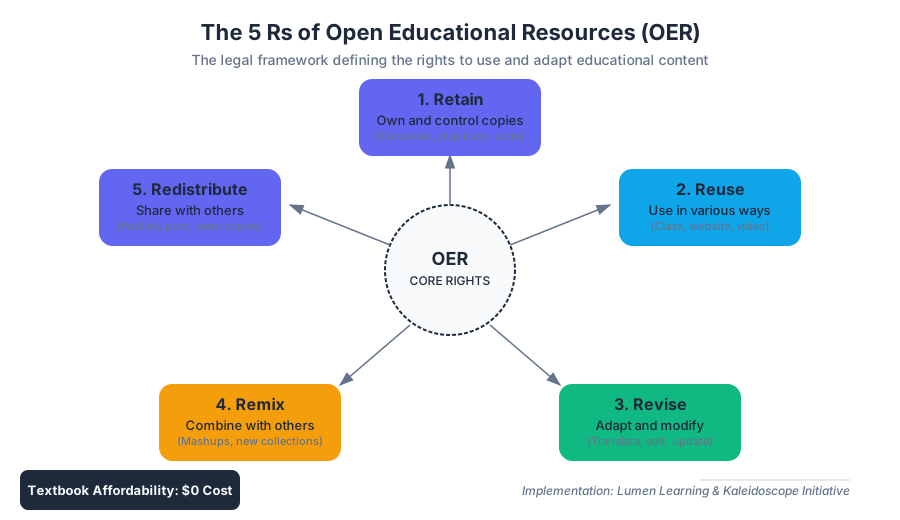
At its core, Open Educational Resources (OER) are teaching, learning, and research materials that reside in the public domain or have been released under an intellectual property license that permits their free use and re-purposing by others. The movement is defined by the "Five Rs" framework, which establishes the legal and practical rights of users:
- Retain: The right to make, own, and control copies of the content.
- Reuse: The right to use the content in a wide range of ways (e.g., in a class, on a website, in a video).
- Revise: The right to adapt, adjust, modify, or alter the content itself (e.g., translating the text into another language).
- Remix: The right to combine the original or revised content with other material to create something new.
- Redistribute: The right to share copies of the original content, your revisions, or your remixes with others.
Textbook Affordability and the Economic Imperative
The primary driver for OER adoption is Textbook Affordability. For decades, the rising cost of traditional textbooks has outpaced inflation, often forcing students to choose between purchasing required materials and meeting basic needs like food or housing.
"Transitioning to OER ensures that all students have access to materials from day one without high costs, effectively leveling the playing field for students from diverse socioeconomic backgrounds." — Christie Fierro, Tacoma Community College
| Feature | Traditional Publishing | Open Educational Resources (OER) |
|---|---|---|
| Cost to Student | High ($100 - $300+ per book) | Zero to Low-cost ($0 - $25) |
| Access Timeline | Upon purchase (often delayed) | Day One of the course |
| Instructor Control | Fixed content; requires new editions | Fully customizable; real-time updates |
| Longevity | Access often expires (digital rentals) | Perpetual access and ownership |
| Format | Hardcover, eBook, or Rental | Digital, PDF, Print-on-demand |
The Lumen Learning Ecosystem
Lumen Learning acts as a bridge between raw OER content and a polished, enterprise-grade learning experience. While OER provides the "raw materials," Lumen provides the Digital Courseware—the infrastructure required to deliver that content effectively within a modern Learning Management System (LMS) like Canvas, Blackboard, or Moodle.
Technical Implementation of OER Metadata
To maintain the integrity of OER, content must be meticulously tracked and attributed. Below is a low-level implementation of how an OER content management system might structure metadata for a specific module in the "Principles of Public Speaking" course.
import json
from datetime import datetime

class OERModule:
    """
    Represents a discrete unit of Open Educational Resource content.
    Ensures compliance with Creative Commons Attribution (CC BY) requirements.
    """
    def __init__(self, title, author, license_type, version="1.0"):
        self.metadata = {
            "title": title,
            "author": author,
            "license": license_type,
            "version": version,
            "timestamp": datetime.utcnow().isoformat(),
            "nodes": []
        }

    def add_content_node(self, node_id, content_type, source_url, attribution_text):
        node = {
            "id": node_id,
            "type": content_type,
            "url": source_url,
            "attribution": attribution_text,
            "checksum": hash(source_url + attribution_text)
        }
        self.metadata["nodes"].append(node)

    def export_manifest(self):
        return json.dumps(self.metadata, indent=4)

# Example: Initializing the 'Introduction to Public Speaking' module
intro_module = OERModule(
    title="Introduction to Public Speaking",
    author="Lisa Schreiber, Ph.D. and Morgan Hartranft",
    license_type="CC BY 4.0"
)

intro_module.add_content_node(
    node_id="CH1_MOD1",
    content_type="Text/HTML",
    source_url="https://lumenlearning.com/publicspeaking/chapter1",
    attribution_text="Original content by Millersville University"
)

print(intro_module.export_manifest())
Creative Commons Licensing
The legal backbone of OER is Creative Commons (CC) Licensing. These licenses allow creators to retain copyright while granting the public permission to use their work under specific conditions. In the "Principles of Public Speaking" course, most materials are licensed under CC BY (Attribution), which is the most permissive license available.
License Variation Matrix
Understanding the nuances of CC licenses is critical for instructors who wish to "remix" or "revise" materials.
| License Type | Symbol | Requirements | Commercial Use? | Derivative Works? |
|---|---|---|---|---|
| CC BY | Attribution | Credit the creator | Yes | Yes |
| CC BY-SA | ShareAlike | Credit creator; same license for new work | Yes | Yes |
| CC BY-NC | NonCommercial | Credit creator; no profit | No | Yes |
| CC BY-ND | NoDerivs | Credit creator; no changes allowed | Yes | No |
| CC BY-NC-SA | NC-ShareAlike | Credit creator; no profit; same license | No | Yes |
Digital Courseware vs. PDF: The Modality Gap
Lumen Learning provides the "Principles of Public Speaking" content in two primary formats: Digital Courseware and PDF. While the PDF offers a static, offline alternative, it is technically and pedagogically inferior to the digital version.
The Interactivity and Accessibility Advantage
Digital courseware utilizes Interactive Learning Content that provides immediate feedback to students. For example, a student reading about "Communication Models" can engage with a simulation of the Transactional Model, identifying noise and feedback loops in real-time.
Key Insight: The PDF version lacks the telemetry required for Continuous Improvement. Digital courseware allows Lumen to analyze learning data—identifying which paragraphs or quiz questions are confusing to students—and update the content globally for all users.
| Feature | Digital Courseware | PDF Alternative |
|---|---|---|
| Accessibility | Screen-reader optimized, alt-text, ARIA labels | Limited accessibility; static layout |
| Multimedia | Embedded video, audio, and simulations | Static images and text only |
| Assessment | Self-check quizzes with instant feedback | No interactive assessment |
| Analytics | Tracks student engagement and mastery | No data collection |
| Updates | Real-time content patches | Requires manual re-download |
Logic Comparison: Static vs. Dynamic Learning
The following pseudocode illustrates the difference in logic between a static PDF "reading check" and a dynamic digital assessment.
// STATIC PDF LOGIC (Non-interactive)
FUNCTION DisplayReadingCheck():
    PRINT "Question: What are the 3 benefits of public speaking?"
    PRINT "A) Personal, Professional, Public"
    PRINT "B) Wealth, Fame, Power"
    PRINT "(Answer found on page 42)"
END FUNCTION

// DIGITAL COURSEWARE LOGIC (Interactive)
FUNCTION ExecuteInteractiveAssessment(student_id):
    DISPLAY "Question: Select the core competencies of public speaking."
    INPUT student_response

    IF student_response == CORRECT_ANSWER:
        UPDATE student_mastery_score(student_id, +10)
        DISPLAY "Correct! You've mastered this concept."
    ELSE:
        LOG "Common Misconception Detected"
        DISPLAY "Not quite. Review the 'Personal Benefits' section here: [Link]"
        TRIGGER "Remediation_Path"
    END IF
END FUNCTION
Pedagogical Foundations in Public Speaking
The OER materials for this course were developed in conjunction with experts like Christie Fierro (Tacoma Community College) and Brent Adrian (Central Community College). Their syllabi emphasize a move away from rote memorization toward Extemporaneous Speaking and Critical Thinking.
Core Competencies and Communication Models
The course foundations rest on eleven core competencies, ranging from topic selection to the use of visual aids. These are framed within two primary models of communication:
- Linear Model: A one-way process where a sender transmits a message to a receiver (e.g., a radio broadcast).
- Transactional Model: A circular process where participants are simultaneously senders and receivers, accounting for feedback and context.
Real-World Usage: Course Configuration
For institutions adopting these resources, the deployment process involves configuring the course manifest to point to the correct OER repositories. This is often handled via a YAML configuration file within the LMS integration.
# Course Manifest for SPCH 1110: Public Speaking
course_metadata:
  title: "Principles of Public Speaking"
  provider: "Lumen Learning"
  oer_initiative: "Kaleidoscope"
  licensing: "CC-BY-4.0"

modules:
  - id: 1
    title: "Introduction to Public Speaking"
    resources:
      - type: "reading"
        source: "lumen://public-speaking/intro"
      - type: "video"
        source: "youtube://v=dQw4w9WgXcQ"
        attribution: "Public Domain"
  - id: 2
    title: "Audience Analysis"
    resources:
      - type: "interactive_lab"
        source: "lumen://labs/audience-demographics"

support_channels:
  technical: "https://support.lumenlearning.com"
  faculty_guide: "https://lumenlearning.com/guides/public-speaking"
Common Pitfalls and Misconceptions
Despite the benefits, several misconceptions persist regarding OER and Lumen Learning:
- Misconception: "OER is lower quality because it's free."
- Correction: OER materials undergo rigorous peer review. Because they are "open," they are subject to more public scrutiny and faster correction cycles than traditional textbooks.
- Misconception: "The PDF is just as good as the online course."
- Correction: As established, the PDF is a "lossy" version of the course. It strips away the interactive elements and accessibility features that define the modern learning experience.
- Misconception: "Instructors lose control of their curriculum."
- Correction: OER actually increases instructor agency. Unlike a proprietary textbook where the instructor cannot change a single word, OER allows for the deletion, addition, or reordering of any content to fit specific local needs.
Continuous Improvement through Data
Lumen Learning utilizes a "Continuous Improvement" cycle. By aggregating anonymized data from thousands of students, the platform identifies "bottleneck" concepts—areas where students consistently struggle.
Data-Driven Refinement Table
| Metric | Indicator | Action Taken |
|---|---|---|
| Low Quiz Scores | Content is unclear or misleading | Instructional designers rewrite the section |
| High "Time on Page" | Content is too dense or poorly formatted | Break text into chunks or add visual aids |
| Low Video Engagement | Video is too long or irrelevant | Replace with shorter, targeted clips |
| Accessibility Errors | Screen readers failing on specific nodes | Update HTML/ARIA tags in the master branch |
- Open Educational Resources (OER): Teaching/learning materials that are free to use, adapt, and share.
- CC BY (Attribution): A license allowing any use as long as the original creator is credited.
- Lumen Learning: A platform that enhances OER with digital tools and LMS integration.
- Five Rs: Retain, Reuse, Revise, Remix, Redistribute.
- Transactional Model: A communication model where all parties act as sender and receiver simultaneously.
- Kaleidoscope Open Course Initiative: An early collaborative effort to create high-quality OER for high-enrollment courses.
- Textbook Affordability: The movement to reduce the financial burden of educational materials on students.
- Extemporaneous Speaking: A style of delivery that is prepared and practiced but not read or memorized.
- Which of the "Five Rs" allows an instructor to translate an OER textbook into a different language?
- (Answer: Revise)
- Why is the Transactional Model of communication preferred over the Linear Model in public speaking pedagogy?
- (Answer: It accounts for real-time feedback and the simultaneous nature of communication.)
- What is the primary technical disadvantage of using the PDF version of the Lumen courseware?
- (Answer: Loss of interactivity, accessibility features, and real-time data for continuous improvement.)
- True or False: A CC BY-NC license allows a bookstore to sell the material for a profit.
- (Answer: False. NC stands for Non-Commercial.)
- How does Lumen Learning maintain academic integrity with its supplemental resources?
- (Answer: By providing instructor-only access to assessments and faculty guides.)
Course Foundations and OER Study Guide
- Understand the Economics: Be able to explain how OER impacts student retention and success by removing "Day One" financial barriers.
- Master the Licenses: Know the difference between CC BY, CC BY-SA, and CC BY-NC. Be prepared to identify which license allows for "Remixing."
- Digital vs. Static: Articulate at least three reasons why the digital courseware is superior to the PDF version (Accessibility, Interactivity, Analytics).
- The Role of Lumen: Understand that Lumen Learning provides the delivery system and support for the OER content, not just the content itself.
- Communication Basics: Review the Linear vs. Transactional models. Identify the "Noise" and "Context" elements in the Transactional model.
- Core Competencies: Familiarize yourself with the 11 competencies of public speaking as outlined in the introductory modules.
The Value of Public Speaking
Key concepts: Personal Development · Professional Employability · Civic Engagement · Self-Confidence · Critical Thinking
Exploration of how public speaking serves as a foundational skill for personal growth, professional advancement, and civic participation.
The Value of Public Speaking
Public speaking is the systematic practice of oral communication delivered to a live audience with the intent to inform, persuade, or entertain. Far from being a mere "soft skill," public speaking represents the intersection of Rhetoric, Cognitive Psychology, and Logical Formalism. In the classical tradition, it was the cornerstone of the Trivium (Grammar, Logic, and Rhetoric), serving as the primary interface between an individual’s internal thoughts and the external social world.
In a modern technical and professional context, public speaking functions as a high-bandwidth protocol for information transfer. While written documentation provides persistence, oral presentation provides salience, nuance, and immediate feedback loops. This article explores the multidimensional value of public speaking through the lenses of personal development, professional utility, and civic necessity.
1. The Rhetorical Foundation: The Mechanics of Persuasion
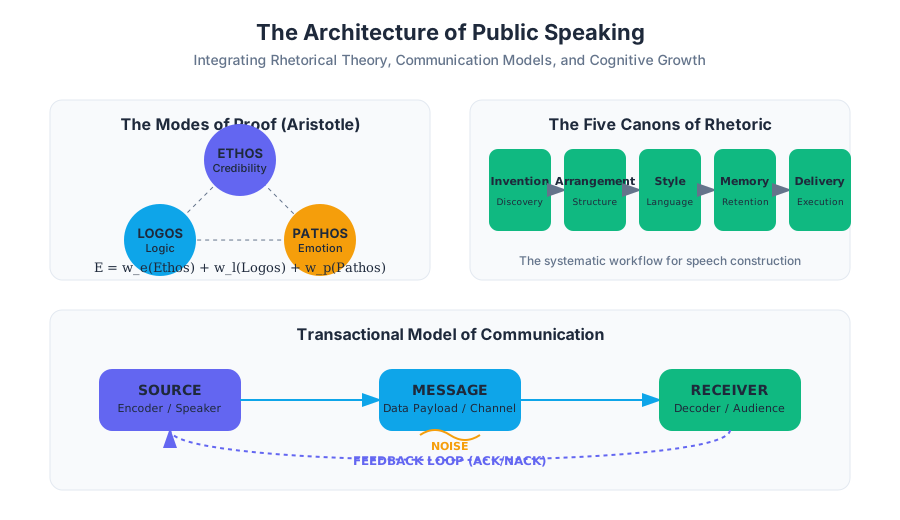
At its core, public speaking is governed by Rhetoric, defined by Aristotle as "the faculty of observing in any given case the available means of persuasion." To understand its value, one must first understand its structural components, traditionally categorized into the Five Canons of Rhetoric: Invention, Arrangement, Style, Memory, and Delivery.
1.1 Invention (Inventio) and the Modes of Proof
Invention is the process of developing arguments. It is not "invention" in the sense of creating something from nothing, but rather the discovery of the best possible "proofs" for a given audience. These proofs are categorized into three pillars:
- Ethos (Credibility): The perceived character and authority of the speaker.
- Logos (Logic): The internal consistency and evidentiary strength of the argument.
- Pathos (Emotion): The alignment of the message with the audience's emotional state or values.
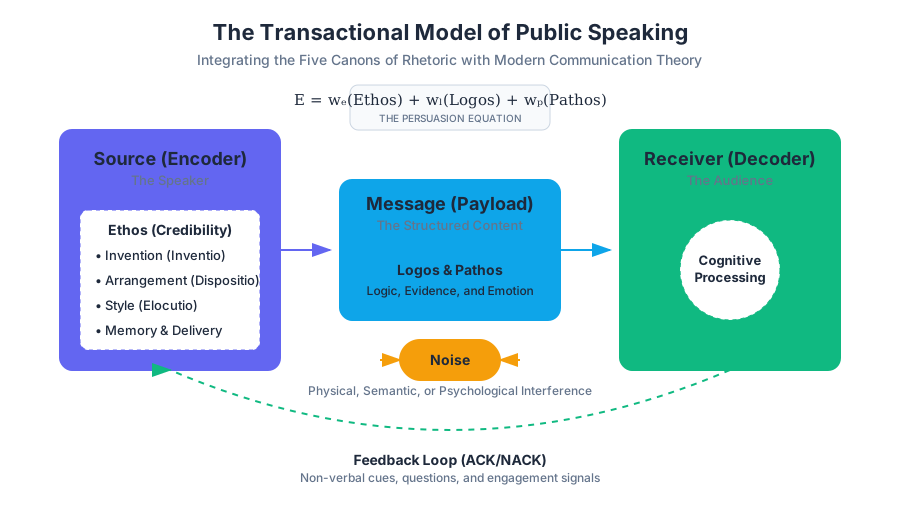
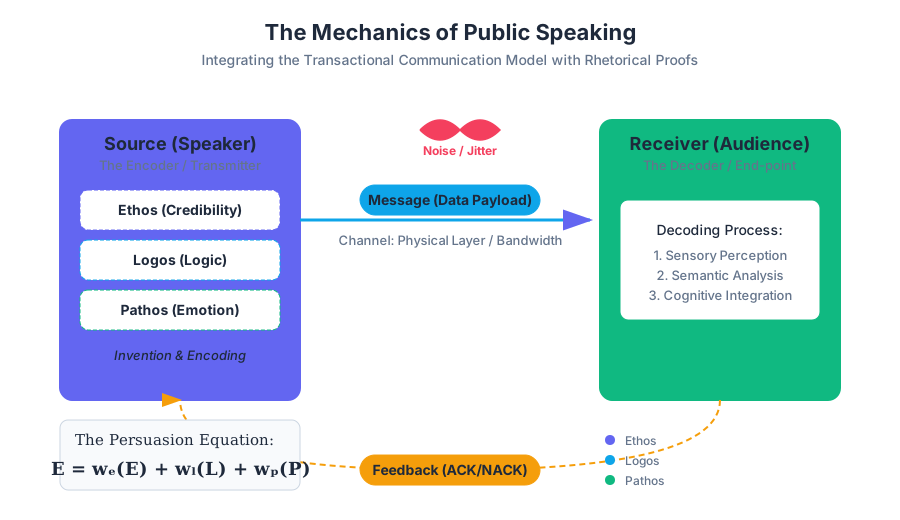
The Persuasion Equation: The effectiveness of a speech $E$ can be modeled as a function of the three proofs, where $w$ represents the weight assigned by the specific audience context: $$E = w_e(\text{Ethos}) + w_l(\text{Logos}) + w_p(\text{Pathos})$$
1.2 The Communication Model
Public speaking is best understood via the Transactional Model of Communication, which posits that sending and receiving happen simultaneously. Unlike a simple "pipe" model, the transactional model accounts for Noise (semantic, physical, or psychological) and Context.
| Component | Definition | Technical Analogy |
|---|---|---|
| Source | The speaker encoding the message. | Encoder / Transmitter |
| Channel | The medium (voice, visual aids, video). | Physical Layer / Bandwidth |
| Message | The structured content and intent. | Data Payload |
| Receiver | The audience decoding the message. | Decoder / End-point |
| Feedback | Non-verbal cues (nodding, frowning). | ACK/NACK Signals |
| Noise | Distractions or misunderstandings. | Signal Interference / Jitter |
2. Personal Development: Cognitive and Psychological Growth
The value of public speaking to the individual is often transformative. It serves as a "forcing function" for mental clarity and emotional regulation.
2.1 Managing Glossophobia and Self-Confidence
Glossophobia (speech anxiety) is a physiological response triggered by the sympathetic nervous system. Public speaking training utilizes Systematic Desensitization—a behavioral therapy technique where the speaker is gradually exposed to the stressor in a controlled environment.
The "Instruction, Imitation, and Practice" model is the primary pedagogical framework here:
- Instruction: Learning the theoretical constraints of speech.
- Imitation: Analyzing "Great Speeches" to reverse-engineer successful patterns.
- Practice: Low-stakes execution to build "muscle memory" in the prefrontal cortex.
2.2 Cognitive Load and Articulation
Public speaking requires the speaker to manage high Cognitive Load. One must simultaneously retrieve information from long-term memory, monitor audience feedback, and maintain physical posture. This "multitasking" strengthens the executive functions of the brain.
Implementation: Analyzing Speech Density
To understand the "Style" canon, we can programmatically analyze the complexity and "punchiness" of a speech using Python. The following script calculates the Gunning Fog Index (readability) and lexical diversity of a speech transcript.
import re

def analyze_speech_metrics(text):
    """
    Calculates readability and lexical density of a speech.
    High lexical density often correlates with 'Logos' heavy content,
    while lower density with high cadence may indicate 'Pathos' focus.
    """
    words = re.findall(r'\w+', text.lower())
    sentences = re.split(r'[.!?]+', text)
    sentences = [s for s in sentences if len(s) > 0]

    word_count = len(words)
    sentence_count = len(sentences)
    avg_sentence_length = word_count / sentence_count

    # Calculate complex words (3+ syllables - simplified proxy)
    complex_words = [w for w in words if len(w) > 7]
    percent_complex = (len(complex_words) / word_count) * 100

    # Gunning Fog Index
    fog_index = 0.4 * (avg_sentence_length + percent_complex)

    # Lexical Diversity (Type-Token Ratio)
    unique_words = set(words)
    lexical_diversity = len(unique_words) / word_count

    return {
        "word_count": word_count,
        "fog_index": round(fog_index, 2),
        "lexical_diversity": round(lexical_diversity, 3)
    }

# Example: A snippet from a persuasive speech
speech_sample = """
We choose to go to the moon in this decade and do the other things,
not because they are easy, but because they are hard.
Because that goal will serve to organize and measure the best of our energies and skills.
"""

metrics = analyze_speech_metrics(speech_sample)
print(f"Speech Metrics: {metrics}")
3. Professional Employability: The Communication Stack
In the modern labor market, technical proficiency is a baseline, but communication is the differentiator. Employers consistently rank "Oral Communication" as a top-tier requirement for leadership roles.
3.1 The "Employability Gap"
Many graduates possess high "Hard Skills" (coding, accounting, engineering) but suffer from a "Soft Skill" deficit. Public speaking bridges this gap by allowing the professional to:
- Translate Complexity: Explaining a $O(n \log n)$ algorithm to a non-technical stakeholder.
- Influence Strategy: Pitching a new product line to executives.
- Lead Teams: Articulating a vision that inspires collective action.
3.2 Comparison of Speech Types in Professional Settings
Different professional scenarios require different rhetorical "configurations."
| Speech Type | Primary Goal | Key Metric | Example |
|---|---|---|---|
| Informative | Knowledge Transfer | Retention Rate | Technical Demo / Onboarding |
| Persuasive | Behavioral Change | Conversion / Buy-in | Sales Pitch / Budget Request |
| Special Occasion | Community Building | Emotional Resonance | Award Acceptance / Keynote |
| Impromptu | Agility | Coherence | Q&A Session / Stand-up Meeting |
Mathematical Derivation: The Value of Clarity
In a professional setting, the "Cost of Miscommunication" ($C_m$) can be modeled as: $$C_m = (N \times T \times R) + D$$ Where:
- $N$ = Number of employees receiving the message.
- $T$ = Time spent clarifying the message.
- $R$ = Hourly rate of employees.
- $D$ = Opportunity cost of delays.
Effective public speaking minimizes $T$, directly impacting the bottom line.
4. Civic Engagement and the Public Sphere
Public speaking is the "engine" of democracy. Without the ability to articulate grievances, propose solutions, and debate policy, the democratic process stalls.
4.1 The Public Sphere
The philosopher Jürgen Habermas defined the Public Sphere as a virtual or physical space where individuals come together to discuss social problems. Public speaking is the primary tool used to navigate this sphere. It allows for:
- Advocacy: Representing the interests of the marginalized.
- Accountability: Challenging those in power through public discourse.
- Deliberation: The slow process of reaching consensus through reasoned argument.
4.2 Ethics in Communication
Because public speaking is powerful, it carries a heavy ethical burden. The "Ethical Speaker" must avoid:
- Demagoguery: Appealing to prejudices rather than reason.
- Plagiarism: Stealing the intellectual labor of others.
- Deception: Intentionally misrepresenting facts (violating Logos).
\text{Ethical Impact} = \frac{\text{Accuracy of Information} \times \text{Transparency of Intent}}{\text{Self-Interest Bias}}
5. Critical Thinking: The Logic of Persuasion
Public speaking is not just about how you say something, but what you are saying. The process of organizing a speech is essentially an exercise in Formal Logic.
5.1 Arrangement (Dispositio)
The arrangement of a speech determines its logical flow. A standard "Linear Logic" structure includes:
- Introduction: Attention-getter, Thesis, and Preview.
- Body: Categorical, Chronological, or Cause-Effect points.
- Conclusion: Summary and Memorable Closing.
5.2 Avoiding Logical Fallacies
A critical thinker uses public speaking to identify and avoid "bugs" in reasoning.
| Fallacy | Description | Public Speaking Context |
|---|---|---|
| Ad Hominem | Attacking the person, not the argument. | Debates and political speeches. |
| Straw Man | Misrepresenting an opponent's position. | Persuasive rebuttals. |
| False Dilemma | Presenting only two options when more exist. | Policy proposals. |
| Slippery Slope | Claiming one small step leads to disaster. | Fear-based rhetoric. |
Real-World Usage: Speech Configuration (YAML)
In modern automated teleprompter systems or speech-to-text pipelines, we might define the structure of a speech using a configuration file to ensure all logical components are present.
speech_metadata:
  title: "The Future of Decentralized Systems"
  speaker_id: "S-7742"
  duration_target: 1800 # seconds
  rhetorical_goal: "Persuasive"

structure:
  introduction:
    hook: "The story of the 2008 financial crash."
    thesis: "Decentralization is the only path to systemic resilience."
    preview: ["History of centralized failure", "The logic of nodes", "The path forward"]
  body_paragraphs:
    - point: "Centralization creates single points of failure."
      evidence_type: "Statistical Analysis"
      proof_mode: "Logos"
    - point: "The human cost of systemic collapse."
      evidence_type: "Case Study"
      proof_mode: "Pathos"
  conclusion:
    summary: "Recap of resilience metrics."
    call_to_action: "Join the testnet today."
6. Common Pitfalls in Public Speaking
Even experienced speakers fall into traps that degrade the value of their communication.
- The "Data Dump" (Logos Overload): Providing too much information without a narrative thread. This exceeds the audience's working memory capacity.
- The "Style over Substance" Trap: Using flashy visuals or charismatic delivery to mask a lack of logical depth.
- Ignoring the "Audience Analysis": Failing to adjust the "encoding" of the message to the specific "decoding" capabilities of the audience (e.g., using jargon with laypeople).
- The "Reading" Fallacy: Reading a script verbatim rather than using an extemporaneous delivery. This breaks the feedback loop of the Transactional Model.
Worked Example: Audience Analysis Adjustment
Suppose you are explaining "Cloud Computing."
- Audience A (CFOs): Focus on Ethos (cost savings, risk mitigation). Use high-level metaphors.
- Audience B (Engineers): Focus on Logos (latency, redundancy, API integration). Use technical specifications.
- Audience C (General Public): Focus on Pathos/Analogy (the "utility" like water or electricity). Use relatable stories.
7. Conclusion: The Compounding Returns of Oral Mastery
The value of public speaking is cumulative. Each successful presentation builds not only the speaker's confidence but also their "Rhetorical Capital"—the trust and authority they hold within their professional and civic circles. By mastering the canons of rhetoric and applying them with ethical rigor, individuals transform from passive observers of information into active architects of the future.
Whether it is a 30-second "elevator pitch" or a 60-minute keynote, the principles remain the same: Invention provides the substance, Arrangement provides the logic, and Delivery provides the connection.
- Ethos: The rhetorical appeal based on the character or credibility of the speaker.
- Logos: The rhetorical appeal based on logic, evidence, and reason.
- Pathos: The rhetorical appeal based on emotion and the audience's values.
- Glossophobia: The clinical term for the fear of public speaking.
- Transactional Model: A communication model where sending and receiving occur simultaneously.
- Invention (Inventio): The first canon of rhetoric; the process of discovering arguments.
- Gunning Fog Index: A formula for calculating the readability of a text.
- Public Sphere: A domain of social life where public opinion can be formed.
- Extemporaneous: A style of delivery that is prepared and practiced but not read or memorized.
- Which canon of rhetoric is primarily concerned with the logical organization of a speech?
- A) Style
- B) Invention
- C) Arrangement
- D) Delivery
- In the Transactional Model of Communication, what does "Noise" represent?
- A) Only loud physical sounds.
- B) Anything that interferes with the message being received as intended.
- C) The feedback given by the audience.
- D) The channel through which the message travels.
- Why is "Instruction, Imitation, and Practice" considered an effective model for learning public speaking?
- A) It bypasses the need for critical thinking.
- B) It focuses solely on memorization.
- C) It combines theoretical knowledge with behavioral conditioning.
- D) It is the only way to eliminate glossophobia entirely.
- An engineer explaining a technical bug to a CEO should prioritize which rhetorical proof?
- A) High-level Pathos
- B) Dense Logos with raw code
- C) Ethos and translated Logos (impact on business)
- D) Style and Memory
- What is the primary ethical danger of "Demagoguery"?
- A) It is boring for the audience.
- B) It prioritizes emotional manipulation over reasoned debate.
- C) It requires too much preparation.
- D) It uses too many logical fallacies.
Core Objectives:
- Understand the historical and theoretical roots of Rhetoric (Aristotle's Five Canons).
- Identify the three modes of proof (Ethos, Pathos, Logos) and how to balance them.
- Analyze the personal, professional, and civic benefits of oral communication.
- Recognize the Transactional Model of Communication and the role of "Noise" and "Feedback."
- Develop strategies for managing speech anxiety through the "Instruction, Imitation, Practice" framework.
Key Formulas to Remember:
- The Persuasion Weighting: $E = w_eE + w_lL + w_pP$
- The Cost of Miscommunication: $C_m = (N \times T \times R) + D$
Practical Application:
- When preparing your next presentation, use the YAML structure provided in Section 5 to ensure you have a "Hook," "Thesis," and "Call to Action."
- Run your transcript through a readability analyzer to ensure your "Fog Index" matches your audience's expertise level.
The Communication Process and Models
Key concepts: Linear Model of Communication · Transactional Model of Communication · Encoding and Decoding · Noise (Physical, Physiological, Psychological, Cultural) · Worldview
A deep dive into the mechanics of communication, contrasting linear and transactional models and identifying the elements that influence message delivery.
The Communication Process and Models
Communication is often colloquially defined as the exchange of information. However, in the rigorous context of communication theory and rhetoric, it is understood as a complex, multi-layered process of meaning-making. It is the primary mechanism through which human beings construct social reality, coordinate action, and share internal states. To master public speaking, one must move beyond the "common sense" understanding of talking and instead view communication as a system susceptible to entropy, interference, and structural constraints.
The Linear Model of Communication: The Transmission Paradigm
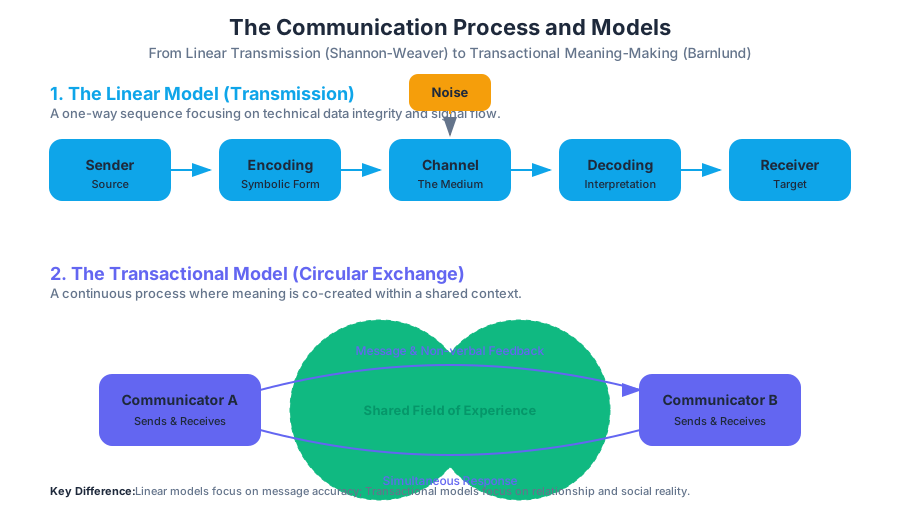
The Linear Model of Communication, often associated with the Shannon-Weaver Model (1949), views communication as a one-way process. Originally developed to improve technical communication (specifically telephone and radio), it treats the human voice much like a radio signal traveling from a transmitter to a receiver.
What it is
In this model, communication is a linear sequence:
- Sender: The source of the message.
- Encoding: The process of converting thoughts into a symbolic form (words, gestures).
- Message: The actual content being sent.
- Channel: The medium through which the message travels (airwaves, fiber optic cables, paper).
- Decoding: The process by which the receiver interprets the symbols.
- Receiver: The target of the message.
- Noise: Any interference that degrades the message.
Why it Matters
The Linear Model is the foundation of Information Theory. It introduced the concept of "noise" as a measurable variable and highlighted the importance of the "channel." In public speaking, this model helps us understand the basic mechanics of a lecture or a broadcast where immediate feedback is limited.
Implementation: A Low-Level View of Data Integrity
To understand the Linear Model from a systems perspective, we can look at how a "Sender" ensures a "Message" arrives intact despite "Noise" using a checksum algorithm in C. This represents the technical side of encoding for reliability.
#include <stdio.h>
#include <string.h>

/**
 * Simple 8-bit Checksum (LRC) to simulate Linear Model data integrity.
 * Represents the 'Encoding' phase where we add redundancy to fight 'Noise'.
 */
unsigned char calculate_checksum(const char *message) {
    unsigned char checksum = 0;
    while (*message) {
        checksum += (unsigned char)(*message++);
    }
    // Two's complement for the final checksum
    return (unsigned char)((checksum ^ 0xFF) + 1);
}

int main() {
    const char *original_message = "Hello, Audience!";
    unsigned char sent_checksum = calculate_checksum(original_message);

    printf("Sender: Encoded message with checksum: 0x%02X\n", sent_checksum);

    // Simulating the 'Channel' with potential 'Noise'
    char received_message[20];
    strcpy(received_message, original_message);

    // Simulate Noise: Flipping a bit in the channel
    // received_message[0] = 'J'; // Uncomment to trigger a decoding error

    unsigned char received_checksum = calculate_checksum(received_message);

    if (received_checksum == sent_checksum) {
        printf("Receiver: Decoding successful. Message: %s\n", received_message);
    } else {
        printf("Receiver: Noise detected! Message corrupted.\n");
    }

    return 0;
}
Common Pitfalls
The primary flaw of the Linear Model is its passivity. It assumes the receiver is a static vessel waiting to be filled with information. It ignores the fact that the receiver is actively interpreting the message based on their own context, and it fails to account for the "feedback loop" that characterizes most human interactions.
The Transactional Model of Communication: The Circular Exchange
The Transactional Model, pioneered by Dean Barnlund (1970), represents a paradigm shift. It posits that communication is not something people do to each other, but something they create with each other.
What it is
In the Transactional Model, the roles of "Sender" and "Receiver" are blurred. Participants are referred to as Communicators who send and receive messages simultaneously.
Definition: The Transactional Model is a continuous process where participants are simultaneously engaged in the sending and receiving of messages, influenced by their past experiences, current relationship, and the social context.
Key Differences: Linear vs. Transactional
| Feature | Linear Model | Transactional Model |
|---|---|---|
| Direction | One-way (Sender → Receiver) | Circular/Simultaneous |
| Role of Participants | Fixed (One speaks, one listens) | Fluid (Both are "Communicators") |
| Feedback | Minimal or delayed | Constant and immediate (non-verbal) |
| Context | Largely ignored | Central to meaning-making |
| Goal | Information transmission | Relationship and meaning construction |
How it Works: The Feedback Loop
In a public speaking setting, even if the audience isn't speaking, they are sending "feedback" via non-verbal cues (nodding, frowning, checking phones). The speaker "decodes" this feedback in real-time and "encodes" adjustments to their delivery. This creates a co-created experience.
Mathematical Derivation: Shannon Entropy and Information Gain
While the Linear Model focuses on signal, the Transactional Model can be viewed through the lens of reducing uncertainty between two agents. We can represent the "Information Content" ($I$) of a message ($x$) using the following logic:
I(x) = -\log_2 P(x)
Where $P(x)$ is the probability of the message occurring. In a Transactional Model, the "Shared Field of Experience" increases the probability of certain meanings, thereby reducing the "Surprisal" and increasing the efficiency of the communication.
Encoding and Decoding: The Cognitive Translation Layer
At the heart of every model are the twin processes of Encoding and Decoding. These are the "interfaces" between our internal mental states and the external world.
What they are
- Encoding: The mental process of selecting symbols (words, images, gestures) to represent ideas. It is an act of translation from the abstract to the concrete.
- Decoding: The process of interpreting those symbols to reconstruct the original idea.
The Complexity of Semantic Mapping
Encoding is never a 1:1 mapping. A speaker might encode the concept of "freedom" using a specific set of metaphors, but the listener's "decoder" might be tuned to a different set of historical or personal definitions.
Real-World Usage: Structured Data as a Communication Protocol
In modern software architecture, we use standardized formats like JSON to ensure that the "Encoding" and "Decoding" processes are synchronized between different systems. This is a perfect analogy for how clear definitions in a speech act as a "schema" for the audience.
{
  "communication_event": {
    "timestamp": "2023-10-27T10:00:00Z",
    "encoding_protocol": "Natural Language (English)",
    "context": {
      "physical": "Auditorium",
      "social": "Academic Conference",
      "relational": "Expert to Peer"
    },
    "message_payload": {
      "subject": "The Transactional Model",
      "key_points": [
        "Simultaneity",
        "Feedback loops",
        "Shared meaning"
      ]
    },
    "noise_threshold": 0.15
  }
}
Common Pitfalls: The "Illusion of Transparency"
Speakers often suffer from the Illusion of Transparency, the belief that their internal states (anxiety, intent, humor) are more apparent to the audience than they actually are. Because the speaker knows what they mean to encode, they assume the audience will perfectly decode the intent.
Noise: The Entropy of Communication
Noise is any stimulus that interferes with the sharing of meaning. In the context of public speaking, noise is not just a loud fan in the back of the room; it is any factor that increases the "error rate" of the transmission.
Taxonomy of Noise
| Type of Noise | Description | Example in Public Speaking | Mitigation Strategy |
|---|---|---|---|
| Physical | External environmental interference. | A siren outside, poor acoustics, flickering lights. | Use a microphone; close windows; move closer to the audience. |
| Physiological | Biological factors affecting the communicator. | Hunger, fatigue, hearing loss, or a headache. | Ensure physical comfort; use visual aids for the hearing impaired. |
| Psychological | Mental or emotional distractions. | Anxiety, preoccupation with personal problems, prejudice. | Use "hooks" to grab attention; address audience concerns directly. |
| Cultural | Differing worldviews or linguistic barriers. | Idioms that don't translate, differing views on eye contact. | Use inclusive language; define terms; research audience demographics. |
Concrete Example: The Cascade of Noise
Imagine a speaker presenting a technical proposal.
- Physical Noise: The projector is slightly out of focus.
- Physiological Noise: The speaker has a dry throat and is coughing.
- Psychological Noise: An audience member is worried about a deadline and isn't fully listening.
- Cultural Noise: The speaker uses high-context jargon that the junior engineers in the room don't understand.
The cumulative effect is a significant loss of Signal-to-Noise Ratio (SNR), leading to a failed communication event.
Worldview: The Internal Operating System
The most profound influence on the communication process is the Worldview. This is the invisible framework through which we filter every message we send and receive.
What it is
Worldview is composed of several philosophical pillars that dictate how a communicator interacts with reality.
| Component | Question it Answers | Impact on Communication |
|---|---|---|
| Epistemology | How do we know what is true? | Determines what counts as "evidence" (e.g., data vs. anecdote). |
| Ontology | What is the nature of reality? | Shapes how we view our relationship with the audience (e.g., hierarchy vs. equality). |
| Axiology | What do we value? | Influences the "Ethos" and "Pathos" of the speech. |
| Cosmology | What is our place in the universe? | Affects the scale and urgency of the message. |
| Praxeology | What is the right way to act? | Dictates the "Style" and "Delivery" of the communication. |
Why it Matters: The "Field of Experience"
In the Transactional Model, communication is most effective when there is an overlap in the participants' Fields of Experience. This overlap is where shared meaning is possible. If a speaker's worldview is entirely decoupled from the audience's worldview (e.g., a scientist speaking to a group that rejects empirical evidence), the "Noise" becomes insurmountable.
Implementation: Analyzing Worldview via CLI
If we were to build a tool to analyze a speech for worldview bias, we might use a Python script to check for "Epistemological Markers"—words that indicate how the speaker justifies their claims.
import re

def analyze_worldview(text):
    """
    Analyzes text for epistemological markers to identify the speaker's worldview.
    """
    markers = {
        "Empirical": [r"data", r"evidence", r"study", r"observed", r"statistics"],
        "Intuitive": [r"feel", r"gut", r"instinct", r"believe", r"sense"],
        "Authoritative": [r"tradition", r"scripture", r"expert", r"law", r"mandate"],
        "Rational": [r"logic", r"therefore", r"reason", r"deduce", r"consistent"]
    }

    results = {}
    for worldview, patterns in markers.items():
        count = sum(len(re.findall(p, text, re.IGNORECASE)) for p in patterns)
        results[worldview] = count

    return results

speech_snippet = """
Based on the latest data and empirical evidence from our study,
it is logical to deduce that the current trends are consistent
with our previous findings.
"""

print(f"Worldview Analysis: {analyze_worldview(speech_snippet)}")
# Output: {'Empirical': 3, 'Intuitive': 0, 'Authoritative': 0, 'Rational': 3}
Synthesis: Communication as Rhetoric
Understanding these models is the first step in mastering the "Invention" stage of rhetoric. By recognizing that communication is transactional, a speaker can move away from a "performance" mindset and toward a "connection" mindset.
- Invention (Logos, Pathos, Ethos): Use the model to choose the right evidence (Logos) for the audience's worldview, the right emotional resonance (Pathos) to cut through psychological noise, and the right character (Ethos) to establish a shared field of experience.
- Arrangement: Organize the message to minimize the cognitive load on the receiver's "decoder."
- Style: Choose language that bridges the gap between the speaker's and the audience's worldviews.
Key Insight: Effective communication is not the absence of noise, but the successful management of it. It is the art of aligning worldviews long enough to create a shared moment of understanding.
Rhetoric and Core Competencies
Key concepts: Rhetoric · Invention (Logos, Pathos, Ethos) · Public Speaking Competence Rubric (PSCR) · Instruction, Imitation, and Practice · Eleven Core Competencies
Introduction to the classical roots of public speaking and the modern standards used to evaluate speaker effectiveness.
Rhetoric and Core Competencies
Public speaking is often misunderstood as a raw, innate talent—a "gift of gab" that one either possesses or lacks. In reality, the field of communication treats public speaking as a high-order cognitive and performance discipline. It is a synthesis of classical Rhetoric (the theoretical art of persuasion) and modern Core Competencies (the measurable behaviors that define effective communication).
To master this domain, one must move beyond the "performance" and into the "architecture" of a speech. This involves understanding the mechanics of Invention, the psychological levers of Ethos, Pathos, and Logos, and the rigorous metrics established by the Public Speaking Competence Rubric (PSCR).
The Classical Foundation: Rhetoric as an Art
At its core, Rhetoric is not merely "talking"; it is a strategic system of discovery and expression. Aristotle defined rhetoric as:
"The faculty of observing in any given case the available means of persuasion."
This definition shifts the focus from the speaker's ego to the speaker's analytical capability. The speaker is a researcher who scans the environment, the audience, and the subject matter to find the most effective "levers" to move an audience.
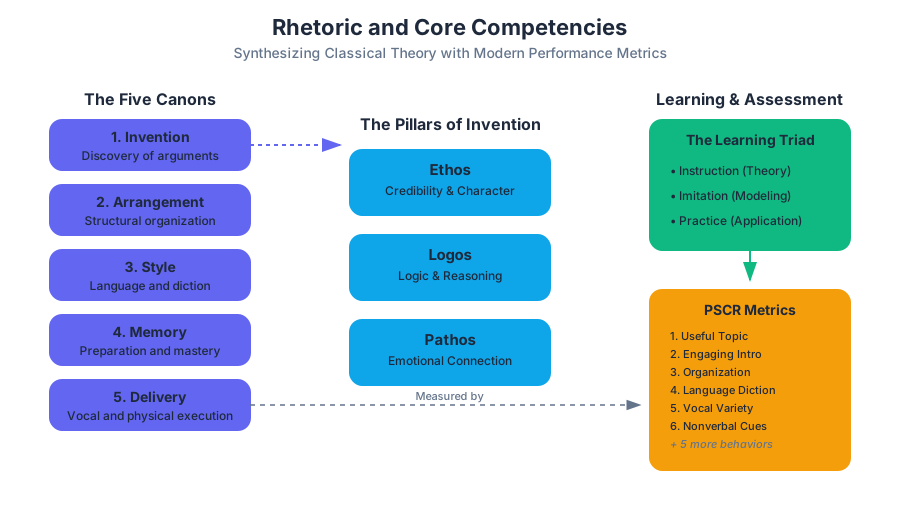
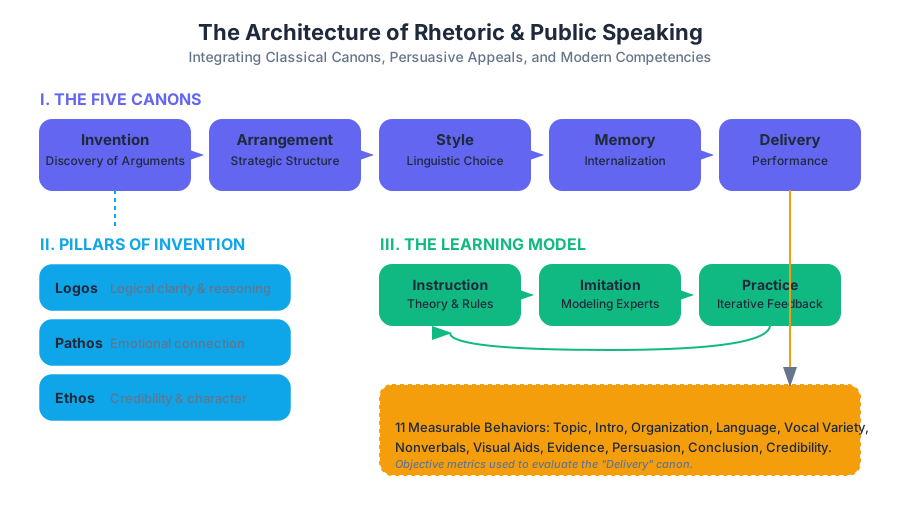
The Five Canons of Rhetoric
The classical tradition breaks the act of speech creation into five distinct stages, known as the Canons of Rhetoric. While modern curricula often emphasize delivery, the classical model suggests that the majority of the work happens before the speaker ever takes the stage.
| Canon | Focus | Description |
|---|---|---|
| Invention | Discovery | Finding the best arguments and evidence for the specific case. |
| Arrangement | Structure | Organizing the parts of the speech for maximum impact (Intro, Body, Conclusion). |
| Style | Language | Choosing the right words, metaphors, and rhetorical devices. |
| Memory | Preparation | Mastering the content so the speaker can engage the audience without reading. |
| Delivery | Performance | The physical and vocal execution of the speech. |
The Three Pillars of Invention: Logos, Pathos, and Ethos
Invention is the first and most critical canon. It is the process of developing the "substance" of the speech. To create a compelling argument, a speaker must balance three distinct modes of appeal.
1. Logos (The Logical Appeal)
Logos refers to the internal consistency and logical clarity of the message. It is the use of reasoning to lead the audience to a conclusion. This is achieved through two primary methods:
- Deductive Reasoning: Moving from general premises to a specific conclusion (e.g., the Syllogism).
- Inductive Reasoning: Moving from specific instances to a general conclusion (e.g., using statistics or case studies).
2. Pathos (The Emotional Appeal)
Pathos is the use of emotional triggers to align the audience's feelings with the speaker's goal. It is not about "manipulation" in the negative sense, but about creating a shared human experience. Effective pathos uses vivid imagery, storytelling, and personal anecdotes to make abstract data feel "real."
3. Ethos (The Ethical Appeal / Credibility)
Ethos is the perceived character of the speaker. According to Aristotle, ethos is composed of three qualities:
- Phronesis (Practical Wisdom): Does the speaker seem knowledgeable and competent?
- Arete (Virtue): Does the speaker seem honest and of good character?
- Eunoia (Goodwill): Does the speaker have the audience's best interests at heart?
The Learning Model: Instruction, Imitation, and Practice
The path to competence in public speaking follows a triadic pedagogical model. Unlike purely academic subjects, speaking requires a "studio" approach where theory is immediately applied to performance.
Instruction
Instruction involves the formal study of communication theory. This includes learning the rules of organization, the psychology of persuasion, and the ethics of public discourse. Without instruction, practice is merely the repetition of bad habits.
Imitation
Imitation (or mimesis) is the practice of analyzing and modeling expert speakers. By studying the "greats"—from Cicero to contemporary TED speakers—students learn to recognize patterns of effective delivery and structural nuance.
Practice
Practice is the iterative process of performance and feedback. In a high-level communication context, practice is not just "rehearsing"; it is the application of specific competencies in a controlled environment where the speaker can receive a "critique" (a technical evaluation) rather than just a "review" (a subjective opinion).
The Public Speaking Competence Rubric (PSCR)
To move from subjective "good/bad" labels to objective assessment, the communication discipline utilizes the Public Speaking Competence Rubric (PSCR). This tool breaks down a presentation into eleven discrete behaviors. Each behavior is scored on a scale (typically 0–3 or 1–5), allowing for a granular analysis of a speaker's strengths and weaknesses.
The Eleven Core Competencies
| Competency | Requirement | Advanced Level (Target) |
|---|---|---|
| 1. Useful Topic | Selection | Topic is timely, appropriate for the audience, and adds value. |
| 2. Engaging Intro | Hook/Thesis | Captures attention immediately and clearly states the purpose. |
| 3. Clear Organization | Structure | Follows a logical pattern (e.g., chronological, spatial, topical). |
| 4. Professional Language | Diction | Uses precise, vivid, and unbiased language; avoids jargon. |
| 5. Vocal Variety | Auditory | Varies pitch, rate, and volume to maintain interest and emphasize points. |
| 6. Nonverbal Cues | Physical | Eye contact, gestures, and posture reinforce the message. |
| 7. Visual Aids | Support | High-quality aids that clarify points without distracting. |
| 8. Strong Evidence | Logos | Uses credible, varied, and well-cited supporting materials. |
| 9. Persuasive Logic | Reasoning | Arguments are sound, free of fallacies, and tailored to the audience. |
| 10. Conclusion | Closure | Summarizes main points and provides a memorable "clincher." |
| 11. Audience Adaptation | Context | Adjusts content and delivery based on audience feedback and demographics. |
Technical Implementation: Analyzing Rhetorical Balance
In a modern context, we can think of these competencies and rhetorical appeals as variables in a system. A "balanced" speech optimizes these variables based on the speaker's intent. For example, a technical briefing might maximize Logos and Visual Aids, while a keynote address might maximize Pathos and Vocal Variety.
The following code block demonstrates a conceptual Python implementation for analyzing the "Rhetorical Density" of a speech transcript.
import re

class RhetoricalAnalyzer:
    def __init__(self, transcript):
        self.transcript = transcript.lower()
        self.total_words = len(self.transcript.split())

    def score_logos(self):
        # Keywords indicating logic, data, and structure
        logical_markers = ['because', 'therefore', 'consequently', 'data', 'percent', 'research', 'study', 'evidence']
        matches = sum(1 for word in logical_markers if word in self.transcript)
        return (matches / self.total_words) * 100

    def score_pathos(self):
        # Keywords indicating emotion and storytelling
        emotional_markers = ['imagine', 'feel', 'heart', 'story', 'tragic', 'hope', 'fear', 'together']
        matches = sum(1 for word in emotional_markers if word in self.transcript)
        return (matches / self.total_words) * 100

    def score_ethos(self):
        # Keywords indicating credibility and shared values
        credibility_markers = ['experience', 'years', 'believe', 'trust', 'we', 'our', 'community', 'qualified']
        matches = sum(1 for word in credibility_markers if word in self.transcript)
        return (matches / self.total_words) * 100

    def get_report(self):
        return {
            "Logos Density": f"{self.score_logos():.2f}%",
            "Pathos Density": f"{self.score_pathos():.2f}%",
            "Ethos Density": f"{self.score_ethos():.2f}%"
        }

# Example Usage
speech_text = "Imagine a world where data shows a 50% increase in hope. Based on my 20 years of experience, we must act."
analyzer = RhetoricalAnalyzer(speech_text)
print(analyzer.get_report())
Logical Derivation of the Syllogism
In the realm of Logos, the most robust form of proof is the Syllogism. This is a deductive argument consisting of a major premise, a minor premise, and a conclusion. In formal logic, this is represented as:
\begin{array}{l}
\forall x (P(x) \rightarrow Q(x)) \quad \text{(Major Premise: All P are Q)} \\
P(a) \quad \text{(Minor Premise: $a$ is a P)} \\
\hline
\therefore Q(a) \quad \text{(Conclusion: Therefore, $a$ is a Q)}
\end{array}
Example of a Rhetorical Syllogism (The Enthymeme)
In public speaking, we rarely use full syllogisms because they sound overly formal. Instead, we use the Enthymeme, which is a syllogism with one premise unstated (implied by the audience).
- Syllogism: All humans are mortal. Socrates is human. Therefore, Socrates is mortal.
- Enthymeme: "Socrates is mortal because he's human." (The audience fills in the unstated premise that all humans are mortal).
The PSCR Data Structure
When evaluating a speaker using the Eleven Core Competencies, the data is often structured for longitudinal tracking. This allows an instructor or a professional coach to see how a speaker improves over time across different dimensions.
{
  "evaluation_id": "SPEECH-2023-001",
  "speaker_id": "U-8829",
  "competencies": {
    "topic_selection": { "score": 3, "feedback": "Highly relevant to current market trends." },
    "introduction": { "score": 2, "feedback": "Strong hook, but thesis was slightly buried." },
    "organization": { "score": 3, "feedback": "Excellent use of a problem-solution pattern." },
    "language": { "score": 3, "feedback": "Vivid metaphors used effectively." },
    "vocal_variety": { "score": 1, "feedback": "Monotone delivery; needs more pitch modulation." },
    "nonverbal": { "score": 2, "feedback": "Good eye contact, but hands were in pockets." },
    "visual_aids": { "score": 3, "feedback": "Slides were clean and supported the data." },
    "evidence": { "score": 3, "feedback": "All statistics were cited from peer-reviewed sources." },
    "persuasion": { "score": 2, "feedback": "Logical flow was good, but lacked a strong call to action." },
    "conclusion": { "score": 3, "feedback": "Memorable closing statement." },
    "adaptation": { "score": 2, "feedback": "Acknowledged the audience's prior knowledge." }
  },
  "aggregate_score": 27,
  "max_possible": 33,
  "competency_level": "Advanced"
}
Common Pitfalls in Competency Development
Even with a clear rubric, speakers often fall into specific traps that hinder their development.
- The "Naturalism" Fallacy: Believing that "being yourself" is enough. While authenticity is important (Ethos), it does not replace the need for structure (Organization) and evidence (Logos).
- Over-reliance on Visuals: Using slides as a "crutch" or a transcript. Visual aids should supplement the speaker, not replace them.
- The "Data Dump": Providing too much Logos without Pathos. An audience can only process a limited amount of raw information before they lose interest.
- Neglecting the Introduction: Many speakers start with "Hi, my name is..." and a boring overview. The PSCR requires an engaging introduction that hooks the audience immediately.
Summary of the Eleven Competencies
To achieve mastery, a speaker must move through the stages of the PSCR. The following table summarizes the transition from a "Beginning" speaker to an "Advanced" speaker.
| Competency | Beginning (1) | Developing (2) | Advanced (3) |
|---|---|---|---|
| Organization | No clear structure; rambling. | Basic intro/body/conclusion. | Seamless transitions; logical flow. |
| Vocal Variety | Monotone or too quiet. | Some variation in volume/pitch. | Dynamic use of voice to convey emotion. |
| Nonverbal | Rigid; no eye contact. | Occasional gestures; some eye contact. | Natural movement; purposeful gestures. |
| Evidence | No sources cited; opinion-based. | Some sources cited; weak credibility. | Diverse, high-quality, cited evidence. |
Listening and Feedback
Key concepts: Hearing vs. Listening · Three A’s of Active Listening (Attention, Attitude, Adjustment) · Barriers to Listening · Verbal and Non-verbal Feedback · Constructive Evaluation
Distinguishing between the physiological act of hearing and the psychological process of active listening, with strategies for providing constructive feedback.
Listening and Feedback
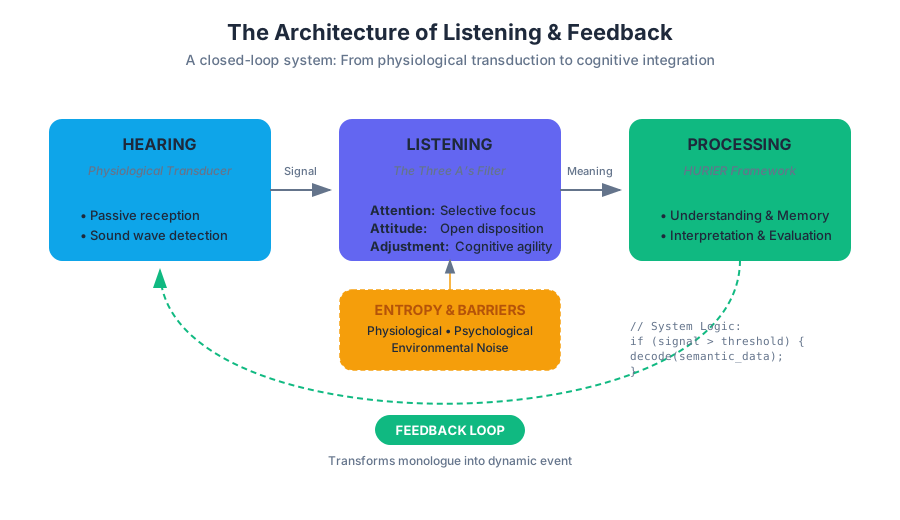
In the architecture of human interaction, listening is not merely the silence between periods of speaking; it is the active, cognitive processing of semantic signals. While speaking is the act of transmission, listening is the act of reception, decoding, and integration. Within the context of public speaking and rhetoric, the feedback loop created by an engaged listener is what transforms a monologue into a dynamic communicative event. To master the art of the "closed-loop" communication system, one must understand the physiological mechanics of hearing, the psychological discipline of listening, and the technical nuances of providing constructive feedback.
The Physiological-Cognitive Divide: Hearing vs. Listening
The distinction between hearing and listening is fundamental to communication theory. Hearing is a physiological process, whereas listening is a psychological and cognitive achievement.
Hearing: The Passive Transducer
Hearing is the accidental and automatic brain response to sound waves hitting the eardrum. It is a continuous process that requires no conscious effort. In engineering terms, hearing is the transduction of mechanical pressure waves into electrical impulses via the cochlea.
Listening: The Active Decoder
Listening is the intentional, focused process of making sense of what we hear. It requires the brain to filter out "noise" (unwanted signals) and assign meaning to the "signal" (the speaker's message). Listening involves complex neurological functions including memory, linguistic processing, and emotional intelligence.
| Feature | Hearing | Listening |
|---|---|---|
| Nature | Physiological / Sensory | Psychological / Cognitive |
| Effort | Passive / Involuntary | Active / Intentional |
| Process | Sound wave reception | Interpretation and Evaluation |
| Requirement | Functioning auditory system | Concentration and Open-mindedness |
| Goal | Detection of sound | Understanding of meaning |
To illustrate this at a systems level, consider the following implementation in C, which differentiates between raw data acquisition (hearing) and the application of a processing filter to extract meaning (listening).
#include <stdio.h>
#include <stdint.h>

/*
 * A low-level simulation of the Hearing vs. Listening process.
 * 'hearing' captures raw amplitude, 'listening' applies a threshold
 * and pattern recognition to identify a "phoneme".
 */

typedef struct {
    int16_t raw_amplitude;
    float frequency_hz;
} AudioSignal;

void process_audio(AudioSignal signal) {
    // The "Hearing" phase: Passive reception of data
    printf("[HEARING] Raw signal detected: %d amp at %.2f Hz\n",
            signal.raw_amplitude, signal.frequency_hz);

    // The "Listening" phase: Active filtering and cognitive focus
    const float HUMAN_VOICE_MIN = 85.0;
    const float HUMAN_VOICE_MAX = 255.0;

    if (signal.frequency_hz >= HUMAN_VOICE_MIN && signal.frequency_hz <= HUMAN_VOICE_MAX) {
        if (signal.raw_amplitude > 500) {
            printf("[LISTENING] Meaningful signal identified. Decoding message...\n");
            // Logic for semantic integration would go here
        } else {
            printf("[LISTENING] Signal too weak. Discarding as background noise.\n");
        }
    } else {
        printf("[LISTENING] Signal outside human speech range. Ignoring.\n");
    }
}

int main() {
    AudioSignal ambient_noise = {100, 15000.0}; // High frequency noise
    AudioSignal speaker_voice = {1200, 110.0};  // Typical male voice frequency

    process_audio(ambient_noise);
    process_audio(speaker_voice);

    return 0;
}
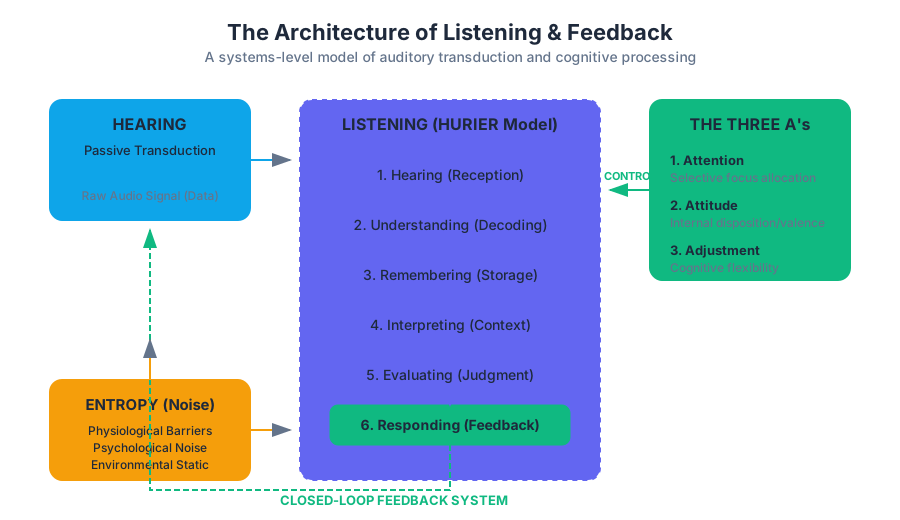
The Triad of Engagement: The Three A’s of Active Listening
To transition from a passive hearer to an active listener, one must employ the Three A’s: Attention, Attitude, and Adjustment. These represent the cognitive prerequisites for effective information absorption.
1. Attention
Attention is the selective narrowing of mental focus. In a world of "continuous partial attention," the listener must consciously allocate cognitive resources to the speaker. This involves overcoming the "speech-thought differential"—the fact that humans speak at approximately 125–150 words per minute but can process thought at speeds exceeding 600 words per minute.
2. Attitude
Attitude refers to the listener's internal disposition toward the speaker and the subject matter. A "deaf spot" occurs when a listener's prejudices or emotional triggers cause them to stop processing information. Approaching a speech with a neutral-to-positive valence ensures that the message is evaluated on its merits rather than through a lens of confirmation bias.
3. Adjustment
Adjustment is the capacity for cognitive flexibility. As a speaker develops their argument, they may take unexpected turns. An effective listener does not "pre-write" the end of the speech in their head; instead, they remain agile, following the speaker's logic even if it challenges their initial expectations.
The HURIER Model: A common framework for these stages is the HURIER model: Hearing, Understanding, Remembering, Interpreting, Evaluating, and Responding. Each stage is a potential point of failure in the communication chain.
Entropy and Interference: Barriers to Listening
In information theory, entropy represents the uncertainty or randomness in a signal. In public speaking, barriers act as "noise" that increases entropy, making the original message harder to reconstruct.
Categories of Barriers
- Physiological Barriers: These are internal to the listener’s body. Examples include hunger, fatigue, illness, or hearing impairments.
- Psychological Barriers: These include mental distractions, such as personal worries, or "receiver apprehension"—the fear that one will be unable to understand a complex message.
- Environmental Barriers: External factors such as a loud air conditioner, a flickering light, or a person whispering nearby.
- Semantic Barriers: Occur when the speaker uses jargon, slang, or specialized language that the listener cannot decode.
| Barrier Category | Source | Example | Mitigation Strategy |
|---|---|---|---|
| Physiological | Internal (Body) | Sleep deprivation | Physical preparation; self-care |
| Psychological | Internal (Mind) | Preconceived bias | Mindfulness; active empathy |
| Environmental | External (Room) | Poor acoustics | Moving closer; closing doors |
| Semantic | Message (Code) | Technical jargon | Asking for clarification; context clues |
The impact of these barriers can be modeled using a variation of the Shannon-Weaver Model of Communication. We can express the "Received Meaning" ($M_r$) as a function of the "Intended Meaning" ($M_i$) minus the cumulative "Noise" ($N$).
M_r = M_i \cdot (1 - \sum_{k=1}^{n} \eta_k)
Where $\eta_k$ represents the efficiency loss coefficient for each barrier $k$. If the sum of noise coefficients exceeds 1, the message is completely lost.
Feedback Mechanisms: Closing the Loop
Feedback is the response provided by the listener to the speaker. It serves as a control signal that allows the speaker to adjust their delivery in real-time. Feedback can be categorized by its modality (verbal vs. non-verbal) and its intent (formative vs. summative).
Non-verbal Feedback
Non-verbal cues are the primary way audiences communicate during a speech.
- Kinesics: Facial expressions, nodding, and posture.
- Oculesics: Eye contact (or lack thereof).
- Proxemics: The physical distance or leaning toward/away from the speaker.
Verbal Feedback
Verbal feedback usually occurs after the speech in the form of questions or critiques. It is most effective when it is specific, objective, and directed toward behaviors rather than personality traits.
| Cue | Positive Interpretation | Negative Interpretation |
|---|---|---|
| Nodding | Agreement / Understanding | Impatience (if rapid) |
| Eye Contact | Engagement / Interest | Hostility (if unblinking) |
| Leaning Forward | High Interest / Intensity | Aggression |
| Fidgeting | Energy / Excitement | Boredom / Anxiety |
In modern digital contexts, feedback is often quantified. The following Python snippet demonstrates a basic sentiment analysis approach to classifying verbal feedback.
import re

def analyze_feedback(text):
    """
    A simple heuristic-based feedback classifier.
    In a real system, this would use a transformer model (e.g., BERT).
    """
    positive_lexicon = {'clear', 'compelling', 'persuasive', 'organized', 'strong'}
    negative_lexicon = {'confusing', 'vague', 'monotone', 'disorganized', 'weak'}

    # Tokenize and normalize
    words = re.findall(r'\w+', text.lower())

    pos_count = sum(1 for w in words if w in positive_lexicon)
    neg_count = sum(1 for w in words if w in negative_lexicon)

    score = (pos_count - neg_count) / (len(words) + 1) # Normalized score

    if score > 0.1:
        return "CONSTRUCTIVE_POSITIVE"
    elif score < -0.1:
        return "CONSTRUCTIVE_CRITICAL"
    else:
        return "NEUTRAL_OR_AMBIGUOUS"

# Example usage:
feedback_1 = "The speaker's argument was clear and organized, though the delivery was a bit monotone."
print(f"Feedback Analysis: {analyze_feedback(feedback_1)}")
Constructive Evaluation: The Feed-forward Protocol
Constructive evaluation is a specialized form of feedback designed to improve future performance. It is distinct from simple "criticism" in that it is prescriptive rather than merely descriptive.
The Components of a Strong Evaluation
- Description: State what you observed (e.g., "You looked at your notes for 70% of the speech").
- Judgment: Explain the impact of that observation (e.g., "This reduced your connection with the audience").
- Justification: Reference a principle of public speaking (e.g., "Eye contact is essential for establishing ethos").
- Recommendation: Provide a specific "feed-forward" action (e.g., "Next time, use bulleted keywords instead of full sentences on your note cards").
Evaluation Rubrics
Standardized rubrics help eliminate subjective bias. A typical rubric might weigh different categories of performance:
| Category | Weight | Criteria |
|---|---|---|
| Invention (Logos) | 30% | Strength of evidence, logical flow, quality of sources. |
| Arrangement | 20% | Clear introduction, transitions, and conclusion. |
| Style / Language | 20% | Appropriateness of tone, use of rhetorical devices. |
| Delivery | 30% | Vocal variety, eye contact, physical presence. |
The "Sandwich" Method vs. Radical Candor: While the "Sandwich" method (Positive-Negative-Positive) is common in introductory settings, professional environments often prefer "Radical Candor"—the combination of challenging directly while caring personally. This avoids the "praise-criticism-praise" loop which can sometimes obscure the necessary corrective action.
Summary of the Listening Pipeline
The process of moving from raw sound to constructive evaluation can be viewed as a pipeline:
- Signal Acquisition (Hearing): Physical reception of sound waves.
- Signal Filtering (Attention): Selecting the speaker over background noise.
- Semantic Decoding (Understanding): Mapping sounds to linguistic meanings.
- Critical Analysis (Evaluation): Testing the logic and evidence (Logos).
- Response Generation (Feedback): Closing the loop via non-verbal or verbal cues.
By mastering each stage of this pipeline, both speakers and listeners contribute to a higher "Signal-to-Noise Ratio" in public discourse, leading to more effective persuasion, education, and collaboration.
Speech Preparation and Topic Selection
Key concepts: General Purpose (Inform, Persuade, Commemorate) · Topic Selection · Audience Analysis · Finding a Purpose · Speech Preparation Tools
The initial stages of creating a presentation, focusing on identifying a general purpose and selecting a topic appropriate for the audience and occasion.
Speech Preparation and Topic Selection
The efficacy of public speaking is rarely determined by the moment of delivery alone. Instead, it is the result of a rigorous, iterative process known as Speech Preparation. In the context of communication theory, preparation is the "encoding" phase where a speaker transforms abstract ideas into a structured, audience-centric message. This phase involves a systematic narrowing of focus—from a broad interest to a General Purpose, then to a Specific Purpose, and finally to a Central Idea.
Effective preparation mitigates Communication Apprehension (public speaking anxiety) by replacing uncertainty with a robust structural framework. By analyzing the audience’s worldview and the constraints of the speaking environment, a speaker can move from a speaker-centered approach ("What do I want to say?") to an audience-centered approach ("What does this audience need to hear, and how can I best deliver it?").
The Taxonomy of General Purposes
Every speech is governed by a General Purpose, which serves as the highest-level objective of the communication. In classical and contemporary rhetoric, these are categorized into three primary domains: Informative, Persuasive, and Commemorative.
Informative Speaking
The goal of Informative Speaking is to act as a teacher or translator. The speaker aims to increase the audience's knowledge or understanding of a topic without attempting to change their fundamental beliefs or behaviors. The primary metric of success is clarity and retention.
Persuasive Speaking
In Persuasive Speaking, the speaker acts as an advocate. The objective is to influence the audience's beliefs, attitudes, values, or behaviors. This requires a deep understanding of the audience's existing "latitude of acceptance" and the strategic use of Ethos (credibility), Logos (logic), and Pathos (emotion).
Commemorative and Entertainment Speaking
Commemorative Speaking (often including speeches of praise, toasts, or eulogies) seeks to strengthen the social bonds between the speaker and the audience by celebrating shared values or milestones. While often shorter, these speeches require high levels of emotional resonance and stylistic polish.
| Purpose Type | Speaker's Role | Primary Goal | Success Metric |
|---|---|---|---|
| Informative | Educator / Reporter | Knowledge Transfer | Audience comprehension and recall |
| Persuasive | Advocate / Catalyst | Behavioral/Attitudinal Change | Shift in audience position or action |
| Commemorative | Master of Ceremonies | Social Cohesion | Emotional resonance and shared identity |
| Entertaining | Performer | Diversion / Enjoyment | Audience engagement and aesthetic pleasure |
Topic Selection: The Funnel of Precision
Topic Selection is the process of identifying a subject that is timely, relevant, and appropriate for the constraints of the speaking engagement. A common pitfall for novice speakers is selecting a topic that is too broad (e.g., "Climate Change"), which leads to a superficial treatment of the subject.
The Selection Pipeline
- Inventory Generation: Brainstorming subjects based on personal expertise, current events, or audience interests.
- Constraint Mapping: Evaluating the topic against the time limit, the setting, and the audience's baseline knowledge.
- Refinement: Narrowing the topic until it can be covered in depth within the allotted time.
The Goldilocks Principle of Topic Selection: A topic must not be so broad that it becomes a list of generalizations, nor so narrow that it lacks significance for the audience. It must be "just right" for the specific temporal and situational constraints.
Recursive Topic Refinement Algorithm
To move from a broad category to a specific speech topic, speakers can use a recursive narrowing process.
def refine_speech_topic(broad_topic, constraints):
    """
    Simulates the narrowing of a speech topic based on
    audience knowledge and time limits.
    """
    current_scope = broad_topic

    # Constraints: (time_in_minutes, audience_expertise_level 0-10)
    time_limit, expertise = constraints

    while len(current_scope.split()) < 5: # Target a specific phrase
        if time_limit < 5:
            current_scope = apply_narrowing_filter(current_scope, "case_study")
        elif expertise > 7:
            current_scope = apply_narrowing_filter(current_scope, "technical_mechanism")
        else:
            current_scope = apply_narrowing_filter(current_scope, "general_overview")

        # Simulate the reduction of scope
        time_limit -= 1

    return f"Specific Purpose: To inform my audience about {current_scope}"

def apply_narrowing_filter(topic, filter_type):
    # Logic to append specific sub-sectors to the topic
    refinements = {
        "case_study": f"a specific instance of {topic}",
        "technical_mechanism": f"the underlying physics of {topic}",
        "general_overview": f"the three main pillars of {topic}"
    }
    return refinements.get(filter_type, topic)

# Example Usage
print(refine_speech_topic("Artificial Intelligence", (4, 8)))
Audience Analysis: The Transactional Foundation
In the Transactional Model of Communication, the audience is not a passive receiver but an active participant who decodes messages based on their unique Frame of Reference and Worldview. Audience Analysis is the systematic process of gathering and interpreting data about the listeners to tailor the speech effectively.
Demographic Analysis
Demographics are the observable characteristics of an audience. While useful, speakers must avoid Stereotyping, which is the assumption that all members of a group share the same beliefs.
| Demographic Variable | Strategic Consideration |
|---|---|
| Age | Influences cultural references, historical context, and life priorities. |
| Gender/Identity | Affects perspectives on social roles and inclusive language choices. |
| Education Level | Dictates the complexity of vocabulary and the depth of technical detail. |
| Religious/Political Affiliation | Shapes the underlying value systems and potential resistance to certain claims. |
Psychographic Analysis
Psychographics delve into the "why" of the audience—their attitudes, beliefs, and values. This is often more predictive of audience reaction than demographics alone.
- Attitudes: Favorable or unfavorable predispositions toward a topic.
- Beliefs: What the audience holds to be true or false (e.g., "Hard work leads to success").
- Values: Deep-seated principles that guide behavior (e.g., Freedom, Equality, Security).
Situational Analysis
This involves the physical and temporal context of the speech.
- Size: Larger audiences require more formal delivery; smaller ones allow for intimacy.
- Physical Setting: Lighting, acoustics, and the presence of a lectern.
- Disposition toward the Occasion: Is the audience there voluntarily (captivated) or because they have to be (captive)?
Finding a Purpose: The Specific Purpose Statement
Once the general purpose and topic are selected, the speaker must draft a Specific Purpose Statement. This is a single infinitive phrase that states precisely what the speaker hopes to accomplish.
Formula for the Specific Purpose
The Specific Purpose should follow a strict logical structure to ensure clarity:
[General Purpose] + [Audience Description] + [Specific Goal]
Example: "To inform (General Purpose) my classmates (Audience) about the three primary components of a blockchain (Specific Goal)."
The Central Idea (Thesis Statement)
While the Specific Purpose is an internal tool for the speaker, the Central Idea is what the speaker actually says to the audience. It is a one-sentence statement that sums up the major ideas of the speech.
Mathematical Logic of Speech Structure
If $S$ is the Speech, $P_s$ is the Specific Purpose, and $M_n$ are the Main Points:
$$S \approx P_s \implies \sum_{i=1}^{n} M_i$$
Where the sum of the main points must logically encompass the Specific Purpose without exceeding the scope defined by the Central Idea.
ALGORITHM: Speech Logic Verification
1. Define Specific Purpose (SP).
2. Define Central Idea (CI).
3. List Main Points (MP1, MP2, MP3).
4. IF (MP1 + MP2 + MP3) != CI THEN
      REVISE Main Points OR REVISE CI
5. IF CI does not satisfy SP THEN
      REVISE CI
6. END
Speech Preparation Tools and Workflow
Modern speech preparation leverages both traditional rhetorical methods and digital tools. The use of Open Educational Resources (OER) has revolutionized how students access high-quality research and templates without the financial burden of traditional textbooks.
The Outlining Process
Outlining is the "blueprint" phase. A Preparation Outline is a highly detailed document including full sentences, citations, and transitions. In contrast, a Speaking Outline (or delivery outline) consists of keywords and cues to facilitate extemporaneous delivery.
Research and Evidence
Effective preparation requires moving beyond general knowledge to find Supporting Materials:
- Examples: Specific instances to illustrate a point.
- Statistics: Numerical data to show magnitude or trends.
- Testimony: Quotations or paraphrases from experts or peers.
| Tool Category | Example Tools | Purpose in Preparation |
|---|---|---|
| Research Databases | JSTOR, Google Scholar | Finding peer-reviewed evidence and expert testimony. |
| Organization | MindMeister, Workflowy | Brainstorming and hierarchical structuring of ideas. |
| Visual Aids | Canva, PowerPoint, LaTeX Beamer | Creating "dual-coding" opportunities for the audience. |
| Readability | Hemingway Editor | Ensuring the oral style is simple and accessible. |
Implementation Example: A Structured Speech Config
A speaker might use a structured format like YAML to organize the metadata of their preparation before writing the full outline.
speech_metadata:
  title: "The Ethics of CRISPR"
  general_purpose: "To Persuade"
  specific_purpose: "To convince my audience that germline editing requires global regulation."
  audience_profile:
    demographics: "University students, ages 18-22"
    knowledge_level: "Intermediate (Biology 101 background)"
    attitude: "Skeptical but curious"
  structure:
    introduction:
      hook: "The story of the 2018 'CRISPR babies' in China."
      thesis: "While CRISPR offers a cure for genetic diseases, its unregulated use in germlines poses an existential threat to human biodiversity."
    main_points:
      - point: "The mechanism of CRISPR-Cas9."
      - point: "The risk of 'off-target' mutations."
      - point: "The necessity of an international regulatory framework."
    conclusion:
      call_to_action: "Support the WHO's advisory committee on human genome editing."
Common Pitfalls in Preparation
Even with a structured approach, speakers often encounter "traps" that can undermine their effectiveness:
- The "Information Dump": Providing too many facts without a clear narrative or "so what?" factor.
- Egocentricism: Failing to relate the topic to the audience's lived experience.
- Lack of Transition Logic: Moving between main points without showing the relationship between them.
- Plagiarism: Failing to credit sources. In public speaking, this includes "Global Plagiarism" (stealing an entire speech), "Patchwork Plagiarism" (stealing from multiple sources), and "Incremental Plagiarism" (failing to give credit for specific quotes or paraphrases).
Ethical Considerations in Topic Selection
Ethics in public speaking begins with topic selection. A speaker has an ethical obligation to:
- Be Prepared: Respect the audience's time by being thoroughly researched.
- Be Honest: Avoid distorting facts or using fallacious reasoning to win an argument.
- Avoid Name-Calling and Abusive Language: Maintain a "marketplace of ideas" where diverse perspectives are respected.
"The goal of public speaking is not just to be heard, but to contribute something of value to the public discourse." — Principles of Public Speaking
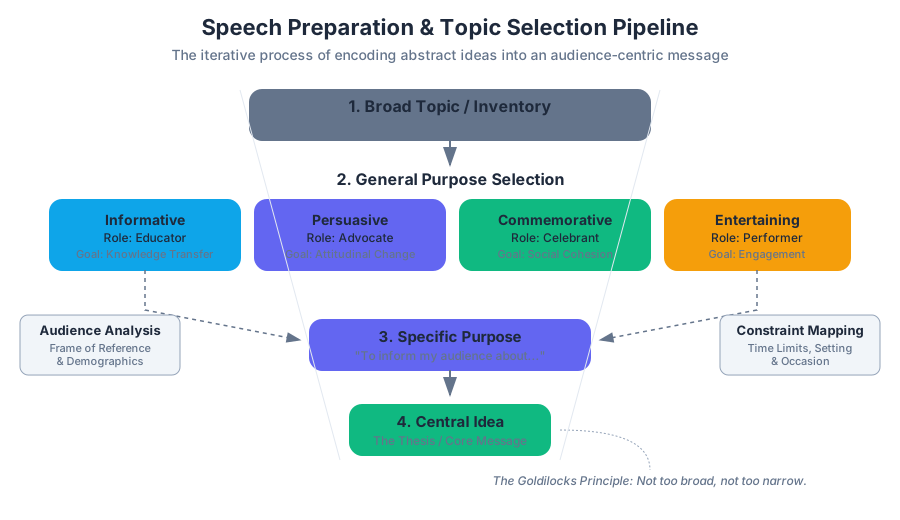
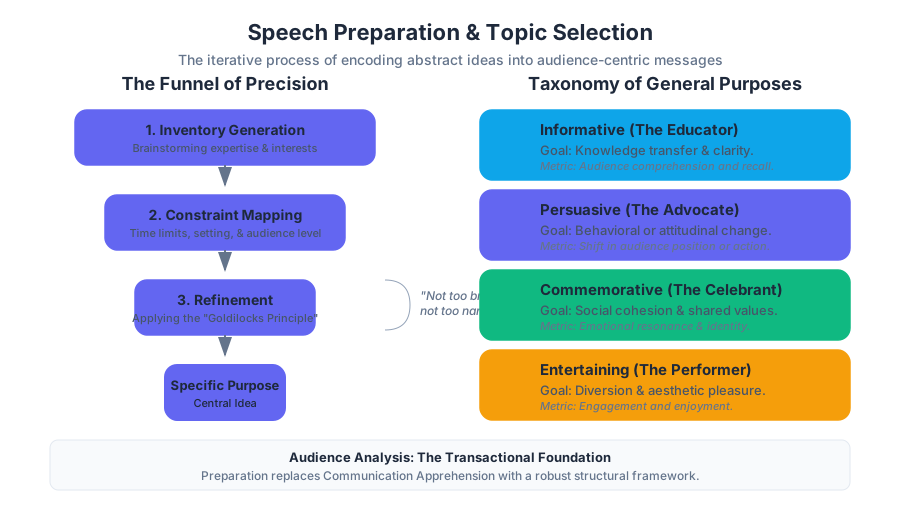
Foundations of Informative Speaking
Key concepts: Functions of Informative Speeches · Speaker Objectivity · Antecedent vs. Consequent Credibility · WIIFM (What’s In It For Me?) · Information vs. Knowledge
An exploration of the goals and ethical responsibilities of the informative speaker, emphasizing objectivity and credibility.
Foundations of Informative Speaking
Informative speaking is the pedagogical backbone of human communication. Unlike persuasive speaking, which seeks to alter an audience’s beliefs, values, or behaviors, informative speaking is designed to reduce uncertainty and increase the audience’s conceptual understanding of a specific domain. In the classical tradition, this was often categorized under the broader umbrella of rhetoric, specifically the "invention" of logical arguments (logos) to illuminate a subject. However, in a modern technical context, we view informative speaking as a knowledge transfer protocol—a structured method for moving information from a high-entropy state (the speaker's complex internal model) to a lower-entropy, organized state within the audience's mind.
Information vs. Knowledge: The Ontological Distinction
To master informative speaking, one must first distinguish between Information and Knowledge. While often used interchangeably in colloquial speech, they represent different stages of cognitive processing.
Definition: The DIKW Hierarchy In the context of communication theory, Information is data endowed with relevance and purpose. Knowledge is the synthesis of information into a functional framework that allows for application, judgment, and prediction.
The informative speaker’s primary task is not merely to transmit information, but to facilitate the audience’s transition from possessing information to possessing knowledge. This requires the speaker to provide context, establish relationships between variables, and offer a "mental map" of the territory.
The Transformation Process
The process of turning information into knowledge involves three distinct cognitive operations:
- Selection: Filtering noise from signal.
- Organization: Categorizing the signal into logical schemas.
- Integration: Linking new schemas to the audience's existing cognitive structures.
| Attribute | Information | Knowledge |
|---|---|---|
| Nature | Discrete, objective facts or data points. | Holistic, internalized understanding. |
| Storage | Databases, books, external media. | Neural networks, mental models. |
| Actionability | Low; requires interpretation. | High; enables decision-making. |
| Speaker Role | The Transmitter (Source). | The Facilitator (Teacher). |
| Entropy | High (unorganized). | Low (structured). |
To quantify the "informativeness" of a speech, we can look at it through the lens of Shannon Entropy. If a speaker tells an audience something they already know, the information gain ($H$) is zero. True informative speaking maximizes the information gain by providing "surprising" (new) but "decodable" (understandable) data.
import math

def calculate_information_gain(probabilities):
    """
    Calculates the Shannon Entropy (H) of a set of outcomes.
    In informative speaking, H represents the potential
    reduction in uncertainty for the audience.
    """
    entropy = 0
    for p in probabilities:
        if p > 0:
            # H = -Σ p(x) * log2(p(x))
            entropy -= p * math.log2(p)
    return entropy

# Example: An audience has 4 possible misconceptions about a topic,
# each with equal probability (0.25).
initial_uncertainty = calculate_information_gain([0.25, 0.25, 0.25, 0.25])
print(f"Initial Audience Uncertainty: {initial_uncertainty:.2f} bits")

# After a clear informative speech, the audience is 100% certain of the truth.
final_uncertainty = calculate_information_gain([1.0, 0.0, 0.0, 0.0])
print(f"Final Audience Uncertainty: {final_uncertainty:.2f} bits")
print(f"Total Information Transferred: {initial_uncertainty - final_uncertainty:.2f} bits")
Functions of Informative Speeches
Informative speeches serve four critical functions within a social or professional ecosystem. Understanding these functions allows a speaker to tailor their content to the specific needs of the environment.
1. Providing Knowledge
This is the most direct function. The speaker acts as a repository of specialized data, translating complex jargon into accessible language. This function is primary in academic lectures, technical briefings, and "How-To" demonstrations.
2. Shaping Perception
Information is never neutral in its effect. By choosing which facts to highlight, a speaker shapes how an audience perceives a reality. For instance, a speech on "The History of the Internet" can be framed as a triumph of military engineering or a triumph of grassroots collaboration. Both are informative, but they shape different conceptual perceptions.
3. Articulating Alternatives
In decision-making contexts, informative speeches provide the "menu" of options. Before a group can choose a path (persuasion), they must understand the available paths (information). This function requires the speaker to lay out the pros, cons, and mechanics of various solutions without explicitly endorsing one.
4. Enhancing Survival and Utility
On a fundamental level, informative speaking is a survival mechanism. Passing down information about how to perform a task, avoid a danger, or utilize a tool ensures the continuity of a community or organization.
| Function | Primary Goal | Example Scenario |
|---|---|---|
| Knowledge Provision | Fact transfer | A lecture on Quantum Mechanics. |
| Perception Shaping | Contextual framing | Explaining the "Ethics of AI" to developers. |
| Alternative Articulation | Option mapping | Presenting three different cloud architectures to a CTO. |
| Survival/Utility | Skill acquisition | A safety briefing for a chemical plant. |
Speaker Objectivity: The Neutrality Constraint
The hallmark of the informative speech is Objectivity. Unlike the advocate, who has a "stake" in the outcome, the informative speaker must maintain a disinterested stance. This does not mean the speaker lacks an opinion; rather, it means they deliberately suppress that opinion to prioritize the audience's independent processing of the facts.
The Spectrum of Neutrality
Objectivity is often a matter of degree. We can model the speaker's stance using a Neutrality Index, where 1.0 is absolute clinical detachment and 0.0 is pure propaganda.
- Fairness: Presenting all significant viewpoints on a controversial topic.
- Balance: Giving roughly equal time or weight to these viewpoints.
- Detachment: Using non-emotive, clinical language.
The Principle of Non-Advocacy If the audience can tell exactly which side of a debate you support by the end of an informative speech, you have likely failed the objectivity test. Your goal is to provide the tools for judgment, not the judgment itself.
# Speech Structure Schema: Informative vs. Persuasive
speech_type: informative
metadata:
  target_objectivity_score: 0.95
  prohibited_elements:
    - emotional_appeals (Pathos)
    - calls_to_action
    - biased_adjectives
structure:
  introduction:
    - define_topic_parameters
    - establish_neutral_ethos
  body_segments:
    - segment_1: "Historical Context (The 'What')"
    - segment_2: "Mechanics and Operations (The 'How')"
    - segment_3: "Current Perspectives/Alternatives (The 'Why')"
  conclusion:
    - summary_of_key_points
    - reference_for_further_study
Credibility (Ethos): Antecedent vs. Consequent
In the Aristotelian framework, Ethos is the perceived character of the speaker. In informative speaking, credibility is the currency that allows the information to be accepted as "true." Credibility is not a static attribute; it is a dynamic variable that fluctuates throughout the communication event.
Antecedent Credibility
Antecedent Credibility is the reputation the speaker brings to the podium before they utter a single word. It is built on:
- Credentials: Degrees, titles, and certifications.
- Experience: Years in the field or specific achievements.
- Introduction: How the moderator frames the speaker’s expertise.
Consequent Credibility
Consequent Credibility is the reputation earned during the speech. A speaker with high antecedent credibility can lose it through poor delivery or factual errors. Conversely, a speaker with low antecedent credibility (e.g., a student) can gain significant consequent credibility through:
- Citing Sources: Referencing peer-reviewed data or authoritative bodies.
- Logical Consistency: Ensuring the speech's internal structure is sound.
- Delivery: Maintaining eye contact, using a confident tone, and handling visual aids fluently.
The Credibility Function
We can derive the total credibility ($C_{total}$) at any point in time $t$ as:
$$C_{total}(t) = C_{antecedent} + \int_{0}^{t} \left( \alpha \cdot R(t) + \beta \cdot D(t) \right) dt$$
Where:
- $R(t)$ is the quality of Research/Evidence presented at time $t$.
- $D(t)$ is the quality of Delivery/Performance at time $t$.
- $\alpha$ and $\beta$ are weighting constants for content and style, respectively.
| Credibility Type | Source | Stability |
|---|---|---|
| Antecedent | Past actions, titles, reputation. | Relatively stable, but fragile. |
| Consequent | Present performance, logic, evidence. | Highly volatile; built in real-time. |
| Terminal | The final impression after the speech. | Becomes the Antecedent for the next speech. |
WIIFM: The Audience-Centric Value Proposition
WIIFM stands for "What's In It For Me?" It is the fundamental psychological filter through which every audience member views a speech. Humans are cognitive misers; we do not want to expend the energy required to process new information unless there is a perceived benefit.
Identifying the Value Proposition
An effective informative speaker must perform an Audience Analysis to determine what "currency" the audience values. This involves mapping the speech topic to the audience's needs:
- Intellectual Value: Does this satisfy curiosity or solve a mental puzzle?
- Professional Value: Will this help them do their job better or earn more?
- Social Value: Will this information give them status or help them connect with others?
- Survival Value: Does this information prevent a loss or mitigate a risk?
Implementation of WIIFM
The WIIFM must be addressed early—usually in the introduction—to secure the audience's "cognitive buy-in."
Example: If speaking about "Blockchain Technology" to a group of accountants, the WIIFM is not "how cryptography works" (technical curiosity), but "how this will automate auditing and change your daily workflow" (professional utility).
To verify the "neutrality" and "value" of a speech's framing, one might use a sentiment analysis API to ensure the language remains objective while still being engaging.
# Example: Using a CLI tool to check the "Objectivity" vs "Subjectivity"
# of a speech transcript via a hypothetical NLP API.

curl -X POST "https://api.nlp-analysis.io/v1/analyze" \
     -H "Content-Type: application/json" \
     -H "Authorization: Bearer $API_KEY" \
     -d '{
       "text": "The implementation of the new tax code is a brilliant move that will save everyone money.",
       "features": ["subjectivity", "sentiment", "bias_detection"]
     }'

# Expected Output Snippet:
# {
#   "subjectivity_score": 0.85,  <-- High subjectivity (Bad for informative)
#   "sentiment": "positive",
#   "bias_detected": true,
#   "suggestions": ["Replace 'brilliant move' with 'legislative change'", "Remove 'save everyone money'"]
# }
Common Pitfalls in Informative Speaking
Even with a strong grasp of the foundations, speakers often fall into specific traps that degrade the quality of knowledge transfer.
1. The "Information Dump"
Providing too much data without a clear organizational structure. This exceeds the audience's Cognitive Load, leading to "mental brownout."
- Mitigation: Use the Rule of Three (limit main points to three) and provide clear transitions (signposts).
2. Persuasive Creep
Allowing personal bias to color the presentation. This often happens through "loaded language" or the selective omission of counter-facts.
- Mitigation: Use the "Devil's Advocate" test—try to find the strongest argument for the side you aren't presenting and include it.
3. Over-Complexity (The Curse of Knowledge)
Assuming the audience knows more than they do. This results in using undefined jargon or skipping foundational steps.
- Mitigation: Use analogies. Relate the "unknown" (the topic) to the "known" (common experiences).
| Pitfall | Symptom | Root Cause | Fix |
|---|---|---|---|
| Information Overload | Glazed eyes, lack of retention. | High entropy, poor filtering. | Chunking, Signposting. |
| Bias/Advocacy | Audience feels "sold to." | Lack of objectivity. | Balanced sourcing, neutral tone. |
| Jargon Fatigue | Confusion, loss of interest. | Curse of Knowledge. | Analogies, Glossary of terms. |
| Low WIIFM | "Why are we here?" | Poor audience analysis. | Explicit value proposition in Intro. |
Summary of the Informative Framework
Informative speaking is a disciplined practice of intellectual honesty. By mastering the distinction between information and knowledge, maintaining strict objectivity, leveraging both antecedent and consequent credibility, and answering the audience's WIIFM, a speaker transforms from a mere "source of noise" into a "source of signal."
The goal is terminal clarity: the audience should leave not just knowing that something is true, but understanding why it is true and how it relates to the broader world. This foundation enables all other forms of communication, including persuasion and inspiration, by providing the factual bedrock upon which they must stand.
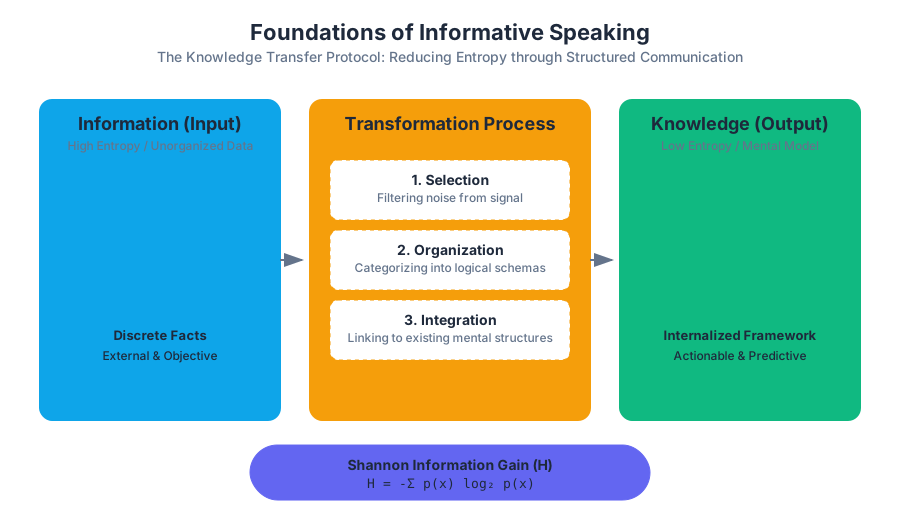
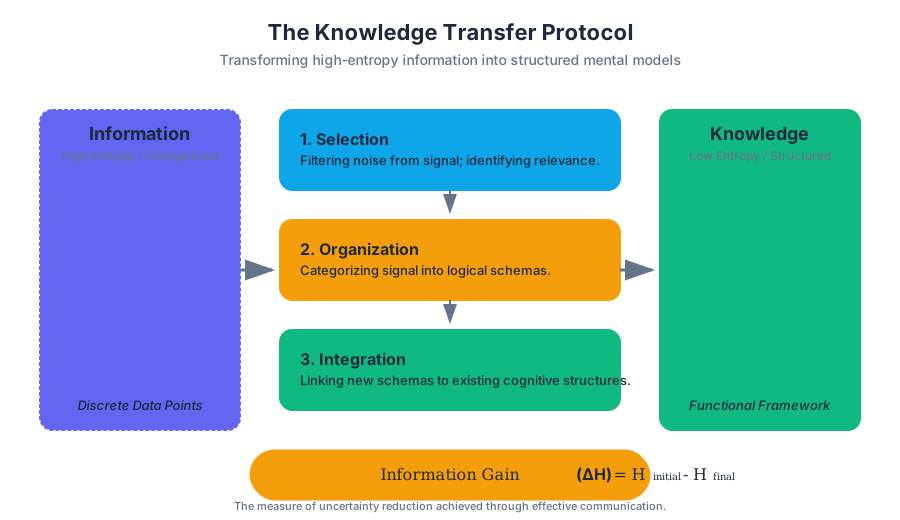
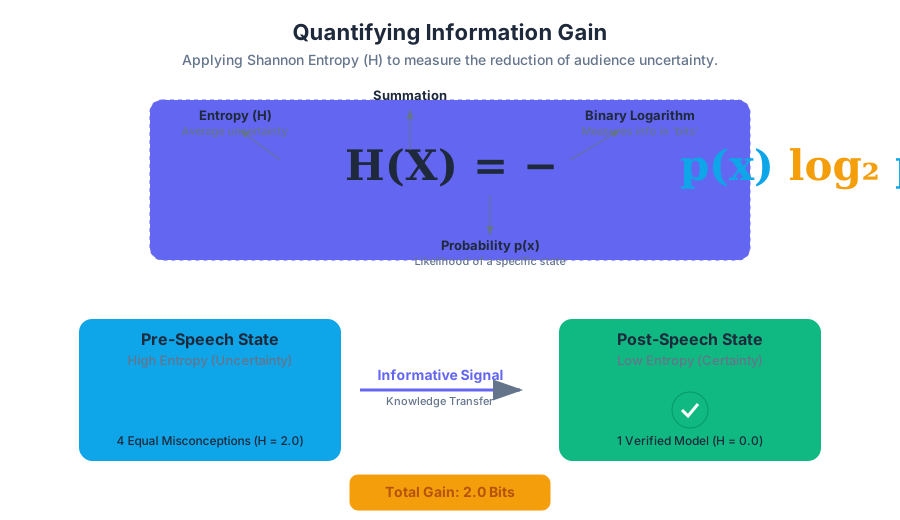
Types of Informative Speeches
Key concepts: Definitional Speeches · Descriptive Speeches · Explanatory Speeches · Demonstration Speeches · Sensory Appeal
Categorizing informative presentations into four distinct types based on their specific goals and methods of delivery.
Types of Informative Speeches
In the classical tradition of rhetoric, the informative speech serves as the foundational act of Docere (to teach). Unlike persuasive speaking, which seeks to alter an audience's values or behaviors, informative speaking aims to increase the audience's knowledge or understanding of a specific subject. This process is not merely a data dump; it is a sophisticated exercise in Invention (finding the right arguments) and Arrangement (structuring them for maximum clarity).
To master the informative speech, one must move beyond the misconception that "sharing facts" is a passive activity. It is an active engineering of the audience's mental model. We categorize these speeches based on their primary communicative goal: defining a concept, describing a reality, explaining a phenomenon, or demonstrating a process.
The Taxonomy of Informative Discourse
Before diving into specific types, we must understand the structural differences that govern each mode of delivery. The following table provides a high-level comparison of the four primary informative speech types based on their cognitive objectives and typical organizational patterns.
| Speech Type | Primary Objective | Cognitive Focus | Common Arrangement |
|---|---|---|---|
| Definitional | Clarify the meaning of a concept or theory. | Abstract Logic | Topical / Categorical |
| Descriptive | Create a vivid mental image of a person, place, or object. | Sensory Perception | Spatial / Chronological |
| Explanatory | Unpack the "why" or "how" behind a complex phenomenon. | Causal Relationships | Causal / Problem-Solution (Informative) |
| Demonstration | Teach the audience how to perform a task or understand a process. | Procedural Memory | Step-by-Step / Chronological |
Definitional Speeches: The Logic of Meaning
A Definitional Speech focuses on the "what." Its purpose is to explain the meaning, theory, or philosophy of a specific topic that the audience may find complex or unfamiliar. In the realm of Logos (logical appeal), the definitional speech relies heavily on the precision of language and the use of "genus and differentia"—defining a term by first placing it in a broad category and then distinguishing it from other members of that category.
Mechanics of Definition
When constructing a definitional speech, the speaker must navigate several layers of meaning:
- Denotation: The literal, dictionary definition.
- Connotation: The emotional or cultural associations attached to the term.
- Etymology: The historical origin of the word, which often reveals deeper insights into its current usage.
- Negation: Explaining what the concept is not to clear up common misconceptions.
Implementation Example: Defining "Entropy"
If a speaker were to define "Entropy" for a non-technical audience, they might use the following logical structure to ensure the abstract becomes concrete.
class ConceptDefinition:
    """
    A programmatic representation of a Definitional Speech structure.
    """
    def __init__(self, term, genus, differentia):
        self.term = term
        self.genus = genus
        self.differentia = differentia
        self.synonyms = []
        self.misconceptions = []

    def generate_thesis(self):
        return f"{self.term} is a type of {self.genus} characterized by {self.differentia}."

# Instance for a Definitional Speech on 'Entropy'
entropy_speech = ConceptDefinition(
    term="Entropy",
    genus="thermodynamic property",
    differentia="the degree of disorder or randomness in a closed system"
)

entropy_speech.misconceptions = ["Entropy is just 'messiness'", "Entropy only applies to physics"]
entropy_speech.synonyms = ["Stochasticity", "Disorder", "Thermal Unavailability"]

print(entropy_speech.generate_thesis())
# Output: Entropy is a type of thermodynamic property characterized by the degree of disorder or randomness in a closed system.
Key Insight: The primary pitfall of definitional speeches is the "Dictionary Trap." Simply reading a definition is boring; a successful speaker must use analogies to bridge the gap between the known and the unknown.
Descriptive Speeches: The Architecture of Imagery
The Descriptive Speech aims to paint a picture in the minds of the audience. While a definitional speech targets the intellect, a descriptive speech targets the Sensory Appeal. The goal is to make the audience see, hear, smell, or feel the subject matter through the power of Style (the third canon of rhetoric).
The Role of Sensory Appeal
To achieve "vividness," a speaker must employ specific linguistic tools:
- Visual: Shapes, colors, movement, and light.
- Auditory: Pitch, volume, rhythm, and onomatopoeia.
- Olfactory/Gustatory: Scents and flavors that evoke memory.
- Kinesthetic: The sense of motion or physical tension.
Spatial Arrangement
Descriptive speeches almost always utilize a Spatial Pattern. If you are describing the International Space Station, you might move from the "Pressurized Modules" to the "Integrated Truss Structure" and finally to the "Solar Arrays." This mimics the way a human eye scans an object.
| Sensory Category | Descriptive Variable | Rhetorical Effect |
|---|---|---|
| Visual | Hue, Saturation, Luminance | Establishes the "scene" and focus. |
| Tactile | Texture, Temperature, Pressure | Creates a sense of "presence" or "weight." |
| Aural | Timbre, Resonance, Cadence | Evokes emotional tone (Pathos). |
| Organic | Internal sensations (hunger, nausea) | Deepens audience empathy/connection. |
Explanatory Speeches: The Mechanics of Causality
While a demonstration speech shows "how to do," an Explanatory Speech (or speech of explanation) shows "how it works" or "why it happens." These are often the most intellectually demanding speeches because they require the speaker to simplify complex systems without being reductive.
The Causal Chain
Explanatory speeches often follow a Causal (Cause-Effect) Pattern. The speaker must establish a logical derivation of events. For example, explaining the 2008 Financial Crisis requires a derivation of how subprime mortgages (cause) led to a liquidity crunch (intermediate effect), which resulted in a global recession (final effect).
Mathematical Representation of Explanation
In an explanatory context, we can think of the phenomenon $P$ as a function of multiple variables $x_n$. The speech's job is to define the function $f$.
P = f(x_1, x_2, x_3, \dots, x_n) + \epsilon
Where:
- $P$: The phenomenon being explained (e.g., Global Warming).
- $x_n$: Independent variables (e.g., CO2 emissions, Albedo effect).
- $f$: The mechanism (The "Why" the speaker is explaining).
- $\epsilon$: The "Explanatory Gap" (uncertainties the speaker must acknowledge ethically).
Common Pitfalls in Explanation
- The Curse of Knowledge: Assuming the audience knows the jargon.
- Over-simplification: Removing so much detail that the explanation becomes inaccurate.
- Lack of "Signposting": In complex explanations, the audience can lose the thread. Use transitions like "Now that we understand the cause, let's look at the mechanism."
Demonstration Speeches: The Algorithm of Action
The Demonstration Speech is procedural. It is designed to lead the audience through a sequence of steps to achieve a specific outcome. This type of speech relies heavily on Visual Aids and physical movement.
The "Instruction, Imitation, Practice" Model
This speech type follows a specific pedagogical loop:
- Instruction: The speaker explains the step.
- Imitation: The speaker performs the step (the "Show").
- Practice: The audience mentally (or physically) rehearses the step.
Structural Requirements
A demonstration speech must be Chronological. Skipping a step in a definitional speech might be a minor error; skipping a step in a demonstration speech (like "how to perform CPR") is a catastrophic failure.
Real-World Usage: Technical Demonstration
In a technical environment, a demonstration might involve a "Live Demo" of a software interface. The following is a CLI-based representation of a demonstration flow for a developer audience.
# Step 1: Initialize the environment
$ git clone https://github.com/example/project.git
$ cd project

# Step 2: Configure dependencies (The "Why" - we need the runtime)
$ npm install

# Step 3: Execute the process
$ npm start

# Step 4: Verify the result
$ curl http://localhost:3000/health
# Expected Output: {"status": "ok"}
Pro-Tip: Always have a "pre-baked" version of your demonstration. If the "live" part fails (the "Demo Effect"), you can show the finished product to maintain the flow of information.
Rhetorical Invention in Informative Speaking
Regardless of the type, every informative speech is built on the three pillars of Invention: Logos, Pathos, and Ethos.
1. Logos (Logical Appeal)
In informative speaking, Logos is the "meat" of the speech. It involves the use of statistics, expert testimony, and factual evidence. The speaker must ensure that the Arrangement of these facts follows a logical progression.
2. Pathos (Emotional Appeal)
It is a misconception that informative speeches should be "dry." Pathos is used to create relevance. Why should the audience care about the lifecycle of a star? By connecting the subject to the audience's curiosity or their sense of wonder, the speaker ensures the information is "sticky."
3. Ethos (Credibility)
The speaker's Ethos is established through:
- Competence: Demonstrating a deep grasp of the material.
- Character: Showing honesty about the limitations of the data.
- Goodwill: Framing the information in a way that benefits the audience.
Comparison of Organizational Patterns
Choosing the right structure is critical for audience retention. The following table maps speech types to their most effective organizational strategies.
| Pattern | Best For... | Logic |
|---|---|---|
| Chronological | Demonstration, History | Time-based sequence. |
| Spatial | Descriptive | Geography or physical structure. |
| Topical | Definitional | Dividing a whole into sub-parts. |
| Causal | Explanatory | Linking origins to outcomes. |
| Comparative | Definitional/Explanatory | Highlighting differences between two similar concepts. |
Ethics in Informative Speaking
Because the speaker is positioned as an "expert" or "teacher," there is a significant ethical burden. The speaker must avoid:
- Persuasion in Disguise: Using biased language to nudge the audience toward a specific viewpoint under the guise of "just the facts."
- Plagiarism: Failing to cite the sources of the information provided.
- Misinformation: Presenting theories as facts or omitting crucial counter-evidence.
Data Integrity Check (SQL Example)
Imagine a system that audits the sources used in an informative speech to ensure ethical compliance and variety.
-- Query to check the diversity and reliability of speech sources
SELECT
    source_type,
    COUNT(*) as source_count,
    AVG(reliability_score) as avg_reliability
FROM
    speech_references
WHERE
    speech_id = 'INF-101-ENTROPY'
GROUP BY
    source_type
HAVING
    avg_reliability > 0.8;
Summary of Best Practices
To deliver a high-impact informative speech, follow these "Senior Engineer" level guidelines:
- Analyze the Audience: Don't explain the "how" if they don't yet understand the "what."
- Use Signposts: Explicitly state where you are in your outline (e.g., "Moving from the causes to the effects...").
- Manage Cognitive Load: Use the "Rule of Three." Most audiences can only retain three major categories of information in a single sitting.
- Incorporate Redundancy: Tell them what you're going to tell them, tell them, and then tell them what you told them. This isn't repetitive; it's reinforcement.
- Visual Synergy: Your visual aids should supplement your words, not replace them. If the audience is reading your slides, they aren't listening to you.


Strategies for Audience Engagement
Key concepts: Attention-Getting Elements (Intensity, Novelty, Contrast) · Narrative Types (Natural, Social, Ultimate) · Intellectual Stimulation · Logical Coherence · Retention Strategies
Techniques for making information memorable and maintaining audience interest throughout a presentation.
Strategies for Audience Engagement
In the context of rhetoric and public communication, Audience Engagement is defined as the sustained cognitive and emotional investment of a listener in the speaker's discourse. It is not merely the absence of boredom, but a state of active processing where the audience's mental models are being continuously updated by the speaker's input. From a neuro-cognitive perspective, engagement involves the synchronization of neural activity between the speaker and the listener—a phenomenon known as neural coupling.
To achieve this state, a speaker must navigate the constraints of human attention, which is a finite biological resource. The strategies for engagement are categorized into sensory triggers, narrative structures, intellectual challenges, and structural coherence.
The Mechanics of Attention: Sensory and Cognitive Triggers
Attention is the gateway to memory. Without capturing the audience's initial focus, the most logically sound argument (Logos) or the most credible speaker (Ethos) will fail to penetrate the listener's consciousness. We categorize these triggers into three primary vectors: Intensity, Novelty, and Contrast.
Intensity
Intensity refers to the magnitude of a stimulus. In public speaking, this is often physical—the volume of the voice, the brightness of a visual aid, or the emotional weight of a statement. High-intensity stimuli trigger the brain's Orienting Response, an involuntary shift of attention toward a significant change in the environment.
Novelty
Novelty is the introduction of a stimulus that is unexpected or unfamiliar. The human brain is an "entropy-detecting machine"; it filters out repetitive, predictable patterns (habituation) and prioritizes new information. A novel metaphor, a surprising statistic, or an unconventional opening serves to reset the audience's habituation timer.
Contrast
Contrast is the perception of difference between two stimuli. This can be structural (moving from a fast-paced delivery to a sudden, pregnant pause) or conceptual (juxtaposing a dire problem with a utopian solution). Contrast highlights the boundaries of information, making the "signal" stand out against the "noise."
| Trigger Type | Mechanism | Implementation Example | Psychological Effect |
|---|---|---|---|
| Intensity | Amplitude/Magnitude | Increasing vocal volume during a climax. | Triggers the Arousal System. |
| Novelty | Information Entropy | Presenting a counter-intuitive fact. | Inhibits Habituation. |
| Contrast | Differential Analysis | Comparing "The World Today" vs. "The World Tomorrow." | Enhances Pattern Recognition. |
| Humor | Incongruity Resolution | A well-timed, relevant anecdote. | Releases Dopamine; Lowers Affective Filter. |
Narrative Frameworks: The Three Types of Storytelling
Narrative is the "operating system" of human cognition. We do not store facts as isolated data points; we store them as sequences of cause and effect. To maximize engagement, speakers utilize three distinct narrative layers: Natural, Social, and Ultimate.
Natural Narratives
Natural Narratives focus on the physical world and the sequence of events. They follow a linear, causal logic: A happened, which caused B, leading to C. These are essential for technical explanations and historical accounts. They satisfy the audience's need for logical progression and spatial-temporal orientation.
Social Narratives
Social Narratives center on human relationships, agency, and conflict. These stories leverage Pathos by invoking empathy. When a speaker describes a personal struggle or a community's triumph, they activate the audience's "mirror neurons," allowing the listener to experience the speaker's journey vicariously.
Ultimate Narratives
Ultimate Narratives (or Meta-narratives) deal with "The Big Why." These are teleological; they address purpose, morality, and the long-term destiny of a group or idea. They provide the "Ultimate" context for the information being presented, transforming a simple speech into a call to action or a foundational belief system.
The Narrative Coherence Theorem: A speech's resonance ($R$) is a function of the alignment between its Natural ($N$), Social ($S$), and Ultimate ($U$) narrative layers. If $N, S, U$ are orthogonal, the audience experiences cognitive dissonance. If they are aligned, $R$ increases exponentially.
Implementation: Surprise and Entropy in Narrative
To keep an audience engaged, a narrative must maintain a specific level of "information entropy." If the story is too predictable, the audience disengages. If it is too chaotic, they lose the thread.
import math

def calculate_narrative_entropy(events):
    """
    Calculates the Shannon Entropy of a narrative sequence.
    High entropy = High surprise/Novelty.
    Low entropy = High predictability/Boredom.
    """
    if not events:
        return 0

    event_counts = {}
    for event in events:
        event_counts[event] = event_counts.get(event, 0) + 1

    total_events = len(events)
    entropy = 0
    for count in event_counts.values():
        probability = count / total_events
        entropy -= probability * math.log2(probability)

    return entropy

# Example: A speech with a repetitive structure vs. a varied structure
repetitive_speech = ["fact", "fact", "fact", "fact", "fact"]
engaging_speech = ["anecdote", "fact", "joke", "challenge", "vision"]

print(f"Repetitive Entropy: {calculate_narrative_entropy(repetitive_speech):.2f}")
print(f"Engaging Entropy: {calculate_narrative_entropy(engaging_speech):.2f}")
Intellectual Stimulation and the Information Gap
Engagement is often driven by the Information Gap Theory, proposed by George Loewenstein. This theory suggests that curiosity is a cognitive induced deprivation that arises when a person identifies a gap between what they know and what they want to know.
The Information Gap Mechanism
- Opening the Gap: The speaker poses a question or presents a puzzle that the audience cannot currently solve.
- Sustaining the Gap: The speaker provides partial information, keeping the "itch" alive without fully scratching it.
- Closing the Gap: The speaker reveals the "missing piece," leading to a release of tension and a sense of intellectual satisfaction.
Balancing Complexity
Intellectual stimulation requires the speaker to operate within the audience's Zone of Proximal Development (ZPD). If the material is too simple, the audience is bored; if it is too complex, they suffer from Cognitive Overload.
| Level | Audience State | Speaker Strategy |
|---|---|---|
| Below ZPD | Boredom / Disengagement | Increase abstraction, use sophisticated metaphors. |
| Within ZPD | Flow / High Engagement | Scaffolding: connect new info to known concepts. |
| Above ZPD | Anxiety / Confusion | Simplify syntax, use concrete analogies, slow down. |
Logical Coherence and Cognitive Load Management
Even the most engaging story will fail if the audience cannot follow the logic. Logical Coherence is the structural integrity of the speech. It ensures that the "mental map" the speaker is building in the audience's mind is consistent and navigable.
Signposting and Transitions
Signposts are verbal cues that indicate where the speaker is in the "arrangement" of the speech. They function like GPS coordinates for the listener.
- Internal Previews: "Now that we've covered the problem, let's look at three specific solutions."
- Internal Summaries: "So, we've seen how intensity and novelty capture attention."
- Transitions: "This leads us directly to our next point..."
Cognitive Load Theory (CLT)
In public speaking, we must manage three types of cognitive load:
- Intrinsic Load: The inherent difficulty of the topic.
- Extraneous Load: Distractions or poor structure that waste mental energy.
- Germane Load: The mental effort used to integrate new information into long-term memory.
The goal of a coherent speech is to minimize Extraneous Load so that the audience can maximize Germane Load.
% Mathematical representation of Cognitive Load Management
\text{Total Cognitive Capacity} (C) \geq L_{intrinsic} + L_{extraneous} + L_{germane}

\text{Goal: } \min(L_{extraneous}) \implies \max(L_{germane})
Coherence Mapping
A coherent speech follows a predictable logical flow. Below is a comparison of common organizational patterns:
| Pattern | Logic | Best Used For... |
|---|---|---|
| Categorical | Grouping by sub-topic. | Informative speeches on complex systems. |
| Chronological | Grouping by time/sequence. | Historical accounts or process demos. |
| Causal | Grouping by Cause $\rightarrow$ Effect. | Persuasive speeches or scientific analysis. |
| Problem-Solution | Identifying a gap and filling it. | Policy proposals or sales pitches. |
Retention Strategies: Moving from Short-Term to Long-Term Memory
Engagement is the first step; Retention is the final goal. A speaker's success is measured by what the audience remembers 24 hours, a week, or a month later.
The Rule of Three and Chunking
The human working memory can typically hold $7 \pm 2$ "chunks" of information. However, in the high-stress environment of listening to a live speech, this capacity often drops. The Rule of Three is a rhetorical principle suggesting that information presented in groups of three is more inherently satisfying and easier to remember.
Vividness and Imagery
The Picture Superiority Effect suggests that concepts are much more likely to be remembered if they are presented as pictures rather than just words. Even without visual aids, a speaker can use "word pictures"—highly descriptive language that triggers the audience's internal visual processing.
Active Recall and Reinforcement
A speaker can facilitate retention by forcing the audience to mentally "retrieve" the information during the speech.
- Rhetorical Questions: "What would you do in this situation?" (Forces mental simulation).
- Call and Response: (Common in certain cultural rhetorical traditions).
- Summary Loops: Re-stating the core thesis at the end of every major section.
# Speech Configuration for Maximum Retention
speech_metadata:
  title: "The Future of Decentralized Energy"
  target_audience: "Senior Engineers"
  duration_minutes: 20

retention_strategy:
  primary_anchor: "The Power of Three"
  key_points:
    - point: "Generation Efficiency"
      mnemonic: "The Three Gs: Grid, Green, Growth"
    - point: "Storage Capacity"
      visual_metaphor: "The Battery as a Water Tank"
    - point: "Distribution Logic"
      analogy: "The Internet of Electricity"

  reinforcement_schedule:
    - timestamp: "05:00"
      action: "Internal Summary of Point 1"
    - timestamp: "12:00"
      action: "Rhetorical Question for Point 2"
    - timestamp: "18:00"
      action: "Final Synthesis (The Loop)"
Common Pitfalls in Engagement
Even experienced speakers fall into traps that actively work against audience engagement.
- The "Curse of Knowledge": Assuming the audience knows more than they do, leading to a massive increase in Intrinsic Load.
- Over-Stimulation: Using too many "Attention-Getters" (too much intensity/novelty) can lead to sensory fatigue. If everything is loud, nothing is loud.
- The "Data Dump": Prioritizing Logos (facts/figures) while ignoring Pathos (narrative) and Ethos (credibility). Facts without a narrative framework are rarely retained.
- Weak Transitions: Moving between points without signposting, causing the audience to "drop the thread" of the argument.
Summary of Engagement Dynamics
The art of engagement is a balancing act between the biological triggers of attention and the structural requirements of memory. By utilizing intensity, novelty, and contrast, a speaker captures the initial focus. By weaving Natural, Social, and Ultimate narratives, they sustain interest. By managing cognitive load through logical coherence, they ensure the message is understood. And finally, through strategic reinforcement, they ensure the message is remembered.
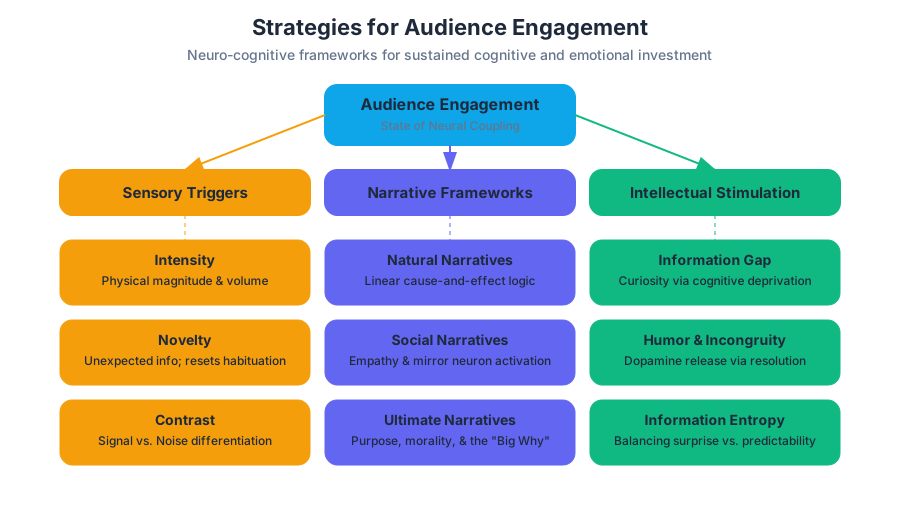
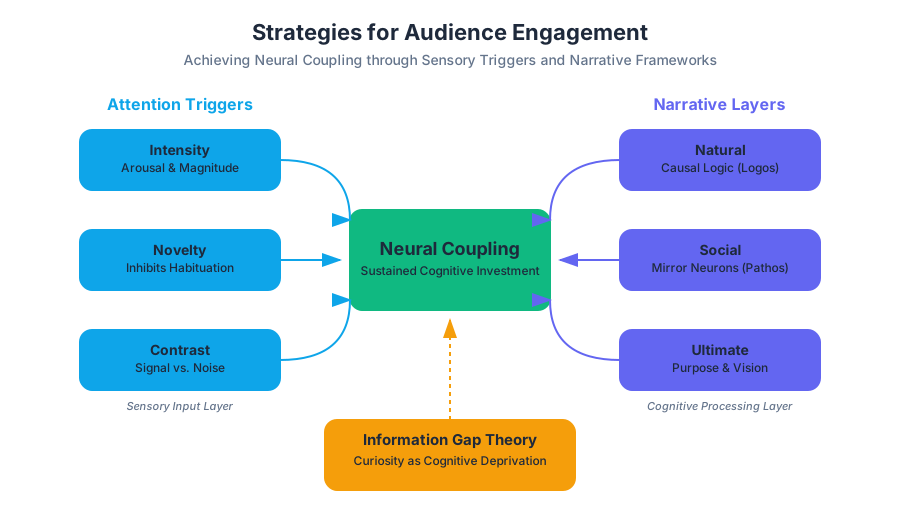
Persuasive Speaking and Rhetorical Analysis
Key concepts: Persuasive Speaking · Logos, Pathos, and Ethos · Rhetorical Analysis · Inspirational Speaking · Call to Action
The principles of influencing audience beliefs, values, and behaviors through logical and emotional appeals.
Persuasive Speaking and Rhetorical Analysis
Persuasion is the intentional process of modifying an audience's beliefs, attitudes, values, or behaviors through the strategic transmission of messages. Unlike informative speaking, which seeks to achieve non-partisan clarity, persuasive speaking operates within the "realm of the uncertain," where multiple viewpoints exist and the speaker must advocate for a specific cognitive or behavioral shift.
In the classical tradition, persuasion is categorized under Rhetoric—defined by Aristotle as "the faculty of observing in any given case the available means of persuasion." Modern rhetorical analysis treats a speech not merely as a performance, but as a complex system of inputs designed to navigate the psychological architecture of the listener.
The Architecture of Invention: The Rhetorical Triangle
At the core of persuasive theory lies the concept of Invention (inventio), the process of developing arguments. This is governed by the Rhetorical Triangle, a tripartite model of artistic proofs: Logos, Ethos, and Pathos. A successful persuasive effort requires a precise calibration of these three vectors based on the "rhetorical situation" (the audience, the occasion, and the exigence).
Logos: The Logical Calculus
Logos refers to the internal consistency and evidentiary strength of the argument. It is the "proof" or apparent proof provided by the words of the speech itself. Logos functions through two primary modes of reasoning:
- Deductive Reasoning: Moving from a general premise to a specific conclusion. The classic form is the Syllogism.
- Inductive Reasoning: Moving from specific instances to a general conclusion. This is the basis of scientific inquiry and anecdotal evidence.
The Enthymeme: In rhetoric, speakers often use an "incomplete syllogism" where one premise is unstated because it is already held by the audience. This forces the audience to participate in the construction of the argument, deepening their cognitive investment.
Ethos: The Credibility Vector
Ethos is the perceived credibility of the speaker. It is not a static trait but a dynamic variable that fluctuates throughout the speech. It is subdivided into:
- Initial Ethos: The reputation the speaker brings to the podium.
- Derived Ethos: The credibility earned during the speech through quality of evidence and delivery.
- Terminal Ethos: The lasting impression of the speaker’s character after the conclusion.
Pathos: The Emotional Resonance
Pathos involves the use of emotional appeals to put the audience into a specific frame of mind. While often dismissed as "manipulation," Pathos is essential for moving an audience from intellectual agreement (Logos) to actual behavior change (Actuation).
| Appeal | Domain | Mechanism | Objective |
|---|---|---|---|
| Logos | Cognition | Evidence, Data, Syllogisms | Intellectual Consent |
| Ethos | Perception | Authority, Character, Goodwill | Trust and Reliability |
| Pathos | Affect | Narratives, Metaphors, Values | Motivation and Urgency |
Formalizing Persuasion: The Bayesian Inference Model
To understand how persuasion works on a technical level, we can view it as a Bayesian Update. An audience member starts with a "prior belief" ($P(H)$). The speaker introduces "evidence" ($E$). The goal of the speech is to maximize the "posterior probability" ($P(H|E)$) that the speaker's proposition is true.
The following Python implementation demonstrates a simplified model of how evidence strength and speaker credibility (Ethos) interact to shift an audience's belief state.
import numpy as np

def calculate_belief_shift(prior_belief, evidence_strength, speaker_credibility):
    """
    Simulates the shift in audience belief using a weighted Bayesian update.

    :param prior_belief: float (0 to 1), the audience's initial agreement.
    :param evidence_strength: float (0 to 1), the logical weight of the argument (Logos).
    :param speaker_credibility: float (0 to 1), the perceived authority (Ethos).
    :return: float, the new belief state.
    """
    # Weight the evidence by the speaker's credibility
    effective_evidence = evidence_strength * speaker_credibility

    # Bayesian-inspired update: P(H|E) = (P(E|H) * P(H)) / P(E)
    # Here simplified to a reinforcement learning step
    posterior_belief = prior_belief + (effective_evidence * (1 - prior_belief))

    return np.clip(posterior_belief, 0, 1)

# Example: A skeptical audience (0.2) hearing a strong argument (0.8)
# from a highly credible speaker (0.9).
initial_state = 0.2
new_state = calculate_belief_shift(initial_state, 0.8, 0.9)

print(f"Initial Audience Agreement: {initial_state * 100}%")
print(f"Post-Speech Agreement: {round(new_state * 100, 2)}%")
Rhetorical Analysis: Deconstructing Influence
Rhetorical Analysis is the systematic study of how a text or speech functions to influence its audience. It does not ask "What is this speaker saying?" but rather "How is this speaker using language to achieve this specific effect?"
The Five Canons of Rhetoric
To perform a deep-dive analysis, one must evaluate the speech through the lens of the Five Canons, a framework originating from Cicero and Quintilian:
- Invention (Inventio): The discovery of valid or seemingly valid arguments.
- Arrangement (Dispositio): The distribution of arguments in an effective order.
- Style (Elocutio): The fitting of proper language to the invented matter (e.g., metaphors, parallelism).
- Memory (Memoria): The techniques used to retain the speech (modernly: the speaker's mastery of the content).
- Delivery (Pronuntiatio): The control of voice and body to suit the matter.
Logical Fallacies in Analysis
A critical component of rhetorical analysis is identifying fallacies—flaws in reasoning that may still be persuasive to an untrained ear.
| Fallacy | Description | Example |
|---|---|---|
| Ad Hominem | Attacking the person instead of the argument. | "We can't trust his tax plan; he's a known liar." |
| Post Hoc Ergo Propter Hoc | Assuming correlation implies causation. | "I wore my lucky socks and we won; therefore, the socks caused the win." |
| Straw Man | Misrepresenting an opponent's position to make it easier to attack. | "My opponent wants to cut the defense budget; he clearly wants us to be defenseless." |
| Slippery Slope | Claiming a small first step will inevitably lead to a chain of negative events. | "If we allow students to use tablets, soon they won't know how to read books at all." |
Arrangement: Structuring the Persuasive Flow
The order in which arguments are presented is often as important as the arguments themselves. In persuasive speaking, the Monroe’s Motivated Sequence is the industry standard for speeches of actuation (those calling for immediate action).
Monroe’s Motivated Sequence (MMS)
MMS follows a five-step psychological path:
- Attention: Capture the audience's interest.
- Need: Demonstrate a significant problem that requires a solution.
- Satisfaction: Provide a clear, workable solution to the problem.
- Visualization: Use "word pictures" to show the benefits of the solution or the costs of inaction.
- Action: Issue a specific, immediate Call to Action.
Mathematical Representation of Argument Weighting
In complex rhetorical situations, speakers must decide whether to lead with their strongest argument (Primacy Effect) or end with it (Recency Effect).
\text{Total Persuasive Impact} (I) = \sum_{i=1}^{n} (w_i \cdot A_i)
Where:
- $n$ = Number of arguments.
- $w_i$ = Weight of the $i$-th argument (determined by audience values).
- $A_i$ = Strength of the $i$-th argument (Logos/Ethos).
For a hostile audience, $w_i$ for controversial points is low; therefore, the speaker must lead with "Common Ground" arguments to increase their derived Ethos before tackling the core proposition.
Inspirational Speaking and the Call to Action
Inspirational Speaking is a subset of persuasion that focuses on reinforcing existing beliefs and elevating the audience's emotional state. While a standard persuasive speech might aim for a policy change, an inspirational speech aims for a "spirit change."
The Anatomy of a Call to Action (CTA)
A Call to Action is the "terminal node" of a persuasive speech. Without it, the energy generated by Pathos dissipates without effect. A high-conversion CTA must be:
- Specific: "Sign this petition" vs. "Do something."
- Low Friction: "Click the link in your inbox" vs. "Find the form on the website."
- Urgent: "We must act before the vote tonight."
Example: Strategic Metadata for a Persuasive Campaign
In a professional setting, rhetorical strategy is often documented before the speech is written. This YAML configuration represents the "pre-flight" analysis for a corporate persuasive pitch.
campaign: "Project Phoenix Implementation"
target_audience:
  segment: "Middle Management"
  prior_disposition: "Skeptical/Risk-Averse"
  core_values: ["Efficiency", "Budget-Compliance", "Job-Security"]

rhetorical_strategy:
  primary_appeal: "Logos"
  secondary_appeal: "Pathos (Fear of Obsolescence)"
  arrangement_pattern: "Comparative Advantage"

key_arguments:
  - id: 1
    type: "Logos"
    claim: "Automation reduces manual error by 40%."
    evidence: "2023 Q3 Internal Audit Data"
  - id: 2
    type: "Ethos"
    claim: "Adopted by 80% of Fortune 500 competitors."
    evidence: "Gartner Industry Report"

call_to_action:
  type: "Actuation"
  immediate_step: "Approve the Pilot Program budget by Friday."
Audience Analysis: The Data-Driven Foundation
Persuasion is impossible without a deep understanding of the audience. Audience Analysis involves gathering demographic and psychographic data to tailor the message.
The "Stasis Theory" Framework
Before crafting an argument, a speaker must identify the "Stasis"—the point at which the speaker and audience disagree.
- Conjecture: Did the act happen? (Facts)
- Definition: What is the nature of the act? (Categorization)
- Quality: How serious is the act? (Ethics/Severity)
- Policy: What should we do about it? (Action)
If the audience disagrees on Conjecture, a speech about Policy will fail.
SQL for Audience Segmentation
In modern digital rhetoric, speakers use data to segment audiences. A political campaigner might use the following query to identify which rhetorical appeal to send to different districts.
SELECT
    district_id,
    AVG(support_score) AS baseline_support,
    CASE
        WHEN economic_index < 40 THEN 'Pathos: Economic Hardship'
        WHEN education_level > 75 THEN 'Logos: Policy Detail'
        ELSE 'Ethos: Leadership/Trust'
    END AS recommended_appeal
FROM
    voter_demographics
GROUP BY
    district_id
HAVING
    AVG(support_score) BETWEEN 0.3 AND 0.6; -- Target the "Persuadable" middle
Common Pitfalls in Persuasion
Even with a mastery of the Rhetorical Triangle, speakers often fall into traps that trigger Psychological Reactance—the phenomenon where an audience perceives a threat to their freedom and strengthens their original belief in response.
- The "Boomerang Effect": Using overly aggressive Pathos (e.g., extreme fear-mongering) that causes the audience to shut down or reject the speaker entirely.
- The Over-Reliance on Logos: Assuming that "the facts speak for themselves." Facts require a narrative (Pathos) and a credible messenger (Ethos) to become meaningful.
- Ethos-Pathos Mismatch: Using a highly emotional delivery (Pathos) that undermines a speaker’s perceived professional competence (Ethos).
- Ignoring the "Middling" Audience: Focusing too much on "True Believers" (who don't need persuading) or "Hardened Opponents" (who won't be persuaded), rather than the "Persuadable Middle."
Conclusion: The Ethics of Influence
Because persuasion is a powerful tool for social engineering, it carries a heavy ethical burden. The Ethical Persuader follows the "Global Imperative":
- Honesty: Do not distort facts to suit the argument.
- Transparency: Disclose any personal interest in the outcome.
- Respect for Autonomy: Provide the audience with the information necessary to make an informed choice, rather than coercing them through psychological manipulation.
In the words of the classical rhetoricians, the goal is to be "a good person speaking well."
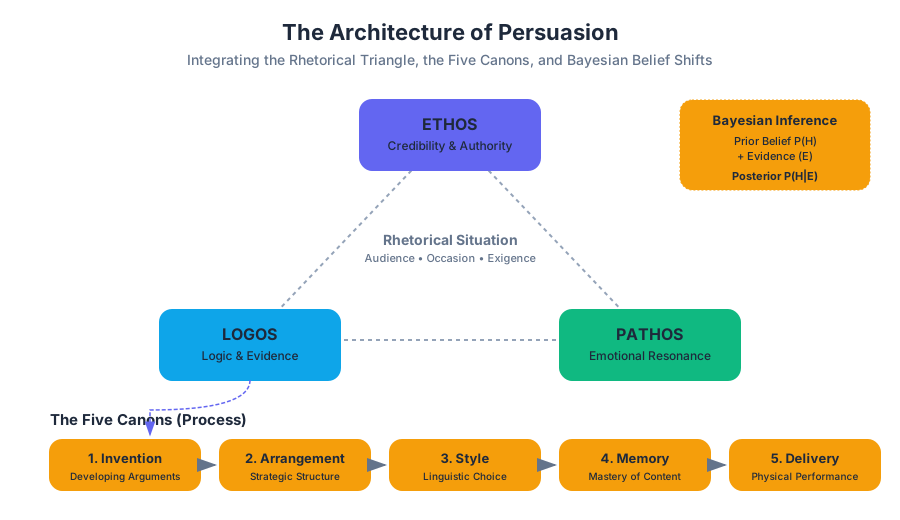
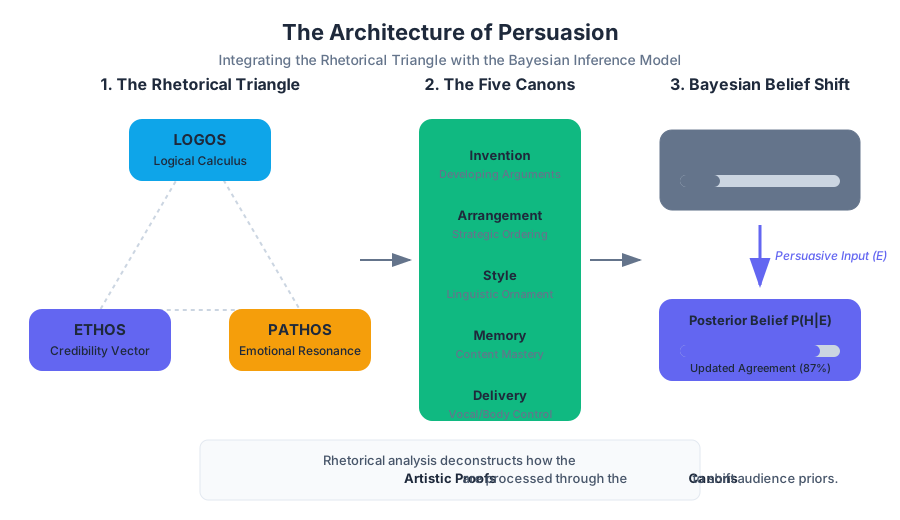
Organization, Outlining, and Delivery
Key concepts: Speech Outlining · Extemporaneous Delivery · APA Guidelines · Visual Aids · Introductions and Conclusions
The structural components of a speech, including the use of outlines, APA citations, and delivery methods like extemporaneous speaking.
Organization, Outlining, and Delivery
In the classical tradition of rhetoric, the transition from Invention (finding what to say) to Arrangement (organizing it) and Delivery (presenting it) represents the most critical phase of speech preparation. This phase transforms a collection of raw data and disparate ideas into a coherent, persuasive, and memorable cognitive experience for the audience. Effective organization is not merely a matter of neatness; it is a fundamental requirement for human information processing. Because oral communication is ephemeral—unlike a text that can be reread—the speaker must provide a clear "mental map" that the audience can follow in real-time.
The Architecture of Information: Speech Outlining
Outlining is the process of establishing a hierarchical structure for a speech. It serves as the blueprint for the presentation, ensuring that the logic is sound and the transitions are fluid. In public speaking pedagogy, we distinguish between the Preparation Outline (a full-sentence, detailed document) and the Speaking Outline (a condensed, keyword-based tool used during delivery).
The Principles of Outlining
A robust outline adheres to four logical pillars:
- Subordination: Lower-level points (sub-points) must support or expand upon the higher-level points (main points) they fall under.
- Coordination: Points at the same level of the hierarchy should carry approximately the same weight and importance.
- Division: If a point is divided, it must be divided into at least two sub-points (the "Rule of Two"). You cannot have an "A" without a "B."
- Parallelism: Main points should follow a similar grammatical structure to aid audience recall.
Comparison of Outline Types
| Feature | Preparation Outline | Speaking Outline |
|---|---|---|
| Format | Full, declarative sentences | Keywords and brief phrases |
| Purpose | To test logic, timing, and evidence | To prompt memory during delivery |
| Citations | Full bibliographic references (APA) | Abbreviated oral cues |
| Detail Level | High (includes all transitions/quotes) | Low (only essential "signposts") |
| Usage | Study and instructor review | Podium/Handheld use |
Implementation: Logic Representation
To understand the hierarchy of a speech, we can model it as a recursive data structure. This low-level representation ensures that the "Rule of Two" and subordination are programmatically enforced.
class SpeechNode:
    """Represents a structural element in a speech outline."""
    def __init__(self, title, content_type="point"):
        self.title = title
        self.content_type = content_type  # intro, body, conclusion, main_point, sub_point
        self.children = []

    def add_subpoint(self, node):
        self.children.append(node)

    def validate_division(self):
        """Ensures the 'Rule of Two': if a point has children, it must have at least 2."""
        if 0 < len(self.children) < 2:
            raise ValueError(f"Structural Error: Point '{self.title}' requires at least two sub-points.")
        for child in self.children:
            child.validate_division()

# Example: Constructing a speech on 'The Benefits of OER'
speech = SpeechNode("The Value of Open Educational Resources", "body")

# Main Point 1
mp1 = SpeechNode("Financial Accessibility", "main_point")
mp1.add_subpoint(SpeechNode("Reduction in textbook costs", "sub_point"))
mp1.add_subpoint(SpeechNode("Immediate access on day one", "sub_point"))

# Main Point 2
mp2 = SpeechNode("Pedagogical Flexibility", "main_point")
mp2.add_subpoint(SpeechNode("Customization of content", "sub_point"))
mp2.add_subpoint(SpeechNode("Integration of diverse voices", "sub_point"))

speech.add_subpoint(mp1)
speech.add_subpoint(mp2)
speech.validate_division() # Passes validation
Extemporaneous Delivery: The "Goldilocks" of Speaking
Extemporaneous Delivery is a method of speaking that involves thorough preparation and a well-organized outline but utilizes a conversational, non-scripted style during the actual presentation. It is widely considered the "gold standard" for professional and academic speaking because it balances the reliability of a manuscript with the spontaneity of impromptu speaking.
The Delivery Spectrum
| Method | Definition | Pros | Cons |
|---|---|---|---|
| Manuscript | Reading word-for-word from a script | Precise phrasing, exact timing | Poor eye contact, robotic tone |
| Memorized | Reciting a script from memory | High engagement (if perfect) | High risk of "blanking," inflexible |
| Impromptu | Speaking with little/no preparation | Authentic, responsive | Disorganized, high anxiety |
| Extemporaneous | Prepared structure, spontaneous wording | Adaptable, high eye contact | Requires significant practice |
Why It Matters: The "Illusion of the First Time"
Extemporaneous delivery allows for the Illusion of the First Time, a concept from acting where the speaker appears to be thinking through the ideas as they present them. This increases audience engagement because the speech feels like a live interaction rather than a pre-recorded broadcast. It also allows the speaker to monitor non-verbal feedback (puzzled looks, nodding) and adjust the explanation in real-time.
Common Pitfalls
- The "Scripting" Trap: Writing out the speech and then trying to "extemporize" from the script. This usually leads to the speaker getting lost when they miss a specific word.
- Under-preparation: Confusing "extemporaneous" with "impromptu." Without a rigorous outline, the speaker will likely ramble.
Academic Integrity and APA Guidelines
In public speaking, Ethos (credibility) is built through the ethical use of information. The APA (American Psychological Association) guidelines provide a standardized framework for citing sources. In a speech, this takes two forms: the written citation in the outline and the oral citation during the delivery.
The Oral Citation Formula
An effective oral citation should provide enough information for the audience to locate the source and judge its credibility without interrupting the flow of the speech.
Key Insight: Unlike a written paper where a parenthetical
(Smith, 2023)suffices, an oral citation should include the Author, the Publication/Source, and the Date.
Mapping Written APA to Oral Delivery
| Source Type | APA Written (Reference List) | Oral Citation Example |
|---|---|---|
| Journal Article | Author, A. A. (Year). Title. Journal, Vol(Issue). | "According to Dr. Lisa Schreiber in a 2023 article for the Communication Education journal..." |
| Website | Organization. (Year, Month Day). Title. URL | "As reported on the Lumen Learning website updated this past January..." |
| Book | Author, B. B. (Year). Title. Publisher. | "In his 2021 book The Art of Rhetoric, Brent Adrian argues that..." |
Mathematical Representation of Credibility (Ethos)
We can conceptualize the speaker's perceived credibility ($C$) as a function of their initial reputation ($R_i$), the quality of their evidence ($E$), and the perceived trustworthiness of their citations ($T$).
C = R_i + \sum_{k=1}^{n} (E_k \cdot T_k)
Where:
- $n$ is the number of sources cited.
- $E_k$ is the relevance/strength of the $k$-th piece of evidence.
- $T_k$ is the audience's trust in the $k$-th source (boosted by proper APA attribution).
Visual Aids and Cognitive Load
Visual aids (slides, objects, videos) are intended to supplement the spoken word, not replace it. Their effectiveness is grounded in Dual Coding Theory, which suggests that humans process information through two distinct channels: verbal and visual. When these channels work in harmony, retention increases; when they conflict, Cognitive Load increases, and learning decreases.
Design Principles (The CRAP Model)
- Contrast: Use colors and sizes to highlight the most important information.
- Repetition: Maintain consistent fonts and layouts to reduce processing effort.
- Alignment: Ensure every element has a visual connection to another element.
- Proximity: Group related items together to signal their relationship.
Technical Implementation: CSS for Visual Hierarchy
When designing digital aids, the underlying structure should reflect the hierarchy of the speech.
/* CSS for a 'Clean' Presentation Slide Layout */

.slide-container {
    display: flex;
    flex-direction: column;
    align-items: center;
    font-family: 'Helvetica', sans-serif;
    background-color: #ffffff;
    color: #333333;
}

.slide-header {
    font-size: 2.5em;
    font-weight: bold;
    color: #004a99; /* High contrast primary color */
    margin-bottom: 20px;
    border-bottom: 2px solid #004a99;
}

.visual-content {
    max-width: 80%;
    box-shadow: 0 4px 8px rgba(0,0,0,0.1);
}

.caption {
    font-style: italic;
    font-size: 1.1em;
    margin-top: 10px;
}
Pitfalls in Visual Aids
- The "Death by PowerPoint" Syndrome: Putting too much text on a slide. If the audience is reading, they are not listening.
- Technical Dependency: Failing to have a backup plan (the "Analog Failover") if the projector or software fails.
The Bookends: Introductions and Conclusions
The beginning and end of a speech are governed by the Serial Position Effect, a psychological phenomenon where people best remember the first and last items in a series.
The Introduction: The Five-Step Sequence
- Attention-Getter: A quote, statistic, story, or provocative question.
- Purpose/Thesis: A clear statement of what the speech is about.
- Credibility (Ethos) Statement: Why the speaker is qualified to speak on this topic.
- Relevance Statement: Why the audience should care (the "WIIFM" - What's In It For Me).
- Preview: A "roadmap" of the main points to follow.
The Conclusion: The Three-Step Sequence
- Signal the End: A transition like "In conclusion" or "To wrap up."
- Summary/Review: A restatement of the main points (reinforcing the preview).
- Clincher: A final, memorable statement that provides closure (often echoing the attention-getter).
Real-World Usage: CLI for Speech Timing
A professional speaker often uses a countdown or "pacer" to ensure they don't exceed their allotted time, especially during the critical "bookend" sections.
# A simple bash pacer for a 5-minute speech
# Usage: ./speech_timer.sh

echo "Speech Started: $(date)"
# Intro: 45 seconds
sleep 45 && echo "--- Move to Main Point 1 ---"
# Body: 3 minutes 30 seconds
sleep 210 && echo "--- Move to Conclusion ---"
# Conclusion: 45 seconds
sleep 45 && echo "--- STOP: Time Expired ---"
Summary of Best Practices
To master organization and delivery, a speaker must move from the abstract (ideas) to the concrete (the outline) and finally to the performative (the delivery).
| Phase | Key Action | Critical Metric |
|---|---|---|
| Organization | Logical Grouping | Mutual Exclusivity, Collective Exhaustivity (MECE) |
| Outlining | Hierarchical Mapping | Subordination and Coordination |
| Citing | Attribution | Source Credibility and APA Accuracy |
| Visuals | Dual Coding | Signal-to-Noise Ratio |
| Delivery | Extemporaneous Practice | Eye Contact and Vocal Variety |
- Subordination: The structural requirement that sub-points must support their parent main point.
- Extemporaneous Delivery: A prepared but conversational speaking style using a keyword outline.
- Oral Citation: The verbal attribution of a source during a speech, including author, date, and publication.
- Serial Position Effect: The psychological tendency to remember the beginning (primacy) and end (recency) of a presentation.
- Dual Coding Theory: The theory that brain processing is enhanced when verbal and visual information are presented simultaneously.
- Speaking Outline: A condensed version of a speech outline used as a memory aid during delivery.
- Ethos: The speaker's perceived credibility and character, often established through citations and delivery.
-
Which outlining principle is violated if a main point has only one sub-point?
- A) Subordination
- B) Coordination
- C) Division
- D) Parallelism Correct: C
-
What is the primary advantage of extemporaneous delivery over manuscript delivery?
- A) It allows for precise word-for-word accuracy.
- B) It eliminates the need for practice.
- C) It facilitates better eye contact and audience adaptation.
- D) It is the easiest method for beginners. Correct: C
-
In an oral citation, which of the following is usually NOT required unless specifically relevant?
- A) The author's name
- B) The page number
- C) The date of publication
- D) The name of the publication Correct: B
-
According to the Serial Position Effect, which part of the speech is an audience most likely to forget?
- A) The Attention-Getter
- B) The Main Points in the middle
- C) The Thesis Statement
- D) The Clincher Correct: B
-
What does the 'R' in the CRAP design model stand for?
- A) Relevance
- B) Rhetoric
- C) Repetition
- D) Resonance Correct: C
Core Objectives:
- Master the transition from a Preparation Outline to a Speaking Outline.
- Understand the 4 pillars of outlining: Subordination, Coordination, Division, and Parallelism.
- Differentiate between the four modes of delivery, focusing on the benefits of Extemporaneous Speaking.
- Learn to construct Oral Citations that build Ethos using APA guidelines.
- Apply Dual Coding Theory to create effective visual aids that minimize cognitive load.
- Structure Introductions and Conclusions to leverage the Primacy and Recency effects.
Practical Application: When practicing, record yourself using only a keyword outline. Check for "filler words" (um, ah) which often occur when the speaker is mentally searching for the next "node" in their outline hierarchy. Ensure your visual aids contain no more than 6 words per line and 6 lines per slide (the 6x6 rule) to maintain a high signal-to-noise ratio.
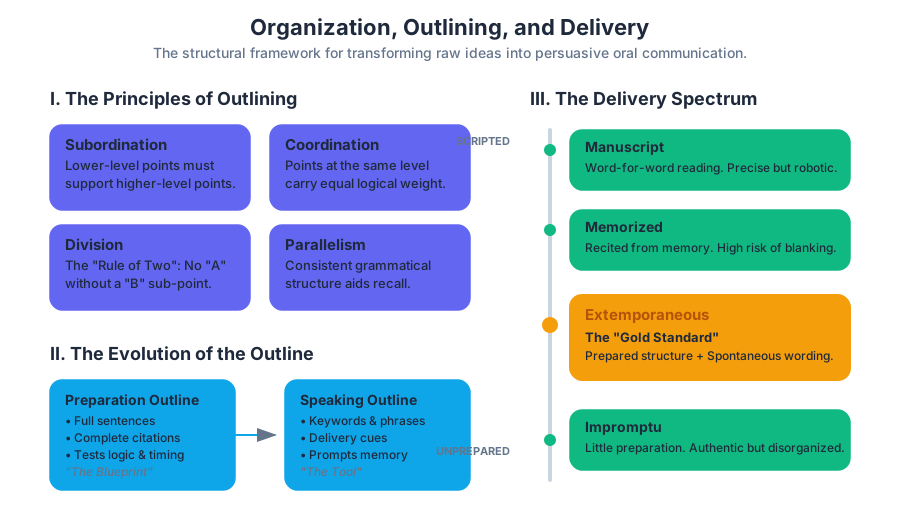
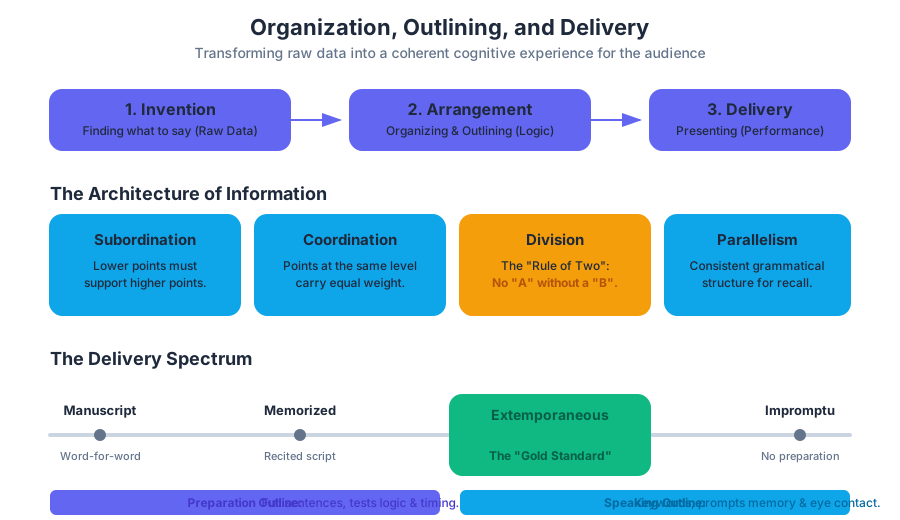
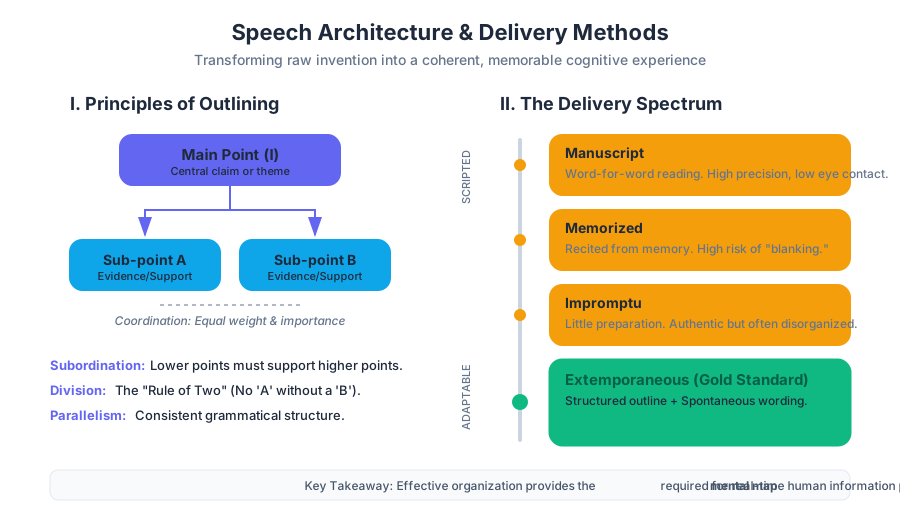
Assignments and Evaluation
Key concepts: Impromptu and Demonstration Speeches · Persuasive and Inspirational Speeches · Peer and Self-Evaluation · Classroom Etiquette · Extra Credit/Real-world Analysis
An overview of the practical applications of the course, including various speech assignments and the process of peer and self-evaluation.
Assignments and Evaluation
In the pedagogical framework of public speaking, the transition from theoretical understanding to rhetorical mastery is mediated by a structured sequence of assignments and rigorous evaluation protocols. This section details the "praxis" of the course—the specific speech types, the algorithmic approach to evaluation, and the professional standards required for effective communication.
The curriculum is designed as a progressive complexity pipeline. Students begin with low-stakes, spontaneous exercises to reduce communication apprehension (CA) and conclude with high-stakes, research-intensive persuasive performances. Evaluation is not merely a terminal grade but a recursive feedback loop involving self-reflection, peer critique, and expert assessment.
### The Taxonomy of Speech Assignments
Public speaking assignments are categorized by their general purpose: to inform, to demonstrate, to persuade, or to inspire. Each type requires a distinct cognitive load and organizational strategy.
1. Impromptu Speeches
The Impromptu Speech is a "cold-start" exercise. It tests the speaker's ability to synthesize thoughts under extreme time constraints (typically 1–2 minutes of preparation for a 2–3 minute delivery).
- Objective: To develop mental agility and the ability to organize thoughts using the PREP (Point, Reason, Example, Point) framework.
- Common Pitfall: "Ramble-looping," where the speaker repeats the same point because they lack a structural exit strategy.
2. Demonstration (Process) Speeches
The Demonstration Speech is a specialized form of informative speaking that explains how something works or how to perform a task. It relies heavily on visual aids and chronological sequencing.
- Objective: To master the "Spatial-Temporal" organizational pattern.
- Key Challenge: The "Curse of Knowledge"—assuming the audience understands intermediate steps without explicit explanation.
3. Persuasive and Inspirational Speeches
These represent the "High-Stakes" tier of the curriculum. Persuasive Speeches aim to change the audience's beliefs, values, or behaviors using the Monroe’s Motivated Sequence or Aristotelian logic. Inspirational Speeches focus on the Pathos (emotional) axis, aiming to uplift or commemorate.
| Speech Type | Primary Goal | Organizational Pattern | Typical Duration |
|---|---|---|---|
| Impromptu | Spontaneous Fluency | PREP or Past/Present/Future | 2–3 Minutes |
| Demonstration | Skill Acquisition | Chronological / Step-by-Step | 5–7 Minutes |
| Persuasive | Behavioral Change | Monroe's Motivated Sequence | 7–10 Minutes |
| Inspirational | Emotional Resonance | Narrative / Topical | 5–8 Minutes |
### The Mechanics of Persuasion: Monroe’s Motivated Sequence
For the persuasive assignment, students are often required to implement Monroe's Motivated Sequence (MMS). This is a five-step functional algorithm designed to move an audience from apathy to action.
- Attention: Capture the audience's focus immediately.
- Need: Demonstrate a significant problem (the "Need" for change).
- Satisfaction: Provide a specific, workable solution.
- Visualization: Use vivid imagery to show the benefits of the solution or the consequences of inaction.
- Action: Give a direct call to action (the "Exit Hook").
Theorem of Persuasive Impact: The probability of audience conversion ($P_c$) is a function of the perceived Magnitude of the Need ($M_n$) and the perceived Efficacy of the Solution ($E_s$), moderated by the Speaker's Credibility ($C$). $$P_c \propto (M_n \times E_s) \cdot C$$
### Evaluation Frameworks
Evaluation in a public speaking context is multidimensional. It moves beyond "did they sound good?" to a technical analysis of delivery, content, and structure.
Peer and Self-Evaluation
The Self-Evaluation is perhaps the most critical assignment for long-term growth. Students record their performances and perform a "post-mortem" analysis using a standardized rubric.
- Self-Evaluation: Focuses on identifying "Micro-Tics" (filler words, shifting weight) and "Macro-Errors" (logical fallacies, poor transitions).
- Peer Evaluation: Provides a "Distributed Intelligence" view of the speech. Peers act as a proxy for the general public, offering feedback on clarity and engagement.
The Feedback Algorithm
To ensure objective grading, we utilize a weighted rubric. Below is a Python-based representation of how a final speech grade might be calculated based on various weighted criteria.
def calculate_speech_grade(criteria_scores, weights):
    """
    Calculates the final grade for a speech assignment.

    :param criteria_scores: dict of {criterion: score_out_of_100}
    :param weights: dict of {criterion: weight_percentage}
    :return: float final_grade
    """
    final_grade = 0.0

    for criterion, score in criteria_scores.items():
        weight = weights.get(criterion, 0)
        weighted_score = (score * weight) / 100
        final_grade += weighted_score

    return round(final_grade, 2)

# Example: Persuasive Speech Evaluation
scores = {
    "Ethos_Credibility": 85,
    "Logos_Evidence": 92,
    "Pathos_Emotional_Appeal": 78,
    "Organization_MMS": 95,
    "Delivery_NonVerbal": 88
}

weights = {
    "Ethos_Credibility": 20,
    "Logos_Evidence": 25,
    "Pathos_Emotional_Appeal": 15,
    "Organization_MMS": 20,
    "Delivery_NonVerbal": 20
}

final_result = calculate_speech_grade(scores, weights)
print(f"Final Speech Grade: {final_result}%")
# Output: Final Speech Grade: 88.2%
### Speech Preparation and Outlining
A common mistake is treating a speech like an essay. A speech is a temporal medium, meaning the audience cannot "re-read" a sentence they missed. Therefore, the Outline is the primary architectural document.
Recursive Outlining Logic
The outlining process follows a hierarchical structure. Every sub-point must support its parent point. If a sub-point does not directly provide evidence or explanation for the main point, it is "orphaned" and must be removed.
ALGORITHM: Speech_Outline_Validation
INPUT: Outline_Tree
OUTPUT: Boolean (Is_Valid)

FUNCTION Validate(Node):
    IF Node is LEAF:
        RETURN True
    FOR EACH Child in Node.Children:
        IF NOT Supports(Child, Node):
            PRINT "Logic Error: Child does not support Parent"
            RETURN False
        IF NOT Validate(Child):
            RETURN False
    RETURN True

PROCEDURE Generate_Transitions(Node):
    FOR i FROM 0 TO Node.Children.Length - 2:
        Insert_Signpost(Node.Children[i], Node.Children[i+1])
The "Signposting" Requirement
In the evaluation phase, instructors look for Signposts—verbal markers that indicate where the speaker is in the speech (e.g., "Moving from the problem to the solution...").
| Signpost Type | Function | Example |
|---|---|---|
| Internal Preview | Forecasts upcoming sub-points | "I will now examine three causes of inflation..." |
| Internal Summary | Recaps a complex section | "Now that we've seen how the engine starts..." |
| Transition | Connects two main points | "Having discussed the symptoms, let's look at the cure." |
### Classroom Etiquette and Professionalism
The classroom is a laboratory. For the experiments (speeches) to succeed, the environment must be controlled. Classroom Etiquette is not about politeness; it is about Audience Responsibility.
- Active Listening: Evaluators look for non-verbal feedback from the audience (nodding, eye contact).
- The "No-Entry" Rule: Students must never enter or leave the room while a speaker is at the lectern. This preserves the "Rhetorical Space."
- Ethical Feedback: Critiques must be "Descriptive, not Evaluative." Instead of saying "Your speech was bad," a peer should say, "The evidence in point two did not seem to support the claim of urgency."
### Extra Credit and Real-world Analysis
To bridge the gap between the classroom and the "wild," extra credit assignments often involve Rhetorical Analysis of external speeches. This requires students to apply the course's analytical tools to professional or historical orators.
Real-world Analysis Framework
Students may attend a city council meeting, a TED talk, or a religious sermon and evaluate the speaker using the following parameters:
| Parameter | Analysis Vector |
|---|---|
| Audience Adaptation | Did the speaker use jargon? Did they acknowledge the local context? |
| Visual Aid Integration | Were the slides "Cognitive Load" heavy or did they provide "Dual Coding"? |
| Vocal Variety | Analysis of pitch, rate, and pauses (the "Silence as Emphasis" technique). |
| Fallacy Detection | Identifying Ad Hominem, Strawman, or Slippery Slope arguments. |
Database Schema for Speech Analysis
For students tracking their progress or instructors managing multiple sections, a structured database is essential for storing evaluation data.
-- Schema for a Speech Evaluation Management System
CREATE TABLE Students (
    student_id INT PRIMARY KEY,
    name VARCHAR(100),
    communication_apprehension_score INT
);

CREATE TABLE Assignments (
    assignment_id INT PRIMARY KEY,
    title VARCHAR(50), -- e.g., 'Persuasive', 'Impromptu'
    max_points INT,
    weight_in_final_grade DECIMAL(3, 2)
);

CREATE TABLE Evaluations (
    eval_id INT PRIMARY KEY,
    student_id INT,
    assignment_id INT,
    instructor_score DECIMAL(5, 2),
    peer_average_score DECIMAL(5, 2),
    self_eval_completed BOOLEAN,
    feedback_text TEXT,
    FOREIGN KEY (student_id) REFERENCES Students(student_id),
    FOREIGN KEY (assignment_id) REFERENCES Assignments(assignment_id)
);
### Common Pitfalls in Evaluation
- The Halo Effect: Grading a student higher on a persuasive speech because they were charming during their impromptu speech.
- Central Tendency Bias: Avoiding high or low scores and grading everyone in the "C+" to "B" range, which provides no actionable data for the student.
- The "Reading" Trap: Students often confuse "delivering a speech" with "reading a paper." Evaluation rubrics strictly penalize lack of eye contact resulting from manuscript dependency.
Key Insight: The goal of evaluation is to move the student from Unconscious Incompetence (not knowing they are bad) to Conscious Competence (working hard to be good), and eventually to Unconscious Competence (natural, fluid mastery).
- Monroe’s Motivated Sequence: A five-step organizational pattern for persuasion (Attention, Need, Satisfaction, Visualization, Action).
- Extemporaneous Delivery: A speech that is prepared and practiced but not memorized or read word-for-word.
- Signposting: Verbal cues that help the audience navigate the structure of a speech.
- Communication Apprehension (CA): The fear or anxiety associated with real or anticipated communication with others.
- Ethos, Pathos, Logos: The three pillars of rhetoric: Credibility, Emotion, and Logic.
- Peer Evaluation: The process of students providing structured feedback to their classmates based on rubric criteria.
- Spatial Pattern: An organizational structure based on physical geography or the parts of an object.
- Rhetorical Space: The conceptual environment created by the speaker and audience where ideas are exchanged.
- Which step of Monroe's Motivated Sequence focuses on showing the audience the negative consequences of not adopting the solution?
- A) Need
- B) Satisfaction
- C) Visualization (Correct)
- D) Action
- Why is an "Internal Preview" used in a speech?
- A) To introduce the speaker's credentials.
- B) To tell the audience what sub-points will be covered in the next section. (Correct)
- C) To summarize the entire speech at the end.
- D) To capture attention in the introduction.
- What is the primary difference between a Demonstration speech and a Persuasive speech?
- A) Demonstration focuses on "How-To"; Persuasion focuses on "Why-To" or "Should-To". (Correct)
- B) Demonstration is shorter than Persuasion.
- C) Persuasion requires visual aids, while Demonstration does not.
- D) Demonstration uses Pathos; Persuasion only uses Logos.
- In the "Theorem of Persuasive Impact," what happens if the Speaker's Credibility (C) is zero?
- A) The persuasion is still effective if the logic is strong.
- B) The total persuasive impact becomes zero. (Correct)
- C) The audience relies more on Pathos.
- D) The Need (Mn) must be doubled.
- True or False: Peer evaluation is primarily used to determine the final grade of a student.
- False (It is primarily used for feedback and developing the peer's analytical skills).
Core Competencies
- Structural Mastery: Ability to select and implement the correct organizational pattern (Chronological, Spatial, Topical, Causal, or Motivated Sequence) for a given speech type.
- Analytical Critique: The skill of deconstructing a speech into its constituent parts (Introduction, Body, Conclusion) and evaluating the efficacy of each.
- Delivery Mechanics: Mastering non-verbal channels including proxemics (use of space), kinesics (movement), and paralanguage (vocalics).
Assignment Checklist
- Impromptu: Practice "Thinking on your feet" using the PREP method.
- Demonstration: Ensure your visual aids are visible to the back of the room and integrated into your speech flow.
- Persuasive: Use at least three high-quality, peer-reviewed sources to build Logos.
- Self-Evaluation: Watch your speech video at least twice—once for content and once for delivery.
Advanced Concepts to Explore
- Cognitive Dissonance Theory: How to use psychological discomfort to motivate change in a persuasive speech.
- The Elaboration Likelihood Model (ELM): Understanding the "Central" vs. "Peripheral" routes to persuasion.
- Vocal Variety Algorithms: Analyzing the "prosody" or rhythm of top-tier speakers to improve one's own vocal delivery.
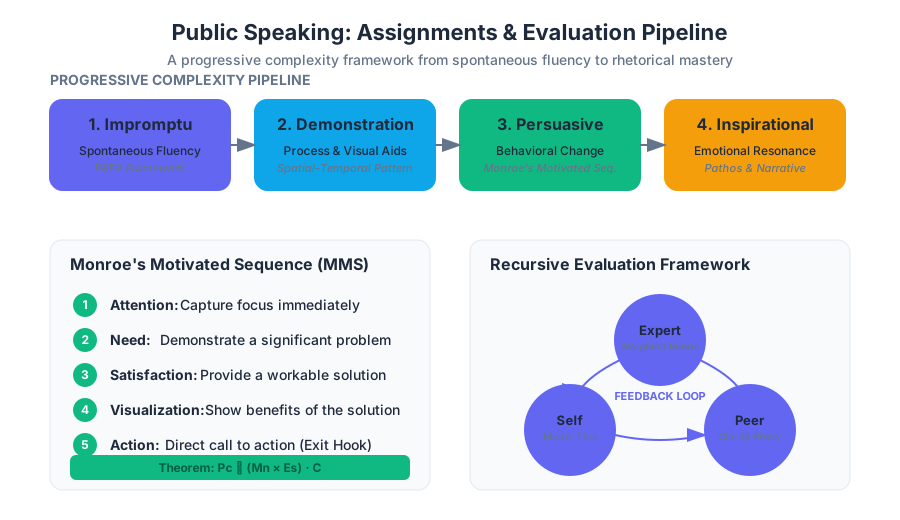
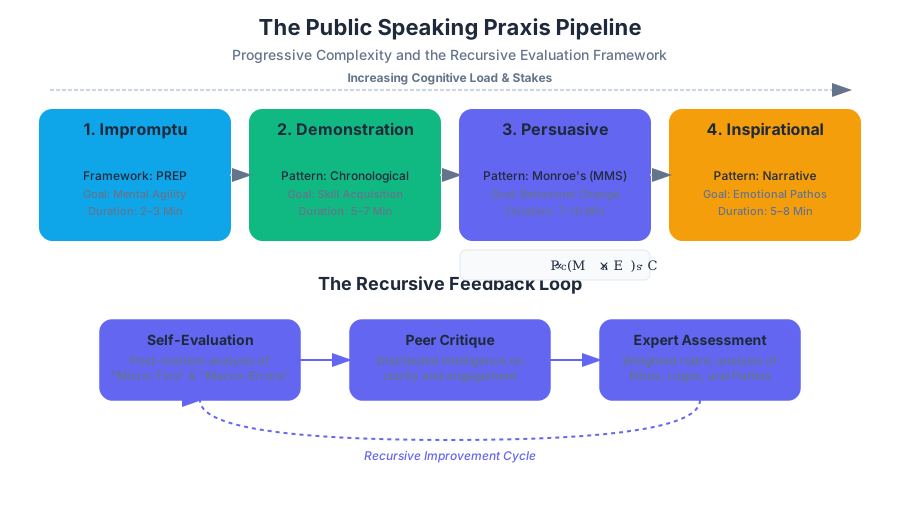
Source Materials
- Principles of Public Speaking
- Principles of Public Speaking
- Principles of Public Speaking
- Principles of Public Speaking
- Principles of Public Speaking
- Principles of Public Speaking
- Principles of Public Speaking PDF
- Principles of Public Speaking
- Principles of Public Speaking
- Wp Login.Php
- Brent Adrian, Central Community College
- Principles of Public Speaking
Study Principles of Public Speaking with AI — Free on Lykke
Sign up for free to generate personalized flashcards, quizzes, and study guides from this course. Chat with an AI tutor that knows the material.
Get Started FreeView this course wiki on Lykke · Browse all public course wikis