From the free course Principles of Public Speaking on Lykke
Speech Preparation and Topic Selection
Key concepts: General Purpose (Inform, Persuade, Commemorate) · Topic Selection · Audience Analysis · Finding a Purpose · Speech Preparation Tools
The initial stages of creating a presentation, focusing on identifying a general purpose and selecting a topic appropriate for the audience and occasion.
Speech Preparation and Topic Selection
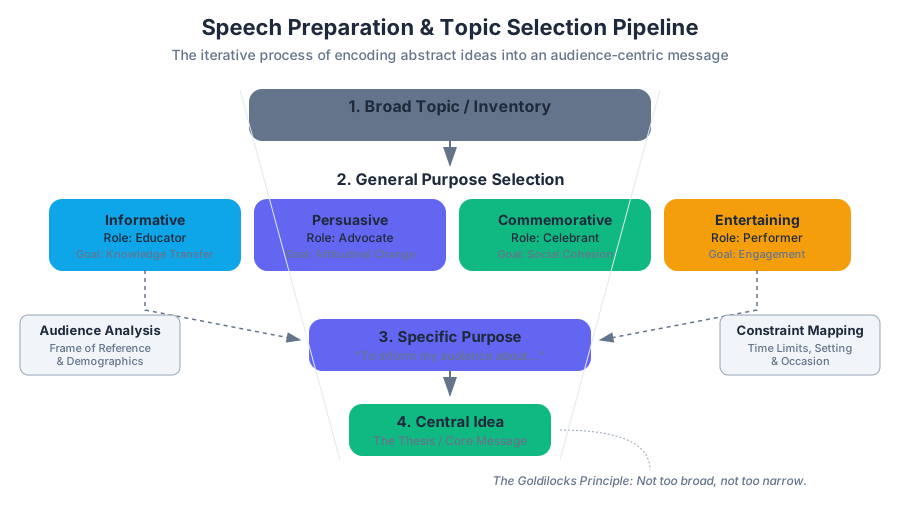
The efficacy of public speaking is rarely determined by the moment of delivery alone. Instead, it is the result of a rigorous, iterative process known as Speech Preparation. In the context of communication theory, preparation is the "encoding" phase where a speaker transforms abstract ideas into a structured, audience-centric message. This phase involves a systematic narrowing of focus—from a broad interest to a General Purpose, then to a Specific Purpose, and finally to a Central Idea.
Effective preparation mitigates Communication Apprehension (public speaking anxiety) by replacing uncertainty with a robust structural framework. By analyzing the audience’s worldview and the constraints of the speaking environment, a speaker can move from a speaker-centered approach ("What do I want to say?") to an audience-centered approach ("What does this audience need to hear, and how can I best deliver it?").
The Taxonomy of General Purposes
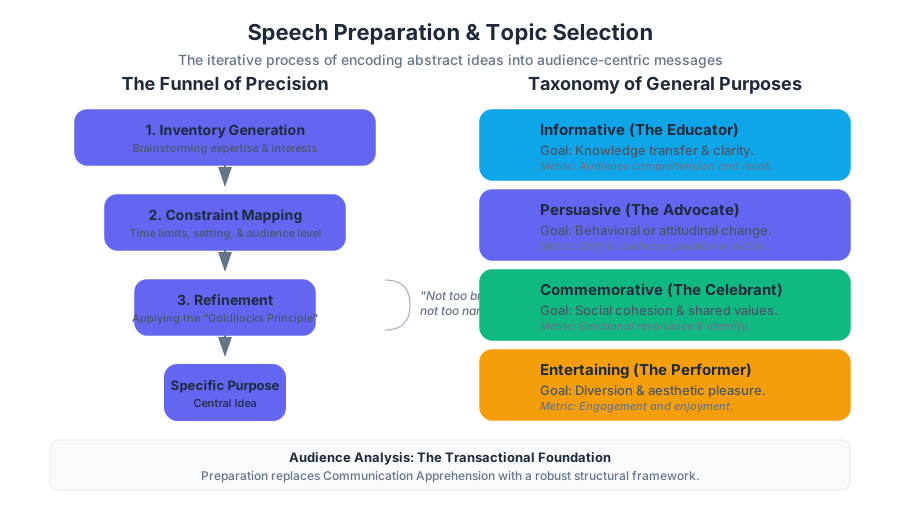
Every speech is governed by a General Purpose, which serves as the highest-level objective of the communication. In classical and contemporary rhetoric, these are categorized into three primary domains: Informative, Persuasive, and Commemorative.
Informative Speaking
The goal of Informative Speaking is to act as a teacher or translator. The speaker aims to increase the audience's knowledge or understanding of a topic without attempting to change their fundamental beliefs or behaviors. The primary metric of success is clarity and retention.
Persuasive Speaking
In Persuasive Speaking, the speaker acts as an advocate. The objective is to influence the audience's beliefs, attitudes, values, or behaviors. This requires a deep understanding of the audience's existing "latitude of acceptance" and the strategic use of Ethos (credibility), Logos (logic), and Pathos (emotion).
Commemorative and Entertainment Speaking
Commemorative Speaking (often including speeches of praise, toasts, or eulogies) seeks to strengthen the social bonds between the speaker and the audience by celebrating shared values or milestones. While often shorter, these speeches require high levels of emotional resonance and stylistic polish.
| Purpose Type | Speaker's Role | Primary Goal | Success Metric |
|---|---|---|---|
| Informative | Educator / Reporter | Knowledge Transfer | Audience comprehension and recall |
| Persuasive | Advocate / Catalyst | Behavioral/Attitudinal Change | Shift in audience position or action |
| Commemorative | Master of Ceremonies | Social Cohesion | Emotional resonance and shared identity |
| Entertaining | Performer | Diversion / Enjoyment | Audience engagement and aesthetic pleasure |
Topic Selection: The Funnel of Precision
Topic Selection is the process of identifying a subject that is timely, relevant, and appropriate for the constraints of the speaking engagement. A common pitfall for novice speakers is selecting a topic that is too broad (e.g., "Climate Change"), which leads to a superficial treatment of the subject.
The Selection Pipeline
- Inventory Generation: Brainstorming subjects based on personal expertise, current events, or audience interests.
- Constraint Mapping: Evaluating the topic against the time limit, the setting, and the audience's baseline knowledge.
- Refinement: Narrowing the topic until it can be covered in depth within the allotted time.
The Goldilocks Principle of Topic Selection: A topic must not be so broad that it becomes a list of generalizations, nor so narrow that it lacks significance for the audience. It must be "just right" for the specific temporal and situational constraints.
Recursive Topic Refinement Algorithm
To move from a broad category to a specific speech topic, speakers can use a recursive narrowing process.
Audience Analysis: The Transactional Foundation
In the Transactional Model of Communication, the audience is not a passive receiver but an active participant who decodes messages based on their unique Frame of Reference and Worldview. Audience Analysis is the systematic process of gathering and interpreting data about the listeners to tailor the speech effectively.
Demographic Analysis
Demographics are the observable characteristics of an audience. While useful, speakers must avoid Stereotyping, which is the assumption that all members of a group share the same beliefs.
| Demographic Variable | Strategic Consideration |
|---|---|
| Age | Influences cultural references, historical context, and life priorities. |
| Gender/Identity | Affects perspectives on social roles and inclusive language choices. |
| Education Level | Dictates the complexity of vocabulary and the depth of technical detail. |
| Religious/Political Affiliation | Shapes the underlying value systems and potential resistance to certain claims. |
Psychographic Analysis
Psychographics delve into the "why" of the audience—their attitudes, beliefs, and values. This is often more predictive of audience reaction than demographics alone.
- Attitudes: Favorable or unfavorable predispositions toward a topic.
- Beliefs: What the audience holds to be true or false (e.g., "Hard work leads to success").
- Values: Deep-seated principles that guide behavior (e.g., Freedom, Equality, Security).
Situational Analysis
This involves the physical and temporal context of the speech.
- Size: Larger audiences require more formal delivery; smaller ones allow for intimacy.
- Physical Setting: Lighting, acoustics, and the presence of a lectern.
- Disposition toward the Occasion: Is the audience there voluntarily (captivated) or because they have to be (captive)?
Finding a Purpose: The Specific Purpose Statement
Once the general purpose and topic are selected, the speaker must draft a Specific Purpose Statement. This is a single infinitive phrase that states precisely what the speaker hopes to accomplish.
Formula for the Specific Purpose
The Specific Purpose should follow a strict logical structure to ensure clarity:
[General Purpose] + [Audience Description] + [Specific Goal]
Example: "To inform (General Purpose) my classmates (Audience) about the three primary components of a blockchain (Specific Goal)."
The Central Idea (Thesis Statement)
While the Specific Purpose is an internal tool for the speaker, the Central Idea is what the speaker actually says to the audience. It is a one-sentence statement that sums up the major ideas of the speech.
Mathematical Logic of Speech Structure
If $S$ is the Speech, $P_s$ is the Specific Purpose, and $M_n$ are the Main Points:
$$S \approx P_s \implies \sum_{i=1}^{n} M_i$$
Where the sum of the main points must logically encompass the Specific Purpose without exceeding the scope defined by the Central Idea.
ALGORITHM: Speech Logic Verification
1. Define Specific Purpose (SP).
2. Define Central Idea (CI).
3. List Main Points (MP1, MP2, MP3).
4. IF (MP1 + MP2 + MP3) != CI THEN
      REVISE Main Points OR REVISE CI
5. IF CI does not satisfy SP THEN
      REVISE CI
6. END
Speech Preparation Tools and Workflow
Modern speech preparation leverages both traditional rhetorical methods and digital tools. The use of Open Educational Resources (OER) has revolutionized how students access high-quality research and templates without the financial burden of traditional textbooks.
The Outlining Process
Outlining is the "blueprint" phase. A Preparation Outline is a highly detailed document including full sentences, citations, and transitions. In contrast, a Speaking Outline (or delivery outline) consists of keywords and cues to facilitate extemporaneous delivery.
Research and Evidence
Effective preparation requires moving beyond general knowledge to find Supporting Materials:
- Examples: Specific instances to illustrate a point.
- Statistics: Numerical data to show magnitude or trends.
- Testimony: Quotations or paraphrases from experts or peers.
| Tool Category | Example Tools | Purpose in Preparation |
|---|---|---|
| Research Databases | JSTOR, Google Scholar | Finding peer-reviewed evidence and expert testimony. |
| Organization | MindMeister, Workflowy | Brainstorming and hierarchical structuring of ideas. |
| Visual Aids | Canva, PowerPoint, LaTeX Beamer | Creating "dual-coding" opportunities for the audience. |
| Readability | Hemingway Editor | Ensuring the oral style is simple and accessible. |
Common Pitfalls in Preparation
Even with a structured approach, speakers often encounter "traps" that can undermine their effectiveness:
- The "Information Dump": Providing too many facts without a clear narrative or "so what?" factor.
- Egocentricism: Failing to relate the topic to the audience's lived experience.
- Lack of Transition Logic: Moving between main points without showing the relationship between them.
- Plagiarism: Failing to credit sources. In public speaking, this includes "Global Plagiarism" (stealing an entire speech), "Patchwork Plagiarism" (stealing from multiple sources), and "Incremental Plagiarism" (failing to give credit for specific quotes or paraphrases).
Ethical Considerations in Topic Selection
Ethics in public speaking begins with topic selection. A speaker has an ethical obligation to:
- Be Prepared: Respect the audience's time by being thoroughly researched.
- Be Honest: Avoid distorting facts or using fallacious reasoning to win an argument.
- Avoid Name-Calling and Abusive Language: Maintain a "marketplace of ideas" where diverse perspectives are respected.
"The goal of public speaking is not just to be heard, but to contribute something of value to the public discourse." — Principles of Public Speaking
Source Materials
Study Principles of Public Speaking on Lykke
This course page is free to open: signed out, you can read its first two sections, and signing in, on any plan, opens the rest. The free Lykke Chrome extension syncs your own Canvas courses, so ChatGPT, Claude and Muse can answer from your classes and deadlines. It only reads Canvas.
Add the free extensionSign in to open every sectionAll sections of Principles of Public Speaking · Browse more course pages