From the free course Principles of Public Speaking on Lykke
Rhetoric and Core Competencies
Key concepts: Rhetoric · Invention (Logos, Pathos, Ethos) · Public Speaking Competence Rubric (PSCR) · Instruction, Imitation, and Practice · Eleven Core Competencies
Introduction to the classical roots of public speaking and the modern standards used to evaluate speaker effectiveness.
Rhetoric and Core Competencies
Public speaking is often misunderstood as a raw, innate talent—a "gift of gab" that one either possesses or lacks. In reality, the field of communication treats public speaking as a high-order cognitive and performance discipline. It is a synthesis of classical Rhetoric (the theoretical art of persuasion) and modern Core Competencies (the measurable behaviors that define effective communication).
To master this domain, one must move beyond the "performance" and into the "architecture" of a speech. This involves understanding the mechanics of Invention, the psychological levers of Ethos, Pathos, and Logos, and the rigorous metrics established by the Public Speaking Competence Rubric (PSCR).
The Classical Foundation: Rhetoric as an Art
At its core, Rhetoric is not merely "talking"; it is a strategic system of discovery and expression. Aristotle defined rhetoric as:
"The faculty of observing in any given case the available means of persuasion."
This definition shifts the focus from the speaker's ego to the speaker's analytical capability. The speaker is a researcher who scans the environment, the audience, and the subject matter to find the most effective "levers" to move an audience.
The Five Canons of Rhetoric
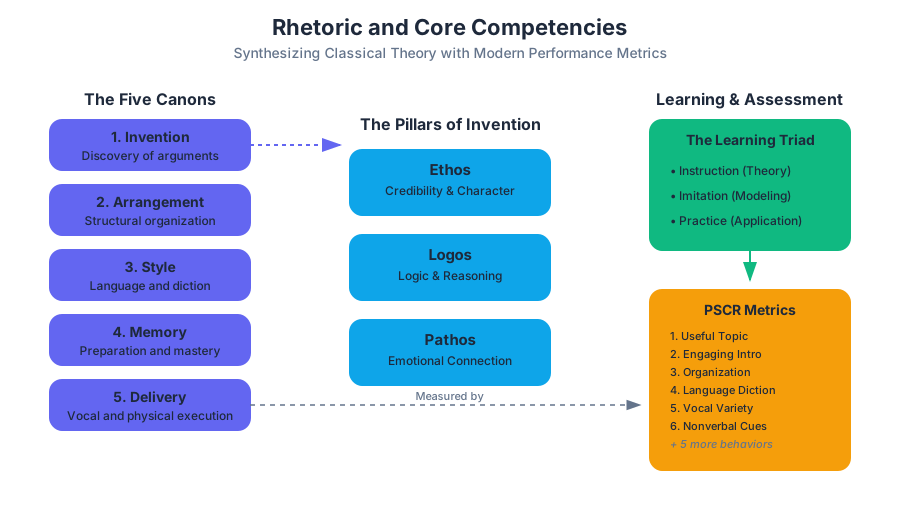
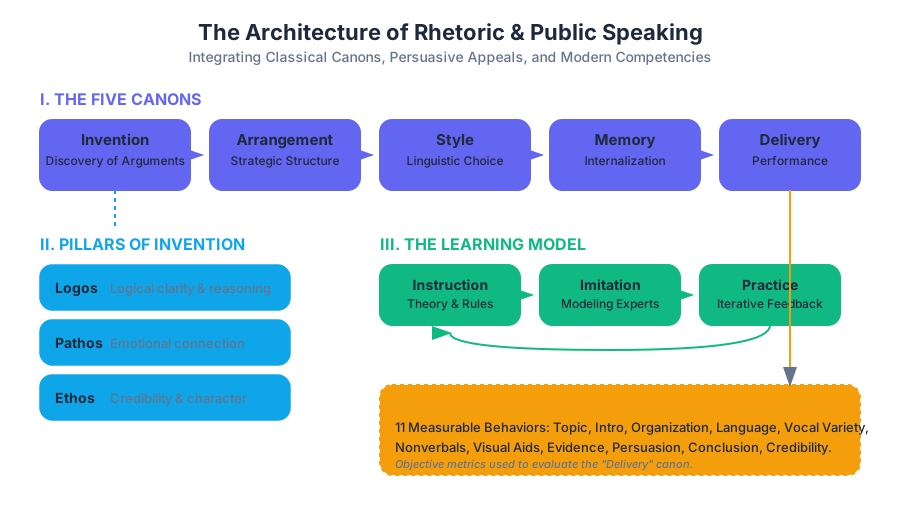
The classical tradition breaks the act of speech creation into five distinct stages, known as the Canons of Rhetoric. While modern curricula often emphasize delivery, the classical model suggests that the majority of the work happens before the speaker ever takes the stage.
| Canon | Focus | Description |
|---|---|---|
| Invention | Discovery | Finding the best arguments and evidence for the specific case. |
| Arrangement | Structure | Organizing the parts of the speech for maximum impact (Intro, Body, Conclusion). |
| Style | Language | Choosing the right words, metaphors, and rhetorical devices. |
| Memory | Preparation | Mastering the content so the speaker can engage the audience without reading. |
| Delivery | Performance | The physical and vocal execution of the speech. |
The Three Pillars of Invention: Logos, Pathos, and Ethos
Invention is the first and most critical canon. It is the process of developing the "substance" of the speech. To create a compelling argument, a speaker must balance three distinct modes of appeal.
1. Logos (The Logical Appeal)
Logos refers to the internal consistency and logical clarity of the message. It is the use of reasoning to lead the audience to a conclusion. This is achieved through two primary methods:
- Deductive Reasoning: Moving from general premises to a specific conclusion (e.g., the Syllogism).
- Inductive Reasoning: Moving from specific instances to a general conclusion (e.g., using statistics or case studies).
2. Pathos (The Emotional Appeal)
Pathos is the use of emotional triggers to align the audience's feelings with the speaker's goal. It is not about "manipulation" in the negative sense, but about creating a shared human experience. Effective pathos uses vivid imagery, storytelling, and personal anecdotes to make abstract data feel "real."
3. Ethos (The Ethical Appeal / Credibility)
Ethos is the perceived character of the speaker. According to Aristotle, ethos is composed of three qualities:
- Phronesis (Practical Wisdom): Does the speaker seem knowledgeable and competent?
- Arete (Virtue): Does the speaker seem honest and of good character?
- Eunoia (Goodwill): Does the speaker have the audience's best interests at heart?
The Learning Model: Instruction, Imitation, and Practice
The path to competence in public speaking follows a triadic pedagogical model. Unlike purely academic subjects, speaking requires a "studio" approach where theory is immediately applied to performance.
Instruction
Instruction involves the formal study of communication theory. This includes learning the rules of organization, the psychology of persuasion, and the ethics of public discourse. Without instruction, practice is merely the repetition of bad habits.
Imitation
Imitation (or mimesis) is the practice of analyzing and modeling expert speakers. By studying the "greats"—from Cicero to contemporary TED speakers—students learn to recognize patterns of effective delivery and structural nuance.
Practice
Practice is the iterative process of performance and feedback. In a high-level communication context, practice is not just "rehearsing"; it is the application of specific competencies in a controlled environment where the speaker can receive a "critique" (a technical evaluation) rather than just a "review" (a subjective opinion).
The Public Speaking Competence Rubric (PSCR)
To move from subjective "good/bad" labels to objective assessment, the communication discipline utilizes the Public Speaking Competence Rubric (PSCR). This tool breaks down a presentation into eleven discrete behaviors. Each behavior is scored on a scale (typically 0–3 or 1–5), allowing for a granular analysis of a speaker's strengths and weaknesses.
The Eleven Core Competencies
| Competency | Requirement | Advanced Level (Target) |
|---|---|---|
| 1. Useful Topic | Selection | Topic is timely, appropriate for the audience, and adds value. |
| 2. Engaging Intro | Hook/Thesis | Captures attention immediately and clearly states the purpose. |
| 3. Clear Organization | Structure | Follows a logical pattern (e.g., chronological, spatial, topical). |
| 4. Professional Language | Diction | Uses precise, vivid, and unbiased language; avoids jargon. |
| 5. Vocal Variety | Auditory | Varies pitch, rate, and volume to maintain interest and emphasize points. |
| 6. Nonverbal Cues | Physical | Eye contact, gestures, and posture reinforce the message. |
| 7. Visual Aids | Support | High-quality aids that clarify points without distracting. |
| 8. Strong Evidence | Logos | Uses credible, varied, and well-cited supporting materials. |
| 9. Persuasive Logic | Reasoning | Arguments are sound, free of fallacies, and tailored to the audience. |
| 10. Conclusion | Closure | Summarizes main points and provides a memorable "clincher." |
| 11. Audience Adaptation | Context | Adjusts content and delivery based on audience feedback and demographics. |
Analyzing Rhetorical Balance
In a modern context, we can think of these competencies and rhetorical appeals as variables in a system. A "balanced" speech optimizes these variables based on the speaker's intent. For example, a technical briefing might maximize Logos and Visual Aids, while a keynote address might maximize Pathos and Vocal Variety.
Logical Derivation of the Syllogism
In the realm of Logos, the most robust form of proof is the Syllogism. This is a deductive argument consisting of a major premise, a minor premise, and a conclusion. In formal logic, this is represented as:
\begin{array}{l}
\forall x (P(x) \rightarrow Q(x)) \quad \text{(Major Premise: All P are Q)} \\
P(a) \quad \text{(Minor Premise: $a$ is a P)} \\
\hline
\therefore Q(a) \quad \text{(Conclusion: Therefore, $a$ is a Q)}
\end{array}
Example of a Rhetorical Syllogism (The Enthymeme)
In public speaking, we rarely use full syllogisms because they sound overly formal. Instead, we use the Enthymeme, which is a syllogism with one premise unstated (implied by the audience).
- Syllogism: All humans are mortal. Socrates is human. Therefore, Socrates is mortal.
- Enthymeme: "Socrates is mortal because he's human." (The audience fills in the unstated premise that all humans are mortal).
The PSCR Data Structure
When evaluating a speaker using the Eleven Core Competencies, the data is often structured for longitudinal tracking. This allows an instructor or a professional coach to see how a speaker improves over time across different dimensions.
Common Pitfalls in Competency Development
Even with a clear rubric, speakers often fall into specific traps that hinder their development.
- The "Naturalism" Fallacy: Believing that "being yourself" is enough. While authenticity is important (Ethos), it does not replace the need for structure (Organization) and evidence (Logos).
- Over-reliance on Visuals: Using slides as a "crutch" or a transcript. Visual aids should supplement the speaker, not replace them.
- The "Data Dump": Providing too much Logos without Pathos. An audience can only process a limited amount of raw information before they lose interest.
- Neglecting the Introduction: Many speakers start with "Hi, my name is..." and a boring overview. The PSCR requires an engaging introduction that hooks the audience immediately.
Summary of the Eleven Competencies
To achieve mastery, a speaker must move through the stages of the PSCR. The following table summarizes the transition from a "Beginning" speaker to an "Advanced" speaker.
| Competency | Beginning (1) | Developing (2) | Advanced (3) |
|---|---|---|---|
| Organization | No clear structure; rambling. | Basic intro/body/conclusion. | Seamless transitions; logical flow. |
| Vocal Variety | Monotone or too quiet. | Some variation in volume/pitch. | Dynamic use of voice to convey emotion. |
| Nonverbal | Rigid; no eye contact. | Occasional gestures; some eye contact. | Natural movement; purposeful gestures. |
| Evidence | No sources cited; opinion-based. | Some sources cited; weak credibility. | Diverse, high-quality, cited evidence. |
Source Materials
Study Principles of Public Speaking on Lykke
This course page is free to open: signed out, you can read its first two sections, and signing in, on any plan, opens the rest. The free Lykke Chrome extension syncs your own Canvas courses, so ChatGPT, Claude and Muse can answer from your classes and deadlines. It only reads Canvas.
Add the free extensionSign in to open every sectionAll sections of Principles of Public Speaking · Browse more course pages