From the free course Principles of Public Speaking on Lykke
Persuasive Speaking and Rhetorical Analysis
Key concepts: Persuasive Speaking · Logos, Pathos, and Ethos · Rhetorical Analysis · Inspirational Speaking · Call to Action
The principles of influencing audience beliefs, values, and behaviors through logical and emotional appeals.
Persuasive Speaking and Rhetorical Analysis
Persuasion is the intentional process of modifying an audience's beliefs, attitudes, values, or behaviors through the strategic transmission of messages. Unlike informative speaking, which seeks to achieve non-partisan clarity, persuasive speaking operates within the "realm of the uncertain," where multiple viewpoints exist and the speaker must advocate for a specific cognitive or behavioral shift.
In the classical tradition, persuasion is categorized under Rhetoric—defined by Aristotle as "the faculty of observing in any given case the available means of persuasion." Modern rhetorical analysis treats a speech not merely as a performance, but as a complex system of inputs designed to navigate the psychological architecture of the listener.
The Architecture of Invention: The Rhetorical Triangle
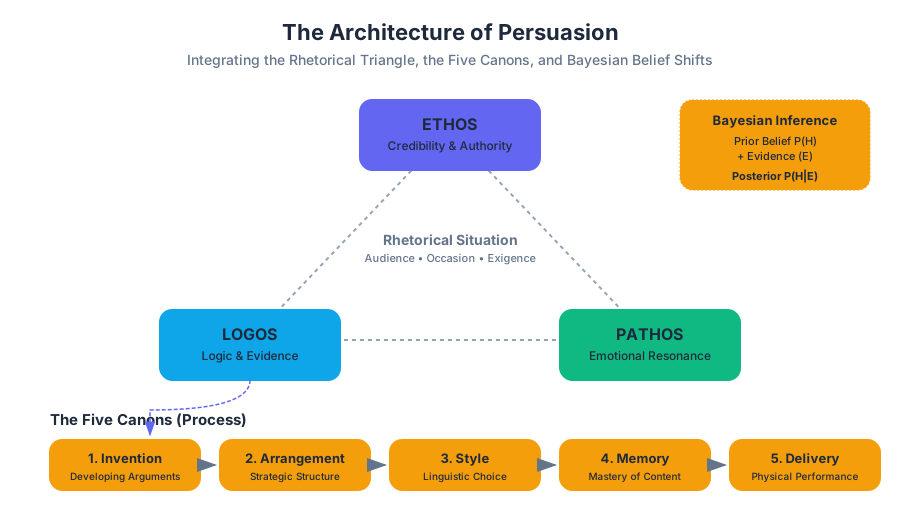
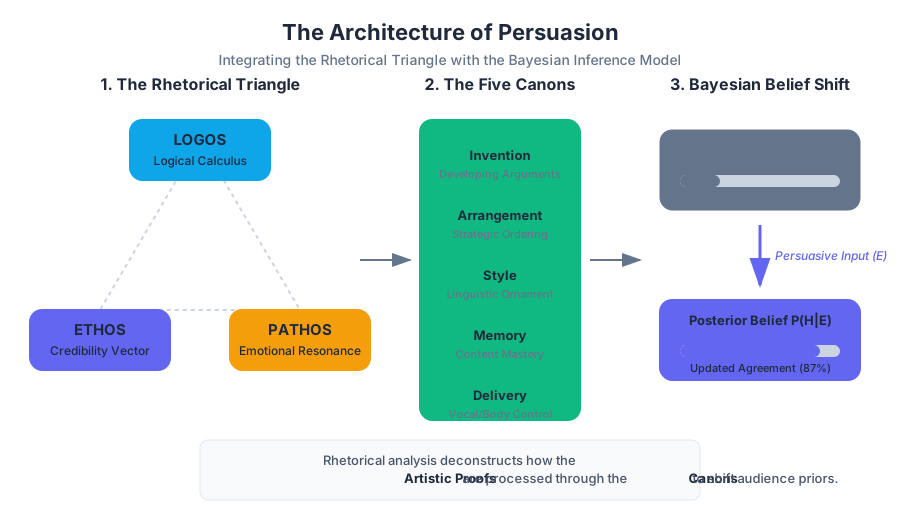
At the core of persuasive theory lies the concept of Invention (inventio), the process of developing arguments. This is governed by the Rhetorical Triangle, a tripartite model of artistic proofs: Logos, Ethos, and Pathos. A successful persuasive effort requires a precise calibration of these three vectors based on the "rhetorical situation" (the audience, the occasion, and the exigence).
Logos: The Logical Calculus
Logos refers to the internal consistency and evidentiary strength of the argument. It is the "proof" or apparent proof provided by the words of the speech itself. Logos functions through two primary modes of reasoning:
- Deductive Reasoning: Moving from a general premise to a specific conclusion. The classic form is the Syllogism.
- Inductive Reasoning: Moving from specific instances to a general conclusion. This is the basis of scientific inquiry and anecdotal evidence.
The Enthymeme: In rhetoric, speakers often use an "incomplete syllogism" where one premise is unstated because it is already held by the audience. This forces the audience to participate in the construction of the argument, deepening their cognitive investment.
Ethos: The Credibility Vector
Ethos is the perceived credibility of the speaker. It is not a static trait but a dynamic variable that fluctuates throughout the speech. It is subdivided into:
- Initial Ethos: The reputation the speaker brings to the podium.
- Derived Ethos: The credibility earned during the speech through quality of evidence and delivery.
- Terminal Ethos: The lasting impression of the speaker’s character after the conclusion.
Pathos: The Emotional Resonance
Pathos involves the use of emotional appeals to put the audience into a specific frame of mind. While often dismissed as "manipulation," Pathos is essential for moving an audience from intellectual agreement (Logos) to actual behavior change (Actuation).
| Appeal | Domain | Mechanism | Objective |
|---|---|---|---|
| Logos | Cognition | Evidence, Data, Syllogisms | Intellectual Consent |
| Ethos | Perception | Authority, Character, Goodwill | Trust and Reliability |
| Pathos | Affect | Narratives, Metaphors, Values | Motivation and Urgency |
Formalizing Persuasion: The Bayesian Inference Model
To understand how persuasion works on a technical level, we can view it as a Bayesian Update. An audience member starts with a "prior belief" ($P(H)$). The speaker introduces "evidence" ($E$). The goal of the speech is to maximize the "posterior probability" ($P(H|E)$) that the speaker's proposition is true.
Rhetorical Analysis: Deconstructing Influence
Rhetorical Analysis is the systematic study of how a text or speech functions to influence its audience. It does not ask "What is this speaker saying?" but rather "How is this speaker using language to achieve this specific effect?"
The Five Canons of Rhetoric
To perform a deep-dive analysis, one must evaluate the speech through the lens of the Five Canons, a framework originating from Cicero and Quintilian:
- Invention (Inventio): The discovery of valid or seemingly valid arguments.
- Arrangement (Dispositio): The distribution of arguments in an effective order.
- Style (Elocutio): The fitting of proper language to the invented matter (e.g., metaphors, parallelism).
- Memory (Memoria): The techniques used to retain the speech (modernly: the speaker's mastery of the content).
- Delivery (Pronuntiatio): The control of voice and body to suit the matter.
Logical Fallacies in Analysis
A critical component of rhetorical analysis is identifying fallacies—flaws in reasoning that may still be persuasive to an untrained ear.
| Fallacy | Description | Example |
|---|---|---|
| Ad Hominem | Attacking the person instead of the argument. | "We can't trust his tax plan; he's a known liar." |
| Post Hoc Ergo Propter Hoc | Assuming correlation implies causation. | "I wore my lucky socks and we won; therefore, the socks caused the win." |
| Straw Man | Misrepresenting an opponent's position to make it easier to attack. | "My opponent wants to cut the defense budget; he clearly wants us to be defenseless." |
| Slippery Slope | Claiming a small first step will inevitably lead to a chain of negative events. | "If we allow students to use tablets, soon they won't know how to read books at all." |
Arrangement: Structuring the Persuasive Flow
The order in which arguments are presented is often as important as the arguments themselves. In persuasive speaking, the Monroe’s Motivated Sequence is the industry standard for speeches of actuation (those calling for immediate action).
Monroe’s Motivated Sequence (MMS)
MMS follows a five-step psychological path:
- Attention: Capture the audience's interest.
- Need: Demonstrate a significant problem that requires a solution.
- Satisfaction: Provide a clear, workable solution to the problem.
- Visualization: Use "word pictures" to show the benefits of the solution or the costs of inaction.
- Action: Issue a specific, immediate Call to Action.
Mathematical Representation of Argument Weighting
In complex rhetorical situations, speakers must decide whether to lead with their strongest argument (Primacy Effect) or end with it (Recency Effect).
\text{Total Persuasive Impact} (I) = \sum_{i=1}^{n} (w_i \cdot A_i)
Where:
- $n$ = Number of arguments.
- $w_i$ = Weight of the $i$-th argument (determined by audience values).
- $A_i$ = Strength of the $i$-th argument (Logos/Ethos).
For a hostile audience, $w_i$ for controversial points is low; therefore, the speaker must lead with "Common Ground" arguments to increase their derived Ethos before tackling the core proposition.
Inspirational Speaking and the Call to Action
Inspirational Speaking is a subset of persuasion that focuses on reinforcing existing beliefs and elevating the audience's emotional state. While a standard persuasive speech might aim for a policy change, an inspirational speech aims for a "spirit change."
The Anatomy of a Call to Action (CTA)
A Call to Action is the "terminal node" of a persuasive speech. Without it, the energy generated by Pathos dissipates without effect. A high-conversion CTA must be:
- Specific: "Sign this petition" vs. "Do something."
- Low Friction: "Click the link in your inbox" vs. "Find the form on the website."
- Urgent: "We must act before the vote tonight."
Example: Strategic Metadata for a Persuasive Campaign
In a professional setting, rhetorical strategy is often documented before the speech is written.
Audience Analysis: The Data-Driven Foundation
Persuasion is impossible without a deep understanding of the audience. Audience Analysis involves gathering demographic and psychographic data to tailor the message.
The "Stasis Theory" Framework
Before crafting an argument, a speaker must identify the "Stasis"—the point at which the speaker and audience disagree.
- Conjecture: Did the act happen? (Facts)
- Definition: What is the nature of the act? (Categorization)
- Quality: How serious is the act? (Ethics/Severity)
- Policy: What should we do about it? (Action)
If the audience disagrees on Conjecture, a speech about Policy will fail.
Common Pitfalls in Persuasion
Even with a mastery of the Rhetorical Triangle, speakers often fall into traps that trigger Psychological Reactance—the phenomenon where an audience perceives a threat to their freedom and strengthens their original belief in response.
- The "Boomerang Effect": Using overly aggressive Pathos (e.g., extreme fear-mongering) that causes the audience to shut down or reject the speaker entirely.
- The Over-Reliance on Logos: Assuming that "the facts speak for themselves." Facts require a narrative (Pathos) and a credible messenger (Ethos) to become meaningful.
- Ethos-Pathos Mismatch: Using a highly emotional delivery (Pathos) that undermines a speaker’s perceived professional competence (Ethos).
- Ignoring the "Middling" Audience: Focusing too much on "True Believers" (who don't need persuading) or "Hardened Opponents" (who won't be persuaded), rather than the "Persuadable Middle."
Conclusion: The Ethics of Influence
Because persuasion is a powerful tool for social engineering, it carries a heavy ethical burden. The Ethical Persuader follows the "Global Imperative":
- Honesty: Do not distort facts to suit the argument.
- Transparency: Disclose any personal interest in the outcome.
- Respect for Autonomy: Provide the audience with the information necessary to make an informed choice, rather than coercing them through psychological manipulation.
In the words of the classical rhetoricians, the goal is to be "a good person speaking well."
Source Materials
Study Principles of Public Speaking on Lykke
This course page is free to open: signed out, you can read its first two sections, and signing in, on any plan, opens the rest. The free Lykke Chrome extension syncs your own Canvas courses, so ChatGPT, Claude and Muse can answer from your classes and deadlines. It only reads Canvas.
Add the free extensionSign in to open every sectionAll sections of Principles of Public Speaking · Browse more course pages