From the free course Principles of Public Speaking on Lykke
Organization, Outlining, and Delivery
Key concepts: Speech Outlining · Extemporaneous Delivery · APA Guidelines · Visual Aids · Introductions and Conclusions
The structural components of a speech, including the use of outlines, APA citations, and delivery methods like extemporaneous speaking.
Organization, Outlining, and Delivery
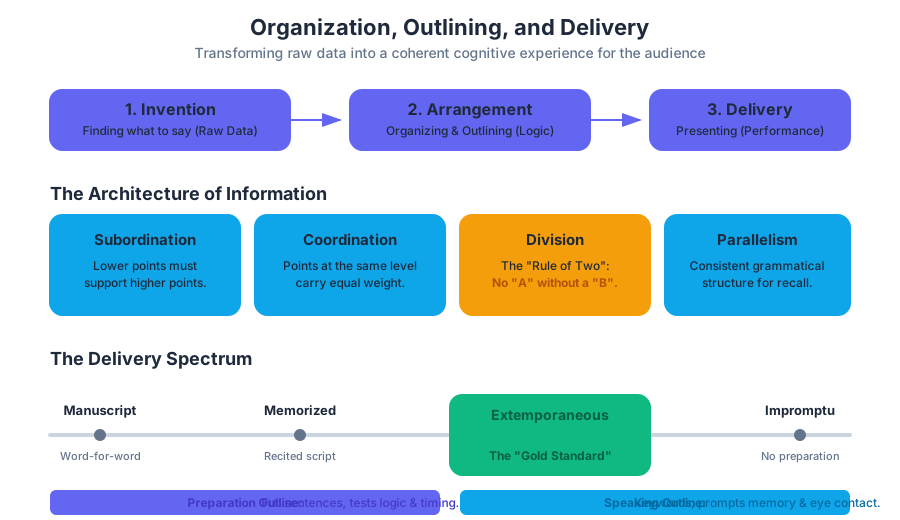
In the classical tradition of rhetoric, the transition from Invention (finding what to say) to Arrangement (organizing it) and Delivery (presenting it) represents the most critical phase of speech preparation. This phase transforms a collection of raw data and disparate ideas into a coherent, persuasive, and memorable cognitive experience for the audience. Effective organization is not merely a matter of neatness; it is a fundamental requirement for human information processing. Because oral communication is ephemeral—unlike a text that can be reread—the speaker must provide a clear "mental map" that the audience can follow in real-time.
The Architecture of Information: Speech Outlining
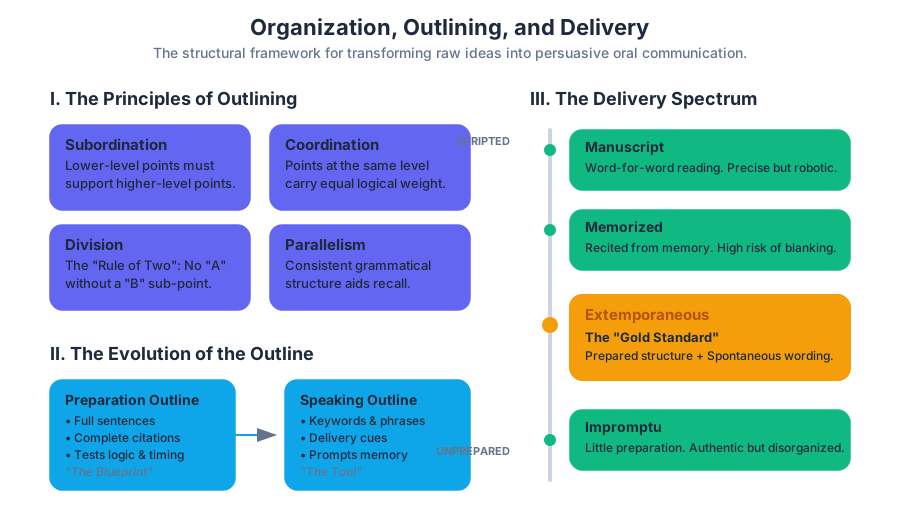
Outlining is the process of establishing a hierarchical structure for a speech. It serves as the blueprint for the presentation, ensuring that the logic is sound and the transitions are fluid. In public speaking pedagogy, we distinguish between the Preparation Outline (a full-sentence, detailed document) and the Speaking Outline (a condensed, keyword-based tool used during delivery).
The Principles of Outlining
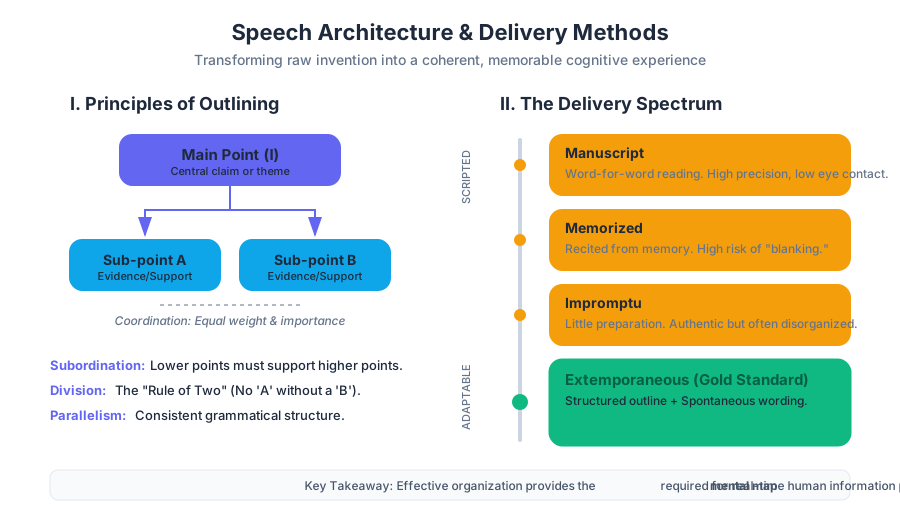
A robust outline adheres to four logical pillars:
- Subordination: Lower-level points (sub-points) must support or expand upon the higher-level points (main points) they fall under.
- Coordination: Points at the same level of the hierarchy should carry approximately the same weight and importance.
- Division: If a point is divided, it must be divided into at least two sub-points (the "Rule of Two"). You cannot have an "A" without a "B."
- Parallelism: Main points should follow a similar grammatical structure to aid audience recall.
Comparison of Outline Types
| Feature | Preparation Outline | Speaking Outline |
|---|---|---|
| Format | Full, declarative sentences | Keywords and brief phrases |
| Purpose | To test logic, timing, and evidence | To prompt memory during delivery |
| Citations | Full bibliographic references (APA) | Abbreviated oral cues |
| Detail Level | High (includes all transitions/quotes) | Low (only essential "signposts") |
| Usage | Study and instructor review | Podium/Handheld use |
Extemporaneous Delivery: The "Goldilocks" of Speaking
Extemporaneous Delivery is a method of speaking that involves thorough preparation and a well-organized outline but utilizes a conversational, non-scripted style during the actual presentation. It is widely considered the "gold standard" for professional and academic speaking because it balances the reliability of a manuscript with the spontaneity of impromptu speaking.
The Delivery Spectrum
| Method | Definition | Pros | Cons |
|---|---|---|---|
| Manuscript | Reading word-for-word from a script | Precise phrasing, exact timing | Poor eye contact, robotic tone |
| Memorized | Reciting a script from memory | High engagement (if perfect) | High risk of "blanking," inflexible |
| Impromptu | Speaking with little/no preparation | Authentic, responsive | Disorganized, high anxiety |
| Extemporaneous | Prepared structure, spontaneous wording | Adaptable, high eye contact | Requires significant practice |
Why It Matters: The "Illusion of the First Time"
Extemporaneous delivery allows for the Illusion of the First Time, a concept from acting where the speaker appears to be thinking through the ideas as they present them. This increases audience engagement because the speech feels like a live interaction rather than a pre-recorded broadcast. It also allows the speaker to monitor non-verbal feedback (puzzled looks, nodding) and adjust the explanation in real-time.
Common Pitfalls
- The "Scripting" Trap: Writing out the speech and then trying to "extemporize" from the script. This usually leads to the speaker getting lost when they miss a specific word.
- Under-preparation: Confusing "extemporaneous" with "impromptu." Without a rigorous outline, the speaker will likely ramble.
Academic Integrity and APA Guidelines
In public speaking, Ethos (credibility) is built through the ethical use of information. The APA (American Psychological Association) guidelines provide a standardized framework for citing sources. In a speech, this takes two forms: the written citation in the outline and the oral citation during the delivery.
The Oral Citation Formula
An effective oral citation should provide enough information for the audience to locate the source and judge its credibility without interrupting the flow of the speech.
Key Insight: Unlike a written paper where a parenthetical
(Smith, 2023)suffices, an oral citation should include the Author, the Publication/Source, and the Date.
Mapping Written APA to Oral Delivery
| Source Type | APA Written (Reference List) | Oral Citation Example |
|---|---|---|
| Journal Article | Author, A. A. (Year). Title. Journal, Vol(Issue). | "According to Dr. Lisa Schreiber in a 2023 article for the Communication Education journal..." |
| Website | Organization. (Year, Month Day). Title. URL | "As reported on the Lumen Learning website updated this past January..." |
| Book | Author, B. B. (Year). Title. Publisher. | "In his 2021 book The Art of Rhetoric, Brent Adrian argues that..." |
Mathematical Representation of Credibility (Ethos)
We can conceptualize the speaker's perceived credibility ($C$) as a function of their initial reputation ($R_i$), the quality of their evidence ($E$), and the perceived trustworthiness of their citations ($T$).
C = R_i + \sum_{k=1}^{n} (E_k \cdot T_k)
Where:
- $n$ is the number of sources cited.
- $E_k$ is the relevance/strength of the $k$-th piece of evidence.
- $T_k$ is the audience's trust in the $k$-th source (boosted by proper APA attribution).
Visual Aids and Cognitive Load
Visual aids (slides, objects, videos) are intended to supplement the spoken word, not replace it. Their effectiveness is grounded in Dual Coding Theory, which suggests that humans process information through two distinct channels: verbal and visual. When these channels work in harmony, retention increases; when they conflict, Cognitive Load increases, and learning decreases.
Design Principles (The CRAP Model)
- Contrast: Use colors and sizes to highlight the most important information.
- Repetition: Maintain consistent fonts and layouts to reduce processing effort.
- Alignment: Ensure every element has a visual connection to another element.
- Proximity: Group related items together to signal their relationship.
Pitfalls in Visual Aids
- The "Death by PowerPoint" Syndrome: Putting too much text on a slide. If the audience is reading, they are not listening.
- Technical Dependency: Failing to have a backup plan (the "Analog Failover") if the projector or software fails.
The Bookends: Introductions and Conclusions
The beginning and end of a speech are governed by the Serial Position Effect, a psychological phenomenon where people best remember the first and last items in a series.
The Introduction: The Five-Step Sequence
- Attention-Getter: A quote, statistic, story, or provocative question.
- Purpose/Thesis: A clear statement of what the speech is about.
- Credibility (Ethos) Statement: Why the speaker is qualified to speak on this topic.
- Relevance Statement: Why the audience should care (the "WIIFM" - What's In It For Me).
- Preview: A "roadmap" of the main points to follow.
The Conclusion: The Three-Step Sequence
- Signal the End: A transition like "In conclusion" or "To wrap up."
- Summary/Review: A restatement of the main points (reinforcing the preview).
- Clincher: A final, memorable statement that provides closure (often echoing the attention-getter).
Summary of Best Practices
To master organization and delivery, a speaker must move from the abstract (ideas) to the concrete (the outline) and finally to the performative (the delivery).
| Phase | Key Action | Critical Metric |
|---|---|---|
| Organization | Logical Grouping | Mutual Exclusivity, Collective Exhaustivity (MECE) |
| Outlining | Hierarchical Mapping | Subordination and Coordination |
| Citing | Attribution | Source Credibility and APA Accuracy |
| Visuals | Dual Coding | Signal-to-Noise Ratio |
| Delivery | Extemporaneous Practice | Eye Contact and Vocal Variety |
- Subordination: The structural requirement that sub-points must support their parent main point.
- Extemporaneous Delivery: A prepared but conversational speaking style using a keyword outline.
- Oral Citation: The verbal attribution of a source during a speech, including author, date, and publication.
- Serial Position Effect: The psychological tendency to remember the beginning (primacy) and end (recency) of a presentation.
- Dual Coding Theory: The theory that brain processing is enhanced when verbal and visual information are presented simultaneously.
- Speaking Outline: A condensed version of a speech outline used as a memory aid during delivery.
- Ethos: The speaker's perceived credibility and character, often established through citations and delivery.
-
Which outlining principle is violated if a main point has only one sub-point?
- A) Subordination
- B) Coordination
- C) Division
- D) Parallelism Correct: C
-
What is the primary advantage of extemporaneous delivery over manuscript delivery?
- A) It allows for precise word-for-word accuracy.
- B) It eliminates the need for practice.
- C) It facilitates better eye contact and audience adaptation.
- D) It is the easiest method for beginners. Correct: C
-
In an oral citation, which of the following is usually NOT required unless specifically relevant?
- A) The author's name
- B) The page number
- C) The date of publication
- D) The name of the publication Correct: B
-
According to the Serial Position Effect, which part of the speech is an audience most likely to forget?
- A) The Attention-Getter
- B) The Main Points in the middle
- C) The Thesis Statement
- D) The Clincher Correct: B
-
What does the 'R' in the CRAP design model stand for?
- A) Relevance
- B) Rhetoric
- C) Repetition
- D) Resonance Correct: C
Core Objectives:
- Master the transition from a Preparation Outline to a Speaking Outline.
- Understand the 4 pillars of outlining: Subordination, Coordination, Division, and Parallelism.
- Differentiate between the four modes of delivery, focusing on the benefits of Extemporaneous Speaking.
- Learn to construct Oral Citations that build Ethos using APA guidelines.
- Apply Dual Coding Theory to create effective visual aids that minimize cognitive load.
- Structure Introductions and Conclusions to leverage the Primacy and Recency effects.
Practical Application: When practicing, record yourself using only a keyword outline. Check for "filler words" (um, ah) which often occur when the speaker is mentally searching for the next "node" in their outline hierarchy. Ensure your visual aids contain no more than 6 words per line and 6 lines per slide (the 6x6 rule) to maintain a high signal-to-noise ratio.
Source Materials
Study Principles of Public Speaking on Lykke
This course page is free to open: signed out, you can read its first two sections, and signing in, on any plan, opens the rest. The free Lykke Chrome extension syncs your own Canvas courses, so ChatGPT, Claude and Muse can answer from your classes and deadlines. It only reads Canvas.
Add the free extensionSign in to open every sectionAll sections of Principles of Public Speaking · Browse more course pages