From the free course Principles of Public Speaking on Lykke
Foundations of Informative Speaking
Key concepts: Functions of Informative Speeches · Speaker Objectivity · Antecedent vs. Consequent Credibility · WIIFM (What’s In It For Me?) · Information vs. Knowledge
An exploration of the goals and ethical responsibilities of the informative speaker, emphasizing objectivity and credibility.
Foundations of Informative Speaking
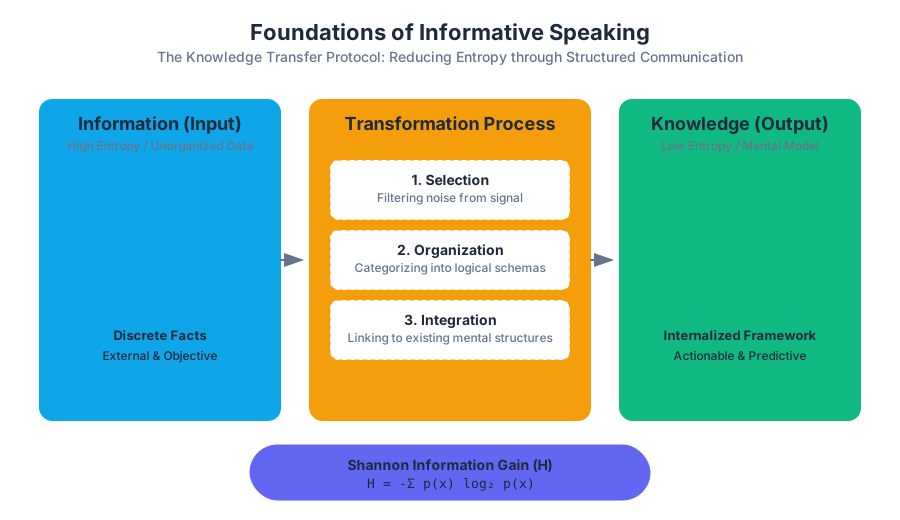
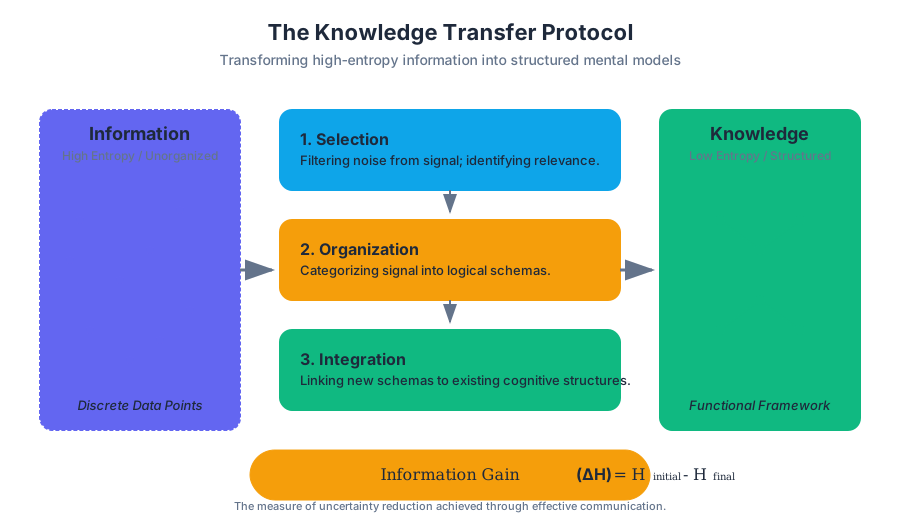
Informative speaking is the pedagogical backbone of human communication. Unlike persuasive speaking, which seeks to alter an audience’s beliefs, values, or behaviors, informative speaking is designed to reduce uncertainty and increase the audience’s conceptual understanding of a specific domain. In the classical tradition, this was often categorized under the broader umbrella of rhetoric, specifically the "invention" of logical arguments (logos) to illuminate a subject. However, in a modern technical context, we view informative speaking as a knowledge transfer protocol—a structured method for moving information from a high-entropy state (the speaker's complex internal model) to a lower-entropy, organized state within the audience's mind.
Information vs. Knowledge: The Ontological Distinction
To master informative speaking, one must first distinguish between Information and Knowledge. While often used interchangeably in colloquial speech, they represent different stages of cognitive processing.
Definition: The DIKW Hierarchy In the context of communication theory, Information is data endowed with relevance and purpose. Knowledge is the synthesis of information into a functional framework that allows for application, judgment, and prediction.
The informative speaker’s primary task is not merely to transmit information, but to facilitate the audience’s transition from possessing information to possessing knowledge. This requires the speaker to provide context, establish relationships between variables, and offer a "mental map" of the territory.
The Transformation Process
The process of turning information into knowledge involves three distinct cognitive operations:
- Selection: Filtering noise from signal.
- Organization: Categorizing the signal into logical schemas.
- Integration: Linking new schemas to the audience's existing cognitive structures.
| Attribute | Information | Knowledge |
|---|---|---|
| Nature | Discrete, objective facts or data points. | Holistic, internalized understanding. |
| Storage | Databases, books, external media. | Neural networks, mental models. |
| Actionability | Low; requires interpretation. | High; enables decision-making. |
| Speaker Role | The Transmitter (Source). | The Facilitator (Teacher). |
| Entropy | High (unorganized). | Low (structured). |
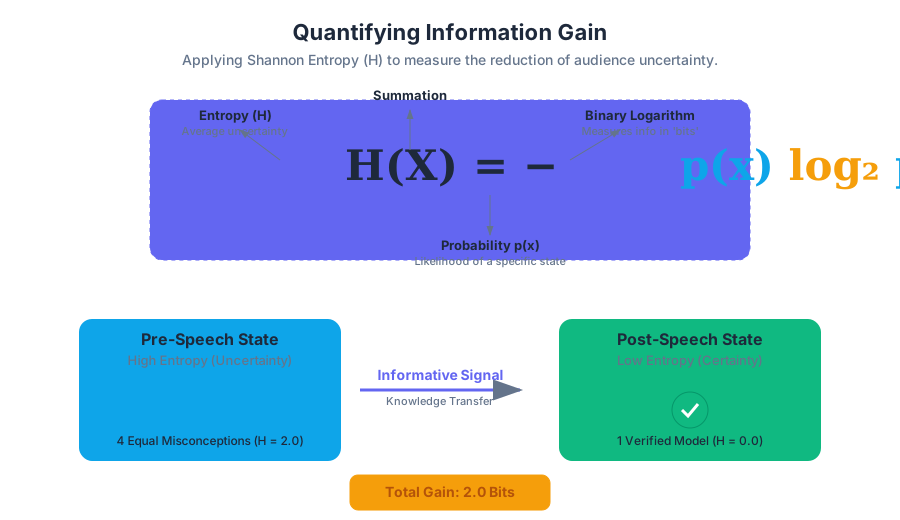
To quantify the "informativeness" of a speech, we can look at it through the lens of Shannon Entropy. If a speaker tells an audience something they already know, the information gain ($H$) is zero. True informative speaking maximizes the information gain by providing "surprising" (new) but "decodable" (understandable) data.
Functions of Informative Speeches
Informative speeches serve four critical functions within a social or professional ecosystem. Understanding these functions allows a speaker to tailor their content to the specific needs of the environment.
1. Providing Knowledge
This is the most direct function. The speaker acts as a repository of specialized data, translating complex jargon into accessible language.
2. Shaping Perception
Information is never neutral in its effect. By choosing which facts to highlight, a speaker shapes how an audience perceives a reality. For instance, a speech on "The History of the Internet" can be framed as a triumph of military engineering or a triumph of grassroots collaboration. Both are informative, but they shape different conceptual perceptions.
3. Articulating Alternatives
In decision-making contexts, informative speeches provide the "menu" of options. Before a group can choose a path (persuasion), they must understand the available paths (information).
4. Enhancing Survival and Utility
On a fundamental level, informative speaking is a survival mechanism. Passing down information about how to perform a task, avoid a danger, or utilize a tool ensures the continuity of a community or organization.
| Function | Primary Goal | Example Scenario |
|---|---|---|
| Knowledge Provision | Fact transfer | A lecture on Quantum Mechanics. |
| Perception Shaping | Contextual framing | Explaining the "Ethics of AI" to developers. |
| Alternative Articulation | Option mapping | Presenting three different cloud architectures to a CTO. |
| Survival/Utility | Skill acquisition | A safety briefing for a chemical plant. |
Speaker Objectivity: The Neutrality Constraint
The hallmark of the informative speech is Objectivity. Unlike the advocate, who has a "stake" in the outcome, the informative speaker must maintain a disinterested stance. This does not mean the speaker lacks an opinion; rather, it means they deliberately suppress that opinion to prioritize the audience's independent processing of the facts.
The Spectrum of Neutrality
Objectivity is often a matter of degree. We can model the speaker's stance using a Neutrality Index, where 1.0 is absolute clinical detachment and 0.0 is pure propaganda.
- Fairness: Presenting all significant viewpoints on a controversial topic.
- Balance: Giving roughly equal time or weight to these viewpoints.
- Detachment: Using non-emotive, clinical language.
The Principle of Non-Advocacy If the audience can tell exactly which side of a debate you support by the end of an informative speech, you have likely failed the objectivity test. Your goal is to provide the tools for judgment, not the judgment itself.
Credibility (Ethos): Antecedent vs. Consequent
In the Aristotelian framework, Ethos is the perceived character of the speaker. In informative speaking, credibility is the currency that allows the information to be accepted as "true." Credibility is not a static attribute; it is a dynamic variable that fluctuates throughout the communication event.
Antecedent Credibility
Antecedent Credibility is the reputation the speaker brings to the podium before they utter a single word. It is built on:
- Credentials: Degrees, titles, and certifications.
- Experience: Years in the field or specific achievements.
- Introduction: How the moderator frames the speaker’s expertise.
Consequent Credibility
Consequent Credibility is the reputation earned during the speech. A speaker with high antecedent credibility can lose it through poor delivery or factual errors. Conversely, a speaker with low antecedent credibility (e.g., a student) can gain significant consequent credibility through:
- Citing Sources: Referencing peer-reviewed data or authoritative bodies.
- Logical Consistency: Ensuring the speech's internal structure is sound.
- Delivery: Maintaining eye contact, using a confident tone, and handling visual aids fluently.
The Credibility Function
We can derive the total credibility ($C_{total}$) at any point in time $t$ as:
$$C_{total}(t) = C_{antecedent} + \int_{0}^{t} \left( \alpha \cdot R(t) + \beta \cdot D(t) \right) dt$$
Where:
- $R(t)$ is the quality of Research/Evidence presented at time $t$.
- $D(t)$ is the quality of Delivery/Performance at time $t$.
- $\alpha$ and $\beta$ are weighting constants for content and style, respectively.
| Credibility Type | Source | Stability |
|---|---|---|
| Antecedent | Past actions, titles, reputation. | Relatively stable, but fragile. |
| Consequent | Present performance, logic, evidence. | Highly volatile; built in real-time. |
| Terminal | The final impression after the speech. | Becomes the Antecedent for the next speech. |
WIIFM: The Audience-Centric Value Proposition
WIIFM stands for "What's In It For Me?" It is the fundamental psychological filter through which every audience member views a speech. Humans are cognitive misers; we do not want to expend the energy required to process new information unless there is a perceived benefit.
Identifying the Value Proposition
An effective informative speaker must perform an Audience Analysis to determine what "currency" the audience values. This involves mapping the speech topic to the audience's needs:
- Intellectual Value: Does this satisfy curiosity or solve a mental puzzle?
- Professional Value: Will this help them do their job better or earn more?
- Social Value: Will this information give them status or help them connect with others?
- Survival Value: Does this information prevent a loss or mitigate a risk?
Implementation of WIIFM
The WIIFM must be addressed early—usually in the introduction—to secure the audience's "cognitive buy-in."
Example: If speaking about "Blockchain Technology" to a group of accountants, the WIIFM is not "how cryptography works" (technical curiosity), but "how this will automate auditing and change your daily workflow" (professional utility).
Common Pitfalls in Informative Speaking
Even with a strong grasp of the foundations, speakers often fall into specific traps that degrade the quality of knowledge transfer.
1. The "Information Dump"
Providing too much data without a clear organizational structure. This exceeds the audience's Cognitive Load, leading to "mental brownout."
- Mitigation: Use the Rule of Three (limit main points to three) and provide clear transitions (signposts).
2. Persuasive Creep
Allowing personal bias to color the presentation. This often happens through "loaded language" or the selective omission of counter-facts.
- Mitigation: Use the "Devil's Advocate" test—try to find the strongest argument for the side you aren't presenting and include it.
3. Over-Complexity (The Curse of Knowledge)
Assuming the audience knows more than they do. This results in using undefined jargon or skipping foundational steps.
- Mitigation: Use analogies. Relate the "unknown" (the topic) to the "known" (common experiences).
| Pitfall | Symptom | Root Cause | Fix |
|---|---|---|---|
| Information Overload | Glazed eyes, lack of retention. | High entropy, poor filtering. | Chunking, Signposting. |
| Bias/Advocacy | Audience feels "sold to." | Lack of objectivity. | Balanced sourcing, neutral tone. |
| Jargon Fatigue | Confusion, loss of interest. | Curse of Knowledge. | Analogies, Glossary of terms. |
| Low WIIFM | "Why are we here?" | Poor audience analysis. | Explicit value proposition in Intro. |
Summary of the Informative Framework
Informative speaking is a disciplined practice of intellectual honesty. By mastering the distinction between information and knowledge, maintaining strict objectivity, leveraging both antecedent and consequent credibility, and answering the audience's WIIFM, a speaker transforms from a mere "source of noise" into a "source of signal."
The goal is terminal clarity: the audience should leave not just knowing that something is true, but understanding why it is true and how it relates to the broader world. This foundation enables all other forms of communication, including persuasion and inspiration, by providing the factual bedrock upon which they must stand.
Source Materials
Study Principles of Public Speaking on Lykke
This course page is free to open: signed out, you can read its first two sections, and signing in, on any plan, opens the rest. The free Lykke Chrome extension syncs your own Canvas courses, so ChatGPT, Claude and Muse can answer from your classes and deadlines. It only reads Canvas.
Add the free extensionSign in to open every sectionAll sections of Principles of Public Speaking · Browse more course pages