From the free course Principles of Public Speaking on Lykke
Course Foundations and Open Educational Resources
Key concepts: Open Educational Resources (OER) · Textbook Affordability · Lumen Learning · Digital Courseware vs. PDF · Creative Commons Licensing
An introduction to the course structure, the use of Open Educational Resources (OER) to ensure textbook affordability, and the administrative frameworks provided by Lumen Learning.
Course Foundations and Open Educational Resources
The modern educational landscape is undergoing a systemic shift from proprietary, high-cost instructional materials toward Open Educational Resources (OER). This transition is not merely a financial adjustment but a pedagogical evolution that prioritizes accessibility, equity, and the continuous improvement of learning content. In the context of "Principles of Public Speaking," the adoption of OER—facilitated by platforms like Lumen Learning and initiatives like the Kaleidoscope Open Course Initiative—represents a commitment to removing barriers to student success.
The Genesis of Open Educational Resources (OER)
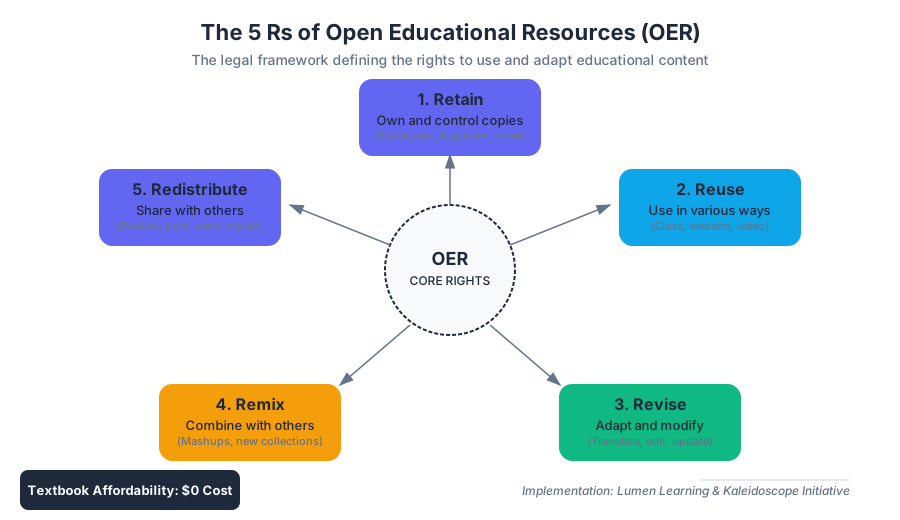
At its core, Open Educational Resources (OER) are teaching, learning, and research materials that reside in the public domain or have been released under an intellectual property license that permits their free use and re-purposing by others. The movement is defined by the "Five Rs" framework, which establishes the legal and practical rights of users:
- Retain: The right to make, own, and control copies of the content.
- Reuse: The right to use the content in a wide range of ways (e.g., in a class, on a website, in a video).
- Revise: The right to adapt, adjust, modify, or alter the content itself (e.g., translating the text into another language).
- Remix: The right to combine the original or revised content with other material to create something new.
- Redistribute: The right to share copies of the original content, your revisions, or your remixes with others.
Textbook Affordability and the Economic Imperative
The primary driver for OER adoption is Textbook Affordability. For decades, the rising cost of traditional textbooks has outpaced inflation, often forcing students to choose between purchasing required materials and meeting basic needs like food or housing.
"Transitioning to OER ensures that all students have access to materials from day one without high costs, effectively leveling the playing field for students from diverse socioeconomic backgrounds." — Christie Fierro, Tacoma Community College
| Feature | Traditional Publishing | Open Educational Resources (OER) |
|---|---|---|
| Cost to Student | High ($100 - $300+ per book) | Zero to Low-cost ($0 - $25) |
| Access Timeline | Upon purchase (often delayed) | Day One of the course |
| Instructor Control | Fixed content; requires new editions | Fully customizable; real-time updates |
| Longevity | Access often expires (digital rentals) | Perpetual access and ownership |
| Format | Hardcover, eBook, or Rental | Digital, PDF, Print-on-demand |
The Lumen Learning Ecosystem
Lumen Learning acts as a bridge between raw OER content and a polished, enterprise-grade learning experience. While OER provides the "raw materials," Lumen provides the Digital Courseware—the infrastructure required to deliver that content effectively within a modern Learning Management System (LMS) like Canvas, Blackboard, or Moodle.
Technical Implementation of OER Metadata
To maintain the integrity of OER, content must be meticulously tracked and attributed.
Creative Commons Licensing
The legal backbone of OER is Creative Commons (CC) Licensing. These licenses allow creators to retain copyright while granting the public permission to use their work under specific conditions. In the "Principles of Public Speaking" course, most materials are licensed under CC BY (Attribution), which is the most permissive license available.
License Variation Matrix
Understanding the nuances of CC licenses is critical for instructors who wish to "remix" or "revise" materials.
| License Type | Symbol | Requirements | Commercial Use? | Derivative Works? |
|---|---|---|---|---|
| CC BY | Attribution | Credit the creator | Yes | Yes |
| CC BY-SA | ShareAlike | Credit creator; same license for new work | Yes | Yes |
| CC BY-NC | NonCommercial | Credit creator; no profit | No | Yes |
| CC BY-ND | NoDerivs | Credit creator; no changes allowed | Yes | No |
| CC BY-NC-SA | NC-ShareAlike | Credit creator; no profit; same license | No | Yes |
Digital Courseware vs. PDF: The Modality Gap
Lumen Learning provides the "Principles of Public Speaking" content in two primary formats: Digital Courseware and PDF. While the PDF offers a static, offline alternative, it is technically and pedagogically inferior to the digital version.
The Interactivity and Accessibility Advantage
Digital courseware utilizes Interactive Learning Content that provides immediate feedback to students. For example, a student reading about "Communication Models" can engage with a simulation of the Transactional Model, identifying noise and feedback loops in real-time.
Key Insight: The PDF version lacks the telemetry required for Continuous Improvement. Digital courseware allows Lumen to analyze learning data—identifying which paragraphs or quiz questions are confusing to students—and update the content globally for all users.
| Feature | Digital Courseware | PDF Alternative |
|---|---|---|
| Accessibility | Screen-reader optimized, alt-text, ARIA labels | Limited accessibility; static layout |
| Multimedia | Embedded video, audio, and simulations | Static images and text only |
| Assessment | Self-check quizzes with instant feedback | No interactive assessment |
| Analytics | Tracks student engagement and mastery | No data collection |
| Updates | Real-time content patches | Requires manual re-download |
Logic Comparison: Static vs. Dynamic Learning
// STATIC PDF LOGIC (Non-interactive)
FUNCTION DisplayReadingCheck():
    PRINT "Question: What are the 3 benefits of public speaking?"
    PRINT "A) Personal, Professional, Public"
    PRINT "B) Wealth, Fame, Power"
    PRINT "(Answer found on page 42)"
END FUNCTION

// DIGITAL COURSEWARE LOGIC (Interactive)
FUNCTION ExecuteInteractiveAssessment(student_id):
    DISPLAY "Question: Select the core competencies of public speaking."
    INPUT student_response

    IF student_response == CORRECT_ANSWER:
        UPDATE student_mastery_score(student_id, +10)
        DISPLAY "Correct! You've mastered this concept."
    ELSE:
        LOG "Common Misconception Detected"
        DISPLAY "Not quite. Review the 'Personal Benefits' section here: [Link]"
        TRIGGER "Remediation_Path"
    END IF
END FUNCTION
Pedagogical Foundations in Public Speaking
The OER materials for this course were developed in conjunction with experts like Christie Fierro (Tacoma Community College) and Brent Adrian (Central Community College). Their syllabi emphasize a move away from rote memorization toward Extemporaneous Speaking and Critical Thinking.
Core Competencies and Communication Models
The course foundations rest on eleven core competencies, ranging from topic selection to the use of visual aids. These are framed within two primary models of communication:
- Linear Model: A one-way process where a sender transmits a message to a receiver (e.g., a radio broadcast).
- Transactional Model: A circular process where participants are simultaneously senders and receivers, accounting for feedback and context.
Common Pitfalls and Misconceptions
Despite the benefits, several misconceptions persist regarding OER and Lumen Learning:
- Misconception: "OER is lower quality because it's free."
- Correction: OER materials undergo rigorous peer review. Because they are "open," they are subject to more public scrutiny and faster correction cycles than traditional textbooks.
- Misconception: "The PDF is just as good as the online course."
- Correction: As established, the PDF is a "lossy" version of the course. It strips away the interactive elements and accessibility features that define the modern learning experience.
- Misconception: "Instructors lose control of their curriculum."
- Correction: OER actually increases instructor agency. Unlike a proprietary textbook where the instructor cannot change a single word, OER allows for the deletion, addition, or reordering of any content to fit specific local needs.
Continuous Improvement through Data
Lumen Learning utilizes a "Continuous Improvement" cycle. By aggregating anonymized data from thousands of students, the platform identifies "bottleneck" concepts—areas where students consistently struggle.
Data-Driven Refinement Table
| Metric | Indicator | Action Taken |
|---|---|---|
| Low Quiz Scores | Content is unclear or misleading | Instructional designers rewrite the section |
| High "Time on Page" | Content is too dense or poorly formatted | Break text into chunks or add visual aids |
| Low Video Engagement | Video is too long or irrelevant | Replace with shorter, targeted clips |
| Accessibility Errors | Screen readers failing on specific nodes | Update HTML/ARIA tags in the master branch |
- Open Educational Resources (OER): Teaching/learning materials that are free to use, adapt, and share.
- CC BY (Attribution): A license allowing any use as long as the original creator is credited.
- Lumen Learning: A platform that enhances OER with digital tools and LMS integration.
- Five Rs: Retain, Reuse, Revise, Remix, Redistribute.
- Transactional Model: A communication model where all parties act as sender and receiver simultaneously.
- Kaleidoscope Open Course Initiative: An early collaborative effort to create high-quality OER for high-enrollment courses.
- Textbook Affordability: The movement to reduce the financial burden of educational materials on students.
- Extemporaneous Speaking: A style of delivery that is prepared and practiced but not read or memorized.
- Which of the "Five Rs" allows an instructor to translate an OER textbook into a different language?
- (Answer: Revise)
- Why is the Transactional Model of communication preferred over the Linear Model in public speaking pedagogy?
- (Answer: It accounts for real-time feedback and the simultaneous nature of communication.)
- What is the primary technical disadvantage of using the PDF version of the Lumen courseware?
- (Answer: Loss of interactivity, accessibility features, and real-time data for continuous improvement.)
- True or False: A CC BY-NC license allows a bookstore to sell the material for a profit.
- (Answer: False. NC stands for Non-Commercial.)
- How does Lumen Learning maintain academic integrity with its supplemental resources?
- (Answer: By providing instructor-only access to assessments and faculty guides.)
Course Foundations and OER Study Guide
- Understand the Economics: Be able to explain how OER impacts student retention and success by removing "Day One" financial barriers.
- Master the Licenses: Know the difference between CC BY, CC BY-SA, and CC BY-NC. Be prepared to identify which license allows for "Remixing."
- Digital vs. Static: Articulate at least three reasons why the digital courseware is superior to the PDF version (Accessibility, Interactivity, Analytics).
- The Role of Lumen: Understand that Lumen Learning provides the delivery system and support for the OER content, not just the content itself.
- Communication Basics: Review the Linear vs. Transactional models. Identify the "Noise" and "Context" elements in the Transactional model.
- Core Competencies: Familiarize yourself with the 11 competencies of public speaking as outlined in the introductory modules.
Source Materials
Study Principles of Public Speaking on Lykke
This course page is free to open: signed out, you can read its first two sections, and signing in, on any plan, opens the rest. The free Lykke Chrome extension syncs your own Canvas courses, so ChatGPT, Claude and Muse can answer from your classes and deadlines. It only reads Canvas.
Add the free extensionSign in to open every sectionAll sections of Principles of Public Speaking · Browse more course pages