From the free course Principles of Public Speaking on Lykke
Assignments and Evaluation
Key concepts: Impromptu and Demonstration Speeches · Persuasive and Inspirational Speeches · Peer and Self-Evaluation · Classroom Etiquette · Extra Credit/Real-world Analysis
An overview of the practical applications of the course, including various speech assignments and the process of peer and self-evaluation.
Assignments and Evaluation
In the pedagogical framework of public speaking, the transition from theoretical understanding to rhetorical mastery is mediated by a structured sequence of assignments and rigorous evaluation protocols. This section details the "praxis" of the course—the specific speech types, the algorithmic approach to evaluation, and the professional standards required for effective communication.
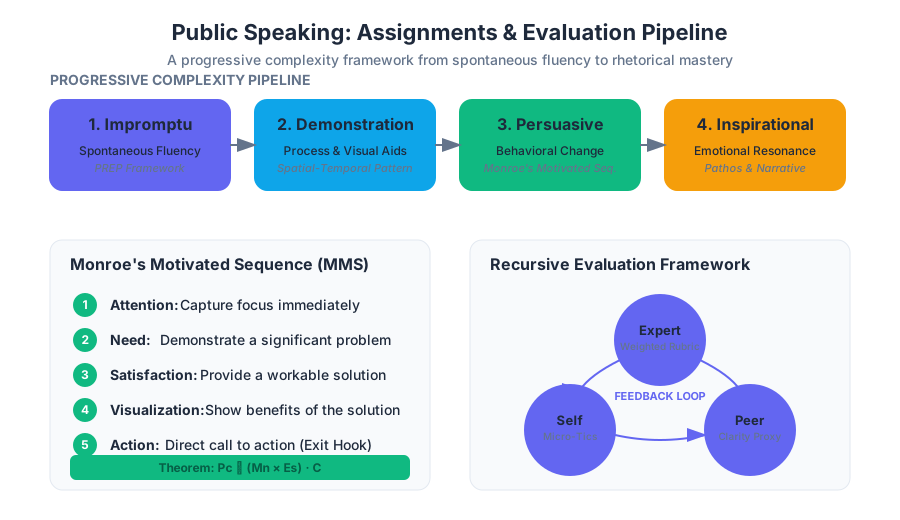
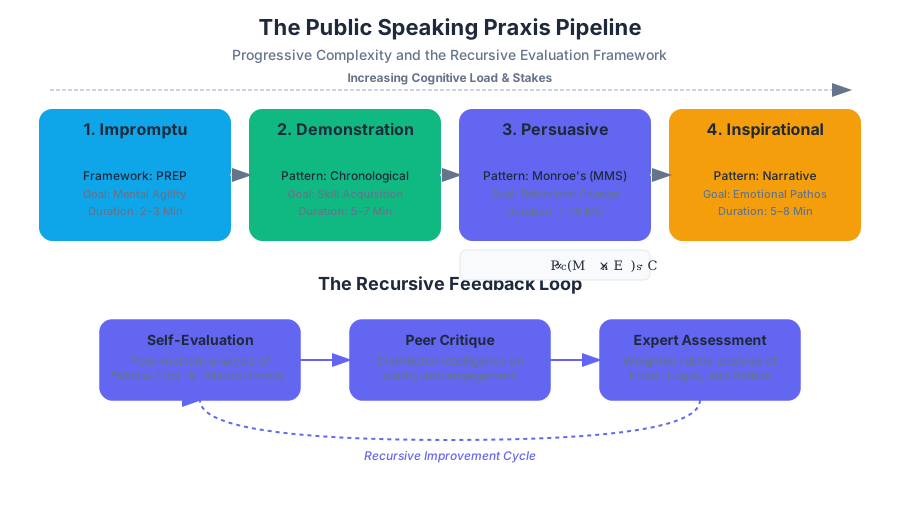
The curriculum is designed as a progressive complexity pipeline. Students begin with low-stakes, spontaneous exercises to reduce communication apprehension (CA) and conclude with high-stakes, research-intensive persuasive performances. Evaluation is not merely a terminal grade but a recursive feedback loop involving self-reflection, peer critique, and expert assessment.
### The Taxonomy of Speech Assignments
Public speaking assignments are categorized by their general purpose: to inform, to demonstrate, to persuade, or to inspire. Each type requires a distinct cognitive load and organizational strategy.
1. Impromptu Speeches
The Impromptu Speech is a "cold-start" exercise. It tests the speaker's ability to synthesize thoughts under extreme time constraints (typically 1–2 minutes of preparation for a 2–3 minute delivery).
- Objective: To develop mental agility and the ability to organize thoughts using the PREP (Point, Reason, Example, Point) framework.
- Common Pitfall: "Ramble-looping," where the speaker repeats the same point because they lack a structural exit strategy.
2. Demonstration (Process) Speeches
The Demonstration Speech is a specialized form of informative speaking that explains how something works or how to perform a task. It relies heavily on visual aids and chronological sequencing.
- Objective: To master the "Spatial-Temporal" organizational pattern.
- Key Challenge: The "Curse of Knowledge"—assuming the audience understands intermediate steps without explicit explanation.
3. Persuasive and Inspirational Speeches
These represent the "High-Stakes" tier of the curriculum. Persuasive Speeches aim to change the audience's beliefs, values, or behaviors using the Monroe’s Motivated Sequence or Aristotelian logic. Inspirational Speeches focus on the Pathos (emotional) axis, aiming to uplift or commemorate.
| Speech Type | Primary Goal | Organizational Pattern | Typical Duration |
|---|---|---|---|
| Impromptu | Spontaneous Fluency | PREP or Past/Present/Future | 2–3 Minutes |
| Demonstration | Skill Acquisition | Chronological / Step-by-Step | 5–7 Minutes |
| Persuasive | Behavioral Change | Monroe's Motivated Sequence | 7–10 Minutes |
| Inspirational | Emotional Resonance | Narrative / Topical | 5–8 Minutes |
### The Mechanics of Persuasion: Monroe’s Motivated Sequence
For the persuasive assignment, students are often required to implement Monroe's Motivated Sequence (MMS). This is a five-step functional algorithm designed to move an audience from apathy to action.
- Attention: Capture the audience's focus immediately.
- Need: Demonstrate a significant problem (the "Need" for change).
- Satisfaction: Provide a specific, workable solution.
- Visualization: Use vivid imagery to show the benefits of the solution or the consequences of inaction.
- Action: Give a direct call to action (the "Exit Hook").
Theorem of Persuasive Impact: The probability of audience conversion ($P_c$) is a function of the perceived Magnitude of the Need ($M_n$) and the perceived Efficacy of the Solution ($E_s$), moderated by the Speaker's Credibility ($C$). $$P_c \propto (M_n \times E_s) \cdot C$$
### Evaluation Frameworks
Evaluation in a public speaking context is multidimensional. It moves beyond "did they sound good?" to a technical analysis of delivery, content, and structure.
Peer and Self-Evaluation
The Self-Evaluation is perhaps the most critical assignment for long-term growth. Students record their performances and perform a "post-mortem" analysis using a standardized rubric.
- Self-Evaluation: Focuses on identifying "Micro-Tics" (filler words, shifting weight) and "Macro-Errors" (logical fallacies, poor transitions).
- Peer Evaluation: Provides a "Distributed Intelligence" view of the speech. Peers act as a proxy for the general public, offering feedback on clarity and engagement.
The Feedback Algorithm
To ensure objective grading, we utilize a weighted rubric.
### Speech Preparation and Outlining
A common mistake is treating a speech like an essay. A speech is a temporal medium, meaning the audience cannot "re-read" a sentence they missed. Therefore, the Outline is the primary architectural document.
Recursive Outlining Logic
The outlining process follows a hierarchical structure. Every sub-point must support its parent point. If a sub-point does not directly provide evidence or explanation for the main point, it is "orphaned" and must be removed.
ALGORITHM: Speech_Outline_Validation
INPUT: Outline_Tree
OUTPUT: Boolean (Is_Valid)

FUNCTION Validate(Node):
    IF Node is LEAF:
        RETURN True
    FOR EACH Child in Node.Children:
        IF NOT Supports(Child, Node):
            PRINT "Logic Error: Child does not support Parent"
            RETURN False
        IF NOT Validate(Child):
            RETURN False
    RETURN True

PROCEDURE Generate_Transitions(Node):
    FOR i FROM 0 TO Node.Children.Length - 2:
        Insert_Signpost(Node.Children[i], Node.Children[i+1])
The "Signposting" Requirement
In the evaluation phase, instructors look for Signposts—verbal markers that indicate where the speaker is in the speech (e.g., "Moving from the problem to the solution...").
| Signpost Type | Function | Example |
|---|---|---|
| Internal Preview | Forecasts upcoming sub-points | "I will now examine three causes of inflation..." |
| Internal Summary | Recaps a complex section | "Now that we've seen how the engine starts..." |
| Transition | Connects two main points | "Having discussed the symptoms, let's look at the cure." |
### Classroom Etiquette and Professionalism
The classroom is a laboratory. For the experiments (speeches) to succeed, the environment must be controlled. Classroom Etiquette is not about politeness; it is about Audience Responsibility.
- Active Listening: Evaluators look for non-verbal feedback from the audience (nodding, eye contact).
- The "No-Entry" Rule: Students must never enter or leave the room while a speaker is at the lectern. This preserves the "Rhetorical Space."
- Ethical Feedback: Critiques must be "Descriptive, not Evaluative." Instead of saying "Your speech was bad," a peer should say, "The evidence in point two did not seem to support the claim of urgency."
### Extra Credit and Real-world Analysis
To bridge the gap between the classroom and the "wild," extra credit assignments often involve Rhetorical Analysis of external speeches. This requires students to apply the course's analytical tools to professional or historical orators.
Real-world Analysis Framework
Students may attend a city council meeting, a TED talk, or a religious sermon and evaluate the speaker using the following parameters:
| Parameter | Analysis Vector |
|---|---|
| Audience Adaptation | Did the speaker use jargon? Did they acknowledge the local context? |
| Visual Aid Integration | Were the slides "Cognitive Load" heavy or did they provide "Dual Coding"? |
| Vocal Variety | Analysis of pitch, rate, and pauses (the "Silence as Emphasis" technique). |
| Fallacy Detection | Identifying Ad Hominem, Strawman, or Slippery Slope arguments. |
### Common Pitfalls in Evaluation
- The Halo Effect: Grading a student higher on a persuasive speech because they were charming during their impromptu speech.
- Central Tendency Bias: Avoiding high or low scores and grading everyone in the "C+" to "B" range, which provides no actionable data for the student.
- The "Reading" Trap: Students often confuse "delivering a speech" with "reading a paper." Evaluation rubrics strictly penalize lack of eye contact resulting from manuscript dependency.
Key Insight: The goal of evaluation is to move the student from Unconscious Incompetence (not knowing they are bad) to Conscious Competence (working hard to be good), and eventually to Unconscious Competence (natural, fluid mastery).
- Monroe’s Motivated Sequence: A five-step organizational pattern for persuasion (Attention, Need, Satisfaction, Visualization, Action).
- Extemporaneous Delivery: A speech that is prepared and practiced but not memorized or read word-for-word.
- Signposting: Verbal cues that help the audience navigate the structure of a speech.
- Communication Apprehension (CA): The fear or anxiety associated with real or anticipated communication with others.
- Ethos, Pathos, Logos: The three pillars of rhetoric: Credibility, Emotion, and Logic.
- Peer Evaluation: The process of students providing structured feedback to their classmates based on rubric criteria.
- Spatial Pattern: An organizational structure based on physical geography or the parts of an object.
- Rhetorical Space: The conceptual environment created by the speaker and audience where ideas are exchanged.
- Which step of Monroe's Motivated Sequence focuses on showing the audience the negative consequences of not adopting the solution?
- A) Need
- B) Satisfaction
- C) Visualization (Correct)
- D) Action
- Why is an "Internal Preview" used in a speech?
- A) To introduce the speaker's credentials.
- B) To tell the audience what sub-points will be covered in the next section. (Correct)
- C) To summarize the entire speech at the end.
- D) To capture attention in the introduction.
- What is the primary difference between a Demonstration speech and a Persuasive speech?
- A) Demonstration focuses on "How-To"; Persuasion focuses on "Why-To" or "Should-To". (Correct)
- B) Demonstration is shorter than Persuasion.
- C) Persuasion requires visual aids, while Demonstration does not.
- D) Demonstration uses Pathos; Persuasion only uses Logos.
- In the "Theorem of Persuasive Impact," what happens if the Speaker's Credibility (C) is zero?
- A) The persuasion is still effective if the logic is strong.
- B) The total persuasive impact becomes zero. (Correct)
- C) The audience relies more on Pathos.
- D) The Need (Mn) must be doubled.
- True or False: Peer evaluation is primarily used to determine the final grade of a student.
- False (It is primarily used for feedback and developing the peer's analytical skills).
Core Competencies
- Structural Mastery: Ability to select and implement the correct organizational pattern (Chronological, Spatial, Topical, Causal, or Motivated Sequence) for a given speech type.
- Analytical Critique: The skill of deconstructing a speech into its constituent parts (Introduction, Body, Conclusion) and evaluating the efficacy of each.
- Delivery Mechanics: Mastering non-verbal channels including proxemics (use of space), kinesics (movement), and paralanguage (vocalics).
Assignment Checklist
- Impromptu: Practice "Thinking on your feet" using the PREP method.
- Demonstration: Ensure your visual aids are visible to the back of the room and integrated into your speech flow.
- Persuasive: Use at least three high-quality, peer-reviewed sources to build Logos.
- Self-Evaluation: Watch your speech video at least twice—once for content and once for delivery.
Advanced Concepts to Explore
- Cognitive Dissonance Theory: How to use psychological discomfort to motivate change in a persuasive speech.
- The Elaboration Likelihood Model (ELM): Understanding the "Central" vs. "Peripheral" routes to persuasion.
- Vocal Variety Algorithms: Analyzing the "prosody" or rhythm of top-tier speakers to improve one's own vocal delivery.
Source Materials
Study Principles of Public Speaking on Lykke
This course page is free to open: signed out, you can read its first two sections, and signing in, on any plan, opens the rest. The free Lykke Chrome extension syncs your own Canvas courses, so ChatGPT, Claude and Muse can answer from your classes and deadlines. It only reads Canvas.
Add the free extensionSign in to open every sectionAll sections of Principles of Public Speaking · Browse more course pages