From the free course Principles of Macroeconomics on Lykke
Monetary and Fiscal Policy
Key concepts: Federal Reserve · Interest Rates · Budget Deficits · Taxation
Examination of the tools used by central banks and governments to influence economic activity.
Monetary and Fiscal Policy
Overview
In the theater of macroeconomics, two primary levers control the speed and direction of the national economy: Monetary Policy and Fiscal Policy. While they share the ultimate goal of maintaining price stability and full employment—often referred to as the "Dual Mandate" in the United States—they operate through fundamentally different mechanisms, timelines, and institutions.
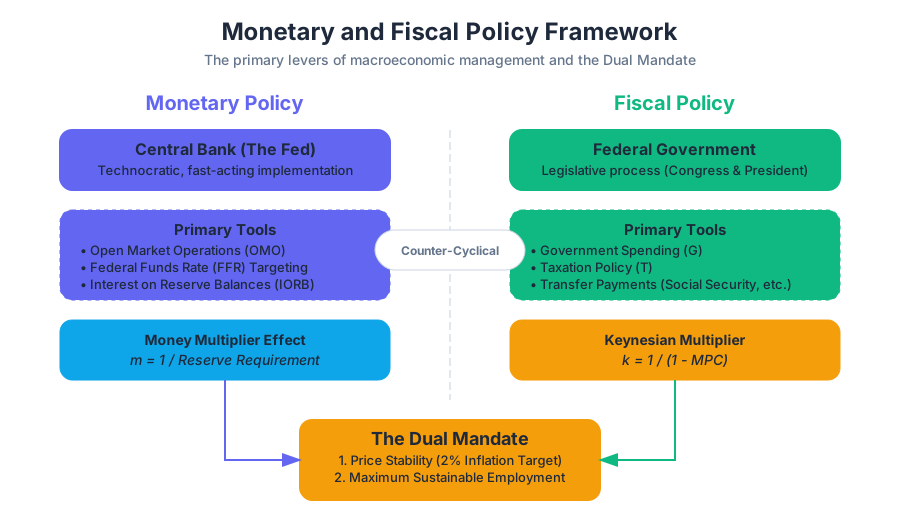
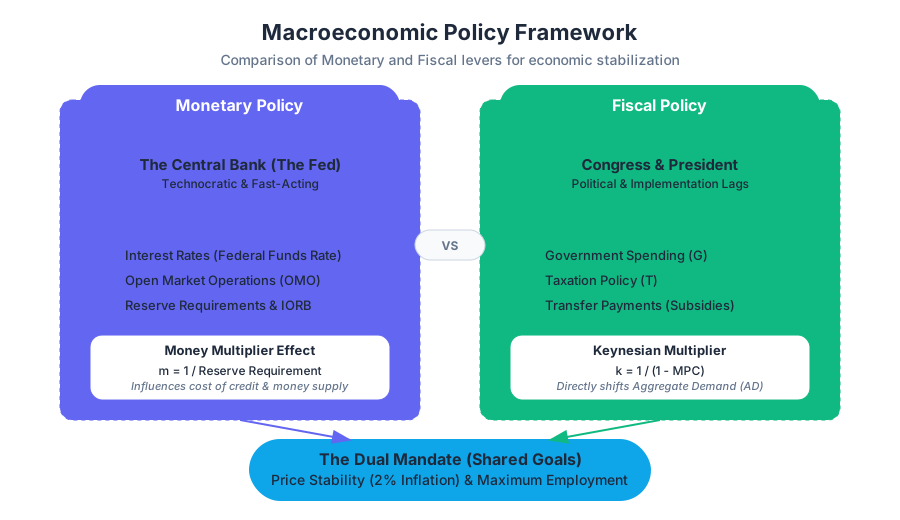
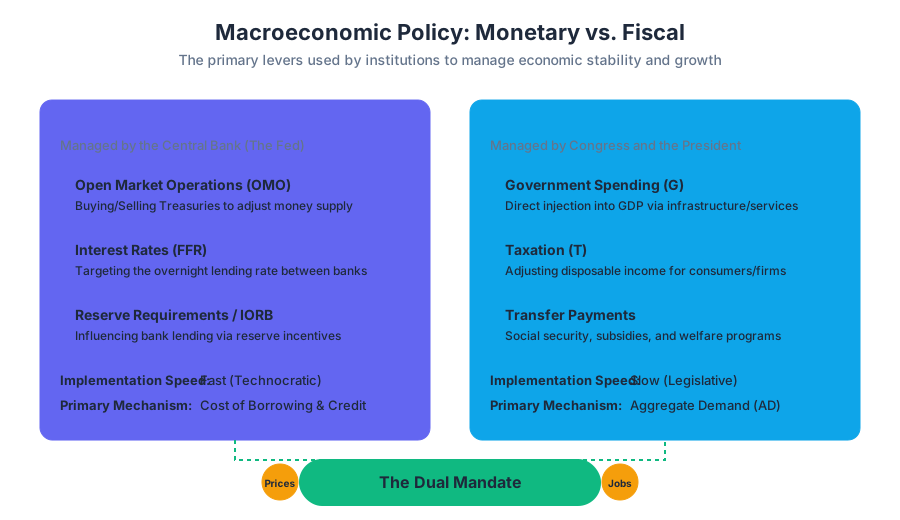
Monetary policy is the domain of the central bank (the Federal Reserve), focusing on the management of the money supply and interest rates. Fiscal policy is the domain of the federal government (Congress and the President), focusing on government spending and taxation. Together, these tools form the basis of counter-cyclical management, attempting to smooth out the "boom and bust" cycles of the market.
Monetary Policy: The Central Bank’s Toolkit
Monetary Policy refers to the actions taken by a central bank to influence the availability and cost of money and credit. In the United States, the Federal Reserve (the "Fed") uses these tools to steer the economy toward its goals of maximum employment and stable prices (typically targeted at 2% inflation).
The Mechanics of the Federal Reserve
The Fed does not directly set the interest rate you pay on a car loan. Instead, it targets the Federal Funds Rate (FFR)—the interest rate at which commercial banks lend their excess reserves to each other overnight. By moving this "anchor" rate, the Fed creates a ripple effect throughout the entire yield curve.
The Money Multiplier Effect: The process by which the banking system creates money. When a bank receives a deposit, it keeps a fraction (the Reserve Requirement) and lends out the rest. The formula for the maximum money multiplier ($m$) is: $$m = \frac{1}{RR}$$ where $RR$ is the reserve requirement ratio.
Tools of Monetary Policy
Historically, the Fed utilized three primary tools, though modern "Ample Reserves" frameworks have shifted the emphasis toward interest on reserve balances.
| Tool | Action | Impact on Money Supply | Impact on Interest Rates |
|---|---|---|---|
| Open Market Operations (OMO) | Buying/Selling Treasury bonds | Buying increases supply | Decreases rates |
| Discount Rate | Interest rate charged to banks by the Fed | Lowering increases borrowing | Decreases market rates |
| Reserve Requirements | % of deposits banks must hold | Lowering increases lending | Decreases rates |
| Interest on Reserve Balances (IORB) | Paying banks to keep money at the Fed | Increasing decreases lending | Increases market rates |
Fiscal Policy: Spending and Taxation
Fiscal Policy is the use of government spending ($G$) and tax policy ($T$) to influence aggregate demand ($AD$). Unlike monetary policy, which is technocratic and fast-acting, fiscal policy is inherently political and subject to significant "implementation lags" due to the legislative process.
The Keynesian Multiplier
The core justification for fiscal intervention is the Spending Multiplier. The idea is that an initial dollar of government spending becomes income for a citizen, who then spends a portion of it, creating further income for others.
The strength of this effect depends on the Marginal Propensity to Consume (MPC)—the fraction of an additional dollar of income that a household spends rather than saves.
\text{Spending Multiplier} = \frac{1}{1 - MPC}
\text{Tax Multiplier} = \frac{-MPC}{1 - MPC}
Note: The tax multiplier is always smaller than the spending multiplier because part of a tax cut is saved by households immediately, whereas government spending enters the GDP stream directly.
Expansionary vs. Contractionary Fiscal Policy
| Policy Type | Goal | Tools | Effect on Budget |
|---|---|---|---|
| Expansionary | Fight Recession / Reduce Unemployment | $\uparrow G$ or $\downarrow T$ | Increases Deficit |
| Contractionary | Reduce Inflation | $\downarrow G$ or $\uparrow T$ | Increases Surplus / Reduces Deficit |
Worked Example: Closing a Recessionary Gap
Suppose an economy has a GDP gap of $400 billion. The government wants to close this gap using fiscal policy, and the $MPC$ is estimated at 0.8.
- Calculate the Multiplier: $1 / (1 - 0.8) = 5$.
- Calculate Required Spending: $\Delta G = \text{Gap} / \text{Multiplier} = 400 / 5 = 80$.
- Result: An injection of $80 billion in new spending will (theoretically) increase total GDP by $400 billion.
Budget Deficits and National Debt
When a government's spending ($G$) exceeds its tax revenue ($T$) in a single year, it runs a Budget Deficit. To finance this, the Treasury issues debt (Bonds, Notes, and Bills). The National Debt is the accumulation of all past deficits and surpluses.
The Crowding Out Effect
A primary criticism of large fiscal deficits is Crowding Out. When the government borrows heavily, it increases the demand for loanable funds, which can drive up interest rates. Higher interest rates make it more expensive for private firms to borrow for investment ($I$).
Crowding Out Theorem: $G \uparrow \rightarrow \text{Demand for Funds} \uparrow \rightarrow r \uparrow \rightarrow I \downarrow$ In this scenario, government spending does not add to total demand; it simply replaces private investment.
Tracking Fiscal Health
To manage these variables, economists track the Debt-to-GDP Ratio. A country with a high debt might still be "healthy" if its GDP is growing faster than its debt servicing costs.
Policy Coordination and Constraints
While we discuss these policies separately, they interact constantly. This interaction can be complementary or conflicting.
The Phillips Curve and Trade-offs
The Phillips Curve suggests an inverse relationship between unemployment and inflation.
- Expansionary Policy: Lowers unemployment but risks higher inflation.
- Contractionary Policy: Lowers inflation but risks higher unemployment.
Lags in Policy
Policy does not work instantaneously. Economists identify three types of lags:
- Recognition Lag: The time it takes to realize a recession or inflation is happening (data is often backward-looking).
- Legislative (Implementation) Lag: The time it takes for Congress to pass a bill or the Fed to meet.
- Impact Lag: The time it takes for the money to actually circulate through the economy (often 6–18 months).
Comparison: Monetary vs. Fiscal Policy
| Feature | Monetary Policy | Fiscal Policy |
|---|---|---|
| Decision Maker | Central Bank (The Fed) | Government (Congress/President) |
| Primary Tool | Interest Rates / Money Supply | Taxes / Spending |
| Political Influence | Low (Independent) | High (Voter-driven) |
| Speed of Action | Fast (Immediate implementation) | Slow (Legislative hurdles) |
| Main Constraint | Liquidity Trap / Zero Lower Bound | Political Gridlock / Debt Sustainability |
Common Pitfalls and Misconceptions
1. The "Household" Fallacy
A common mistake is comparing a national budget to a household budget. While a household must eventually pay off its debt, a government can "roll over" debt indefinitely as long as the economy grows and it maintains the power to tax. The constraint is not "running out of money," but rather the inflationary pressure caused by over-stimulating the economy.
2. The Liquidity Trap
In a deep recession, interest rates may hit the Zero Lower Bound (ZLB). At this point, traditional monetary policy becomes ineffective because rates cannot go lower. This is when "Unconventional Monetary Policy," such as Quantitative Easing (QE)—where the Fed buys long-term assets to lower long-term rates—is employed.
3. Automatic Stabilizers
Not all fiscal policy is "discretionary." Automatic Stabilizers are programs that automatically stimulate the economy without new legislation. For example, in a recession, more people qualify for unemployment insurance (increasing $G$) and people earn less income, so they pay less in taxes (decreasing $T$). This provides an immediate, non-political cushion.
Practical Implementation: Executing a Policy Shift
In the real world, a policy shift involves a complex series of market operations. If the Fed decides to raise rates, it doesn't just change a number on a website; it conducts transactions.
Source Materials
Study Principles of Macroeconomics on Lykke
This course page is free to open: signed out, you can read its first two sections, and signing in, on any plan, opens the rest. The free Lykke Chrome extension syncs your own Canvas courses, so ChatGPT, Claude and Muse can answer from your classes and deadlines. It only reads Canvas.
Add the free extensionSign in to open every sectionAll sections of Principles of Macroeconomics · Browse more course pages