From the free course Principles of Macroeconomics on Lykke
Macroeconomic Models and Perspectives
Key concepts: AD/AS Model · Keynesian Economics · Neoclassical Economics · Say's Law
A deep dive into the Aggregate Demand/Aggregate Supply (AD/AS) model and the debate between Keynesian and Neoclassical viewpoints.
Macroeconomic Models and Perspectives
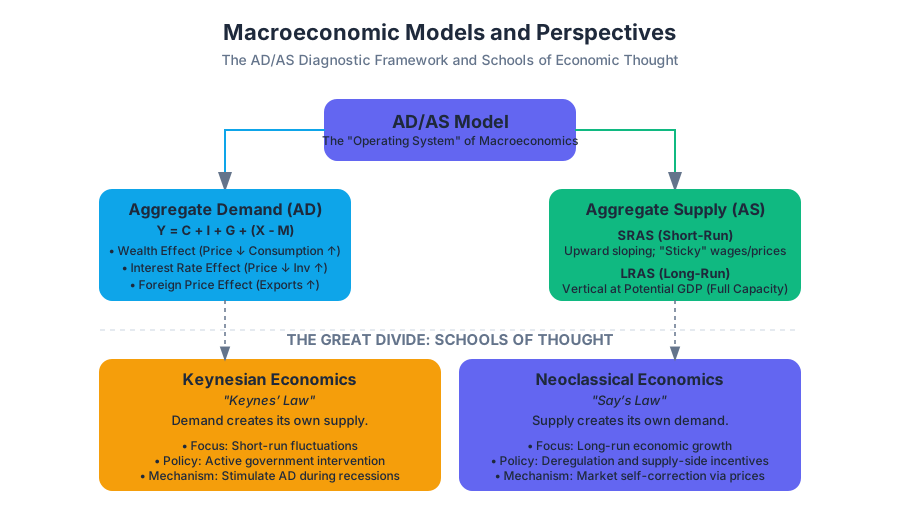
Macroeconomics is the study of the economy as a holistic, complex system. Unlike microeconomics, which focuses on individual decision-making units, macroeconomics examines the aggregate outcomes of these decisions—total output, general price levels, and systemic employment. To navigate this complexity, economists utilize the Aggregate Demand/Aggregate Supply (AD/AS) model as a primary diagnostic framework. This model serves as the "operating system" for macroeconomic analysis, providing a structured way to visualize how various shocks and policy interventions ripple through the global economy.
The field is characterized by a fundamental tension between two primary schools of thought: Keynesian Economics, which emphasizes the role of demand and the necessity of government intervention during downturns, and Neoclassical Economics, which prioritizes supply-side factors and the long-term self-correcting nature of markets. Understanding these perspectives requires a deep dive into Say’s Law, Keynes’ Law, and the mechanics of price flexibility.
The AD/AS Model: The Macroeconomic Operating System
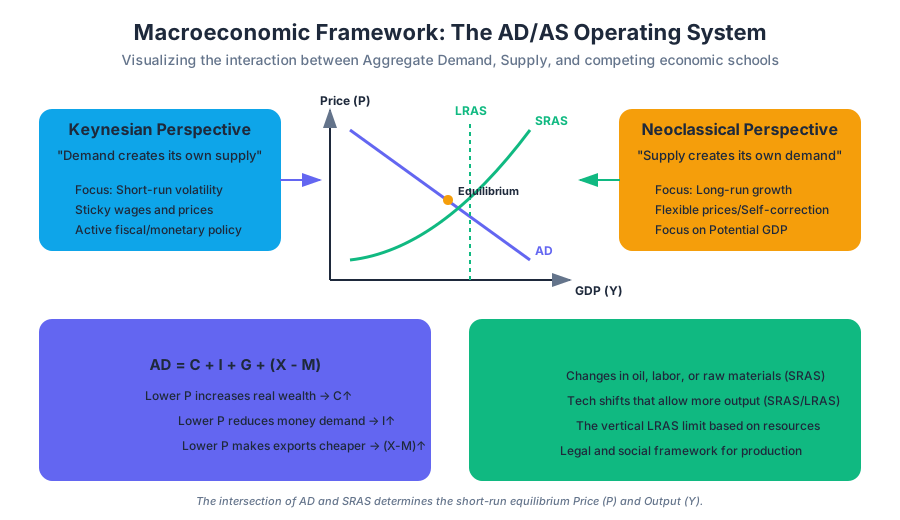
The Aggregate Demand/Aggregate Supply (AD/AS) model illustrates the relationship between the total quantity of goods and services that households, businesses, the government, and foreign buyers want to purchase (Aggregate Demand) and the total quantity that firms are willing to produce (Aggregate Supply) at a given price level.
1. Aggregate Demand (AD)
Aggregate Demand represents the total spending on domestic goods and services in an economy. It is mathematically defined by the components of Gross Domestic Product (GDP):
Definition: $AD = C + I + G + (X - M)$ Where $C$ is Consumption, $I$ is Investment, $G$ is Government Spending, $X$ is Exports, and $M$ is Imports.
The AD curve is downward-sloping due to three distinct economic phenomena:
- The Wealth Effect: As the price level drops, the real value of money holdings increases, boosting consumer purchasing power and consumption ($C$).
- The Interest Rate Effect: Lower price levels reduce the demand for money, leading to lower interest rates, which stimulates investment ($I$).
- The Foreign Price Effect: If domestic prices fall while foreign prices remain constant, domestic goods become more competitive, increasing exports ($X$) and decreasing imports ($M$).
2. Aggregate Supply (AS)
Aggregate Supply refers to the total quantity of output firms are willing to produce and sell. It is divided into two distinct time horizons:
- Short-Run Aggregate Supply (SRAS): Upward-sloping because some nominal input prices (like wages) are "sticky" or slow to adjust.
- Long-Run Aggregate Supply (LRAS): A vertical line at the level of Potential GDP (also called full-employment GDP). This represents the maximum output an economy can sustain with its existing levels of labor, physical capital, technology, and institutions.
| Component | Definition | Determinants of Shifts |
|---|---|---|
| AD | Total spending on GDP | Consumer confidence, interest rates, tax policy, government spending, exchange rates. |
| SRAS | Total production in the short run | Input prices (oil, labor), productivity shocks, inflation expectations, supply chain integrity. |
| LRAS | Potential output at full capacity | Technological innovation, growth in labor force, capital accumulation, institutional quality. |
Numerical Equilibrium Solver
In professional economic modeling, we often treat the AD/AS framework as a system of non-linear equations.
The Great Divide: Say’s Law vs. Keynes’ Law
The history of macroeconomic thought is largely a debate over which "law" governs the economy. This distinction dictates whether policy should focus on stimulating demand or incentivizing supply.
Say’s Law: "Supply Creates Its Own Demand"
Proposed by Jean-Baptiste Say in the early 19th century, this view suggests that the act of producing goods generates enough income (via wages and profits) to purchase those goods. In this world, sustained overproduction is impossible because prices and wages adjust instantly to clear markets.
- Focus: Long-run growth.
- Policy Implication: Minimize government interference; focus on deregulation and capital formation.
Keynes’ Law: "Demand Creates Its Own Supply"
Coined during the Great Depression by John Maynard Keynes, this law argues that firms produce only what they expect to sell. If aggregate demand is insufficient, firms will cut production and lay off workers, regardless of their capacity to supply.
- Focus: Short-run fluctuations (the business cycle).
- Policy Implication: Active fiscal and monetary policy to manage demand.
| Feature | Say's Law (Neoclassical) | Keynes' Law (Keynesian) |
|---|---|---|
| Primary Driver | Supply / Production | Demand / Spending |
| Time Horizon | Long Run | Short Run |
| Price Behavior | Fully Flexible | Sticky / Rigid |
| Unemployment | Voluntary or Frictional | Involuntary (Cyclical) |
| Market State | Always clears | Can get stuck in "Recessionary Gap" |
The Keynesian Perspective: Demand-Driven Dynamics
The Keynesian perspective is built on the observation that the economy does not always self-correct quickly. The central mechanism for this failure is Sticky Wages and Prices.
Why Prices are Sticky
- Menu Costs: The literal and administrative costs of changing prices (printing new catalogs, updating software).
- Coordination Failure: Even if everyone knows prices should fall, no single firm wants to be the first to cut wages or prices for fear of losing talent or revenue.
- Efficiency Wage Theory: Employers pay more than the market-clearing wage to ensure productivity and loyalty, making them reluctant to cut pay during downturns.
The Expenditure Multiplier
Keynes introduced the concept of the Multiplier, where an initial change in spending leads to a more than proportionate change in GDP. This occurs because one person's spending becomes another's income, which is then partially spent again.
\text{Multiplier} = \frac{1}{1 - MPC(1 - t) + MPI}
MPC: Marginal Propensity to Consumet: Tax rateMPI: Marginal Propensity to Import
Mathematical Derivation of the Multiplier Effect
% Derivation of the Equilibrium Output in a closed economy
Y = C + I + G
C = C_0 + c(Y - T)  % Consumption function with marginal propensity 'c'
Y = C_0 + c(Y - T) + I + G
Y - cY = C_0 - cT + I + G
Y(1 - c) = C_0 - cT + I + G
Y = \frac{1}{1 - c} [C_0 - cT + I + G]

% The term 1/(1-c) is the multiplier.
% If c = 0.8, the multiplier is 1/(1-0.8) = 5.
The Neoclassical Perspective: Supply-Side Fundamentals
Neoclassical economists argue that while demand-side shocks matter in the short run, the economy's long-run trajectory is determined by its productive capacity (LRAS). They emphasize the role of Rational Expectations.
1. Rational Expectations vs. Adaptive Expectations
- Adaptive Expectations: People look at past trends to predict the future. If inflation was 2% last year, they expect 2% this year.
- Rational Expectations: People use all available information, including predicted government policy, to form forecasts. If the government announces a stimulus that will cause inflation, people adjust their behavior (and prices) immediately.
2. The Self-Correcting Mechanism
In the neoclassical view, if the economy is in a recession, the surplus of labor will eventually drive down wages. Lower wages reduce production costs, shifting the SRAS curve to the right until the economy returns to Potential GDP.
3. Policy Focus: The "Natural Rate"
Neoclassical policy focuses on reducing the Natural Rate of Unemployment (frictional + structural) rather than trying to eliminate cyclical unemployment through demand management, which they believe only leads to inflation in the long run.
Synthesis: The Modern Macroeconomic Consensus
Modern macroeconomics often uses a "Keynesian in the short run, Neoclassical in the long run" approach. This synthesis acknowledges that while demand management is necessary to mitigate immediate crises, long-term prosperity depends on supply-side factors like education, infrastructure, and technology.
Comparison of Policy Tools
| Tool | Keynesian Application | Neoclassical Application |
|---|---|---|
| Fiscal Policy | Deficit spending to boost AD during recessions. | Tax cuts to incentivize investment and work. |
| Monetary Policy | Lowering interest rates to stimulate $I$ and $C$. | Maintaining low, predictable inflation to reduce uncertainty. |
| Labor Market | Minimum wage and unions to protect worker income. | Flexible wages and labor mobility to ensure market clearing. |
Real-World Application: Analyzing Economic Data
To apply these models, economists fetch real-time data from sources like the Federal Reserve Economic Data (FRED).
Common Pitfalls and Misconceptions
- Confusing Micro-Supply with Macro-Supply: In microeconomics, a supply curve slopes up because of substitution (producing more of X instead of Y). In macroeconomics, the SRAS slopes up because of economy-wide nominal rigidities (wages/prices).
- The "Lump of Labor" Fallacy: The mistaken belief that there is a fixed amount of work to be done. Neoclassical theory refutes this, showing that supply creates its own demand through the circular flow of income.
- Ignoring the Time Lag: Keynesian policy often suffers from "recognition lags" (realizing there is a problem) and "implementation lags" (passing legislation), which can lead to stimulus hitting the economy only after it has already begun to recover.
Source Materials
Study Principles of Macroeconomics on Lykke
This course page is free to open: signed out, you can read its first two sections, and signing in, on any plan, opens the rest. The free Lykke Chrome extension syncs your own Canvas courses, so ChatGPT, Claude and Muse can answer from your classes and deadlines. It only reads Canvas.
Add the free extensionSign in to open every sectionAll sections of Principles of Macroeconomics · Browse more course pages