From the free course Principles of Macroeconomics on Lykke
Foundations of Macroeconomics and Choice
Key concepts: Scarcity · Opportunity Cost · Production Possibilities Frontier · Specialization
Introduction to the economic way of thinking, focusing on scarcity, trade-offs, and the fundamental tools used by economists.
Foundations of Macroeconomics and Choice
Macroeconomics is often misunderstood as the study of money, banking, and stock markets. While these are components, the core of the discipline is the study of choice under constraint. At its most fundamental level, macroeconomics seeks to understand how societies allocate limited resources to satisfy virtually unlimited human wants. This tension creates the "Economic Problem," a universal condition that necessitates trade-offs, prioritization, and the optimization of production systems.
The Axiom of Scarcity
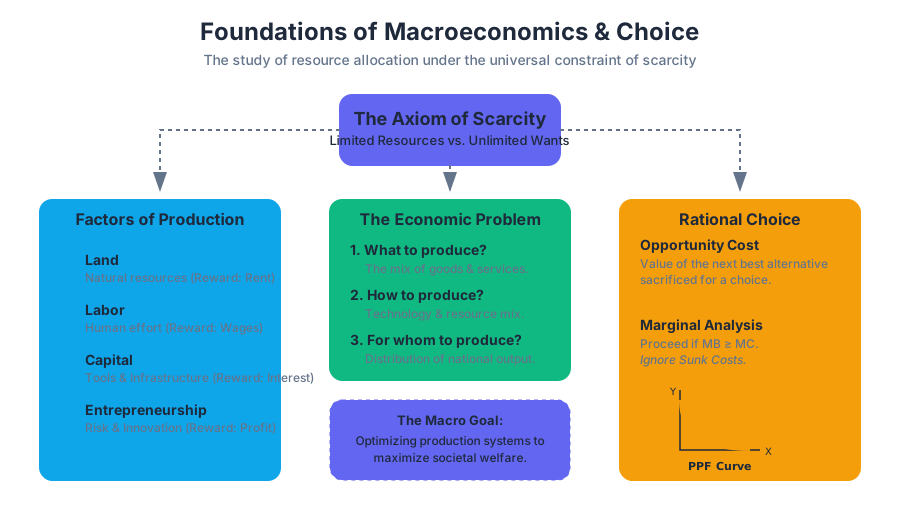
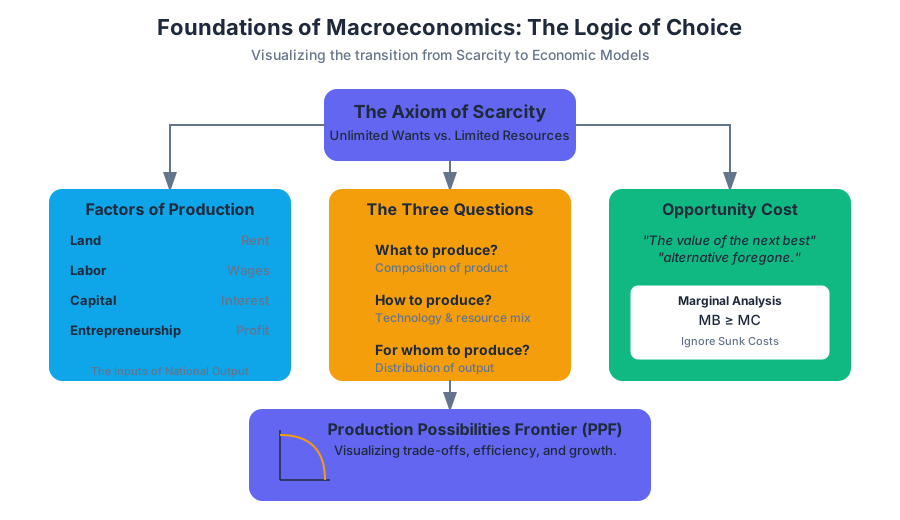
Scarcity is the foundational reality of the human condition. It is the gap between limited resources—land, labor, capital, and entrepreneurship—and the limitless desires for goods and services. Unlike a "shortage," which is a temporary market imbalance where demand exceeds supply at a specific price, scarcity is a permanent, structural fact of existence. Even the wealthiest individuals and nations face scarcity, if only in the form of time, the ultimate non-renewable resource.
The Factors of Production
To understand how scarcity manifests, we categorize the resources available to an economy into four distinct "Factors of Production."
| Factor | Description | Reward/Return | Example in Macro-scale |
|---|---|---|---|
| Land | All natural resources used in production (minerals, water, arable land). | Rent | Rare earth metals for semiconductor manufacturing. |
| Labor | The physical and mental effort exerted by humans in production. | Wages | The aggregate workforce of a nation's tech sector. |
| Capital | Man-made tools, machinery, and infrastructure used to produce goods. | Interest | Automated assembly lines or fiber-optic networks. |
| Entrepreneurship | The human resource that organizes the other three factors and bears risk. | Profit | A startup founder developing a new carbon-capture technology. |
The Mechanics of Scarcity
In a macroeconomic model, scarcity forces a society to answer three fundamental questions:
- What to produce? (The composition of the National Product).
- How to produce? (The choice of technology and resource mix).
- For whom to produce? (The distribution of the resulting output).
The inability to satisfy all wants simultaneously implies that every choice to produce "Good A" is implicitly a choice not to produce "Good B." This leads us directly to the concept of the "shadow price" of all economic activity: Opportunity Cost.
Opportunity Cost: The Logic of Foregone Alternatives
Opportunity Cost is defined as the value of the next best alternative that must be sacrificed to pursue a certain action. It is not the sum of all rejected alternatives, but specifically the value of the single best alternative.
Definition: The Opportunity Cost ($OC$) of choosing alternative $A$ over $B$ is the net benefit of $B$ that is lost by not choosing it. Mathematically, if $U(x)$ is the utility or value of an option: $OC_A = U(B_{max}) - U(A)$ (where $B_{max}$ is the best alternative).
Marginal Analysis and Sunk Costs
Economists utilize Marginal Analysis to make rational decisions. This involves comparing the Marginal Benefit (MB) of an action against its Marginal Cost (MC). A rational actor continues an activity as long as $MB \geq MC$.
Crucially, this analysis ignores Sunk Costs—costs that have already been incurred and cannot be recovered. In macroeconomics, focusing on sunk costs (e.g., continuing to fund a failing infrastructure project simply because "we've already spent billions") is considered an irrational "Sunk Cost Fallacy."
The Production Possibilities Frontier (PPF)
The Production Possibilities Frontier (PPF) is a graphical representation of the maximum possible output combinations an economy can achieve given its fixed resources and technology. It serves as a visual manifestation of scarcity, trade-offs, and efficiency.
Assumptions of the PPF Model
To isolate the mechanics of the frontier, we assume:
- Only two goods are produced (e.g., "Capital Goods" vs. "Consumption Goods").
- The quantity and quality of resources are fixed.
- Technology is constant.
- Resources are used with maximum efficiency.
The Law of Increasing Opportunity Cost
Most PPF curves are "bowed outward" (concave to the origin). This shape reflects the Law of Increasing Opportunity Cost, which states that as you produce more of one good, the opportunity cost of producing an additional unit increases. This happens because resources are not perfectly adaptable to all uses; a skilled software engineer is highly productive in "Tech Services" but may be significantly less efficient in "Agriculture."
\text{Marginal Rate of Transformation (MRT)} = \left| \frac{dY}{dX} \right|
The MRT is the slope of the PPF at any given point. It represents the rate at which one good can be "transformed" into another by reallocating resources.
| Point Location | Economic Status | Meaning |
|---|---|---|
| On the Curve | Productive Efficiency | Resources are fully utilized; no more of one good can be produced without losing some of the other. |
| Inside the Curve | Inefficiency / Unemployment | Resources are idle or misallocated (e.g., high unemployment during a recession). |
| Outside the Curve | Unattainable (Current) | The economy lacks the resources or technology to reach this level of production. |
Shifting the Frontier: Economic Growth
The PPF is not static. It can shift outward or inward based on changes in the economy’s underlying capacity.
- Outward Shift (Growth): Caused by technological advancement, discovery of new resources, or an increase in the labor force/human capital.
- Inward Shift (Contraction): Caused by natural disasters, war, or depletion of resources.
Specialization and the Gains from Trade
If scarcity limits what a single entity can produce, how do modern societies achieve such high standards of living? The answer lies in Specialization and Trade.
Absolute vs. Comparative Advantage
The distinction between these two concepts is the most critical insight in international trade theory.
- Absolute Advantage: The ability to produce more of a good than a competitor using the same amount of resources.
- Comparative Advantage: The ability to produce a good at a lower opportunity cost than a competitor.
The Ricardian Insight: Even if Country A has an absolute advantage in everything, it still benefits from trading with Country B, provided they have different comparative advantages. Both countries can consume at a point outside their individual PPFs by specializing in what they do relatively best and trading for the rest.
Calculating Comparative Advantage: A Numeric Example
Consider two countries, Alpha and Beta, producing Wheat and Computers with 100 units of labor.
| Country | Wheat (Max Output) | Computers (Max Output) | OC of 1 Wheat | OC of 1 Computer |
|---|---|---|---|---|
| Alpha | 100 | 50 | 0.5 Computers | 2 Wheat |
| Beta | 40 | 40 | 1 Computer | 1 Wheat |
In this scenario:
- Alpha has an Absolute Advantage in both Wheat and Computers.
- Alpha has a Comparative Advantage in Wheat (0.5 < 1).
- Beta has a Comparative Advantage in Computers (1 < 2).
By specializing, Alpha produces only Wheat and Beta produces only Computers. They then trade at a price (Terms of Trade) between their internal opportunity costs (e.g., 1 Wheat for 0.75 Computers).
Common Pitfalls and Misconceptions
- Confusing "Money Cost" with "Economic Cost": Students often forget that time and effort are costs. If a "free" concert requires waiting in line for 5 hours, the cost is not zero; it is the value of those 5 hours (e.g., lost wages or study time).
- The "Fixed Pie" Fallacy: The belief that for one person/nation to gain, another must lose. Comparative advantage proves that trade is a "positive-sum game" where the total "pie" of global production increases through specialization.
- Efficiency vs. Equity: The PPF shows Productive Efficiency (maximum output), but it does not tell us which point on the curve is "best." That is a question of Allocative Efficiency, which depends on societal preferences and values (Normative Economics).
- Static vs. Dynamic Analysis: Assuming that a country's comparative advantage is permanent. In reality, nations can "create" comparative advantage through strategic investment in education and infrastructure (e.g., South Korea's transition from agriculture to high-tech electronics).
Synthesis: The Macroeconomic Perspective
The foundations of choice—scarcity, opportunity cost, and the PPF—provide the scaffolding for all macroeconomic theory. When we scale these individual choices up to the national level, we begin to see the mechanisms of the Circular Flow Model.
In the macro-economy:
- Households own the factors of production and sell them to firms in the Factor Market.
- Firms use these factors to produce goods and services, which they sell to households in the Product Market.
- Government intervenes to correct market failures, provide public goods, and redistribute income, effectively shifting the economy's position on or toward the PPF.
Understanding these foundations is not merely an academic exercise; it is the prerequisite for analyzing complex issues like inflation, unemployment, and global trade wars. By recognizing that every policy has an opportunity cost and every growth spurt requires an expansion of the frontier, we can move from emotive reactions to rigorous economic reasoning.
Source Materials
Study Principles of Macroeconomics on Lykke
This course page is free to open: signed out, you can read its first two sections, and signing in, on any plan, opens the rest. The free Lykke Chrome extension syncs your own Canvas courses, so ChatGPT, Claude and Muse can answer from your classes and deadlines. It only reads Canvas.
Add the free extensionSign in to open every sectionAll sections of Principles of Macroeconomics · Browse more course pages