From the free course Principles Microeconomics 3e on Lykke
Principles of Microeconomics 3e
Key concepts: Principles of Microeconomics 3e · Economic Theory · Introductory College-Level Economics
A deep dive into the core textbook for this course, covering its structure and approach to introductory economic theory.
Principles of Microeconomics 3e
The third edition of Principles of Microeconomics represents a significant evolution in introductory economic pedagogy. Published by OpenStax, this peer-reviewed resource adheres to a rigorous academic standard while embracing the Creative Commons Attribution License (CC-BY), ensuring that high-level economic theory remains accessible to a global audience. Unlike traditional static textbooks, the 3e revision integrates modern data sets, diverse economic perspectives (including behavioral and institutional economics), and seamless LMS Integration via OpenStax Assignable.
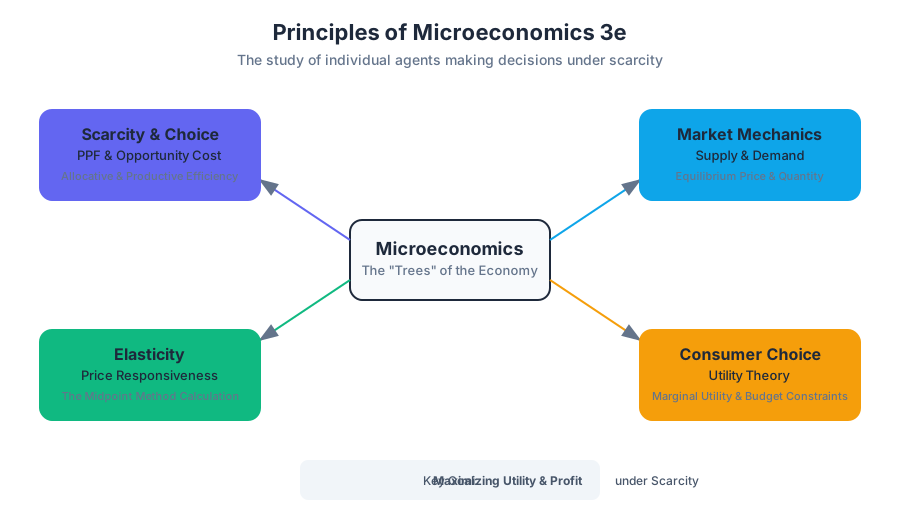
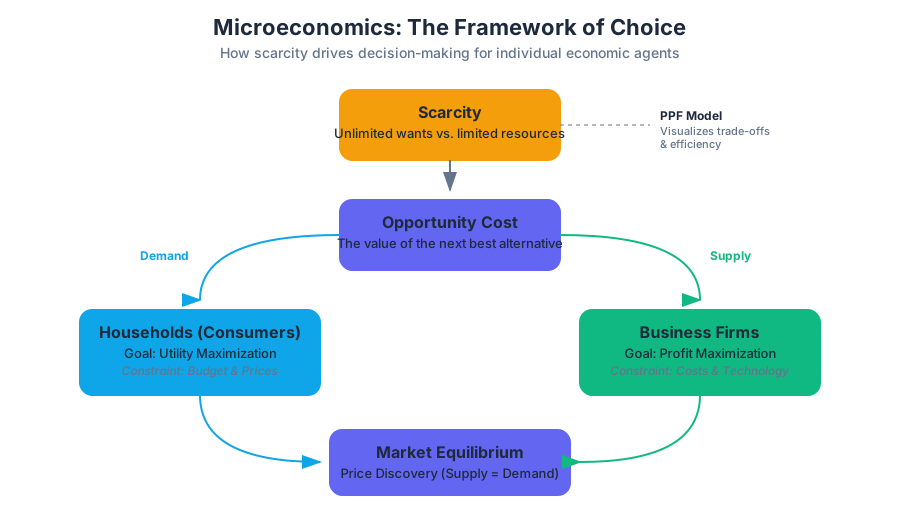
At its core, microeconomics is the study of how individual agents—households, workers, and business firms—make decisions in the face of scarcity. While macroeconomics looks at the "forest" (the national economy), microeconomics examines the "trees" (individual markets and price mechanisms).
The Economic Problem: Scarcity and Choice
The foundational axiom of all economic theory is scarcity: the reality that human wants for goods, services, and resources exceed what is available. This necessitates choice, and every choice involves an opportunity cost.
The Production Possibilities Frontier (PPF)
The Production Possibilities Frontier (PPF) is a graphical representation of the possible combinations of two goods an economy can produce given its available resources and technology. It illustrates the concepts of efficiency, trade-offs, and economic growth.
Definition: Opportunity Cost The value of the next best alternative foregone as the result of making a decision. Mathematically, the opportunity cost of good $x$ in terms of good $y$ is the slope of the PPF: $OC_x = |\Delta y / \Delta x|$.
| Concept | Description | Graphical Representation |
|---|---|---|
| Productive Efficiency | Producing without waste; any point on the PPF. | Points on the curve. |
| Allocative Efficiency | Producing the specific mix of goods most desired by society. | A specific point on the curve. |
| Law of Diminishing Returns | As additional increments of resources are added to a certain purpose, the marginal benefit will decline. | The "bowed-out" shape of the PPF. |
Market Mechanics: Supply and Demand
The Demand and Supply model is the primary tool for analyzing how prices and quantities are determined in a market. It describes the behavior of buyers and sellers and how they interact to reach an equilibrium.
The Law of Demand and Supply
The Law of Demand states that, ceteris paribus (all other things being equal), as the price of a good increases, the quantity demanded decreases. Conversely, the Law of Supply states that as the price increases, the quantity supplied increases.
To find the market equilibrium, we solve for the price $P$ where $Q_d = Q_s$.
Shifts vs. Movements
A movement along the curve occurs only when the price of the good itself changes. A shift of the curve occurs when exogenous factors change, such as:
- Demand Shifts: Changes in income, tastes, prices of related goods (substitutes/complements), or expectations.
- Supply Shifts: Changes in input prices (labor, raw materials), technology, or government policies (taxes/subsidies).
Elasticity: Measuring Responsiveness
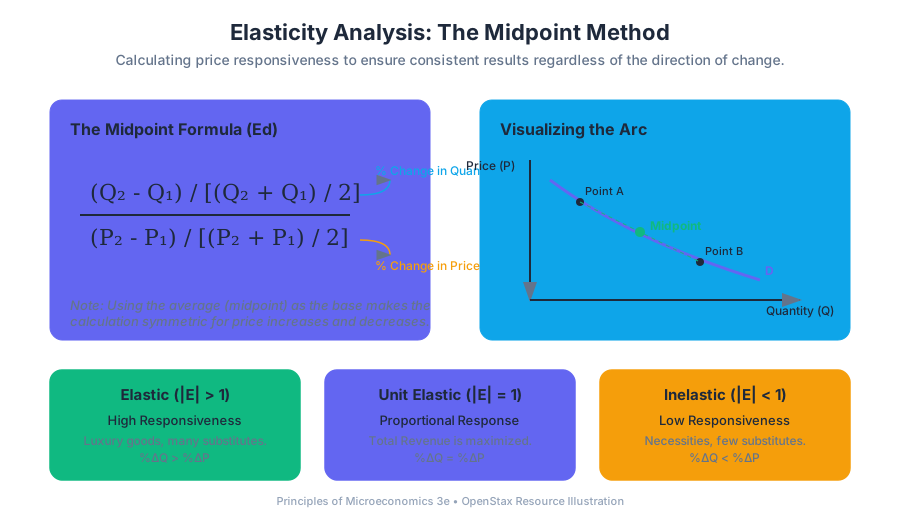
Elasticity is a unitless measure of how much one variable responds to changes in another. In Principles of Microeconomics 3e, the Midpoint Method is emphasized to ensure that the percentage change is the same regardless of whether the price is increasing or decreasing.
The Midpoint Formula
The Price Elasticity of Demand ($E_d$) is calculated as:
E_d = \frac{(Q_2 - Q_1) / [(Q_2 + Q_1) / 2]}{(P_2 - P_1) / [(P_2 + P_1) / 2]}
| Elasticity Value | Terminology | Interpretation |
|---|---|---|
| $ | E | > 1$ |
| $ | E | < 1$ |
| $ | E | = 1$ |
| $E = 0$ | Perfectly Inelastic | Quantity does not change regardless of price (e.g., life-saving medicine). |
Consumer Choice and Utility
Microeconomics 3e explores the "why" behind demand through Utility Theory. Consumers aim to maximize their total utility subject to a budget constraint.
Marginal Utility and Optimization
Marginal Utility (MU) is the additional satisfaction gained from consuming one more unit of a good. The Law of Diminishing Marginal Utility suggests that as a person consumes more of a good, the additional utility from each new unit decreases.
To maximize utility, a consumer should allocate their budget such that the marginal utility per dollar spent is equal across all goods:
\text{Utility Maximization Rule: } \frac{MU_1}{P_1} = \frac{MU_2}{P_2} = \dots = \frac{MU_n}{P_n}
Income and Substitution Effects
When the price of a good falls, two things happen:
- Substitution Effect: The good becomes relatively cheaper compared to others, so consumers buy more of it.
- Income Effect: The consumer's "real" purchasing power increases, allowing them to buy more of all normal goods.
Production, Costs, and Industry Structure
For a firm, the goal is typically profit maximization, where $\text{Profit} = \text{Total Revenue} - \text{Total Cost}$.
Cost Categories
- Fixed Costs (FC): Costs that do not change with output (e.g., rent).
- Variable Costs (VC): Costs that change with output (e.g., labor, materials).
- Marginal Cost (MC): The cost of producing one additional unit: $MC = \Delta TC / \Delta Q$.
Market Structures
The 3rd edition categorizes industries based on the number of firms and the degree of product differentiation.
| Structure | Number of Firms | Product Type | Barriers to Entry | Pricing Power |
|---|---|---|---|---|
| Perfect Competition | Many | Identical | None | None (Price Taker) |
| Monopolistic Competition | Many | Differentiated | Low | Some |
| Oligopoly | Few | Identical/Differentiated | High | Significant (Strategic) |
| Monopoly | One | Unique | Very High | Price Maker |
The Profit Maximization Rule
Regardless of market structure, a firm maximizes profit by producing the quantity where Marginal Revenue (MR) equals Marginal Cost (MC).
Perfect Competition vs. Monopoly
In Perfect Competition, $P = MR = MC$. Firms earn zero economic profit in the long run. In a Monopoly, the firm faces the entire downward-sloping market demand curve, meaning $MR < P$. This leads to deadweight loss, as the monopolist produces less and charges more than the socially optimal level.
Market Failures: Externalities and Public Goods
Markets are efficient only when all costs and benefits are internalized. When they are not, we encounter Market Failure.
Externalities
An externality occurs when a third party, outside the transaction, is affected by a market exchange.
- Negative Externality: Pollution. The social cost exceeds the private cost.
- Positive Externality: Vaccination. The social benefit exceeds the private benefit.
Public Goods
Public goods are characterized by two traits:
- Non-excludable: It is impossible to prevent someone from using the good.
- Non-rivalrous: One person's use does not diminish another's.
This leads to the Free Rider Problem, where individuals consume the good without paying for it, often requiring government intervention to provide the service (e.g., national defense).
Labor Markets and Poverty
Principles of Microeconomics 3e places a strong emphasis on the Labor Market. Unlike the market for goods, in the labor market, households are the suppliers and firms are the demanders.
The Marginal Productivity of Labor
A firm will hire workers up to the point where the Value of the Marginal Product of Labor ($VMPL$) equals the market wage ($W$). $VMPL = MP_L \times P_{output}$.
Income Inequality
The text discusses the Lorenz Curve and the Gini Coefficient as tools to measure inequality. It explores the trade-off between economic equality and incentives, often referred to as the "leaky bucket" experiment.
Variations and Extensions: Behavioral Economics
A major addition to the 3rd edition is the expanded coverage of Behavioral Economics. While traditional theory assumes "Homo Economicus" (a perfectly rational actor), behavioral economics integrates psychology to explain:
- Loss Aversion: The tendency to feel the pain of a loss more strongly than the joy of an equivalent gain.
- Nudging: Small changes in environment that influence behavior without forbidding options (e.g., making organ donation the "opt-out" default).
- Sunk Cost Fallacy: Continuing an endeavor because of previously invested resources, even when it no longer makes sense.
Common Pitfalls in Microeconomic Analysis
- Confusing Demand with Quantity Demanded: A change in price moves you along the curve; it does not shift the curve.
- Ignoring Opportunity Cost: Only looking at "out-of-pocket" (explicit) costs and ignoring implicit costs like time or alternative investments.
- The Fallacy of Composition: Assuming that what is true for one individual (e.g., saving more money) is true for the entire economy (which could lead to a recession if everyone stops spending).
- $MR = MC$ vs. $P = MC$: Remembering that only perfectly competitive firms produce where $P = MC$. Monopolists produce where $MR = MC$, but charge a price $P > MC$.
Source Materials
Study Principles Microeconomics 3e on Lykke
This course page is free to open: signed out, you can read its first two sections, and signing in, on any plan, opens the rest. The free Lykke Chrome extension syncs your own Canvas courses, so ChatGPT, Claude and Muse can answer from your classes and deadlines. It only reads Canvas.
Add the free extensionSign in to open every sectionAll sections of Principles Microeconomics 3e · Browse more course pages