From the free course Principles Microeconomics 3e on Lykke
Open Education and Accessibility
Key concepts: Creative Commons Attribution License · Peer-Reviewed Educational Resources · Educational Affordability
An introduction to the OpenStax mission and the legal framework of Creative Commons licensing that makes free education possible.
Open Education and Accessibility
The landscape of higher education is undergoing a fundamental shift from a proprietary, "closed-source" model of knowledge distribution to an open-access framework. At the center of this transition is the concept of Open Educational Resources (OER)—teaching, learning, and research materials that reside in the public domain or have been released under an intellectual property license that permits their free use and re-purposing by others.
The OpenStax initiative, based at Rice University, represents the vanguard of this movement. By synthesizing rigorous academic standards with the legal flexibility of the Creative Commons Attribution License (CC BY), OpenStax addresses the dual crises of educational affordability and pedagogical rigidity. This article explores the technical, legal, and economic architectures that make open education possible, focusing on the mechanisms of peer review, the mechanics of open licensing, and the integration of these resources into modern Learning Management Systems (LMS).
The Creative Commons Attribution License (CC BY)
The Creative Commons Attribution License (CC BY) is the most permissive of the six standard Creative Commons licenses. It serves as the legal backbone for the OER movement by decoupling the right to use content from the requirement to pay for it, while still preserving the author's moral right to credit.
The Legal Architecture of CC BY
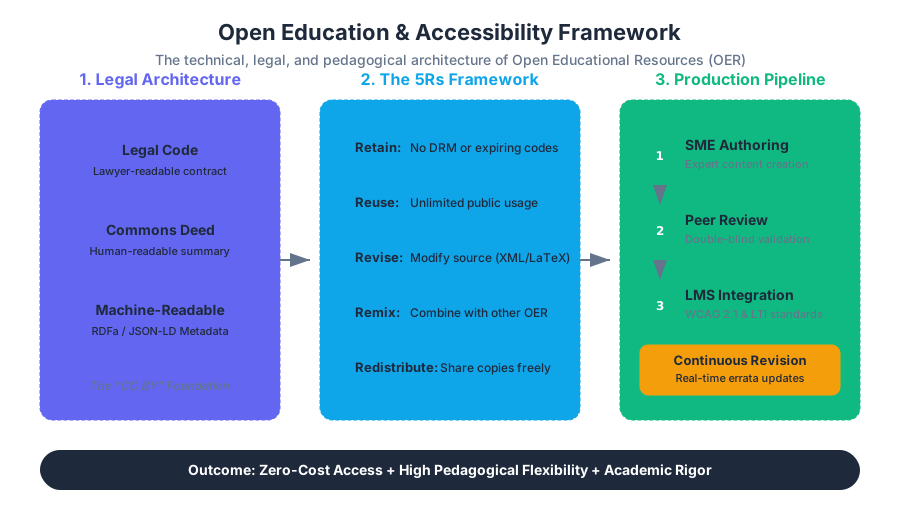
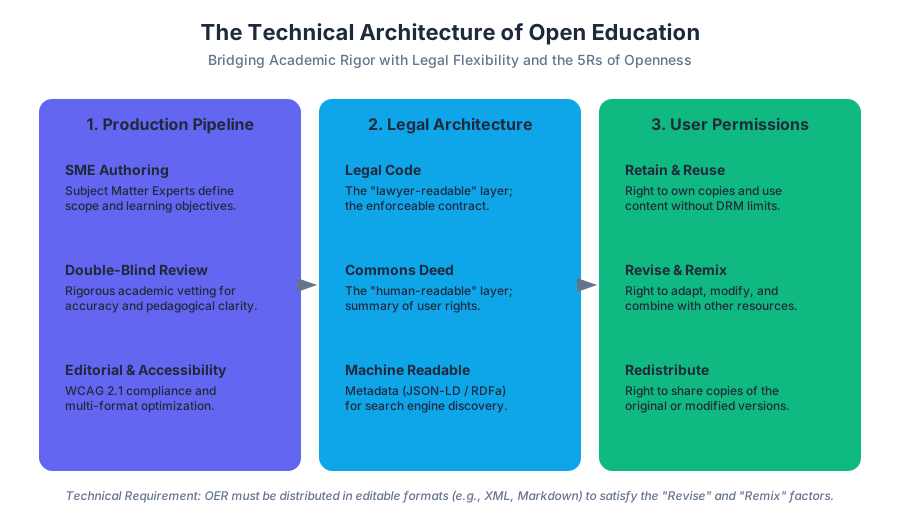
Unlike traditional "All Rights Reserved" copyright, which functions as a default "No" to any use, CC BY functions as a "Yes, provided that..." The license is built on a three-layer design:
- Legal Code: The "lawyer-readable" layer that contains the actual enforceable contract.
- Commons Deed: The "human-readable" layer that summarizes the key terms (Attribution).
- Machine-Readable: A CC REL (Rights Expression Language) metadata layer that allows search engines and software to identify the license automatically.
The 5Rs of Openness
To be considered truly "Open," a resource must facilitate the 5Rs, a framework developed by David Wiley to define the degrees of freedom granted to the user:
| R-Factor | Definition | Technical Implication |
|---|---|---|
| Retain | The right to make, own, and control copies of the content. | No "Digital Rights Management" (DRM) or expiring access codes. |
| Reuse | The right to use the content in a wide range of ways (e.g., in a class, on a website). | Content can be hosted on local servers or offline devices. |
| Revise | The right to adapt, adjust, modify, or alter the content itself. | Source files (e.g., LaTeX, Markdown, XML) must be available. |
| Remix | The right to combine the original or revised content with other material. | Interoperability between different CC-licensed works. |
| Redistribute | The right to share copies of the original content, your revisions, or your remixes. | Permission to host mirrors or distribute via USB/Print. |
Key Insight: The "Revise" and "Remix" capabilities are what distinguish OER from "Free-to-Read" resources. A PDF that is free to download but illegal to modify is not OER; it is merely a zero-cost proprietary asset.
Peer-Reviewed Educational Resources
A common critique of free online content is the perceived lack of quality control. OpenStax mitigates this by applying the Peer-Review model—traditionally used in academic journals—to the production of introductory textbooks.
The OpenStax Workflow
The production of a resource like Principles of Microeconomics 3e follows a rigorous pipeline that mirrors the complexity of commercial publishing but operates with the goal of public benefit rather than profit maximization.
- Scope and Sequence Development: Subject matter experts (SMEs) define the learning objectives to ensure alignment with standard curriculum requirements.
- Authoring: Experts write the initial draft, ensuring that "Diverse Economic Perspectives" are integrated rather than added as an afterthought.
- Double-Blind Peer Review: Multiple reviewers evaluate the manuscript for accuracy, pedagogical clarity, and bias.
- Editorial Refinement: Professional editors ensure a consistent voice and adherence to accessibility standards (e.g., WCAG 2.1).
- Continuous Revision: Unlike static print editions, digital OER can be updated "in-place" to correct errata or reflect new economic data.
Comparison: Traditional vs. Open Peer Review
| Feature | Traditional Publishing | OpenStax OER Model |
|---|---|---|
| Incentive Structure | Royalties and sales volume. | Grant funding and institutional support. |
| Update Cycle | 3–5 years (New editions forced for profit). | Continuous (Errata corrected in real-time). |
| Reviewer Profile | Often anonymous, internal. | Transparent list of contributors/reviewers. |
| Accessibility | Proprietary formats (e.g., VitalSource). | Multi-format (Web, PDF, EPUB, Print). |
Educational Affordability and the Access Gap
Educational Affordability is not merely a financial metric; it is a pedagogical one. When the cost of a textbook exceeds $200, a significant percentage of students attempt to complete the course without the material, leading to higher DFW (Drop, Fail, Withdraw) rates.
The Economics of the "First-Day Access"
In the traditional model, students often wait for financial aid disbursements to purchase books, missing the first 2–3 weeks of reading. OER provides First-Day Access, ensuring that the "Access Gap" is zero.
Case Study: Principles of Microeconomics 3e
The third edition of Principles of Microeconomics by OpenStax provides a comprehensive look at market forces, labor markets, and international trade. By being free, it eliminates the "asymmetric information" problem where students don't know the value of the book until they have already paid for it.
Theorem of Educational Elasticity: As the price of required course materials ($P_m$) approaches zero, the probability of student engagement ($E_s$) increases non-linearly, particularly for students in lower-income deciles.
Technical Integration and LMS Interoperability
For OER to be effective in a modern university, it must integrate seamlessly with the Learning Management System (LMS) like Canvas, Moodle, or Blackboard. OpenStax achieves this through OpenStax Assignable.
LTI (Learning Tools Interoperability)
OpenStax uses the LTI standard to allow its content and assessment tools to "talk" to the LMS. This allows for:
- Single Sign-On (SSO): Students don't need a separate account.
- Gradebook Sync: Scores from OpenStax assessments automatically populate the instructor's gradebook.
- Deep Linking: Instructors can link directly to specific chapters or sections within the LMS modules.
Diverse Economic Perspectives in OER
One of the most significant advantages of the CC BY license is the ability to localize and diversify content. Traditional textbooks often present a monolithic view of economic theory. OpenStax's Principles of Microeconomics 3e explicitly incorporates diverse perspectives, including:
- Behavioral Economics: Moving beyond the "rational actor" model.
- Environmental Economics: Integrating externalities and sustainability.
- Global Context: Using examples from emerging markets, not just the US/EU.
The "Remix" as a Tool for Inclusion
Because the license allows for revision, a professor in South Africa can take the OpenStax Microeconomics book and replace US-centric examples (like the Federal Reserve) with local examples (the South African Reserve Bank) without seeking permission. This ensures the material is culturally and contextually relevant.
Mathematical Representation of Market Equilibrium
In the textbook, the core concepts are presented with mathematical rigor. For instance, the equilibrium where Quantity Supplied ($Q_s$) equals Quantity Demanded ($Q_d$) is derived as follows:
\begin{aligned}
Q_d &= a - bP \\
Q_s &= c + dP \\
\text{At Equilibrium: } Q_d &= Q_s \\
a - bP &= c + dP \\
a - c &= (b + d)P \\
P^* &= \frac{a - c}{b + d}
\end{aligned}
This level of detail ensures that "free" does not mean "simplified." The academic rigor is maintained while the financial barrier is removed.
Common Pitfalls and Misconceptions
- "OER is just a PDF": While many OERs are distributed as PDFs, true OER is a philosophy of access. A PDF that cannot be edited or that is hosted behind a paywall is not OER.
- The "Quality-Price" Fallacy: The assumption that if a resource is free, it must be low quality. Peer-reviewed OER like OpenStax often undergoes more rigorous vetting than commercial books, which are sometimes rushed to market to meet sales cycles.
- Licensing Confusion: Users often confuse CC BY (Attribution) with CC BY-NC (Non-Commercial). OpenStax uses CC BY, meaning you can actually sell the book (e.g., a bookstore selling a printed copy for the cost of ink and paper).
Summary of Educational Affordability Metrics
| Metric | Traditional Model | OER Model (OpenStax) |
|---|---|---|
| Average Cost per Student | $100 - $300 | $0 (Digital) / ~$30 (Print) |
| Access Date | Day 10 - 20 (Post-purchase) | Day 1 |
| Long-term Access | Ends after semester (Rental/Access Code) | Perpetual |
| Customizability | Zero (Copyright restricted) | High (CC BY licensed) |
Source Materials
Study Principles Microeconomics 3e on Lykke
This course page is free to open: signed out, you can read its first two sections, and signing in, on any plan, opens the rest. The free Lykke Chrome extension syncs your own Canvas courses, so ChatGPT, Claude and Muse can answer from your classes and deadlines. It only reads Canvas.
Add the free extensionSign in to open every sectionAll sections of Principles Microeconomics 3e · Browse more course pages