From the free course Principles Microeconomics 3e on Lykke
Diverse Economic Perspectives
Key concepts: Diverse Economic Perspectives · Inclusion in Economics · Real-World Application
Exploration of how the course incorporates various viewpoints and real-world contexts into economic study.
Diverse Economic Perspectives: The Evolution of Pluralistic Economic Modeling
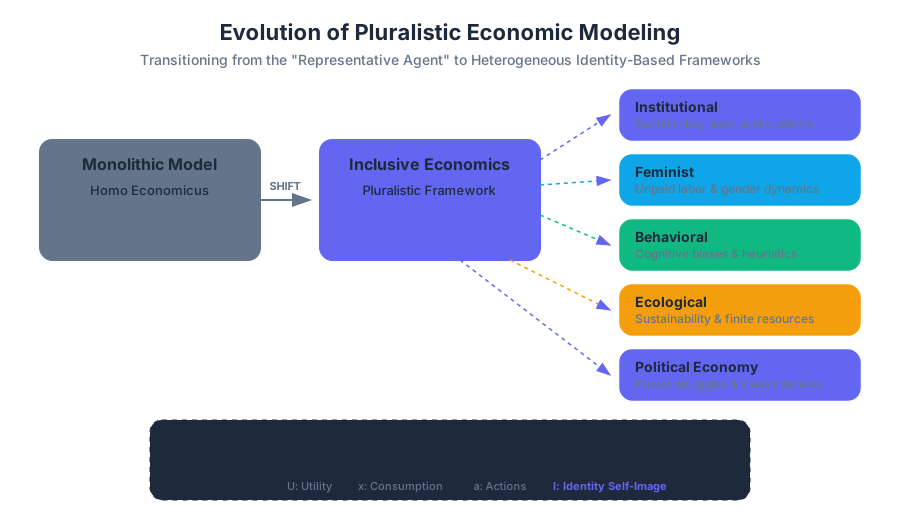
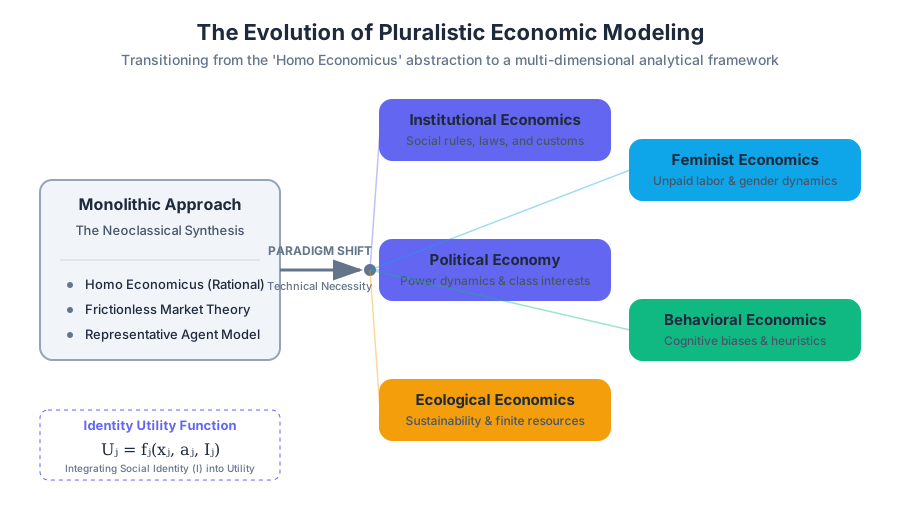
Modern economics is undergoing a fundamental paradigm shift. Historically, the field was dominated by a "monolithic" approach—primarily the Neoclassical synthesis—which relied on the assumption of the Homo Economicus: a perfectly rational, self-interested actor operating in frictionless markets. However, the contemporary landscape, as reflected in the Principles of Microeconomics 3e, recognizes that this model often fails to account for the complexities of human identity, institutional barriers, and systemic inequities.
Diverse Economic Perspectives represent an analytical framework that integrates heterodox theories, demographic variables, and multi-disciplinary insights into the core of economic inquiry. This is not merely a matter of "social representation"; it is a technical necessity for improving the predictive power and descriptive accuracy of economic models. By incorporating perspectives from different demographic groups, geographic regions, and schools of thought, economists can better understand how policy interventions propagate through a heterogeneous population.
The Framework of Inclusive Economics
Inclusive economics moves beyond the "representative agent" model to acknowledge that economic agents are embedded in social structures. This transition requires a shift from Positive Economics (what is) to a more robust integration of Normative Economics (what ought to be) and Institutional Economics (how rules shape outcomes).
Core Pillars of Diversity in Economic Theory
To understand the breadth of this field, we must categorize the primary schools of thought that contribute to a diverse perspective.
| School of Thought | Primary Focus | Key Critique of Neoclassical Model |
|---|---|---|
| Institutional Economics | The role of social institutions, laws, and customs in shaping economic behavior. | Markets do not exist in a vacuum; they are "instituted" by social rules. |
| Feminist Economics | The inclusion of unpaid labor (care work), gendered wage gaps, and intra-household resource allocation. | Traditional GDP and utility models ignore non-market production and gendered power dynamics. |
| Behavioral Economics | Psychological factors and cognitive biases that lead to "irrational" decision-making. | Humans are not "rational optimizers" but "satisficers" prone to heuristics. |
| Ecological Economics | The economy as a subsystem of the Earth's ecosystem, focusing on sustainability and finite resources. | Infinite growth is impossible on a finite planet; externalities are not "glitches" but central features. |
| Political Economy | The interplay between political power, class interests, and economic policy. | Economic outcomes are often the result of power struggles rather than pure market efficiency. |
Quantitative Modeling of Identity and Bias
One of the most significant technical advancements in diverse economics is the formalization of Identity Economics. This subfield, pioneered by George Akerlof and Rachel Kranton, introduces social identity into the utility function.
The Identity Utility Function
In a standard model, utility $U$ is a function of consumption $x$. In a diverse model, utility is expressed as:
$$U_j = f_j(x_j, a_j, I_j)$$
Where:
- $x_j$: Consumption of goods and services.
- $a_j$: Actions taken by individual $j$.
- $I_j$: The individual’s Identity Self-Image, which depends on the social category they belong to and the extent to which their actions $a_j$ conform to the "prescriptions" (norms) of that category.
Measuring Disparity: The Oaxaca-Blinder Decomposition
In the study of Inclusion in Economics, it is not enough to observe that a wage gap exists. We must determine why it exists. The Oaxaca-Blinder Decomposition is a statistical method used to partition the difference in an outcome (like wages) into a part that is explained by individual characteristics (education, experience) and an "unexplained" part, often attributed to discrimination or structural barriers.
Mathematical Derivation
Given two groups, $L$ (Lead) and $C$ (Comparison), we estimate a linear regression for wages ($Y$):
$$Y_L = \beta_L X_L + \epsilon_L$$ $$Y_C = \beta_C X_C + \epsilon_C$$
The difference in mean outcomes $\bar{Y}_L - \bar{Y}_C$ can be decomposed as:
$$\Delta \bar{Y} = \underbrace{(\bar{X}_L - \bar{X}_C)\hat{\beta}C}{\text{Endowments (Explained)}} + \underbrace{\bar{X}_C(\hat{\beta}_L - \hat{\beta}C)}{\text{Coefficients (Unexplained)}} + \underbrace{(\bar{X}_L - \bar{X}_C)(\hat{\beta}_L - \hat{\beta}C)}{\text{Interaction}}$$
Key Insight: If the "Coefficients" term is large, it suggests that the market rewards the same characteristics differently depending on the group, highlighting a lack of inclusion and the presence of systemic bias.
Real-World Application: Urban Economics and "Redlining"
A concrete example of how diverse perspectives change economic analysis is the study of Redlining in the United States. A traditional neoclassical model might view neighborhood decline as a simple result of "market preferences." However, an inclusive perspective looks at the historical institutional data.
The Impact of Discriminatory Lending
In the 1930s, the Home Owners' Loan Corporation (HOLC) created maps that color-coded neighborhoods by "mortgage fitness." Minority neighborhoods were shaded red ("hazardous"), leading to a systemic denial of credit.
| Metric | Redlined Area (Historical) | Greenlined Area (Historical) | Long-term Economic Impact |
|---|---|---|---|
| Home Equity | Stagnant/Low | High Growth | Massive wealth gap (intergenerational) |
| Public Investment | Minimal | Robust | Disparities in school funding and infrastructure |
| Environmental Risk | High (Urban Heat Islands) | Low (Tree Canopy) | Health costs and lower labor productivity |
Variations and Extensions
1. Intersectionality in Modeling
Diverse perspectives also require an Intersectional approach. This means recognizing that the economic experience of a person is not just the sum of their parts (e.g., "Woman" + "Black"), but a unique experience created by the intersection of these identities. In regression analysis, this is handled through interaction terms.
2. The "Global South" Perspective
Development economics has shifted from "Washington Consensus" models (which prescribed universal deregulation) to models that respect local institutional contexts. This includes recognizing the role of the Informal Economy, which accounts for over 60% of employment in some developing regions but is often ignored in standard GDP calculations.
3. Stratification Economics
This subfield focuses specifically on how social groups (race, caste, class) maintain their relative status through the control of resources and the creation of "social distance." It challenges the idea that markets naturally erode discrimination over time.
Common Pitfalls in Diverse Economic Analysis
- Tokenism in Data: Including a "diversity variable" in a model without adjusting the underlying theoretical framework. If the model still assumes a frictionless market, the variable will likely show up as "noise" or be misinterpreted.
- The "Essentialism" Fallacy: Assuming that all members of a specific demographic group share the same economic preferences or behaviors. Diversity exists within groups as much as between them.
- Survivorship Bias: Analyzing only the successful members of a marginalized group to draw conclusions about the group's economic mobility, while ignoring those who were filtered out by structural barriers.
- Ignoring Unpaid Labor: Failing to account for the "Care Economy." If a policy increases labor force participation but destroys the informal care network for children and the elderly, the net economic impact may be negative despite a rise in GDP.
Conclusion: The Future of the Discipline
The integration of diverse economic perspectives is not a "political" addition to the field; it is an analytical upgrade. As global markets become more interconnected and social structures more complex, the ability to model heterogeneity becomes the hallmark of a sophisticated economist. The Principles of Microeconomics 3e serves as a foundational step in this direction, equipping students with the tools to see the economy not as a series of abstract curves, but as a vibrant, complex system of human interaction.
- Pluralism: The practice of using multiple theoretical frameworks to understand economic phenomena.
- Oaxaca-Blinder Decomposition: A statistical method to split differences in outcomes into explained and unexplained (discriminatory) components.
- Identity Economics: A subfield that incorporates social identity and norms into the utility function.
- Informal Economy: Economic activities, enterprises, and jobs that are not regulated or protected by the state.
- Stratification Economics: A branch of economics investigating the social and economic barriers that keep certain groups in a lower status.
- Care Economy: The sector of the economy that encompasses unpaid domestic work and social reproduction.
-
Which term describes the "unexplained" portion of the Oaxaca-Blinder decomposition?
- A) Endowments
- B) Coefficients (Discrimination)
- C) Interaction
- D) Residual Variance Correct: B
-
How does Feminist Economics critique the standard calculation of GDP?
- A) It claims GDP is too high.
- B) It argues GDP ignores the value of unpaid care work and domestic labor.
- C) It suggests GDP should only measure government spending.
- D) It claims GDP is a purely political metric with no economic value. Correct: B
-
In the Identity Utility Function $U = f(x, a, I)$, what does $I$ represent?
- A) Interest rates
- B) Investment capital
- C) Identity self-image and social norms
- D) Inflationary expectations Correct: C
-
Institutional Economics argues that markets...
- A) Are perfectly efficient by nature.
- B) Are social constructs shaped by laws and customs.
- C) Should be abolished in favor of central planning.
- D) Operate independently of political influence. Correct: B
-
Which pitfall involves assuming all members of a demographic group behave identically?
- A) Tokenism
- B) Essentialism
- C) Survivorship Bias
- D) Omitted Variable Bias Correct: B
Key Learning Objectives:
- Contrast Neoclassical assumptions with the reality of diverse economic agents.
- Identify the primary heterodox schools of thought (Feminist, Institutional, Behavioral).
- Understand the mathematical integration of identity into utility functions.
- Analyze the historical and structural roots of economic disparity (e.g., Redlining).
- Apply statistical tools like the Oaxaca-Blinder decomposition to real-world data.
Review Questions:
- Why is the "Representative Agent" model often insufficient for policy-making in diverse societies?
- How do social norms influence individual economic choices according to Identity Economics?
- What are the long-term economic consequences of systemic exclusion from credit markets?
- How can an intersectional approach change the results of a standard labor market regression?
Further Reading:
- Principles of Microeconomics 3e, Chapter 1: "Welcome to Economics!"
- Akerlof and Kranton, Identity Economics: How Our Identities Shape Our Work, Wages, and Well-Being.
- Amartya Sen, Development as Freedom.
Source Materials
Study Principles Microeconomics 3e on Lykke
This course page is free to open: signed out, you can read its first two sections, and signing in, on any plan, opens the rest. The free Lykke Chrome extension syncs your own Canvas courses, so ChatGPT, Claude and Muse can answer from your classes and deadlines. It only reads Canvas.
Add the free extensionSign in to open every sectionAll sections of Principles Microeconomics 3e · Browse more course pages