From the free course Principles Marketing on Lykke
Strategic Planning and Market Research
Key concepts: SWOT Analysis · Market Segmentation · Targeting and Positioning (STP) · Primary vs. Secondary Research
Focuses on the strategic planning process, environmental scanning, and the use of market research to inform business decisions.
Strategic Planning and Market Research
Strategic planning in marketing is the architectural process of aligning an organization’s internal capabilities with the external environment to achieve sustainable competitive advantage. It is not a static document but a dynamic feedback loop driven by rigorous data collection and analytical frameworks. At its core, the process seeks to answer three fundamental questions: Where are we now? Where do we want to go? How do we get there?
Environmental Scanning and SWOT Analysis
The first phase of strategic planning is Environmental Scanning, the systematic monitoring of the internal and external environments to identify early signs of opportunities and threats that may influence the organization's current and future plans. The primary tool for synthesizing this information is the SWOT Analysis.
Defining SWOT
SWOT Analysis is a strategic framework used to evaluate the Strengths, Weaknesses, Opportunities, and Threats involved in a project or business venture. It categorizes factors into internal (controllable) and external (uncontrollable) origins.
| Factor Category | Origin | Nature | Description |
|---|---|---|---|
| Strengths | Internal | Positive | Core competencies, proprietary technology, brand equity, or human capital. |
| Weaknesses | Internal | Negative | Resource gaps, lack of expertise, poor location, or outdated infrastructure. |
| Opportunities | External | Positive | Market growth, technological shifts, regulatory changes, or competitor failure. |
| Threats | External | Negative | Economic downturns, new entrants, substitute products, or shifting consumer tastes. |
The TOWS Matrix: From Analysis to Strategy
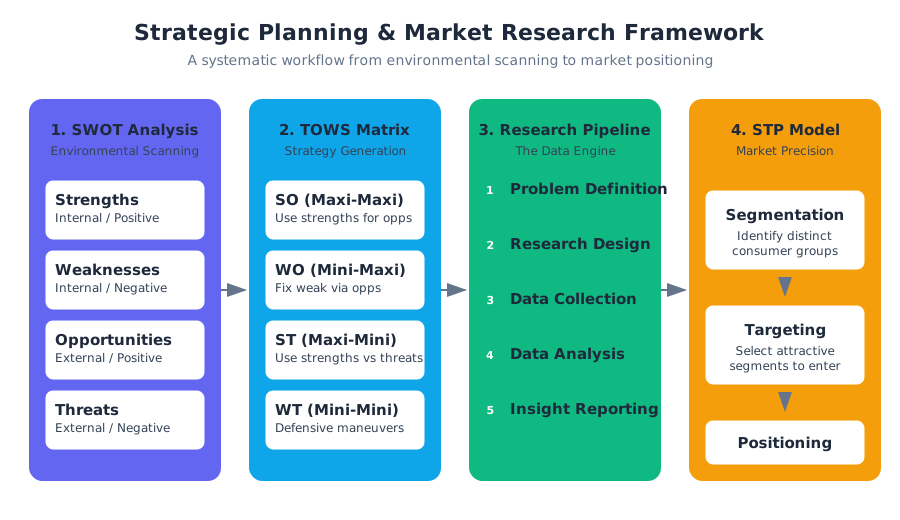
A common pitfall in SWOT analysis is the "listing trap," where organizations simply list factors without deriving action. The TOWS Matrix (a variant of SWOT) addresses this by cross-referencing factors to generate four distinct strategic types:
- SO (Maxi-Maxi) Strategies: Using internal strengths to capitalize on external opportunities.
- WO (Mini-Maxi) Strategies: Overcoming internal weaknesses by exploiting external opportunities.
- ST (Maxi-Mini) Strategies: Utilizing strengths to avoid or mitigate external threats.
- WT (Mini-Mini) Strategies: Defensive tactics aimed at reducing internal weaknesses and avoiding external threats.
Market Research: The Data Engine
Market research is the systematic design, collection, analysis, and reporting of data relevant to a specific marketing situation. It serves as the empirical foundation for the STP process and SWOT analysis.
Primary vs. Secondary Research
The distinction between primary and secondary research is defined by the provenance and purpose of the data.
| Feature | Secondary Research | Primary Research |
|---|---|---|
| Definition | Data previously collected for other purposes. | Data collected specifically for the current problem. |
| Cost | Low to Moderate (often free). | High (requires design, labor, and tools). |
| Time | Immediate availability. | Lengthy collection and processing period. |
| Specificity | General; may not fit the specific problem. | Highly tailored to the research objectives. |
| Examples | Census data, industry reports, internal sales logs. | Focus groups, surveys, A/B testing, ethnographic study. |
The Research Process Pipeline
The execution of market research follows a rigorous scientific method:
- Problem Definition: Identifying the "decision problem" and translating it into a "research problem."
- Research Design: Determining the approach (Exploratory, Descriptive, or Causal).
- Data Collection: Executing the sampling plan and gathering raw data.
- Data Analysis: Cleaning, weighting, and analyzing data using statistical methods.
- Reporting: Translating findings into actionable business insights.
The STP Process: Segmentation, Targeting, and Positioning
The STP Model represents the transition from a broad, "one-size-fits-all" approach to a precision-targeted strategy. It recognizes that markets are heterogeneous—composed of diverse consumers with varying needs.
1. Market Segmentation
Segmentation is the process of partitioning a large market into distinct subsets of consumers who share common characteristics and respond similarly to marketing stimuli.
Segmentation Variables:
- Geographic: Region, urban/rural, climate.
- Demographic: Age, income, gender, education, occupation.
- Psychographic: Lifestyle, personality, values (often measured via VALS framework).
- Behavioral: Usage rate, brand loyalty, benefits sought, readiness to buy.
Mathematical Basis for Segmentation
Segmentation often utilizes K-Means Clustering, where the goal is to minimize the within-cluster sum of squares (WCSS).
J = \sum_{i=1}^{k} \sum_{x \in S_i} ||x - \mu_i||^2
Where:
- $J$ is the objective function to minimize.
- $k$ is the number of clusters (segments).
- $S_i$ is the set of points in the $i$-th cluster.
- $\mu_i$ is the centroid (mean) of points in $S_i$.
2. Targeting
Once segments are identified, the firm must evaluate them and decide which to pursue. This is Targeting. A segment is "attractive" if it meets the MASA criteria:
- Measurable: Can we quantify the size and purchasing power?
- Accessible: Can we reach them through distribution and communication?
- Substantial: Is it large/profitable enough to justify the effort?
- Actionable: Can we actually design effective programs to attract them?
3. Positioning
Positioning is the act of designing the company’s offering and image to occupy a distinctive place in the mind of the target market. It is defined by the Value Proposition.
Perceptual Mapping
Marketers use Perceptual Maps to visualize how brands are perceived relative to competitors across two key dimensions (e.g., Price vs. Quality).
Common Pitfalls in Strategic Planning
- The SWOT Hallucination: Listing "Strengths" that are actually just "Table Stakes" (features every competitor has). A true strength must be a Differential Advantage.
- Segmentation Over-Granularity: Creating segments so small that the cost of reaching them exceeds the potential revenue (violating the "Substantial" criteria).
- Positioning Drift: Attempting to be "everything to everyone," which results in a diluted brand image that resonates with no one.
- Confirmation Bias in Research: Designing survey questions that lead the respondent toward a desired answer rather than uncovering objective truth.
Research Configuration Example
To avoid bias and ensure data integrity, research parameters must be strictly defined.
Synthesis: The Strategic Loop
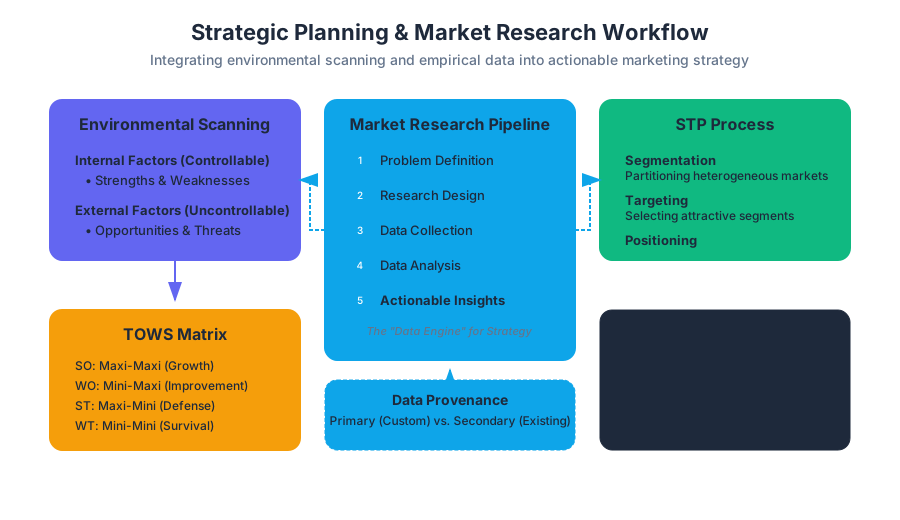
Strategic planning is not a linear path but a cycle. Market research informs the SWOT analysis; the SWOT analysis identifies the strategic direction; the STP process defines the execution focus; and the results of that execution are fed back into market research for the next planning cycle.
Organizations that master this loop can pivot faster than competitors because their decisions are rooted in data-driven positioning rather than executive intuition.
Source Materials
Study Principles Marketing on Lykke
This course page is free to open: signed out, you can read its first two sections, and signing in, on any plan, opens the rest. The free Lykke Chrome extension syncs your own Canvas courses, so ChatGPT, Claude and Muse can answer from your classes and deadlines. It only reads Canvas.
Add the free extensionSign in to open every sectionAll sections of Principles Marketing · Browse more course pages