From the free course Principles Marketing on Lykke
Foundations of Marketing and Value Creation
Key concepts: Value Proposition · Marketing Mix (4 Ps) · Marketing Ethics · Stakeholder Theory
An introduction to the core definitions of marketing, the evolution of marketing philosophy, and the central role of value creation for customers and stakeholders.
Foundations of Marketing and Value Creation
Marketing is the architectural framework through which organizations identify, create, communicate, and deliver value to a target audience. In a modern technical context, marketing is less about "persuasion" and more about value-matching: the algorithmic alignment of a solution's utility with a specific market's latent or active needs. It is a multi-disciplinary field that synthesizes psychology, economics, data science, and ethics to facilitate an exchange that leaves both the provider and the consumer better off.
1. The Value Proposition: The Core "Why"
At the heart of every marketing strategy lies the Value Proposition. This is a clear statement that explains how a product solves customers' problems or improves their situation (relevancy), delivers specific benefits (quantified value), and tells the ideal customer why they should buy from this provider and not from the competition (unique differentiation).
Definition: A Value Proposition is the full positioning of a brand—the full mix of benefits on which it is positioned. It is the answer to the customer’s question: "Why should I buy your brand rather than a competitor’s?"
1.1 The Value Equation
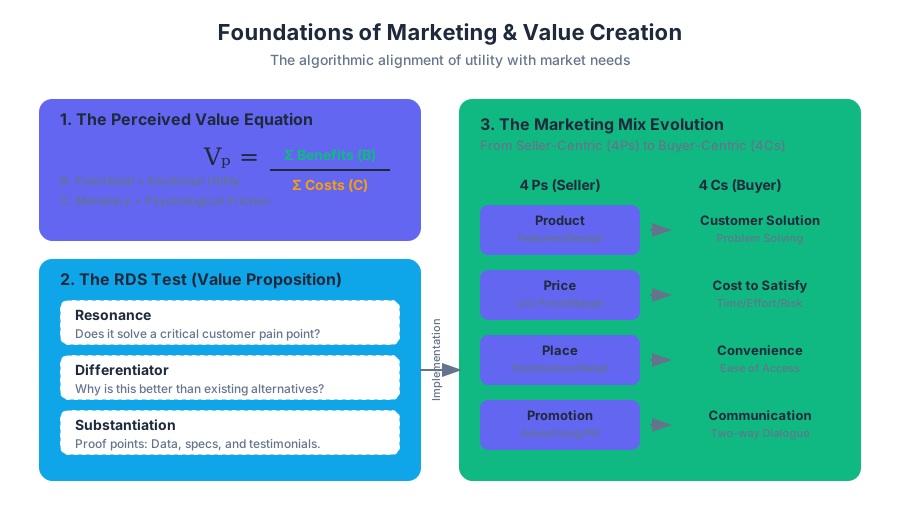
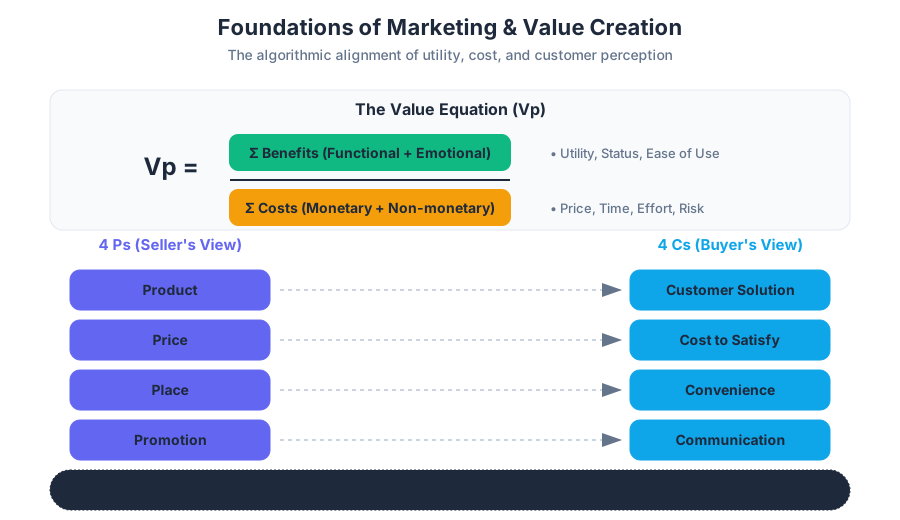
Mathematically, value is not an absolute number but a perceived ratio. We can represent it as:
$$V_{p} = \frac{\sum B_{functional} + \sum B_{emotional}}{\sum C_{monetary} + \sum C_{non-monetary}}$$
Where:
- $V_{p}$: Perceived Value
- $B$: Benefits (Utility, status, ease of use)
- $C$: Costs (Price, time, effort, psychological risk)
1.2 Components of a Strong Value Proposition
A robust value proposition must pass the "Resonance-Differentiator-Substantiation" (RDS) test:
| Component | Focus | Objective |
|---|---|---|
| Resonance | Customer Pain Points | Does this solve a problem the customer actually cares about? |
| Differentiator | Competitive Landscape | Is this significantly different or better than existing alternatives? |
| Substantiation | Proof Points | Can the claims be backed by data, testimonials, or technical specs? |
1.3 Pitfalls in Value Creation
A common mistake is the Product Myth: assuming that a superior technical product will automatically create value. Value is only realized when the product is mapped to a specific "Job to be Done" (JTBD). If the friction of adoption (cost) exceeds the perceived utility (benefit), the value proposition is effectively zero.
2. The Marketing Mix (The 4 Ps)
The Marketing Mix is the operational toolkit used by marketers to implement a strategy. Originally proposed by E. Jerome McCarthy in 1960, the 4 Ps provide a structured way to manage the variables of a market offering.
2.1 The Four Pillars
- Product: The tangible good or intangible service. This includes design, features, quality, and branding.
- Price: The amount a customer pays. This involves pricing strategy (skimming vs. penetration), discounts, and credit terms.
- Place: The distribution channels. How the product reaches the consumer (e-commerce, retail, wholesale).
- Promotion: The communication strategy. Advertising, public relations, social media, and direct sales.
2.2 Calculating Customer Lifetime Value (CLV)
To optimize the Marketing Mix, firms must understand the long-term value of the customers they are acquiring.
2.3 Evolution: From 4 Ps to 4 Cs
As marketing shifted from a production-centric to a customer-centric model, the 4 Ps were mirrored by the 4 Cs, focusing on the consumer's perspective.
| 4 Ps (Seller's View) | 4 Cs (Buyer's View) | Strategic Shift |
|---|---|---|
| Product | Customer Solution | Focus on solving a problem, not just features. |
| Price | Cost to Satisfy | Includes time, effort, and opportunity cost. |
| Place | Convenience | How easy is it to find and purchase? |
| Promotion | Communication | A two-way dialogue rather than a broadcast. |
3. Marketing Ethics and Social Responsibility
Marketing Ethics refers to the moral principles and values that govern the actions and decisions of marketers. In an era of big data and algorithmic targeting, ethics have moved from a "nice-to-have" to a core component of brand equity.
3.1 Ethical Frameworks
Marketers typically navigate three primary ethical lenses:
- Utilitarianism: The greatest good for the greatest number. (e.g., Is this data collection beneficial for the majority of users?)
- Deontology: Adherence to moral rules and duties regardless of the outcome. (e.g., "Never lie in an advertisement," even if it reduces sales.)
- Virtue Ethics: Focusing on the character of the marketer and the organization.
3.2 Common Ethical Dilemmas
- Data Privacy: The tension between personalization and surveillance.
- Vulnerable Populations: Targeting children or those with addictions (e.g., loot boxes in gaming).
- Greenwashing: Misleading consumers about the environmental benefits of a product.
3.3 The Triple Bottom Line (TBL)
Modern marketing ethics often integrates the TBL framework, which suggests that companies should be measured on three "Ps":
- Profit: Traditional financial performance.
- People: Social equity and fair labor practices.
- Planet: Environmental stewardship.
\text{Corporate Sustainability} = \int (\text{Economic Growth} + \text{Social Equity} + \text{Environmental Protection}) \, dt
4. Stakeholder Theory in Marketing
Stakeholder Theory, popularized by R. Edward Freeman, posits that a business's goal is to create value for all stakeholders, not just shareholders. In a marketing context, this means the strategy must account for the interests of employees, suppliers, customers, communities, and the environment.
4.1 Stakeholder Mapping
Marketers use stakeholder mapping to prioritize communication and value delivery.
| Stakeholder Group | Primary Interest | Marketing Impact |
|---|---|---|
| Customers | Product quality, fair pricing | Direct revenue, brand loyalty. |
| Employees | Job security, company reputation | Brand ambassadors, service quality. |
| Suppliers | Fair terms, long-term partnership | Supply chain stability, ethical sourcing. |
| Regulators | Compliance, consumer protection | Legal "license to operate," data usage. |
| Community | Environmental impact, philanthropy | Local brand perception, CSR. |
4.2 The Interconnectedness of Stakeholders
A failure to provide value to one stakeholder often cascades. For example, if a company exploits Suppliers (leading to poor quality), the Customers receive a sub-par Product, which damages the Brand Equity and eventually reduces Shareholder value.
5. The Evolution of Marketing Thought
Marketing has evolved through several distinct eras, reflecting changes in technology and social organization.
5.1 Historical Eras
- Production Era (Pre-1920s): "A good product will sell itself." Focus on manufacturing efficiency (e.g., Henry Ford’s Model T).
- Sales Era (1920s–1950s): Focus on aggressive selling and advertising to move oversupply.
- Marketing Concept Era (1950s–1990s): The "Customer is King." Focus on identifying needs before developing products.
- Relationship Era (1990s–Present): Focus on long-term engagement and Customer Relationship Management (CRM).
- Social/Mobile Era (2010s–Present): Real-time interaction, transparency, and social influence.
6. Summary and Synthesis
The foundations of marketing represent a shift from transactional mechanics to relational value creation. By integrating the 4 Ps within an ethical framework and considering the needs of all stakeholders, organizations can build sustainable Value Propositions.
- Value is the numerator of the business equation; without it, no amount of promotion can sustain a brand.
- The Marketing Mix is the execution engine; it must be balanced and data-driven.
- Ethics and Stakeholders are the guardrails; they ensure that value creation does not come at the cost of social or environmental degradation.
Source Materials
Study Principles Marketing on Lykke
This course page is free to open: signed out, you can read its first two sections, and signing in, on any plan, opens the rest. The free Lykke Chrome extension syncs your own Canvas courses, so ChatGPT, Claude and Muse can answer from your classes and deadlines. It only reads Canvas.
Add the free extensionSign in to open every sectionAll sections of Principles Marketing · Browse more course pages