From the free course Principles Management on Lykke
Strategic and Human Resource Management
Key concepts: Strategic Management · Human Resource Management · Competitive Advantage
Explores how organizations position themselves for success and manage their most valuable asset: people.
Strategic and Human Resource Management
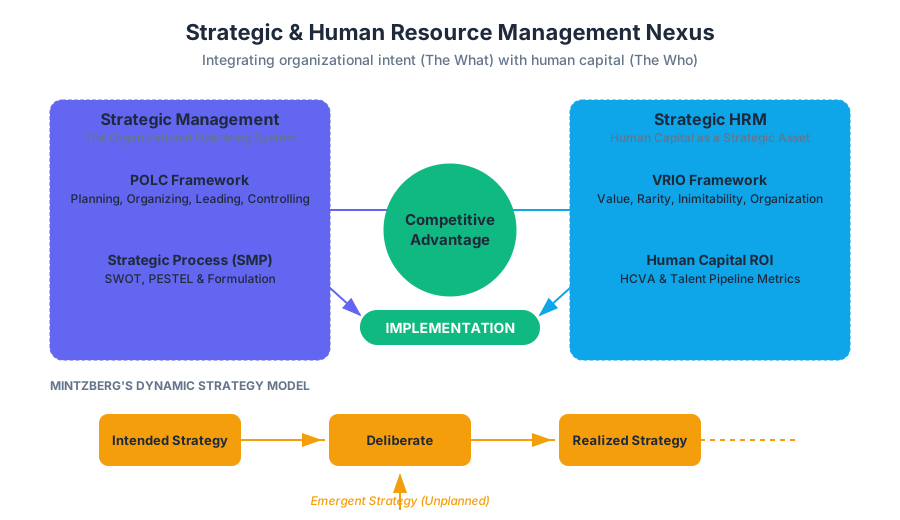
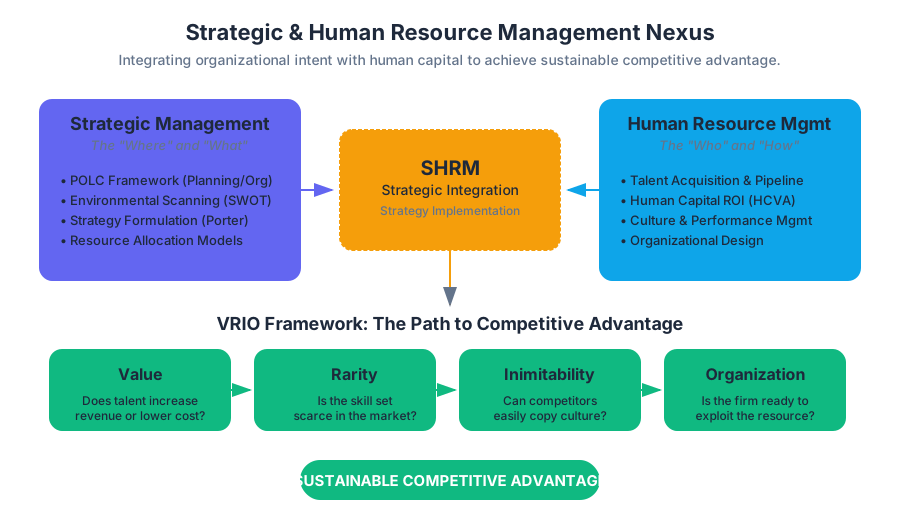
The modern enterprise is no longer a static collection of assets and labor; it is a dynamic system of human capital directed by strategic intent. The intersection of Strategic Management and Human Resource Management (HRM) represents the most critical nexus in organizational theory. While strategy defines the "where" and "what" of an organization’s future, HRM provides the "who" and "how." This deep dive explores the frameworks, mathematical underpinnings, and operational mechanics that allow organizations to transform abstract goals into sustainable Competitive Advantage.
The Strategic Management Framework
Strategic Management is the continuous process of planning, monitoring, analyzing, and assessing all necessities an organization needs to meet its goals and objectives. It is the high-level "operating system" of the firm.
The POLC Framework
At the core of traditional management lies the POLC Framework, which categorizes the primary functions of a manager.
| Function | Focus Area | Key Activities | Output |
|---|---|---|---|
| Planning | Vision & Strategy | Environmental scanning, goal setting, identifying resources. | Strategic Plan |
| Organizing | Structure & Design | Allocating resources, defining roles, departmentalization. | Organizational Chart |
| Leading | People & Culture | Motivating employees, communicating, resolving conflicts. | High Morale/Performance |
| Controlling | Monitoring & Adjustment | Setting standards, measuring performance, corrective action. | Quality/Efficiency |
The Strategic Management Process (SMP)
The SMP is a recursive cycle that ensures the organization remains aligned with its environment. It typically follows a five-stage pipeline:
- Mission and Objectives: Defining the "North Star."
- Environmental Scanning: Utilizing tools like SWOT (Strengths, Weaknesses, Opportunities, Threats) and PESTEL (Political, Economic, Social, Technological, Environmental, Legal).
- Strategy Formulation: Choosing between Cost Leadership, Differentiation, or Niche Focus (Porter’s Generic Strategies).
- Strategy Implementation: The point where HRM becomes critical.
- Strategy Evaluation: Measuring the gap between intended and realized strategy.
The Mintzberg Insight: Strategy is rarely a straight line. Henry Mintzberg distinguished between Intended Strategy (what we plan), Deliberate Strategy (what we actually do), and Emergent Strategy (unplanned responses to the environment). The final Realized Strategy is often a hybrid of the deliberate and the emergent.
Strategic Human Resource Management (SHRM)
Human Resource Management (HRM) is the strategic approach to the effective management of people such that they help a business gain a competitive advantage. When HRM is integrated with the strategic goals of the firm, it becomes Strategic HRM (SHRM).
The Evolution of the HR Function
The transition from "Personnel Management" to "SHRM" reflects a shift from administrative overhead to strategic partnership.
| Attribute | Traditional Personnel Management | Strategic HRM |
|---|---|---|
| Time Horizon | Short-term (reactive) | Long-term (proactive) |
| Role of HR | Administrative/Transactional | Strategic Partner/Change Agent |
| Accountability | Cost Center | Investment Center |
| Key Metric | Compliance & Headcount | ROI, Talent Pipeline, Culture |
| Employee View | Replaceable Labor | Strategic Asset (Human Capital) |
Human Capital ROI (HCROI)
In SHRM, we quantify the value of the workforce. A common metric is the Human Capital Revenue Factor and the Human Capital Value Added (HCVA).
The mathematical representation of HCVA is:
HCVA = \frac{Revenue - (Operating Expenses - Total Compensation Costs)}{Total Full-Time Equivalents (FTE)}
This formula isolates the value created by the human element by removing non-people-related operating expenses from the revenue calculation.
Talent Acquisition and the VRIO Framework
To achieve a Competitive Advantage, the resources provided by HRM must satisfy the VRIO Framework:
- Value: Does the talent provide a service that increases revenue or decreases cost?
- Rarity: Is the skill set difficult to find in the labor market?
- Inimitability: Can competitors easily copy the organizational culture or specific team dynamics?
- Organization: Is the firm organized to capture the value of this talent?
Behavioral Management and Motivation
Strategy fails when the workforce is not motivated to execute it. Behavioral management focuses on the psychological and social aspects of work.
Key Motivation Theories
Understanding why people work is essential for designing compensation and performance management systems.
- Maslow’s Hierarchy of Needs: Suggests a progression from physiological needs to self-actualization.
- Herzberg’s Two-Factor Theory: Distinguishes between Hygiene Factors (salary, conditions) which prevent dissatisfaction, and Motivators (recognition, growth) which create satisfaction.
- Expectancy Theory (Vroom): Proposes that motivation is a product of three factors:
- Expectancy: Effort → Performance
- Instrumentality: Performance → Reward
- Valence: Reward → Personal Goals
Formalizing Expectancy Theory
We can express the Force of Motivation ($F$) as:
F = E \cdot (\sum I \cdot V)
Where:
- $E$ = Expectancy (0 to 1)
- $I$ = Instrumentality (0 to 1)
- $V$ = Valence (-1 to 1)
Common Pitfalls in Strategic HRM
Even with sophisticated frameworks, organizations often fail in the execution of Strategic HRM.
- The "Strategy-Culture" Gap: Peter Drucker famously noted that "Culture eats strategy for breakfast." If the strategic goal is "Innovation" but the HRM system punishes failure, the strategy will fail.
- Metric Overload: Focusing on "Vanity Metrics" (e.g., number of training hours) instead of "Impact Metrics" (e.g., increase in sales per trained employee).
- Siloed Planning: When the C-suite develops a 5-year strategy without consulting HR regarding labor market trends or internal skill gaps.
- The "War for Talent" Fallacy: Over-focusing on external hiring while neglecting the development and retention of internal talent (the "Make vs. Buy" decision).
Integration: The HR Value Chain
The HR Value Chain demonstrates how HR activities lead to organizational performance. It is a causal chain:
- HR Activities: Recruitment, Training, Compensation.
- HR Outcomes: Employee engagement, Competence, Retention.
- Organizational Outcomes: Innovation, Quality, Customer Satisfaction.
- Financial Outcomes: Profits, Market Share, ROI.
DevOps for HR: Infrastructure as People
In high-tech environments, the management of people mirrors the management of infrastructure. We can think of "Onboarding" as a deployment pipeline.
Summary of Strategic Alignment
The ultimate goal of combining Strategic Management and HRM is to create a "Fit." Vertical Fit ensures that HR practices are aligned with the business strategy (e.g., a "Cost Leadership" strategy aligned with efficiency-based incentives). Horizontal Fit ensures that all HR practices (hiring, training, pay) are consistent with each other.
Further Reading and References
- Porter, M. E. (1985). Competitive Advantage: Creating and Sustaining Superior Performance.
- Barney, J. B. (1991). Firm Resources and Sustained Competitive Advantage.
- Huselid, M. A. (1995). The Impact of Human Resource Management Practices on Turnover, Productivity, and Corporate Financial Performance.
- OpenStax Principles of Management.
Source Materials
Study Principles Management on Lykke
This course page is free to open: signed out, you can read its first two sections, and signing in, on any plan, opens the rest. The free Lykke Chrome extension syncs your own Canvas courses, so ChatGPT, Claude and Muse can answer from your classes and deadlines. It only reads Canvas.
Add the free extensionSign in to open every sectionAll sections of Principles Management · Browse more course pages