From the free course Principles Management on Lykke
Open Educational Resources (OER) in Management
Key concepts: Open Educational Resources (OER) · Accessibility · Affordability
An overview of how OpenStax utilizes OER to provide high-quality, accessible management education.
Open Educational Resources (OER) in Management
The landscape of management education is undergoing a fundamental shift from proprietary, closed-loop knowledge distribution to an open-source, decentralized model. Open Educational Resources (OER) represent the technical and philosophical backbone of this transition. In the context of management—a field defined by the optimization of resources—OER serves as both a subject of study and a methodology for delivery. By leveraging open licenses, institutions can bypass the "broken market" of traditional publishing, ensuring that the Planning, Organizing, Leading, and Controlling (POLC) framework is accessible to a global cohort of learners regardless of socioeconomic status.
The Taxonomy of Openness: The 5Rs Framework
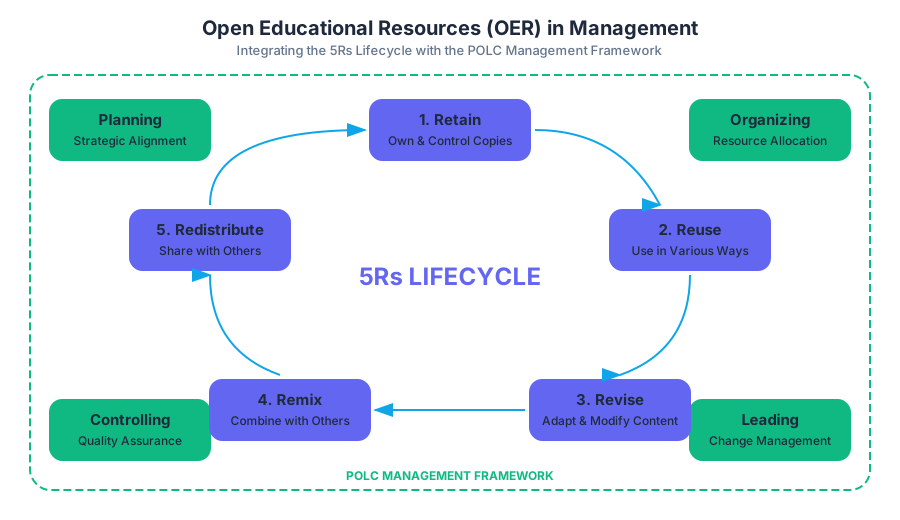
To understand OER in a management context, one must move beyond the "free of charge" definition. True OER is defined by the legal and technical permissions granted to the user. These are codified in the 5Rs Framework, which dictates the lifecycle of a management textbook or case study.
Definition: The 5Rs of OER A set of rights proposed by David Wiley that defines the "openness" of a resource:
- Retain: The right to make, own, and control copies of the content.
- Reuse: The right to use the content in a wide range of ways (e.g., in a class, on a website, in a video).
- Revise: The right to adapt, adjust, modify, or alter the content itself (e.g., translating a management case study into another language).
- Remix: The right to combine the original or revised content with other material to create something new.
- Redistribute: The right to share copies of the original content, your revisions, or your remixes with others.
Comparison: Traditional vs. Open Management Resources
| Feature | Traditional Textbooks | Open Educational Resources (OER) |
|---|---|---|
| Cost to Student | High ($100 - $300+) | $0 (Digital) / At-cost (Print) |
| Legal Status | All Rights Reserved (Copyright) | Creative Commons / Public Domain |
| Adaptability | Static; updates require new editions | Dynamic; real-time revision possible |
| Accessibility | Limited by paywalls and DRM | Universal; multi-format (HTML, PDF, EPUB) |
| Distribution | Controlled by publishers | Decentralized; Peer-to-peer |
Accessibility vs. Affordability: The Economic Engineering of OER
While often used interchangeably, Accessibility and Affordability represent distinct vectors in the management of educational equity.
- Affordability is a quantitative metric. It measures the reduction of financial friction. In management education, where students often balance work and study, high textbook costs act as a "regressive tax" that disproportionately affects lower-income students.
- Accessibility is a qualitative and technical metric. It refers to the Universal Design for Learning (UDL)—ensuring that a management student with visual impairments can use a screen reader on a
Principles of Managementchapter, or that a student with low bandwidth can download a text-only version of a strategic analysis.
Technical Standards for OER Accessibility
| Standard | Requirement | Management Application |
|---|---|---|
| WCAG 2.1 (AA) | Contrast, Alt-text, Keyboard Nav | Ensuring complex Org Charts are readable by screen readers. |
| EPUB3 | Reflowable text, semantic HTML | Allowing SWOT analysis tables to scale on mobile devices. |
| LTI (Learning Tools Interoperability) | Seamless LMS integration | Connecting OER quizzes directly to the Canvas/Moodle gradebook. |
The POLC Framework in OER Implementation
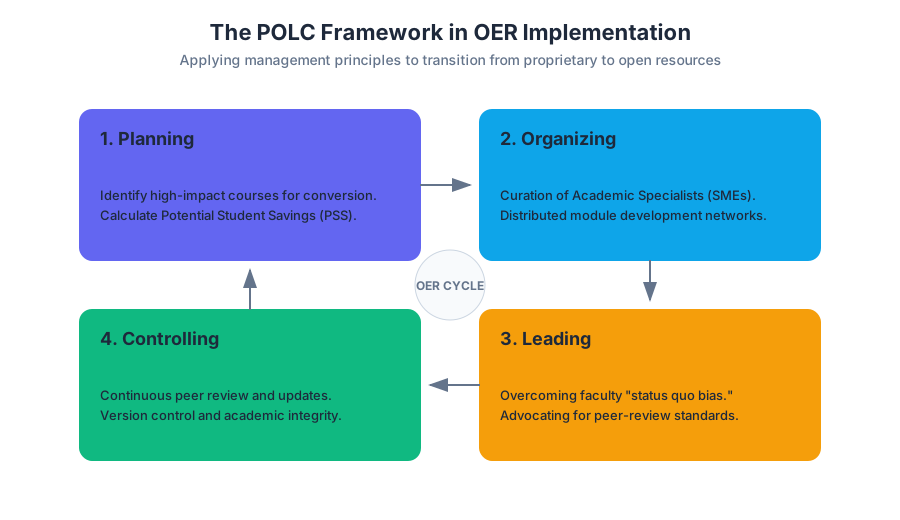
The "Principles of Management" course material, such as that provided by OpenStax, is structured around the POLC Framework. Implementing OER within a university department requires applying these very management principles to the curriculum itself.
1. Planning (Strategic Alignment)
Management must decide which courses are "high-impact" for OER conversion. This usually involves analyzing enrollment data and textbook costs to calculate the Potential Student Savings (PSS).
2. Organizing (Resource Allocation)
This involves the curation of Academic Specialists. Unlike traditional publishing, where a single author might hold the "keys," OER organizing involves a distributed network of subject matter experts (SMEs) who contribute modules on Human Resource Management, Organizational Behavior, and Supply Chain Logistics.
3. Leading (Change Management)
Transitioning a faculty from a "standard" textbook to OER requires leadership. It involves overcoming "status quo bias" and demonstrating that open resources meet or exceed the peer-review standards of legacy publishers.
4. Controlling (Quality Assurance)
In OER, "controlling" is not about restricting access, but about maintaining academic integrity. This is achieved through continuous peer review and version control.
The Economic Theory of OER: The Z-Degree Model
The ultimate goal of OER in management is the creation of the Z-Degree (Zero-Textbook-Cost Degree). The economic logic follows a cost-displacement model where the high upfront cost of content creation is amortized over a massive, global user base, eventually driving the marginal cost of distribution to near zero.
Mathematical Derivation of OER Cost-Efficiency
The total cost of ownership ($TCO$) for traditional materials vs. OER can be expressed as:
$$TCO_{trad} = \sum_{i=1}^{n} (C_{textbook} \times S_i)$$ $$TCO_{oer} = C_{dev} + \sum_{i=1}^{n} (C_{infra} \times S_i)$$
Where:
- $n$ = Number of semesters
- $S_i$ = Number of students in semester $i$
- $C_{textbook}$ = Price of a traditional textbook
- $C_{dev}$ = One-time cost of OER development/curation
- $C_{infra}$ = Cost of hosting/printing per student (usually $\approx 0$)
In this model, OER becomes exponentially more efficient as $n$ and $S$ increase, whereas traditional costs scale linearly with the number of students.
Mathematical Simulation of Savings
% Algorithm: Calculate Break-Even Point for OER Investment
% Inputs: Development Cost (D), Avg Textbook Price (P), Students per Year (N)

\begin{algorithm}
\caption{OER Break-Even Analysis}
\begin{algorithmic}
\STATE $TotalSavings \leftarrow 0$
\STATE $Year \leftarrow 0$
\WHILE{$TotalSavings < D$}
    \STATE $Year \leftarrow Year + 1$
    \STATE $AnnualSavings \leftarrow N \times P$
    \STATE $TotalSavings \leftarrow TotalSavings + AnnualSavings$
\ENDWHILE
\RETURN $Year$
\end{algorithmic}
\end{algorithm}
Strategic Management and Human Resource Management (HRM) in OER
OER isn't just a product; it's a strategic asset. In the context of Strategic Management, OER allows institutions to differentiate themselves by offering lower "Total Cost of Attendance."
In Human Resource Management (HRM), OER principles are applied to corporate training. Instead of paying per-head licensing fees for leadership training modules, companies are increasingly developing internal OER. This allows for:
- Contextualization: A retail company can "remix" an open management textbook to include specific scenarios relevant to floor managers.
- Continuous Improvement: Employees can provide feedback that is immediately integrated into the next version of the training module.
Table: Creative Commons Licenses in Management OER
| License | Symbol | Permissions | Best For |
|---|---|---|---|
| CC BY | Attribution | Any use, even commercial. Must credit author. | Standard textbooks (OpenStax). |
| CC BY-SA | ShareAlike | Must share derivative works under same license. | Collaborative case study repositories. |
| CC BY-NC | Non-Commercial | Cannot be used for profit. | Niche academic research. |
| CC BY-ND | NoDerivatives | Can share, but cannot change content. | Official certification standards. |
Technical Deployment: The OER Pipeline
Modern OER management utilizes a "Docs-as-Code" approach. This ensures that the Controlling aspect of management is handled by automated systems.
- Source: Content is written in Markdown.
- Version Control: Managed via Git (GitHub/GitLab).
- Continuous Integration (CI): Automated checks for broken links and accessibility (WCAG) compliance.
- Deployment: Static Site Generators (Hugo, Jekyll) push content to a CDN (Content Delivery Network).
Common Pitfalls in OER Management
Despite the benefits, several "management failures" can occur during OER adoption:
- The "Ghost Resource" Problem: Creating an OER and failing to plan for its long-term maintenance. Without a Controlling mechanism, the data (e.g., market statistics in a management text) becomes obsolete.
- Licensing Incompatibility: Remixing a CC BY-SA module with a CC BY-NC module creates a legal "dead end" where the resulting work cannot be legally licensed.
- Discovery Friction: Even the best OER is useless if students and faculty cannot find it. This requires robust Metadata Management (using Schema.org/LRMI).
Conclusion: The Future of Management Education
OER is not merely a cost-saving measure; it is a fundamental re-imagining of how management knowledge is curated and distributed. By applying the POLC framework to the creation and maintenance of educational materials, the academic community can ensure that the principles of effective leadership and strategic thinking are available to everyone, everywhere. As AI and machine learning continue to evolve, the "Open" nature of these resources will allow for even more sophisticated personalization, transforming the static textbook into a dynamic, intelligent mentor.
Source Materials
Study Principles Management on Lykke
This course page is free to open: signed out, you can read its first two sections, and signing in, on any plan, opens the rest. The free Lykke Chrome extension syncs your own Canvas courses, so ChatGPT, Claude and Muse can answer from your classes and deadlines. It only reads Canvas.
Add the free extensionSign in to open every sectionAll sections of Principles Management · Browse more course pages