From the free course Principles Management on Lykke
Behavioral Management and Motivation
Key concepts: Behavioral Management · Motivation · Organizational Behavior
Focuses on the psychological and behavioral aspects of management, including how to motivate diverse teams.
Behavioral Management and Motivation
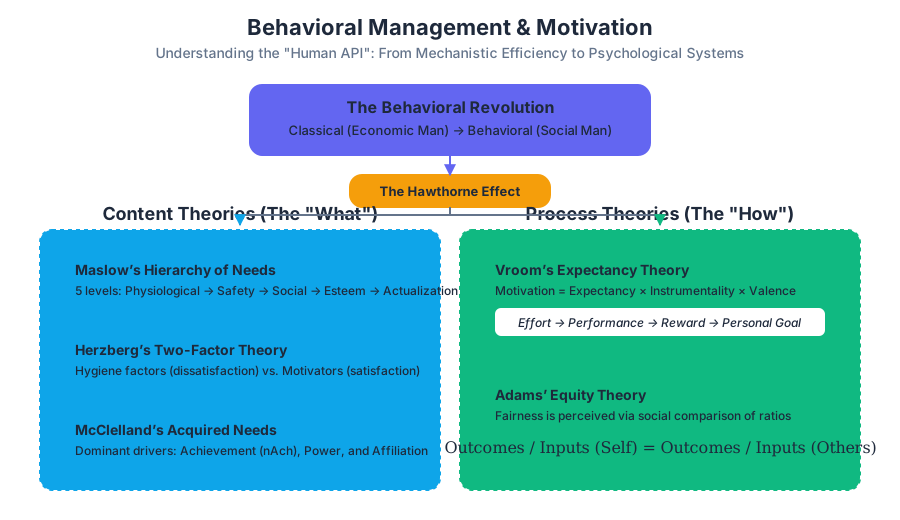
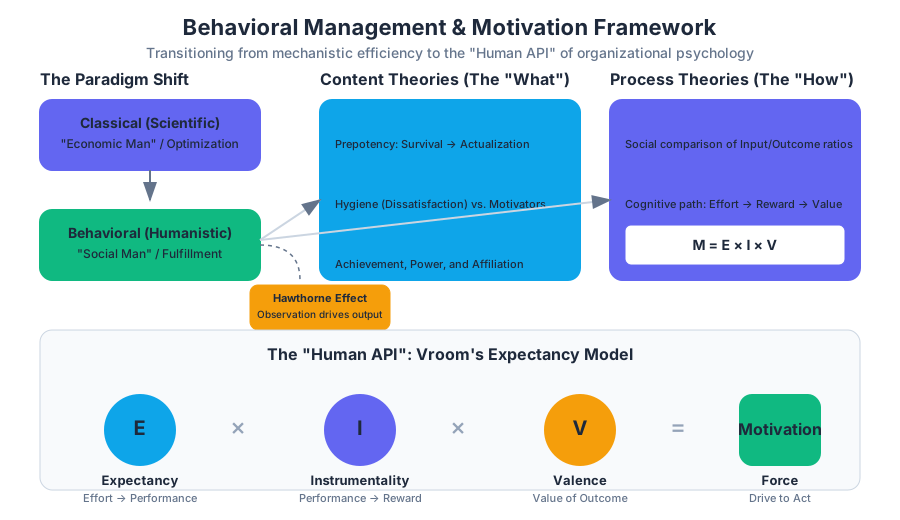
Behavioral management represents a paradigm shift in organizational theory, transitioning from the "mechanistic" view of workers as interchangeable parts to a "humanistic" view of employees as complex psychological entities. While classical management (Taylorism) focused on the optimization of physical movements and economic incentives, behavioral management posits that productivity is inextricably linked to social relations, personal fulfillment, and the internal psychological state of the workforce.
In the modern enterprise, understanding motivation is not merely a "soft skill" but a technical requirement for systems design. Whether designing an Agile workflow or an algorithmic performance-tracking system, the underlying "human API" must be understood to prevent system failure in the form of turnover, burnout, or quiet quitting.
The Behavioral Revolution: From Scientific to Humanistic Management
The transition to behavioral management was catalyzed by the realization that economic incentives alone have diminishing returns. This movement, often termed the Human Relations Movement, emerged from the tension between industrial efficiency and human limitations.
The Hawthorne Studies and the "Hawthorne Effect"
The most significant inflection point in behavioral management was the Hawthorne Studies (1924–1932) conducted at Western Electric. Researchers initially sought to find the optimal level of illumination for productivity. However, they discovered that productivity increased regardless of whether light levels were raised or lowered.
The Hawthorne Effect: The phenomenon where individuals improve or modify an aspect of their behavior in response to their awareness of being observed.
This discovery shifted the focus of management from environmental engineering to social engineering. It proved that psychological factors—such as feeling valued or being part of a cohesive group—outweighed physical conditions in driving output.
Comparison of Management Paradigms
| Feature | Classical Management (Scientific) | Behavioral Management (Humanistic) |
|---|---|---|
| Primary Focus | Task efficiency and standardization | Employee well-being and social needs |
| View of Worker | "Economic Man" (motivated by money) | "Social Man" (motivated by recognition) |
| Organizational Structure | Rigid hierarchy / Centralized | Flexible / Participative |
| Communication | Top-down / Formal | Multi-directional / Informal included |
| Key Metric | Units per hour / Physical throughput | Engagement / Job satisfaction / Retention |
Content Theories of Motivation: Identifying the "What"
Content theories focus on the internal factors that energize and direct human behavior. They answer the question: What specific needs do people have that must be met to motivate them?
Maslow’s Hierarchy of Needs
Abraham Maslow proposed that human needs are arranged in a prepotency hierarchy. An individual cannot effectively focus on higher-level needs until lower-level "deficiency needs" are satisfied.
- Physiological: Base survival (food, water, shelter).
- Safety: Security, stability, and protection from physical/emotional harm.
- Social (Belongingness): Affection, acceptance, and friendship.
- Esteem: Internal (self-respect, autonomy) and external (status, recognition).
- Self-Actualization: The drive to become what one is capable of becoming; achieving potential.
Herzberg’s Two-Factor Theory
Frederick Herzberg’s research suggested that job satisfaction and job dissatisfaction are not opposite ends of the same continuum but are driven by entirely different factors.
- Hygiene Factors: Elements that do not give positive satisfaction but whose absence leads to dissatisfaction (e.g., salary, company policies, physical working conditions).
- Motivators: Elements that yield positive satisfaction and high motivation (e.g., achievement, recognition, the work itself, responsibility).
| Factor Type | Impact if Absent | Impact if Present | Examples |
|---|---|---|---|
| Hygiene | High Dissatisfaction | Neutrality (No Dissatisfaction) | Salary, Job Security, Lighting |
| Motivator | Neutrality | High Satisfaction / Engagement | Promotion, Personal Growth |
McClelland’s Acquired Needs Theory
David McClelland argued that people develop three specific needs through their life experiences:
- Need for Achievement (nAch): The drive to excel and succeed in relation to a set of standards.
- Need for Power (nPow): The need to make others behave in a way they would not have otherwise.
- Need for Affiliation (nAff): The desire for friendly and close interpersonal relationships.
Process Theories of Motivation: Modeling the "How"
Process theories describe the cognitive mechanisms through which motivation is generated. They treat motivation as a dynamic system of inputs, expectations, and perceived outcomes.
Vroom’s Expectancy Theory
Victor Vroom proposed that the strength of a tendency to act in a certain way depends on the strength of an expectation that the act will be followed by a given outcome and on the attractiveness of that outcome to the individual.
The fundamental equation of motivation is:
$Motivation = Expectancy \times Instrumentality \times Valence$
- Expectancy ($E \to P$): The belief that effort will lead to performance.
- Instrumentality ($P \to R$): The belief that performance will lead to a reward.
- Valence ($V$): The value the individual places on the reward.
Equity Theory
Developed by J. Stacy Adams, Equity Theory posits that individuals compare their job inputs (effort, experience, education) and outcomes (salary, recognition) with those of others.
If the ratio $\frac{Outcomes_{Self}}{Inputs_{Self}}$ is perceived as unequal to $\frac{Outcomes_{Other}}{Inputs_{Other}}$, the individual experiences "equity tension" and will take action to resolve it (e.g., reducing effort, asking for a raise, or leaving the job).
Behavioral Modification and Reinforcement
While content and process theories focus on internal cognition, Reinforcement Theory (B.F. Skinner) ignores the inner state of the individual and focuses solely on what happens when he or she takes some action.
Operant Conditioning
Behavior is a function of its consequences. Managers can shape behavior using four primary tools:
- Positive Reinforcement: Providing a desirable reward following a behavior (e.g., a bonus for finishing a project early).
- Negative Reinforcement: Removing an unpleasant consequence when a behavior is performed (e.g., stopping micromanagement when a junior dev proves their competence).
- Punishment: Applying an undesirable consequence to decrease a behavior (e.g., a formal reprimand for safety violations).
- Extinction: Withholding reinforcement for a behavior that was previously reinforced, causing the behavior to eventually stop.
Schedules of Reinforcement
The timing of reinforcement is as critical as the reinforcement itself.
| Schedule | Description | Effect on Behavior | Example |
|---|---|---|---|
| Fixed-Interval | Reward after a set amount of time. | Average/Irregular performance. | Monthly paycheck. |
| Variable-Interval | Reward after unpredictable time. | Moderately high/Stable performance. | Pop quizzes or random spot checks. |
| Fixed-Ratio | Reward after a set number of responses. | High/Stable performance. | Piece-rate pay (commission per sale). |
| Variable-Ratio | Reward after unpredictable responses. | Very high performance; resistant to extinction. | Slot machines or "Gambification" of tasks. |
Mathematical Derivation of Equity Tension
The psychological state of inequity can be represented as a delta between subjective ratios.
\text{Equity Tension} (\Delta) = \left| \frac{\sum O_{i}}{\sum I_{i}} - \frac{\sum O_{j}}{\sum I_{j}} \right|
Where:
- $O_i$: Outcomes for the individual.
- $I_i$: Inputs for the individual.
- $O_j$: Outcomes for the referent "other."
- $I_j$: Inputs for the referent "other."
When $\Delta > \epsilon$ (where $\epsilon$ is the individual's threshold for perceived unfairness), behavioral adjustments occur.
Group Dynamics and Organizational Behavior (OB)
Behavioral management extends beyond the individual to the group. A group is defined as two or more individuals, interacting and interdependent, who have come together to achieve particular objectives.
Tuckman’s Stages of Group Development
Groups do not start at peak performance; they evolve through a predictable lifecycle:
- Forming: Characterized by uncertainty about purpose, structure, and leadership.
- Storming: Intragroup conflict as members resist constraints and jockey for position.
- Norming: Development of close relationships and cohesiveness; "the rules of the game" are established.
- Performing: The structure is fully functional and accepted. Energy moves from getting to know each other to performing the task.
- Adjourning: Wrapping up activities and preparing to disband.
The Ringelmann Effect (Social Loafing)
One of the primary challenges in group dynamics is Social Loafing: the tendency for individuals to expend less effort when working collectively than when working individually.
Technical Solution to Loafing: To mitigate this, managers must ensure individual contributions are identifiable and measurable, and provide rewards based on both individual and group performance.
Strategic Integration: Behavioral Management in the POLC Framework
Modern management integrates behavioral insights into the Planning, Organizing, Leading, and Controlling (POLC) framework.
- Planning: Setting goals that are challenging yet attainable (Goal-Setting Theory).
- Organizing: Designing jobs that provide autonomy and feedback (Job Characteristics Model).
- Leading: Using transformational leadership to inspire and meet self-actualization needs.
- Controlling: Implementing performance management systems that use positive reinforcement rather than punitive measures.
Common Pitfalls in Behavioral Management
- The "One Size Fits All" Fallacy: Assuming all employees are motivated by the same factors (e.g., assuming everyone wants a promotion when some may prefer autonomy).
- Neglecting Hygiene Factors: Attempting to motivate employees with "employee of the month" awards while their base salary is below market rate. This leads to cynicism.
- Over-Reliance on Extrinsic Rewards: Excessive use of monetary bonuses can lead to the Overjustification Effect, where intrinsic interest in a task decreases because it is seen as a means to an end.
- Ignoring Informal Groups: Failing to recognize that informal social networks within a company often have more influence over behavior than the formal org chart.
Conclusion: The Synthesis of Human and System
Behavioral management is the bridge between the rigid requirements of organizational structure and the fluid reality of human psychology. By mastering the theories of motivation—from Maslow’s needs to Vroom’s expectations—and understanding the dynamics of group evolution, managers can build resilient systems that do not just extract labor, but foster genuine engagement.
In the era of knowledge work, where the "means of production" resides within the minds of the employees, behavioral management is no longer an elective strategy—it is the core operating system of the successful enterprise.
- Hawthorne Effect: The tendency of individuals to change their behavior because they are being studied.
- Prepotency Principle: The idea in Maslow's hierarchy that a lower-level need must be satisfied before a higher-level need becomes a motivator.
- Hygiene Factors: Job elements (like pay and conditions) that prevent dissatisfaction but do not create satisfaction.
- Expectancy: The belief that one's effort will result in a specific level of performance ($E \to P$).
- Instrumentality: The belief that performance will lead to a specific outcome or reward ($P \to R$).
- Social Loafing: The phenomenon where individuals exert less effort in a group than when working alone.
- Operant Conditioning: A learning process through which the strength of a behavior is modified by reinforcement or punishment.
- Valence: The subjective value or attractiveness an individual assigns to a specific reward.
-
Scenario: An employee is paid a high salary but works in a toxic environment with no chance for growth. According to Herzberg, what is the likely outcome?
- A) High Satisfaction
- B) No Dissatisfaction, but No Motivation
- C) High Motivation
- D) High Dissatisfaction (Correct: B — Salary is a hygiene factor; its presence removes dissatisfaction, but growth/environment are motivators required for satisfaction.)
-
Which theory is expressed by the formula $M = E \times I \times V$?
- A) Equity Theory
- B) Maslow's Hierarchy
- C) Expectancy Theory
- D) Reinforcement Theory (Correct: C)
-
In Tuckman's stages of group development, which stage is characterized by "intragroup conflict"?
- A) Forming
- B) Norming
- C) Storming
- D) Performing (Correct: C)
-
Equity Theory suggests that if an employee feels under-rewarded compared to a peer, they might:
- A) Increase their effort to "catch up"
- B) Distort their perception of the peer's work
- C) Experience no change in behavior
- D) Both B and potentially reducing their own effort (Correct: D)
-
A "Variable-Ratio" reinforcement schedule is most similar to which real-world activity?
- A) Receiving a monthly salary
- B) Checking a slot machine
- C) Taking a scheduled final exam
- D) Getting a bonus for every 10 items sold (Correct: B)
Core Objectives
- Differentiate between classical and behavioral management approaches.
- Explain the significance of the Hawthorne Studies in the history of management.
- Compare and contrast Content vs. Process theories of motivation.
- Identify the four types of reinforcement in Operant Conditioning.
- Describe the five stages of group development and the challenge of social loafing.
Key Equations to Remember
- Motivation Force: $MF = E \times I \times V$
- Equity Ratio: $\frac{O}{I} (Self) \approx \frac{O}{I} (Other)$
Critical Thinking Questions
- How does the "remote work" era change the application of the Hawthorne Effect?
- Can an organization rely solely on hygiene factors to maintain a competitive advantage?
- Why is the "Variable-Ratio" schedule the most resistant to extinction, and how can that be applied ethically in a workplace?

Source Materials
Study Principles Management on Lykke
This course page is free to open: signed out, you can read its first two sections, and signing in, on any plan, opens the rest. The free Lykke Chrome extension syncs your own Canvas courses, so ChatGPT, Claude and Muse can answer from your classes and deadlines. It only reads Canvas.
Add the free extensionSign in to open every sectionAll sections of Principles Management · Browse more course pages